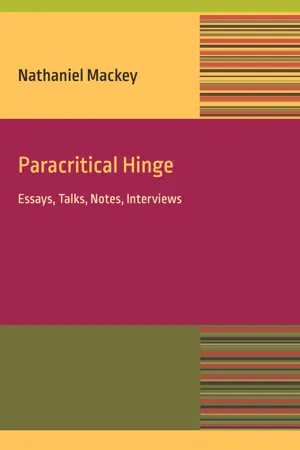
Paracritical Hinge is a collection of varied yet interrelated pieces highlighting Nathaniel Mackey's multifaceted work as writer and critic. It embraces topics ranging from Walt Whitman's interest in phrenology to the marginalization of African American experimental writing; from Kamau Brathwaite's "calibanistic" language practices to Federico García Lorca's flamenco aesthetic of duende and its continuing repercussions; from H. D.'s desert measure and coastal way of knowing to the altered spatial disposition of Miles Davis's trumpet sound; from Robert Duncan's serial poetics to diasporic syncretism; from the lyric poem's present-day predicaments to gnosticism. Offering illuminating commentary on these and other artists including Amiri Baraka, Mississippi Fred McDowell, Wilson Harris, Jack Spicer, John Coltrane, Jay Wright, and Bob Kaufman, Paracritical Hinge also sheds light on Mackey's own work as a poet, fiction writer, and editor.
- English
- ePUB (mobile friendly)
- Available on iOS & Android
eBook - ePub
About this book
Information
Phrenological Whitman
Regarded as a pseudoscience nowadays and subject to parody and caricature, phrenology was “the science of mind” in the United States during the nineteenth century. It was taken seriously by a great number of people and Walt Whitman was one of those people; Fowler and Wells was a phrenological business whose Phrenological Cabinet Whitman visited frequently in New York. In the 1855 preface to Leaves of Grass, Whitman includes the phrenologist among those he describes as “the lawgivers of poets”: “The sailor and traveler . . . the anatomist chemist astronomer geologist phrenologist spiritualist mathematician historian and lexicographer are not poets, but they are the lawgivers of poets and their construction underlies the structure of every perfect poem.”1 He reiterates this in “Song of the Answerer”: “The builder, geometer, chemist, anatomist, phrenologist, artist, all these underlie the maker of poems.” In “By Blue Ontario’s Shore,” he asks,
Who are you indeed who would talk or sing to America?
Have you studied out the land, its idioms and men?
Have you learn’d the physiology, phrenology, politics, geography, pride, freedom, friendship of the land? its substratums and objects?
Earlier in the poem, he praises mechanics and farmers, particularly “the freshness and candor of their physiognomy, the copiousness and decision of their phrenology.” Phrenological terms, terms such as Amativeness, Adhesiveness, and Combativeness, which were used to describe the phrenological faculties, are scattered throughout this and other poems.
Phrenology portrayed the brain as divided into different faculties that controlled the various aspects of personality. Adhesiveness was its name for the propensity for friendship and camaraderie, Amativeness its name for romantic, sexual love, Philoprogenitiveness its name for the love of offspring, and so on. There was disagreement among the different versions of phrenology as to how many faculties there were, the number ranging from thirty-five to ninety-six, but phrenological nomenclature pertaining to the faculties contributed significantly to the vocabulary of Whitman’s poems. In “Mediums,” regarding future Americans, truly fulfilled Americans, he proclaims: “They shall be alimentive, amative, perceptive, / They shall be complete women and men.” Adhesiveness became Whitman’s favorite phrenological term. In “Song of the Open Road,” he writes, “Here is adhesiveness.” And in “So Long!”: “I announce adhesiveness, I say it shall be limitless unloosen’d.” “A Song of Joys” doesn’t explicitly name the phrenological faculties, but the joys that it catalogs are each related to a specific phrenological “organ” and, taken together, constitute a model of phrenological well-being. The poem was inspired by one of Orson and Lorenzo Fowler’s phrenological manuals, The New Illustrated Self-Instructor in Phrenology and Physiology.
The documentation of Whitman’s interest in phrenology dates back to 1846. An article on phrenology that he clipped from an issue of American Review that year has been found among his papers. In November of that year, while he was editor of the Brooklyn Daily Eagle, he wrote a review of several phrenological manuals, a review in which he announced, “Breasting the waves of detraction, as a ship dashes sea-waves, Phrenology, it must now be confessed by all men who have open eyes, has at last gained a position, and a firm one, among the sciences.”2 Four months later, in March 1847, he wrote an article called “Something about Physiology and Phrenology” in which he praised the leading proselytizers of phrenology in the United States, Orson and Lorenzo Fowler and Samuel Wells: “Among the most persevering workers in phrenology in this country, must certainly be reckoned the two Fowlers and Mr. Wells” (cited in HH 100). Whitman was not alone in his interest in phrenology. It was an interest he shared with most if not all of the writers and thinkers of his day, including Edgar Allan Poe, Horace Mann, and Ralph Waldo Emerson, as phrenology played an important role in various movements for self-improvement and social reform. Its basic precept was appealingly simple: the faculties within the brain display their degree of development by protrusions on the cranium, bumps on the head; hence the other name it was known by, “Bumpology.” Phrenologists would read, as they put it, the bumps on a client’s head, particular bumps corresponding to particular faculties. The head was thought to offer a map of the client’s mind and personality. Whitman had his bumps read by Lorenzo Fowler in July 1849.
Orson and Lorenzo Fowler, who were to become publishers of the second edition of Leaves of Grass in August 1856, transformed phrenology into a business enterprise during the 1830s. Orson Fowler became interested in phrenology early in the decade while he was a student at Amherst College. In Vermont in 1834 he gave his first lecture on phrenology, and during the next few years, with his brother Lorenzo, he made a number of lecture tours around the country. In 1838 he set up an office in Philadelphia called the Phrenological Museum (also called the Phrenological Cabinet and the Phrenological Depot) and began to publish the American Phrenological Journal and Miscellany, which would eventually publish some of Whitman’s anonymous reviews of his own Leaves of Grass. This was a year after his brother had set up the New York Phrenological Rooms on Broadway in Manhattan. In 1842 the two of them joined forces when Orson moved from Philadelphia to New York; there they established, with their brother-in-law Samuel Wells, who was married to their sister Charlotte, the Phrenological Cabinet that Whitman grew fond of visiting. Speaking of his return from New Orleans in 1848, Whitman wrote in one of his reminiscences, “One of the choice places of New York to me then was the ‘Phrenological Cabinet’ of Fowler & Wells, Nassau Street near Beekman.”3 It was there that he had his bumps read by Lorenzo Fowler, and he kept the chart all his life. It was published five times: in the Brooklyn Daily Times in September 1855, in the first, second, and third editions of Leaves of Grass, and posthumously by his literary executors, to whom Whitman had given it during the last year of his life, in a book called Regarding Walt Whitman.
Whitman published and republished his chart to credential himself; it was, according to phrenological opinion on the subject, a poet’s chart. Wells and the Fowlers were interested, as were others, in the poetic personality and the making of the poet, and in the American Phrenological Journal they featured articles on the phrenological characteristics of poets. These articles stressed the balanced, well-rounded character of the poet, the equitable development of the poet’s faculties and the manifestation of this equitability on the poet’s head. The expression “well-rounded” had to do with the phrenological belief that the best head is a round head, a head whose bumps are equally developed and distributed. Whitman’s chart describes his head as “large and rounded in every direction” and he offered it as evidence of his poetic qualifications. He makes his own case for the poet’s well-roundedness in the 1855 preface when he writes, “The poet is the equable man.” This, by then, was a phrenological commonplace. An article published in The Phrenological Journal and Magazine of Moral Science in 1846, for example, argued, “Good Taste consists in the appropriate manifestation of each and all of the faculties in their proper season and degree; and this can only take place from persons in whom they are so balanced that there is no tendency for any one of them unduly to assume the mastery. When such a mind is prompted by some high theme to its fullest action, each organ contributes to the emotion of the moment and words are uttered in such condensed meaning, that a single sentence will touch every fibre of the heart, or, what is the same thing, arouse every faculty of the hearer. The power is known as Inspiration, and the medium in which it is conveyed is called Poetry” (cited in WWCB, 366). The power of poetry resides in an equitable development of the faculties; the mind should be a democratic ensemble in which no single faculty dominates. This idea is central to Whitman’s sense of himself as poet and to his sense of the American poet’s democratic vocation.
Phrenology’s attention to cranial manifestation of mind, its postulation of a tangible, tactile availability of mental attributes, epitomized a physiological accent that had obvious impact on Whitman’s work. In one of the Fowler and Wells publications we find the following: “Poets require the highest order of both temperament and development. Poetry depends more on the physiology than the phrenology. It consists in a spiritual ecstasy which can be better felt than described. Not one in many thousands of those who write verses has the first inspiration of true poetry” (cited in HH 73). Whitman’s long song of bodily exuberance and appetitive touch tends at times, in ways that this formulation would have ratified, toward a hypersensitivity of a convulsive sort, bordering on ecstatic susceptibility: “You villain touch! what are you doing? . . . . my breath is tight in its throat; / Unclench your floodgates! you are too much for me.” Likewise, his emphasis on bodily health and development was in keeping with the practical phrenology of Wells and the Fowlers, who were in the forefront of influential movements for social and individual reform. They not only advocated change in such areas as education and criminology but were proponents of vegetarianism, water cures, and the like. They conducted a campaign against tight clothing and rigid posture, whose influence can be seen in the famous photograph of Whitman published in the early editions of Leaves of Grass. This too was a self-credentialing move; his relaxed pose and his unbottoned shirt show him to be phrenologically correct.
A significantly commercial undertaking, practical phrenology marketed the idea that a person could change his character; bumps, like muscles, could be made bigger or smaller through more or less exercise. A belief in the changeability or, even, perfectability of personality was crucial to phrenology’s program of self-improvement and social reform, a program whose commercial as well as ideological aspects we find Whitman very much in the thick of. Fowler and Wells sold and distributed the first edition of Leaves of Grass, which Whitman published himself, and then published the second edition the following year. Whitman had had an earlier connection with them; he worked as a bookseller in 1850 and 1851, and very prominent on his shelves were books published by Fowler and Wells. He reviewed Leaves of Grass anonymously, as previously mentioned, in th...
Table of contents
- Cover
- Series Page
- Title Page
- Copyright
- Contents
- Acknowledgments
- Introduction: Door Peep (Shall Not Enter)
- Part I
- Part II
- Part III
- Part IV
- Part V
- Notes
- Discography
- Index
- Series List
Trusted by 375,005 students
Access to over 1.5 million titles for a fair monthly price.
Study more efficiently using our study tools.
Frequently asked questions
Yes, you can cancel anytime from the Subscription tab in your account settings on the Perlego website. Your subscription will stay active until the end of your current billing period. Learn how to cancel your subscription
No, books cannot be downloaded as external files, such as PDFs, for use outside of Perlego. However, you can download books within the Perlego app for offline reading on mobile or tablet. Learn how to download books offline
Perlego offers two plans: Essential and Complete
- Essential is ideal for learners and professionals who enjoy exploring a wide range of subjects. Access the Essential Library with 800,000+ trusted titles and best-sellers across business, personal growth, and the humanities. Includes unlimited reading time and Standard Read Aloud voice.
- Complete: Perfect for advanced learners and researchers needing full, unrestricted access. Unlock 1.5M+ books across hundreds of subjects, including academic and specialized titles. The Complete Plan also includes advanced features like Premium Read Aloud and Research Assistant.
We are an online textbook subscription service, where you can get access to an entire online library for less than the price of a single book per month. With over 1.5 million books across 990+ topics, we’ve got you covered! Learn about our mission
Look out for the read-aloud symbol on your next book to see if you can listen to it. The read-aloud tool reads text aloud for you, highlighting the text as it is being read. You can pause it, speed it up and slow it down. Learn more about Read Aloud
Yes! You can use the Perlego app on both iOS and Android devices to read anytime, anywhere — even offline. Perfect for commutes or when you’re on the go.
Please note we cannot support devices running on iOS 13 and Android 7 or earlier. Learn more about using the app
Please note we cannot support devices running on iOS 13 and Android 7 or earlier. Learn more about using the app
Yes, you can access Paracritical Hinge by Nathaniel Mackey in PDF and/or ePUB format, as well as other popular books in Literature & Literary Criticism. We have over 1.5 million books available in our catalogue for you to explore.