A novel of star-crossed love from the
New York Times–bestselling author of Nebula and Hugo Award–winning novel
Dreamsnake.
In a future where space travel moves at faster-than-light speed, starship crews can only survive transit if drugged nearly to death. Then there are those like Laenea Trevelyan, who want to become pilots so badly they will go through years of training and major surgery to free themselves of biological rhythms. But though they become literally heartless, their emotions are just as human as before.
Laenea discovers this herself when she immediately falls for crewman Radu Dracul upon her early release—some might say escape—from the hospital after her procedure. She is not unknown to Radu; Laenea was the first offworlder he ever saw when she and her crew delivered a vaccine for the cryptovirus that decimated his family and his planet.
However, their intense attraction cannot last. Laenea's modifications will not survive in close proximity to Radu's biorhythms, which are too strong to allow him to become a pilot.
But even in the vastness of space, where ships and hearts can be lost, fate—and danger—can have a hand in bringing two people together again . . .
"Smoothly told . . . with the sturdy character conflicts snugly worked into the hyperspace-navigation backdrop." —
Kirkus Reviews
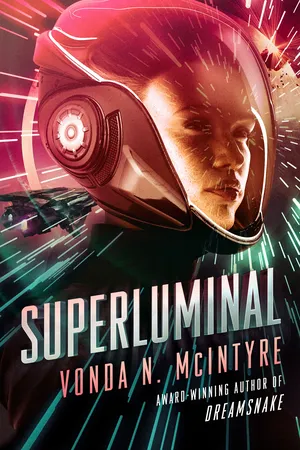
- 279 pages
- English
- ePUB (mobile friendly)
- Available on iOS & Android
eBook - ePub
Superluminal
About this book
Information
Subtopic
Science FictionIndex
LiteratureChapter 1
She gave up her heart quite willingly.
After the operation, Laenea Trevelyan lived through what seemed an immense time of semiconsciousness, drugged so she would not feel the pain, kept almost insensible while drugs sped her healing. Those who watched her did not know she would have preferred consciousness and an end to her uncertainty. So she slept, shallowly, drifting toward awareness, driven back, existing in a world of nightmare. Her dulled mind suspected danger but could do nothing to protect her. She had been forced too often to sleep through danger. She would have preferred the pain.
Once Laenea almost woke: She glimpsed the sterile white walls and ceiling, blurrily, slowly recognizing what she saw. The green glow of monitoring screens flowed across her shoulder, over the scratchy sheets. Taped down, needles scraped nerves in her arm. She became aware of sounds, and heard the rhythmic thud of a beating heart.
She tried to cry out in anger and despair. Her left hand was heavy, lethargic, insensitive to her commands, but she moved it. It crawled like a spider to her right wrist and fumbled at the needles and tubes.
Air shushed from the room as the door opened. A gentle voice and a gentle touch reproved her, increased the flow of sedative, and cruelly returned her to sleep.
A tear slid back from the corner of her eye and trickled into her hair as she reentered her nightmares, accompanied by the counterpoint of a basic human rhythm, the beating of a heart, that she had hoped never to hear again.
Pastel light was Laenea’s first assurance that she would live. It gave her no comfort. Intensive care had been stark white. Yellows and greens brightened this room. The sedative wore off and she knew she would finally be allowed to wake. She did not fight the continuing drowsiness, but depression prevented anticipation of the return of her senses. She wanted only to hide within her own mind, ignoring her body, ignoring failure. She did not even know what she would do in the future; perhaps she had none anymore.
Yet the world impinged on her as she grew bored with lying still and sweaty and self-pitying. She had never been able to do simply nothing. Stubbornly she kept her eyes closed, but the sounds vibrated through her body, like shudders of cold and fear.
This was my chance, she thought, but I knew I might fail. It could have been worse, or better: I might have died.
She slid her hand up her body, from her stomach to her ribs, across the bandages and the tip of the new scar between her breasts, to her throat. Her fingers rested at the corner of her jaw, just above the carotid artery.
She could not feel her pulse.
Pushing herself up abruptly, Laenea ignored sharp twinges of pain. The vibration of a heartbeat continued beneath her palms, but now she could tell that it did not come from her own body.
The amplifier sat on the bedside table, sending out a steady low-frequency pattern. Laenea felt laughter bubbling up. She knew it would hurt and she did not care. She dragged the speaker off the table. Its cord ripped from the wall as she flung it sidearm across the room. It smashed in the corner with a satisfying clatter.
She pushed aside the sheets. She was stiff and sore. She rolled out of bed because it hurt too much to sit up. She staggered and caught herself. Fluid in her lungs coarsened her breathing. She coughed, caught her breath, coughed again. Time was a mystery, measured only by weakness. She thought the administrators fools, to force sleep into her, risk her to pneumonia, and play recorded hearts, instead of letting her wake and move and adjust to her new condition.
Barefoot, Laenea walked slowly across the cool tile to a warm patch of sunshine. She gazed out the window. The day was variegated, gray and golden. Clouds moved from the west across the mountains and the Sound while sunlight still spilled over the city. The shadows moved along the water, turning it from shattered silver to slate.
White from the heavy winter snowfall, the Olympic Mountains rose between Laenea and the port. The approaching rain hid even the trails of spacecraft escaping the earth, and the glint of shuttles returning to their target in the sea. She would see them again soon. She laughed aloud, stretching against the soreness in her chest and the ache of her ribs, throwing back her tangled wavy hair. It tickled the nape of her neck.
The door opened and air moved past her as if the room were breathing. Laenea turned and faced Dr. van de Graaf. The surgeon was tiny and frail looking, and her hands possessed strength like steel wires. She glanced at the shattered amplifier and shook her head.
“Was that necessary?”
“Yes,” Laenea said. “For my peace of mind.”
“It was here for your peace of mind.”
“It has the opposite effect.”
“The administrators feel there’s no reason to change the procedure,” she said. “We’ve been doing it since the first pilots.”
“The administrators are known for continuing bad advice.”
“Well, pilot, soon you can design your own environment.”
“When?”
“Soon. I don’t mean to be obscure—I decide when you can leave the hospital, but when you may leave takes more than my word. The scar tissue needs time to strengthen. Do you want to go already? I cracked your ribs rather thoroughly.”
Laenea grinned. “I know.” She was strapped up tight and straight, but she could feel each juncture of rib end and cartilage.
“It will be a few days at least.”
“How long has it been?”
“Since surgery? About forty-eight hours.”
“It seemed like weeks.”
“Well… adjusting to all the changes at once has proved to be quite a shock for most people. Sleeping seems to help.”
“I’m an experiment,” Laenea said. “All of us are. With experiments, you should experiment.”
“We’ve made enough pilots so your group isn’t an experiment anymore. We’ve found this works best.”
“But when I heard the heartbeat,” Laenea said, “I thought you’d had to put me back to normal.”
“It’s meant to be a comforting sound.”
“No one else ever complained?”
“Not quite so strongly,” van de Graaf said, then dismissed the subject. “It’s done now, pilot.”
It was finished, for Laenea. She shrugged. “When can I leave?” she asked again. The hospital was one more place of stasis that Laenea was anxious to escape.
“For now, go back to bed. Morning’s soon enough to talk about the future.”
Laenea turned away. The windows, the walls, the filtered air cut her off from the gray clouds and the city.
“Pilot—”
Rain slipped down the glass. Laenea stayed where she was. She did not feel like sleeping.
The doctor sighed. “Do something for me, pilot.”
Laenea shrugged again.
“I want you to test your control.”
Laenea acquiesced with sullen silence.
“Speed your heart up slowly, and pay attention to the results.”
Laenea intensified the firing of the nerve.
“What do you feel?”
“Nothing,” Laenea said, though her blood, impelled by the smooth rotary pump, rushed through what had been her pulse points: temples, throat, wrists.
Beside her the surgeon frowned. “Increase a little more, but very slowly.”
Laenea obeyed. Bright lights flashed just behind her vision. Her head hurt in a streak above her right eye to the back of her skull. She felt high and excited. She turned away from the window. “I want to get out of here.”
Van de Graaf touched her arm at the wrist; Laenea laughed aloud at the idea of feeling for her pulse. The doctor led her to a chair by the window. “Sit down.” But Laenea felt she could climb the helix of her dizziness: She felt no need for rest.
“Sit down.” The voice was whispery, soft sand slipping across stone. Laenea obeyed.
“Remember the rest of your training. It’s important to vary your blood pressure. Sit back. Slow the pump. Expand the capillaries. Relax.”
Laenea called back her biocontrol. For the first time she was conscious of a presence rather than an absence. Her pulse was gone, but...
Table of contents
- Title Page
- Our Hero by Nisi Shawl
- Chapter 1
- Chapter 2
- Chapter 3
- Chapter 4
- Chapter 5
- Chapter 6
- Chapter 7
- Chapter 8
- Chapter 9
- Chapter 10
- Chapter 11
- Chapter 12
- Chapter 13
- Chapter 14
- About the Author
- Copyright
Trusted by 375,005 students
Access to over 1.5 million titles for a fair monthly price.
Study more efficiently using our study tools.
Frequently asked questions
Yes, you can cancel anytime from the Subscription tab in your account settings on the Perlego website. Your subscription will stay active until the end of your current billing period. Learn how to cancel your subscription
No, books cannot be downloaded as external files, such as PDFs, for use outside of Perlego. However, you can download books within the Perlego app for offline reading on mobile or tablet. Learn how to download books offline
Perlego offers two plans: Essential and Complete
- Essential is ideal for learners and professionals who enjoy exploring a wide range of subjects. Access the Essential Library with 800,000+ trusted titles and best-sellers across business, personal growth, and the humanities. Includes unlimited reading time and Standard Read Aloud voice.
- Complete: Perfect for advanced learners and researchers needing full, unrestricted access. Unlock 1.5M+ books across hundreds of subjects, including academic and specialized titles. The Complete Plan also includes advanced features like Premium Read Aloud and Research Assistant.
We are an online textbook subscription service, where you can get access to an entire online library for less than the price of a single book per month. With over 1.5 million books across 990+ topics, we’ve got you covered! Learn about our mission
Look out for the read-aloud symbol on your next book to see if you can listen to it. The read-aloud tool reads text aloud for you, highlighting the text as it is being read. You can pause it, speed it up and slow it down. Learn more about Read Aloud
Yes! You can use the Perlego app on both iOS and Android devices to read anytime, anywhere — even offline. Perfect for commutes or when you’re on the go.
Please note we cannot support devices running on iOS 13 and Android 7 or earlier. Learn more about using the app
Please note we cannot support devices running on iOS 13 and Android 7 or earlier. Learn more about using the app
Yes, you can access Superluminal by Vonda N. McIntyre in PDF and/or ePUB format, as well as other popular books in Literature & Science Fiction. We have over 1.5 million books available in our catalogue for you to explore.