- 166 pages
- English
- ePUB (mobile friendly)
- Available on iOS & Android
eBook - ePub
About this book
Branding is ultimately the CEO's responsibility and #1 priority. The brand dictates a company's costs of sales, capital, and media. The goal of branding is to be unique, to stand out from the white-noise of me-too competition. Most CEOs allow their companies to copy or resemble their competitors. If people don't "get" your company's brand -- its value proposition -- within 15 seconds, they'll resist purchasing from, investing in, and writing about your company. Or, they'll ignore your company altogether. Hence, the title of this guide: Be Unique or Be Ignored.
Information
CHAPTER ONE: Branding Basics
Branding is an age-old identification practice, traced back to the Ancient Egyptians, which livestock owners use to permanently mark their herds. The “brand,” usually a symbol or code, is burned, frozen, tattooed, or tagged onto an animal. It has no inherent meaning other than distinguishing its owner and his livestock from other livestock and their owners, in cases of lost or stolen animals.
Marketers metaphorically have adapted this livestock branding to the business world, to differentiate their companies and products from those of their competitors. Instead of hot irons, they employ words, images, and sounds to make lasting “impressions” on customers, investors, media pros, analysts, and other influencers.
Branding has two components: the message and the megaphone (the branding platforms): homepage, tradeshows, CEO keynotes, radio/TV interviews, salesforce, sales training, product/corporate brochures, financial documents, industry and financial analysts, IPO roadshows, advertising, PR, joint ventures, partnering, articles, and social media.
Alas, most companies emphasize the megaphone and minimize the message, believing that incessant social-media posting and search-engine optimization somehow compensate for nebulosity. Look around; it’s true. Reality: Sending white noise through a megaphone generates louder white noise.
It gets worse. Companies habitually nurse inconsistent and out-of-synch branding platforms, each one featuring a different message! Example: your salesreps and homepage tell completely different stories. Totally unacceptable.
At MarcRudov.com, I conducted a poll of 800 senior-level exec, as well as salesreps, with this question: According to YOUR SALESREPS, how helpful to successfully closing business is YOUR company's homepage? The results didn’t shock me: 38% of respondents voted “saleskiller”; 27% voted “irrelevant”; only 13% voted “extremely helpful.” What does all this mean? CEOs are wasting marketing dollars. Not good.
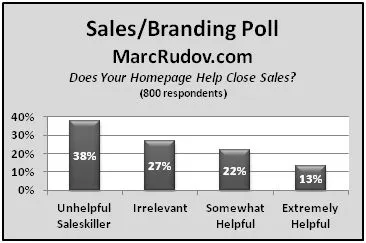
How can you, the CEO, expect customers, investors, analysts, and reporters to form a crystal-clear, unique feel for your company when you broadcast confusing and conflicting signals to them? Hint: you can’t. White noise is costly!
Brand/Commodity Battle
We appreciate a person who gets to “the point” quickly, succinctly, and memorably—a unique standout who’s never confused with others. We gravitate to him because he adds maximum value, at minimum cost, to our lives. We know what he stands for, and we can describe it easily. Ronald Reagan was that kind of man. He had a unique brand that endures.
Likewise, we gravitate to a vendor that gets to “the point” quickly, succinctly, memorably: We know your problem, have a unique solution, and urge you to act now. Never do we confuse a unique vendor with its jargon-spewing, white-noise-dwelling rivals, which force us to play eenie meenie miny moe.
A brand is not a jargonized, functional description of your product; it is your value proposition, your billboard, your opening statement, your barcode, your reason d’être, the jar that exposes your jam. Products and technologies change every six months, but a strong brand outlives both.
The first benefit of having a strong brand is the ability to charge a premium over your competitors’ prices (and your costs). Why? Your customers believe that you offer unique value, expressed in their language, vis-a-vis your competitors.
Alternatively, the more you look and sound like your rivals—your customers can’t distinguish you from them—the more your product resembles a commodity and, thus, must succumb to commodity pricing: no premium. Using jargon assures your company of commodity status.
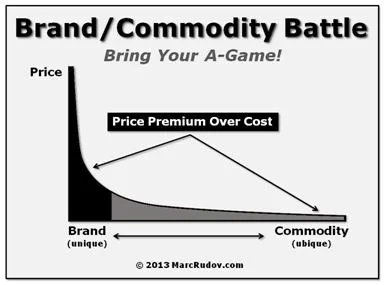
Your neverending battle is crystal-clear: fight against becoming a commodity. If branding is not your #1 priority, you will lose this battle—I guarantee it.
Brand Dictates Cost of Sales
The second benefit of a strong brand is a lower cost of sales. Is your sales cycle—the time from identifying a prospect to closing the deal—one year or greater? If so, you have a costly sales cycle: endless calls, emails, faxes, overnighted parcels, face-to-face meetings, teleconferences, spinning your wheels, and insanity.
Have you asked yourself why it takes your company at least 12 months to close a sale? Any CEO worth his salt has pondered this challenge. Perhaps your product is lackluster, or you employ an ineffective salesforce or channel. But, without knowing you or your company, I’ll tell you why your cost of sales is unnecessarily high: your brand is weak.
In Chapter 14, “Always Be Branding,” I list the top-five excuses CEOs invariably give me for avoiding or delaying branding activity. I’ll repeat them here:
- We’re too busy fo...
Table of contents
- Table of Contents
- Copyright
- Food for Thought
- Dedication
- Preface
- CHAPTER ONE: Branding Basics
- CHAPTER TWO: B2B: Branding to Business
- CHAPTER THREE: GutShareTM vs. Mindshare
- CHAPTER FOUR: Producting or Marketing?
- CHAPTER FIVE: Branding vs. Marketing
- CHAPTER SIX: Politics of Branding
- CHAPTER SEVEN: Fear of Branding
- CHAPTER EIGHT: Word of Mouth
- CHAPTER NINE: Branding & Sales
- CHAPTER TEN: Delusory Demand Generation
- CHAPTER ELEVEN: Pitching to Investors
- CHAPTER TWELVE: Pitching to Reporters
- CHAPTER THIRTEEN: Channel Branding
- CHAPTER FOURTEEN: Always Be Branding
- CHAPTER FIFTEEN: Myopic Mobile Marketing
- CHAPTER SIXTEEN: Clouding Your Brand
- CHAPTER SEVENTEEN: Lasting Impression
- CHAPTER EIGHTEEN: Final Thoughts
- ABOUT THE AUTHOR
Trusted by 375,005 students
Access to over 1.5 million titles for a fair monthly price.
Study more efficiently using our study tools.
Frequently asked questions
Yes, you can cancel anytime from the Subscription tab in your account settings on the Perlego website. Your subscription will stay active until the end of your current billing period. Learn how to cancel your subscription
No, books cannot be downloaded as external files, such as PDFs, for use outside of Perlego. However, you can download books within the Perlego app for offline reading on mobile or tablet. Learn how to download books offline
Perlego offers two plans: Essential and Complete
- Essential is ideal for learners and professionals who enjoy exploring a wide range of subjects. Access the Essential Library with 800,000+ trusted titles and best-sellers across business, personal growth, and the humanities. Includes unlimited reading time and Standard Read Aloud voice.
- Complete: Perfect for advanced learners and researchers needing full, unrestricted access. Unlock 1.5M+ books across hundreds of subjects, including academic and specialized titles. The Complete Plan also includes advanced features like Premium Read Aloud and Research Assistant.
We are an online textbook subscription service, where you can get access to an entire online library for less than the price of a single book per month. With over 1.5 million books across 990+ topics, we’ve got you covered! Learn about our mission
Look out for the read-aloud symbol on your next book to see if you can listen to it. The read-aloud tool reads text aloud for you, highlighting the text as it is being read. You can pause it, speed it up and slow it down. Learn more about Read Aloud
Yes! You can use the Perlego app on both iOS and Android devices to read anytime, anywhere — even offline. Perfect for commutes or when you’re on the go.
Please note we cannot support devices running on iOS 13 and Android 7 or earlier. Learn more about using the app
Please note we cannot support devices running on iOS 13 and Android 7 or earlier. Learn more about using the app
Yes, you can access Be Unique or Be Ignored by Marc H. Rudov,Marc H Rudov in PDF and/or ePUB format, as well as other popular books in Business & Business Strategy. We have over 1.5 million books available in our catalogue for you to explore.