eBook - ePub
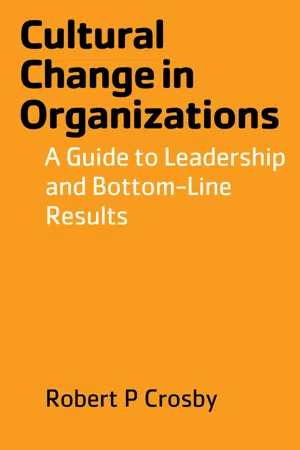
Cultural Change in Organizations
A Guide to Leadership and Bottom-Line Results
- English
- ePUB (mobile friendly)
- Available on iOS & Android
eBook - ePub
Information

Part One
Peter’s Story
CHAPTER 1
Peter’s Dilemma: How Do I Start a Cultural Change?
Peter stood at his office window overlooking the bay. It was a typical late fall morning in Seattle, gray and reflective. To a native like Peter, it was certain that the steely mist would turn to rain by rush hour.
“Hmm, storm on the way out there, too” he reflected. “And in here? Products are late, competitors are pricing lower. And now there’s this new employee survey data to deal with.”
He turned toward his desk and, almost without thinking, dialed a number. And as he replaced the receiver, Art Merlin appeared at the door.
“What’s up?” Merlin moved to the conference table where they usually met.
“I’m frustrated and I need help. I hope your advice is as magic as your name.”
“You seem jumpy.”
“Of course I am. We’re losing market share, and now I get this survey data from our workforce, and the news is not good. Apparently, we’re not seen as a make-it-happen company; quite the opposite, the employees think we’d rather blame than fix. We have what the management gurus call a ‘heavily blaming corporate culture.’ The employees also say that they can’t count on their colleagues to come through when they say they will. What’s wrong with these people anyway?”
“Nothing you couldn’t change.”
“Come on, Art, your gray hair doesn’t give you the right to blame me. See? There it is—that blaming thing. So, what’s your advice?”
“First,” Merlin began, “you need to see the results of the employee survey as useful information.5 Not definition. Not a list of things that are ‘wrong with these people’ or wrong with you. Then you need to take a few simple steps to—how shall I say—shift the thinking in your company. For example, it is possible within a few months to see a turn-around on this blaming business and major changes on the survey scores in all areas.”
“You said ‘a few simple steps.’ Simple to whom?”
“Well, simple for me, certainly, because it’s you, Peter, who has to do the work.” Taking Peter’s offer of a cup of tea, Art Merlin settled back in his chair. “Peter, you may call what I’m about to tell you ‘common sense.’ The difference lies between knowing it and doing it. Few do it. However, I’ve seen it done…several times. Now listen carefully. First you must accept that you are the leader. You’ve listened to your people. Now swing the bat.
“A wise man once wrote, ‘Foresight is the lead that a leader has. Once leaders lose this lead and events start to force their hand, they are leaders in name only. They are not leading, but are reacting to current events…. Foresight is the central ethic of leadership.’6 Give up the illusion—the pretense—that your top management team will figure out where you should be headed. You’ve heard enough—you know enough to set a course. Now. Today.”
Art moved to the white board and sketched three semi-circles.
FIGURE 1: RAINBOW MODEL OF GOALS

“The bottom circle signifies a bottom-line goal—a stretch goal to be achieved in the next six to 12 months. This could be a cost reduction or a significant growth goal.”
Merlin was barely finished before Peter rushed to his desk and produced a thick document. “Look, here’s our five-year strategy. We’ve already completed it and it hasn’t helped!”
“A five-year plan? Peter, the Soviets tried that for half a century. No. I’m talking about a six-to 12-month goal that is at the core of your business success—or even survival.”
“Well, we produce now at $3.78 a unit. Would a $3.00 goal be what you mean? Let’s say by the end of the year—in nine months?”
Merlin eyed Peter for a moment. “Is it easy to reach that goal?”
“Not at all,” responded Peter.
“Is it possible?”
Peter paused and then said, “Yes.”
“Would it stretch your people?”
“Definitely.”
“Is it critical? That is, can you help your employees anticipate their pain if you miss this goal—that’s called ‘delegating pain’?”
“Well, some will get laid off if we don’t make it. You see, Merlin, at $3.00 a unit we will likely reverse our market share loss—that is, if we quit being so confounded late!”
Merlin returned to his diagram. “So, the bottom circle represents three bucks a unit achieved in nine months. Right? Now take the next semi-circle. Let it represent work processes that must be maximally effective for you to achieve the three-buck goal. You just said that some of your special projects are way behind schedule, and I’m sure your employees could name other processes and projects…”
Peter interrupted, “But they’ve done that already, Art. We have a list of key dysfunctional processes and little has changed!”
“Hold onto that despair for a bit, Peter, and focus on the top circle, the one that symbolizes how you are with people, human factors—the human dimension—how engaged people are in their work. For instance, are they focused only on task outcomes or technical knowledge and not on how processes work? And are some managers expert at ‘shooting messengers,’ which discourages work process improvements, while others are so permissive that there’s no clear structure, no clear idea about who decides what?”
“Yes…all the above. In spite of training programs.”
“O.K. Now I’ll tell you what the best leaders do because I’ve seen them do it and do it with far more than the 400 people in your company.”
Moving to the white board again, Merlin writes:
Rule #1: The leader leads.
“Like Columbus, the leader sets the course—the ‘what’ in each of your three circles—and stays the course in a non-reactive way against the inevitable resistance. You’ve heard them all before:
‘It can’t be done…’
‘We tried this before…’
‘All of us should decide…’
‘I’ve got a better idea….’ ”
Writing on the board again, Merlin turns to another rule:
Rule #2: The leader communicates.
“I’d suggest this even if you had a cast of thousands. With 400 it’s a piece of cake. Meet with all of your employees in groups of 20 to 50. Hey, this can actually work with several hundred at a time but keep it smaller if you can. Tell them what’s up—the situation the company’s in. Do it briefly. Tell them you’re going to say more about your goals but stop at that point and receive comments.”
“That doesn’t work. I’ve asked for questions before and only two or three people talk.”
“Great,” says Merlin, “then don’t do that again. Don’t go down the same maze if there wasn’t any cheese! Don’t ask for questions—request comments. Don’t worry about questions—they’ll come. In fact, most of the comments will be phrased as questions. It’s safer. People learn in their early years not to be authentic with authorities. One way we do that is by pretending our statement—our strongly held opinion—is merely a question. Don’t fall for that. Begin modeling that it’s O.K. to state a contrary point of view and that you don’t have to hide it in this company! Be as concerned about communicating that value as you are about the content of the statements. Your company’s future depends on it.”
“I think I get what you’re saying, Art. It’s about data flowing honestly.”
“Right. Accurate data flow, after all, is truthfulness, being authentic, saying what’s so about goals, deadlines, differences, consequences, authority, decision-making and day-to-day work interactions. And it begins with you. It doesn’t matter whether the ‘data’ deals with schedule commitment or technical opinions. Or feelings,” Merlin suggested.
“Well, I don’t really think the office is the place for that,” Peter sputtered before Merlin interrupted him.
“Or feelings,” Merlin repeated firmly. “Give me a break, Peter! Do you mean that no one has emotions at work? Feelings are simply another part of the data flow about what’s actually going on. In most companies, information about feelings is routinely shoved under the rug, except maybe for anger or passivity which come out in blaming, and the result is that they run the show from there. Or rather run the meeting from under there! Better give them a place at the table, Peter.
“But back to your employee meeting. Before you take comments, have the participants talk in groups of two or three for about three minutes and discuss three things:
- What they especially agreed with that you said;
- What they are surprised or troubled about; and
- What was missing in what you said.”
“They’ll never do it, Art. Before I’m done giving instructions, there’ll be five other suggestions about how to proceed. In the past, I’d have tolerated no interference, which didn’t work in the long run. Now that I’ve invited them to participate in really running the company, well, it seems like the lunatics have taken over the asylum. And giving orders is tough. I imagine they’ll have at least 20 minutes of reasons why talking in small groups is a waste of time.”
“And your response is ‘No, I want it done this way,’ and then you might repeat your instructions. Don’t let the employees run your meeting. Give your instructions and turn away.”
“So by doing that I’m demonstrating that I—not Mordred—am running the meeting.”
“Mordred? Who’s Mordred?”
“Well, you of all people should know that, Merlin!” Peter said laughing. “Mordred is my evil twin—you know, in the way that King Arthur and Mordred were enemies. He is the employee who blames someone else—often me—for every mistake, misstep, error, unintended consequence, glitch…for global warming and downtown traffic jams. Now that I think about it, the Mordreds—there are way more than one—are the source of the blaming culture in this company. He’s everywhere, it seems.”
“So he’s running the company?”
“Well, some days it would seem so, Merlin. But it’s not working, and I’m tired of it and am pretty angry at how I’ve let things get out of hand. Is he running the company? Well, not any more, he isn’t,” Peter concluded in a firm voice.
“Peter, in one morning’s meeting not only will you demonstrate how to manage the Mordreds of the world, but also, by allowing the brief preparatory discussions, you will declare that everyone’s voice is important. When time is up, ask for input from the back of the room, down front, everywhere. If Mordred speaks in a blaming way say something like, ‘I get it, Mordred. You think it’s my fault. And I accept some responsibility. Thanks for your comment.’ Then look away from Mordred and say, ‘Who’s next?’
“Then it’s time to share your goals—the three semi-circles. Be brief, clean and resolute. Have them partner again and give them another question:
- What’s your piece of this pie, and what will you do to pull this off?”
“Delegate accountability,” Peter says nodding. “But first I’ll need to tell my direct reports and the union president. They have to own it.”
“Of course, Peter, but be careful of the word ‘own.’ If you’re going to guide this ship through the rough waters, your crew needs to be rowing in the same direction. Hear them. Hear their concerns. But you’re not seeking a consensus or even a majority decision. The hard message is this—you won’t make it with an unwilling or unskilled crew. You need to be as sure as you can that you have the right people, the right number of people, and the most streamlined organizational structure possible.7 Peter, you need to be the beacon from which visions come and, above all, a leader who encourages people to unleash their own potential and ROW!” Merlin laughed.
Peter smiled. For a few minutes he stared out at the rain which had just begun to fall. “Art, I’m thinking of the story of the monkeys, where one monkey started washing the sand off yams with salt water, thereby making them palatable to eat. Then a second monkey started doing it, then another and another. By the time a certain number of monkeys—let’s say a hundred—started washing the sand off the yams, then all the monkeys, even on other isolated islands, began doing the sam...
Table of contents
- Front Cover
- Title Page
- Copyright Page
- Dedication
- About the Author
- Acknowledgments
- Foreword
- About This Book
- Table of Contents
- Prologue
- Part One: Peter’s Story
- Part Two: Changing Your Organization
- Part Three: A Theory of Leadership
- Appendices
- Footnote Text
Trusted by 375,005 students
Access to over 1.5 million titles for a fair monthly price.
Study more efficiently using our study tools.
Frequently asked questions
Yes, you can cancel anytime from the Subscription tab in your account settings on the Perlego website. Your subscription will stay active until the end of your current billing period. Learn how to cancel your subscription
No, books cannot be downloaded as external files, such as PDFs, for use outside of Perlego. However, you can download books within the Perlego app for offline reading on mobile or tablet. Learn how to download books offline
Perlego offers two plans: Essential and Complete
- Essential is ideal for learners and professionals who enjoy exploring a wide range of subjects. Access the Essential Library with 800,000+ trusted titles and best-sellers across business, personal growth, and the humanities. Includes unlimited reading time and Standard Read Aloud voice.
- Complete: Perfect for advanced learners and researchers needing full, unrestricted access. Unlock 1.5M+ books across hundreds of subjects, including academic and specialized titles. The Complete Plan also includes advanced features like Premium Read Aloud and Research Assistant.
We are an online textbook subscription service, where you can get access to an entire online library for less than the price of a single book per month. With over 1.5 million books across 990+ topics, we’ve got you covered! Learn about our mission
Look out for the read-aloud symbol on your next book to see if you can listen to it. The read-aloud tool reads text aloud for you, highlighting the text as it is being read. You can pause it, speed it up and slow it down. Learn more about Read Aloud
Yes! You can use the Perlego app on both iOS and Android devices to read anytime, anywhere — even offline. Perfect for commutes or when you’re on the go.
Please note we cannot support devices running on iOS 13 and Android 7 or earlier. Learn more about using the app
Please note we cannot support devices running on iOS 13 and Android 7 or earlier. Learn more about using the app
Yes, you can access Cultural Change in Organizations by Robert P Crosby in PDF and/or ePUB format, as well as other popular books in Business & Management. We have over 1.5 million books available in our catalogue for you to explore.