Emily Dickinson and Walt Whitman are widely acknowledged as two of America's foremost nature poets, primarily due to their explorations of natural phenomena as evocative symbols for cultural developments, individual experiences, and poetry itself. Yet for all their metaphorical suggestiveness, Dickinson's and Whitman's poems about the natural world neither preclude nor erase nature's relevance as an actual living environment. In their respective poetic projects, the earth matters both figuratively, as a realm of the imagination, and also as the physical ground that is profoundly affected by human action. This double perspective, and the ways in which it intersects with their formal innovations, points beyond their traditional status as curiously disparate icons of American nature poetry. That both of them not only approach nature as an important subject in its own right, but also address human-nature relationships in ethical terms, invests their work with important environmental overtones.
Dickinson and Whitman developed their environmentally suggestive poetics at roughly the same historical moment, at a time when a major shift was occurring in American culture's view and understanding of the natural world. Just as they were achieving poetic maturity, the dominant view of wilderness was beginning to shift from obstacle or exploitable resource to an endangered treasure in need of conservation and preservation.
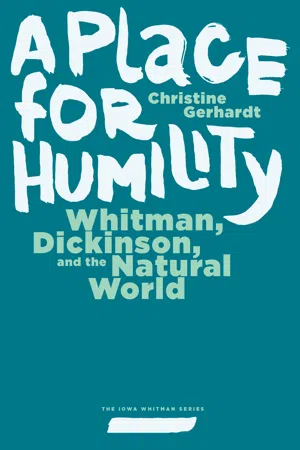
A Place for Humility examines Dickinson's and Whitman's poetry in conjunction with this important change in American environmental perception, exploring the links between their poetic projects within the context of developing nineteenth-century environmental thought. Christine Gerhardt argues that each author's poetry participates in this shift in different but related ways, and that their involvement with their culture's growing environmental sensibilities constitutes an important connection between their disparate poetic projects. There may be few direct links between Dickinson's "letter to the World" and Whitman's "language experiment," but via a web of environmentally-oriented discourses, their poetry engages in a cultural conversation about the natural world and the possibilities and limitations of writing about it—a conversation in which their thematic and formal choices meet on a surprising number of levels.
Dickinson and Whitman developed their environmentally suggestive poetics at roughly the same historical moment, at a time when a major shift was occurring in American culture's view and understanding of the natural world. Just as they were achieving poetic maturity, the dominant view of wilderness was beginning to shift from obstacle or exploitable resource to an endangered treasure in need of conservation and preservation.
A Place for Humility examines Dickinson's and Whitman's poetry in conjunction with this important change in American environmental perception, exploring the links between their poetic projects within the context of developing nineteenth-century environmental thought. Christine Gerhardt argues that each author's poetry participates in this shift in different but related ways, and that their involvement with their culture's growing environmental sensibilities constitutes an important connection between their disparate poetic projects. There may be few direct links between Dickinson's "letter to the World" and Whitman's "language experiment," but via a web of environmentally-oriented discourses, their poetry engages in a cultural conversation about the natural world and the possibilities and limitations of writing about it—a conversation in which their thematic and formal choices meet on a surprising number of levels.