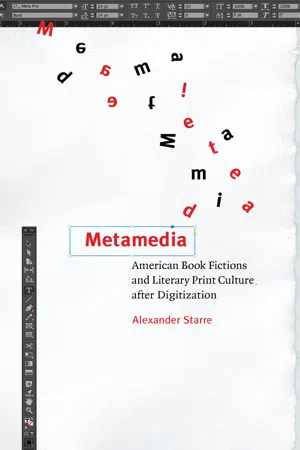
Does literature need the book? With electronic texts and reading devices growing increasingly popular, the codex is no longer the default format of fiction. Yet as Alexander Starre shows in Metamedia, American literature has rediscovered the book as an artistic medium after the first e-book hype in the late 1990s. By fusing narrative and design, a number of "bibliographic" writers have created reflexive fictions—metamedia—that invite us to read printed formats in new ways. Their work challenges ingrained theories and beliefs about literary communication and its connections to technology and materiality. Metamedia explores the book as a medium that matters and introduces innovative critical concepts to better grasp its narrative significance.
Combining sustained textual analysis with impulses from the fields of book history, media studies, and systems theory, Starre explains the aesthetics and the cultural work of complex material fictions, such as Mark Z.Danielewski's House of Leaves (2000), Chip Kidd's The Cheese Monkeys (2001), Salvador Plascencia's The People of Paper (2005), Reif Larsen's The Selected Works of T. S. Spivet (2009), and Jonathan Safran Foer's Tree of Codes (2010). He also broadens his analysis beyond the genre of the novel in an extensive account of the influential literary magazine McSweeney's Quarterly Concern and its founder, Dave Eggers.
For this millennial generation of writers and publishers, the computer was never a threat to print culture, but a powerful tool to make better books. In careful close readings, Starre puts typefaces, layouts, and cover designs on the map of literary criticism. At the same time, the book steers clear of bibliophile nostalgia and technological euphoria as it follows writers, designers, and publishers in the process of shaping the surprising history of literary bookmaking after digitization.
Combining sustained textual analysis with impulses from the fields of book history, media studies, and systems theory, Starre explains the aesthetics and the cultural work of complex material fictions, such as Mark Z.Danielewski's House of Leaves (2000), Chip Kidd's The Cheese Monkeys (2001), Salvador Plascencia's The People of Paper (2005), Reif Larsen's The Selected Works of T. S. Spivet (2009), and Jonathan Safran Foer's Tree of Codes (2010). He also broadens his analysis beyond the genre of the novel in an extensive account of the influential literary magazine McSweeney's Quarterly Concern and its founder, Dave Eggers.
For this millennial generation of writers and publishers, the computer was never a threat to print culture, but a powerful tool to make better books. In careful close readings, Starre puts typefaces, layouts, and cover designs on the map of literary criticism. At the same time, the book steers clear of bibliophile nostalgia and technological euphoria as it follows writers, designers, and publishers in the process of shaping the surprising history of literary bookmaking after digitization.