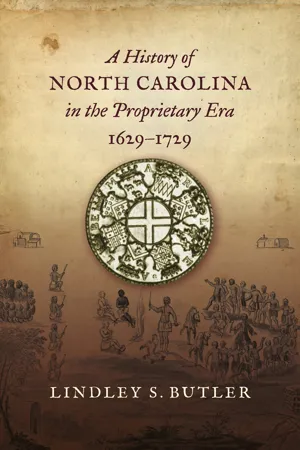
In this book, Lindley S. Butler traverses oft-noted but little understood events in the political and social establishment of the Carolina colony. In the wake of the English Civil Wars in the mid-seventeenth century, King Charles II granted charters to eight Lords Proprietors to establish civil structures, levy duties and taxes, and develop a vast tract of land along the southeastern Atlantic coast. Butler argues that unlike the New England theocracies and Chesapeake plantocracy, the isolated colonial settlements of the Albemarle—the cradle of today’s North Carolina—saw their power originate neither in the authority of the church nor in wealth extracted through slave labor, but rather in institutions that emphasized political, legal, and religious freedom for white male landholders. Despite this distinct pattern of economic, legal, and religious development, however, the colony could not avoid conflict among the diverse assemblage of Indigenous, European, and African people living there, all of whom contributed to the future of the state and nation that took shape in subsequent years.
Butler provides the first comprehensive history of the proprietary era in North Carolina since the nineteenth century, offering a substantial and accessible reappraisal of this key historical period.
- 480 pages
- English
- ePUB (mobile friendly)
- Available on iOS & Android
eBook - ePub
A History of North Carolina in the Proprietary Era, 1629-1729
About this book
Trusted by 375,005 students
Access to over 1.5 million titles for a fair monthly price.
Study more efficiently using our study tools.
Information
CHAPTER ONE

Aliens in a Strange Land
Land has been found by modern man which was unknown to the ancients, another world with respect to the one they knew.
— Verrazzano, 1524
IN THE YEAR OF OUR LORD 1524, a far-flung expedition commanded by Giovanni da Verrazzano was dispatched from the kingdom of France to cross the Great Western Ocean with two aims—to seek a northern route to Asia and to establish a claim to new territory hitherto consigned by treaty to Spain and Portugal. From the European perspective, England’s right to North America had been established by John Cabot’s 1497 voyage to Newfoundland sponsored by King Henry VII, and Juan Ponce de León had discovered Florida for Spain in 1513. The North American coast from Florida to Newfoundland, however, was terra incognita, “unknown land,” and the position of France and England was that new lands were secured by occupation, not discovery. When Verrazzano sighted land north of Cape Fear on the first of March, he thought it “a new land which had never been seen before by any man.”1
In 1521, news of Hernan Cortés’s conquest and despoiling of the fabulously wealthy Aztec Empire in Mexico had swept through the courts of Europe. The trickle of gold coming to Spain from the West Indies now became a glittering torrent of silver, gold, and gems that for nearly two centuries fueled Spain’s effort to dominate Europe. The next year, Juan Sebastian de Elcano returned to Spain in Victoria, the only ship of Ferdinand Magellan’s flotilla to survive the first voyage around the globe. Again Europe was agog, for the discovery of an alternative sea route to China raised the prospect of great riches. Spurred by these events, King Francis I collaborated with the Italian expatriate community in France to launch Verrazzano’s voyage.
Francis I was a French king with a global vision who looked to Italy for leadership and counsel. Leonardo da Vinci was the most celebrated of the Italian state ministers, merchants, bankers, and mariners who served him. His chief navigator, the well-educated Verrazzano, may have been born in France. Italian silk merchants and bankers, including relatives of Verrazzano, had been drawn to Lyon, where the community they established provided funds and technical support for the voyage of exploration.2 At thirty-nine, Verrazzano’s experience included years as a mariner and navigator in the Mediterranean and at least one voyage across the Atlantic from France to Newfoundland.
Sailing from the Madeira Islands in 1524, Verrazzano commanded La Dauphine, the 100-tun ship provided by the Crown.3 Except for a fierce storm that forced a course change to the north, the voyage was uneventful. On the first of March on latitude 34° north of Cape Fear, Verrazzano caught his first glimpse of a “rather low lying” coast. Approaching within a mile of the beach, the French could see bonfires onshore, evidence that there were inhabitants, although they saw no one. After a fruitless voyage south fifty leagues (about 110 nautical miles), they returned to the original landfall and anchored offshore, likely just north of the cape near present-day Kure Beach.4
As the French longboats rowed toward the beach, they attracted a group of curious but cautious Natives. Demonstrating “great wonderment” and “great delight at seeing us,” they reached out gingerly to touch these odd-looking men from another world—their peculiar and excessive clothing and their “whiteness.” To Verrazzano the inhabitants looked “not unlike the Ethiopians,” with dark complexion, black hair and eyes, broad faces, and tall, “well-proportioned” physical stature. He commented that in their agility, swiftness, and “sharp cunning” they “resemble the Orientals.” Most striking was their near nakedness, barely covered by loincloths of animal skins and grass belts festooned with animal tails. The surroundings—the forest of palms, laurel, bay, cedar, and cypress unknown in Europe—also suggested Asia. In the “salubrious” early spring breezes, trees exuded “a sweet fragrance over a large area.”5
Continuing their reconnaissance, the French sailed up the coast that angled toward the east, reporting more fires, possibly beacons. In need of fresh water, La Dauphine anchored offshore at a place Verrazzano named Annunciata in honor of the Annunciation of the Virgin Mary. Here he observed a chain of islands less than a mile wide. Looking northwest across the island, he saw a vast body of water with no land in sight that he thought must be the “eastern sea” (Pacific Ocean), the eagerly sought way to fabled India and China. What Verrazzano saw at Annunciata was the Outer Banks. With a sea visible to the northwest, he was off either Ocracoke or Hatteras Island, where Pamlico Sound appears to be a limitless ocean.
As before, friendly Natives motioned to the French to come ashore. Finding the breakers too rough to risk a landing in their longboat, Verrazzano sent a strong swimmer with “little bells, mirrors, and other trifles” to the waiting crowd. Caught by the heavy surf and half drowned, he was rescued by the Natives, who built a fire by the dune to revive him. The terrified sailor and his shipmates were convinced that he was about to be roasted and eaten. To everyone’s great relief, when the youth recovered, he was gently led to the sea’s edge, embraced, and watched until he had safely returned to the boat.6

Sailing for France in 1524, Giovanni da Verrazzano began the first exploration of North America’s eastern coast at Cape Fear. Courtesy of North Carolina Collection, Wilson Special Collections Library, University of North Carolina at Chapel Hill.
From Annunciata, La Dauphine rounded the cape and sailed north along the Outer Banks to another offshore anchorage at a land “much more beautiful and full of great forests.” This country Verrazzano called Arcadia after a hilly woodland in ancient Greece, envisioned by Virgil as an ideal landscape. A low-level flight from North Carolina to New Jersey has identified the area around Kitty Hawk and Kill Devil Hill as the sole candidate for Arcadia.7 Kill Devil Hill and nearby Jockey’s Ridge, the highest sand dune on the East Coast, boast elevations close to 100 feet. Tucked behind Jockey’s Ridge is Nags Head Woods Preserve, a mature maritime forest of tall pines and hardwoods, interspersed with freshwater ponds and rich with wildlife. Walking into this national natural landmark, one enters a haven of harmony and peace, a rare place that European explorers of five centuries ago would recognize.
Anchoring offshore, the French saw a solitary man on the beach, studying them and their ship. Verrazzano himself led a twenty-man shore party. As the French boat approached, the few other people in sight scurried into the woods, but the stoic man stood his ground and was gradually enticed closer. Verrazzano observed a handsome man, naked and olive-skinned, with his hair tied in a knot at the back of his head like a sailor’s queue. The Native made a friendly overture of a “burning stick,” probably a pipe of smoking tobacco, a central element of their ritual. The puzzled French, who had never seen such an object, responded by striking flint and steel to ignite gunpowder in a flash and a cloud of smoke and then fired a shot from a harquebus. The Indian was “thunderstruck” and, trembling, fell to his knees in apparent prayer, pointing to the sky, the sea, and their ship.8
Leaving the man shaken but unmolested, the search party spread out into the woods and open marshes. In a glade deep in the forest they stumbled upon a frightened old woman, a “very beautiful and tall woman” some eighteen or twenty years old, and six children—five girls and a boy about eight years old. Confronted with armed men in strange garb spouting gibberish, their faces bizarrely hidden by beards, the terrified little band cried out in alarm. With good intentions, the French offered food that the old woman took eagerly but the young woman dashed to the ground in disgust, perhaps fearing the men’s intentions. The French, abandoning kindliness, seized the young boy and tried to capture the young woman as well, but she began screaming. Realizing that they were totally isolated from their shipmates and vulnerable to an ambush, the men hastily retreated to their boat.9
The contrast between these Natives’ fear and the curiosity of those near Capes Fear and Hatteras may indicate that the “Arcadians” had had hostile encounters with Europeans and perhaps had witnessed kidnappings by Spanish slavers. By taking the youth, the French reinforced the wicked reputation of the strangers from the sea. The fate of the boy is unknown.
Verrazzano described these people as bareheaded, lighter in color than the Natives farther south, and dressed in clothing woven from Spanish moss and hemp thread. The French discovered a clearing where dugout canoes were fashioned from large logs by burning and scraping. Verrazzano was impressed with the country’s fertility, particularly noting the abundance of wild grapevines laden with “dry fruit sweet and pleasant, not unlike our own.” He thought that with cultivation the grapes could produce “excellent wines.”10
After three days La Dauphine headed north along the North American seaboard as far as latitude 50° on the coast of Newfoundland. Although Verrazzano missed Chesapeake and Delaware Bays, he did enter New York’s harbor and explore the shores of Long Island, Narragansett Bay, Cape Cod, and Maine. His narrative would stimulate further exploration of the southeastern coast and the ongoing search for the Northwest Passage to the Orient. The identification of Pamlico Sound as an arm of the Pacific Ocean was recorded on the 1529 map of his brother, Gerolamo da Verrazzano, who was on the voyage.11
Verrazzano was the first European explorer to describe the coast of North Carolina from Cape Fear to Kitty Hawk, and decades passed before other Europeans revisited the area. Beyond North Carolina, Verrazzano had found a continent “larger than our Europe, than Africa, and almost larger than Asia.”12 His discoveries fired the imaginations of Spanish, French, and English alike, and through the remainder of the sixteenth century all would stake their claims and attempt to possess the new country.13
——————
THE SPANISH CONQUISTADOR Juan Ponce de León had been the first European to set foot in southeastern North America. The seasoned warrior accompanied Columbus on his 1493 voyage to Hispaniola and later conquered Puerto Rico. On an expedition north, on 2 April 1513 he made landfall, probably at an inlet south of Daytona Beach that still bears his name, christening the land La Florida, which delineated the entire Southeast for over seventy years. Turning south, León encountered the north-flowing Gulf Stream, the great offshore current destined to convey countless ships to Europe. Returning in 1521 to colonize the Gulf Coast, he was mortally wounded in a savage clash with Natives and withdrew to die in Puerto Rico.14
That same year a series of Spanish voyages explored the mainland as far north as the Carolinas, seeking land, slaves, and gold. Lucas Vázquez de Ayllón, a judge from Santo Domingo, dispatched Francisco Gordillo, who in the Bahamas met another slaver, Pedro de Quejo. Together they made landfall on 24 June at the mouth of the wide South Santee, which on a subsequent voyage was christened the Jordan River.15 Excited by the discovery, Ayllón secured a royal patent granting exclusive rights to the land from Chicora, the Winyah Bay region, north to Chesapeake Bay. Since Chicora corresponded to the latitude of Andalucía, one of the most productive provinces in Spain, Ayllón had high hopes for his colony.
In 1525, Ayllón sent Quejo to La Florida to reconnoiter the mainland from present northern Florida to Chesapeake Bay. From Chicora at the Jordan River he sailed north, exploring Cape Fear, Cape Hatteras, and the inlets near Roanoke Island. Quejo’s report of desolate marshes, sandy islands, and dangerous shoals in the northern range of Ayllón’s patent confirmed that Chicora was the most promising site for a colony.16 Thereafter, the area that became North Carolina no longer figured in Ayllón’s colonization plans.
The next adventurer to succumb to the allure of the region’s reputed wealth was Hernando de Soto, a middle-aged conquistador who had made a great fortune with Pizarro in Peru. Bored by a courtier’s life in Spain, de Soto received a royal appointment as governor of Cuba with the right to colonize La Florida. From Havana in 1539 he set sail in a large fleet, carrying nearly 600 men, including priests, gentlemen, slaves and servants, and over 200 horses, the largest and best-equipped expedition ever sent to the Southeast. Landing in May near Tampa Bay, the Spanish plunged into the interior, trailed by hundreds of pigs for provisions and mastiffs for hunting both men and game.
The invaders soon discovered that they were not in an uncharted wilderness but in the homeland of the highly civilized Mississippian culture that flourished from 800 to 1700 C.E. Radiating from the great urban ceremonial center, Cahokia, in modern East St. Louis, the culture spread along the Mississippi valley north toward the Great Lakes and southeast to the shores of the Gulf and the Atlantic as far north as Tennessee and North Carolina. Characterized by agrarian villages and fortified towns centered on plazas dominated by earthen ceremonial mounds, the Mississippians were organized into regional chiefdoms.17
De Soto arrived in the period when the culture was waning, having been pushed to the brink by a smallpox epidemic, which weakened the traditional chiefdoms. The invaders carved a bloody and tragic swath across the Southeast as far north as North Carolina and west across the Mississippi River. In town after town the Spaniards seized hostages, demanded ransoms, and impressed hundreds of men and women to serve as bearers and concubines. The Natives frequently harassed the Spanish with guerrilla tactics and occasionally met them in open battle. When queried about gold and silver, the Indians pointed northward, luring the intruders farther into the interior.18
Once they left the trackless forests of the Savannah River valley, the Spanish entered the realm of the legendary city of Cofitachequi, where fields flanked trails that were arteries of commerce linking villages, towns, and cities. Through the early morning mist on the Wateree River, the exhausted Spanish saw the three high mounds of the large city. Arriving by canoe, the “Lady of Cofitachequi,” niece of the ruling queen, ceremonially greeted de Soto, bedecking him with a long string of pearls. The Spanish were invited to the city, where they found a diminished population, a food shortage, and no gold, but were permitted to loot great quantities of pearls from the temples and mortuaries of the realm. At nearby Talimeco the iron axes, knife, rosary, and trade beads they discovered surely came from the Chicora voyages.
Continuing up the Wateree-Catawba River valley, the Spanish entered North Carolina’s western piedmont in late May 1540. Eight days’ journey brought them to Xuala, a sizable town in th...
Table of contents
- Cover Page
- Title Page
- Copyright Page
- Dedication
- Contents
- List of Illustrations
- Preface
- A Miscellany of Seventeenth-Century Usages
- Introduction
- Chapter One. Aliens in a Strange Land
- Chapter Two. The Carolana Propriety
- Chapter Three. Carolina: Founding a Colony
- Chapter Four. Clarendon County: Puritans and Barbadians on the Cape Fear
- Chapter Five. Albemarle County: The Cradle of North Carolina
- Chapter Six. Unrest, Upheaval, and Rebellion: Testing the Limits of Freedom
- Chapter Seven. Life in the Tidewater: Family and Society
- Chapter Eight. Making a Living: Planters, Traders, and Merchants
- Chapter Nine. A Dissenter’s Colony: Quakers and Baptists
- Chapter Ten. From North and East of Cape Fear to North Carolina
- Chapter Eleven. A New Century: John Lawson’s North Carolina
- Chapter Twelve. The Church Establishment and the Cary Rebellion
- Chapter Thirteen. The Tuscarora War
- Chapter Fourteen. A Pirate Haven: The Bahamas and the Carolina Coast
- Chapter Fifteen. The End of an Era
- Epilogue: Toward a New State
- Notes
- Bibliography
- Index
Frequently asked questions
Yes, you can cancel anytime from the Subscription tab in your account settings on the Perlego website. Your subscription will stay active until the end of your current billing period. Learn how to cancel your subscription
No, books cannot be downloaded as external files, such as PDFs, for use outside of Perlego. However, you can download books within the Perlego app for offline reading on mobile or tablet. Learn how to download books offline
We are an online textbook subscription service, where you can get access to an entire online library for less than the price of a single book per month. With over 1.5 million books across 990+ topics, we’ve got you covered! Learn about our mission
Look out for the read-aloud symbol on your next book to see if you can listen to it. The read-aloud tool reads text aloud for you, highlighting the text as it is being read. You can pause it, speed it up and slow it down. Learn more about Read Aloud
Yes! You can use the Perlego app on both iOS and Android devices to read anytime, anywhere — even offline. Perfect for commutes or when you’re on the go.
Please note we cannot support devices running on iOS 13 and Android 7 or earlier. Learn more about using the app
Please note we cannot support devices running on iOS 13 and Android 7 or earlier. Learn more about using the app
Yes, you can access A History of North Carolina in the Proprietary Era, 1629-1729 by Lindley S. Butler in PDF and/or ePUB format, as well as other popular books in History & Early American History. We have over 1.5 million books available in our catalogue for you to explore.