In this affecting and innovative global history—starting with the European children who fled the perils of World War II and ending with the Central American children who arrive every day at the U.S. southern border—Anita Casavantes Bradford traces the evolution of American policy toward unaccompanied children. At first a series of ad hoc Cold War–era initiatives, such policy grew into a more broadly conceived set of programs that claim universal humanitarian goals. But the cold reality is that decisions about which endangered minors are allowed entry to the United States have always been and continue to be driven primarily by a “geopolitics of compassion” that imagines these children essentially as tools of political statecraft.
Even after the creation of the Unaccompanied Refugee Minors program in 1980, the federal government has failed to see migrant children as individual rights-bearing subjects. The claims of these children, especially those who are poor, nonwhite, and non-Christian, continue to be evaluated not in terms of their unique circumstances but rather in terms of broader implications for migratory flows from their homelands. This book urgently demonstrates that U.S. policy must evolve in order to ameliorate the desperate needs of unaccompanied children.
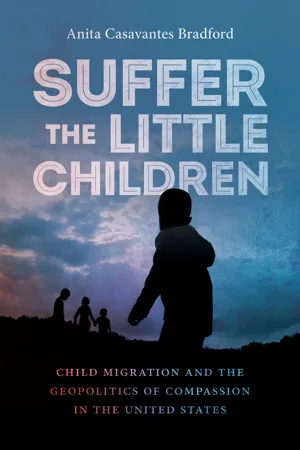
eBook - ePub
Suffer the Little Children
Child Migration and the Geopolitics of Compassion in the United States
- 304 pages
- English
- ePUB (mobile friendly)
- Available on iOS & Android
eBook - ePub
Suffer the Little Children
Child Migration and the Geopolitics of Compassion in the United States
About this book
Information
1
Against All Odds
Child-Saving and Exclusion in FDR’s America
Between 1933 and 1939, as fascism spread across Europe, concerned Americans would improvise a range of responses to the emerging threats to children’s safety on the continent. The first, organized by American Jews after Adolf Hitler’s rise to power, sought to bring 1,000 coreligionist children out of German to the safety of American coreligionist foster homes. During the same period, the devastating impact of the Spanish Civil War on the peninsula’s youngest citizens inspired American supporters of the Spanish Republic to come together to attempt to find temporary homes for 500 Basque refugee children in the United States.
Against all odds, the first of these initiatives achieved a modest degree of success; the second, after provoking an initial flurry of media attention, collapsed before it began. They both nonetheless represent an essential part of the history of unaccompanied child migration to the United States. When considered individually and in relation to one another, they provide valuable insight into the diverse worldviews of the people that participated in or opposed early twentieth-century American child evacuation schemes, the motives behind their actions, and the approaches and strategies they employed in promoting or curtailing efforts to aid displaced children. In doing so, they shed new light on the complex and contested ways Americans imagined refugees and children during the interwar years, as well as on the ways that Americans’ notions of religion, race, and culture interacted with evolving understandings of the national interest to shape immigration law and policy.
In January 1933 Adolf Hitler began to transform the collapsing German Weimar Republic, seeking to establish a National Socialist dictatorship that would dominate Europe. Convinced that Germany’s military, economic, and cultural decline after World War I resulted from a communist-Jewish conspiracy and that Jewish people threatened the racial integrity of the nation, Hitler took swift action to restrict Jewish participation in national life. His actions ushered in a period of racist anti-Semitic terror and violence that eventually spilled over Germany’s borders and provoked a second world war.1
In the months following Hitler’s rise to power, American Jewish leaders organized to seek out new emigration options for coreligionists in Germany. However, current U.S. immigration laws made this almost impossible. Since 1924, the Johnson-Reed Act had strictly curtailed admissions according to a nationality-based annual quota designed to bolster the northwestern European and Protestant populations of the United States, while barring Asian immigration and drastically limiting immigration from southern and central Europe. Voted into law by an overwhelming congressional majority, the 1924 act’s racialized restrictionist logic quickly became enshrined in U.S. political culture as well as the popular imagination, framing debates around immigration for the next forty years.2
Moreover, the 1924 act—like U.S. immigration laws before it—contained no specific provision for refugee admissions. And whereas in earlier periods laissez-faire immigration policies had facilitated the indirect admission of many victims of persecution, the new act’s extraordinarily restrictive quotas, combined with rigid enforcement of visa eligibility requirements, would work together to curtail immigration and close the nation’s doors to refuge seekers. In April 1933 Assistant Secretary of State Wilbur Carr instructed consular officials that Jews fleeing Germany must apply for visas, like any other applicants, and if qualified for admission, wait their turn for a quota number. Thus, as Nazi persecution of Jews worsened, the deliberate under-issuance of visas reduced admissions from Germany to a small percentage of their modest annual quota of 27,000.3
In response, a coalition of well-connected Jewish Americans, including representatives of the American Jewish Committee and the B’nai B’rith, lobbied the State Department to adjust inspection procedures to facilitate visas for German Jews. Irving Lehman, a prominent lawyer and chief judge of the New York Court of Appeals, asked his close friend President Franklin Delano Roosevelt to relax enforcement of the 1917 Immigration Act’s “public charge” clause, which barred admission of any immigrant seen as likely to become dependent on taxpayer funded services.4 A few days later, FDR charged Secretary of State Cordell Hull and Secretary of Labor Frances Perkins with looking at how visa procedures might be modified to allow admission of a “small number of prominent individuals” fleeing Nazi persecution.5
Giving the request serious consideration, Secretary Perkins recommended the president issue an executive order facilitating issuance of visas to German Jews. However, Secretary Hull vigorously opposed the idea, defending the State Department’s rigorous admission standards and arguing Germany would see special treatment for Jews claiming religious or political persecution as unwarranted meddling in their domestic affairs.6 Moreover, he insisted, increased immigration would antagonize labor and hurt American workers. Defending her territory, the outspoken Perkins—the first woman Cabinet member in U.S. history—retorted that labor relations and immigration’s impact on the economy were HER concern and suggested that the Department of State confine its assessments of the national interest to the sphere of foreign relations.
This exchange began a prolonged turf battle between the Departments of State and Labor over the authority to regulate admission of Jewish refugees, revealing the divergent priorities of their offices as well as fundamentally incompatible understandings of the relationship between immigration and the national interest.7 Perkins, a deeply idealistic leader whose experiences in the settlement movement convinced her of immigrants’ positive impact, was determined to assist Jews fleeing Germany in every legally permissible way. The patrician southerner Hull, a former senator from Tennessee, firmly believed the nation’s isolationist foreign policy rested on restrictive immigration laws. Hull’s objections to Jewish refugees also reflected concerns about the negative political and economic consequences of immigration, as well as the racist anti-Semitic worldview he shared with many of the State Department’s senior career officers who suspected Jews of exaggerating their suffering to unfairly circumvent U.S. immigration law.8
With FDR’s cabinet deadlocked over the issue of Jewish refugees, American Jewish community leaders doggedly searched for ways to free up the German quota. A unique opportunity appeared in the spring of 1933 with the establishment of a department for child emigration within the Reich Agency for Jews in Germany (Reichsvertretung der Juden in Deutschland). The American Jewish Congress recognized that a convergence of international and domestic circumstances—the Nazi regime’s desire to incentivize youth emigration combined with the availability of unused German quota visas—might make possible the evacuation of Jewish children to the United States.9
During the next six months, a subcommittee of representatives from the American Jewish Congress, the American Jewish Committee, and B’nai B’rith—including prominent women like Cecilia Razovsky, a first-generation Jewish American who served as assistant to the executive director of the National Refugee Service (NRS) and executive director of the National Coordinating Committee for Aid to Immigrants and Refugees from Germany—came together to envision a child evacuation plan. A subcommittee under the auspices of the National Conference of Jewish Social Workers launched its own exploration of the feasibility of such a program.10 By early 1934, the two subcommittees joined forces to seek government approval for the admission of as many as 1,000 children to the United States.
After prolonged discussion, the subcommittees agreed to consider only children born in Germany for evacuation; they set the age limit for participants at sixteen, a decision foreshadowing later tensions between advocates for evacuation of the more endangered adolescents and those who insisted the program give preference to younger children, who were more sympathetic and easier to place. With these compromises in place, committee members created the German-Jewish Children’s Aid (GJCA) to undertake fundraising, coordination of visa applications, transportation, and identification of American foster homes.
The diverse motivations underlying different organizations’ participation in the GJCA’s founding revealed the extraordinarily diverse Jewish American community’s multivalent response to rising threats for their coreligionists in Europe. Zionist, more recently arrived, and traditionally observant Jews frequently understood child evacuation as part of broader efforts to assist all Jewish refugees, especially through relocation to Palestine. However, many elite and assimilated Jewish Americans saw child evacuation as a temporary strategy, a means of capitalizing on humanitarian concern for children even as they continued to advocate for expanded Jewish German immigration to the United States.11 These more elite Jews—whose vision finally prevailed within the GJCA—likely understood their efforts as one of the few available means of providing assistance to German coreligionists who were either unable to leave or unwilling to surrender their homes and assets to the Nazis as a precursor to emigration.
Despite these differences, however, the GJCA’s proposed program reflected American Jews’ shared concern for the vulnerabilities of German Jewish children who, expelled from schools and subjected to bullying and violence, were among the first victims of Nazi anti-Semitism.12 But the new organization’s leaders quickly discovered that the legal obstacles to the admission of children were even more formidable than those confronting German Jewish adults. Unlike other areas of American jurisprudence and social policy, U.S. immigration law did not recognize children as possessing any unique age-based claim on state resources or protection.13 It granted no special consideration to children, including those fleeing persecution or threats to their physical survival. What’s more, the Immigration Act of 1917 barred unaccompanied boys and girls under sixteen from entering the United States without a special waiver from the secretary of labor—which could only be provided if they met all of the other eligibility requirements for a quota visa, including proving they would not become a public charge.14
But the GJCA’s determined leaders discovered a loophole in immigration law that might allow for the admission of unaccompanied Jewish children. Led by retired New York State judge Joseph Proskauer, they met with representatives of the Departments of State and Labor in September 1933, requesting that—as per Section 21 of the Immigration Act of 1917—the secretary of labor accept bonds as a guarantee that the children would not become a public charge. Their request reignited the conflict between Secretaries Perkins and Hull over Jewish refugees. Although Perkins judged the bond statute inappropriate for facilitating the widespread admission of German refugees, she agreed with Jewish community leaders that minors represented an exceptional case: since they would not compete with U.S. citizens for jobs, the provision might be used to admit Jewish children. The State Department’s leadership disagreed vehemently, warning that any easing of the regulations would antagonize organized labor, spark an anti-Semitic public backlash, and lead to demands that Congress pass legislation to drastically reduce existing quotas.
Reflecting Perkins’ and Hull’s divergent worldviews, the disagreement also pointed to a fundamental difference between the way that refugee advocates and restrictionists understood childhood. Perkins’ reasoning suggests she understood refugee children as holding a unique age-based claim to sympathy and legal accommodation. In contrast, Secretary Hull and State Department senior leaders’ comments suggest they saw Jewish children primarily as representatives of a racialized community, without any right as children to special treatment under the law. They framed objections to the children’s admission in the same terms used to oppose the admission of refugees in general—the negative economic and political consequences of increased immigration. Seeing children as extensions of their inadmissible parents rather than as individuals, State Department officials believed relaxing any visa requirements would allow children to serve as an “entering wedge” and establish a dangerous precedent for policy exceptions.
In December 1933, the attorney general ruled in support of the Department of Labor’s authority to grant bonds to facilitate admission of a limited number of German Jewish children.15 A few months later, GJCA leaders met with Immigration and Naturalization Service (INS) commissioner Daniel MacCormack to work out details of the bonding procedure. Leading the delegation was GJCA executive secretary Cecilia Razovsky who, having been active in immigrant aid and resettlement work since the 1920s, was thoroughly acquainted with immigration law; a former child labor inspector for the U.S. Children’s Bureau, she also enjoyed positive relationships with federal government officials.16 In the end Commissioner MacCormack agreed to quota numbers for up to 250 boys and girls, to be placed with Jewish families approved by a U.S. Children’s Bureau–certified social services agency. Foster parents would sign affidavits swearing to provide for the children’s care and education until th...
Table of contents
- Cover
- Half Title
- Title Page
- Copyright Page
- Dedication
- Contents
- List of Illustrations
- Acknowledgments
- Introduction
- 1. Against All Odds
- 2. Collateral Humanitarianism
- 3. War Orphans and Children on Demand
- 4. Cold War Kids
- 5. An Exception within an Exception
- 6. The Most Difficult Type of Refugee
- 7. The Origins of a Crisis
- Epilogue: The Right to Have Rights? Migrant Children and the Geopolitics of Compassion in the Twenty-First Century
- Notes
- Index
Trusted by 375,005 students
Access to over 1.5 million titles for a fair monthly price.
Study more efficiently using our study tools.
Frequently asked questions
Yes, you can cancel anytime from the Subscription tab in your account settings on the Perlego website. Your subscription will stay active until the end of your current billing period. Learn how to cancel your subscription
No, books cannot be downloaded as external files, such as PDFs, for use outside of Perlego. However, you can download books within the Perlego app for offline reading on mobile or tablet. Learn how to download books offline
Perlego offers two plans: Essential and Complete
- Essential is ideal for learners and professionals who enjoy exploring a wide range of subjects. Access the Essential Library with 800,000+ trusted titles and best-sellers across business, personal growth, and the humanities. Includes unlimited reading time and Standard Read Aloud voice.
- Complete: Perfect for advanced learners and researchers needing full, unrestricted access. Unlock 1.5M+ books across hundreds of subjects, including academic and specialized titles. The Complete Plan also includes advanced features like Premium Read Aloud and Research Assistant.
We are an online textbook subscription service, where you can get access to an entire online library for less than the price of a single book per month. With over 1.5 million books across 990+ topics, we’ve got you covered! Learn about our mission
Look out for the read-aloud symbol on your next book to see if you can listen to it. The read-aloud tool reads text aloud for you, highlighting the text as it is being read. You can pause it, speed it up and slow it down. Learn more about Read Aloud
Yes! You can use the Perlego app on both iOS and Android devices to read anytime, anywhere — even offline. Perfect for commutes or when you’re on the go.
Please note we cannot support devices running on iOS 13 and Android 7 or earlier. Learn more about using the app
Please note we cannot support devices running on iOS 13 and Android 7 or earlier. Learn more about using the app
Yes, you can access Suffer the Little Children by Anita Casavantes Bradford in PDF and/or ePUB format, as well as other popular books in History & North American History. We have over 1.5 million books available in our catalogue for you to explore.