In this interdisciplinary work, Stacy J. Lettman explores real and imagined violence as depicted in Caribbean and Jamaican text and music, how that violence repeats itself in both art and in the actions of the state, and what that means for Caribbean cultural identity. Jamaica is known for having one of the highest per capita murder rates in the world, a fact that Lettman links to remnants of the plantation era—namely the economic dispossession and structural violence that still haunt the island. Lettman contends that the impact of colonial violence is so embedded in the language of Jamaican literature and music that violence has become a separate language itself, one that paradoxically can offer cultural modes of resistance. Lettman codifies Paul Gilroy’s concept of the “slave sublime” as a remix of Kantian philosophy through a Caribbean lens to take a broad view of Jamaica, the Caribbean, and their political and literary history that challenges Eurocentric ideas of slavery, Blackness, and resistance.
Living at the intersection of philosophy, literary and musical analysis, and postcolonial theory, this book sheds new light on the lingering ghosts of the plantation and slavery in the Caribbean.
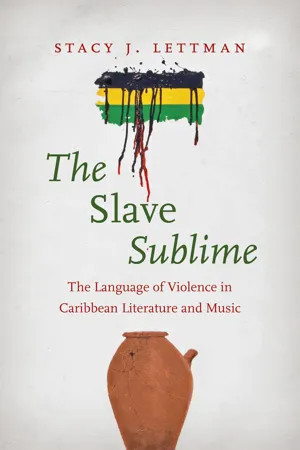
eBook - ePub
The Slave Sublime
The Language of Violence in Caribbean Literature and Music
- 272 pages
- English
- ePUB (mobile friendly)
- Available on iOS & Android
eBook - ePub
About this book
Information
CHAPTER ONE A Trickster’s Challenge to Rationalism
Andrew Salkey’s Discourse of the Imagination in A Quality of Violence
Reason exerts a dominion over sensibility in order to extend it in conformity with its proper realm (the practical) and to make it look out into the Infinite, which is for it an abyss. In fact, without development of moral Ideas, that which we, prepared by culture, call sublime, presents itself to the uneducated man merely as terrible.
—Immanuel Kant, Critique of Judgment
Let us note this rather special inscription of a judgment programmed in nature, needing culture, but not produced by culture. It is not possible to become cultured in this culture, if you are naturally alien to it. We should read Kant’s description of the desirability of the proper humanizing of the human through culture within this frame of paradox.
—Gayatri Chakravorty Spivak, A Critique of Postcolonial Reason
Western metaphysics has traditionally defined the human in terms of the possession of language and reason. In effect, there is no humanity without language. Reason in particular confers on the human being a generic identity, a universal essence, from which flows a collection of rights and values … The exercise of this faculty generates liberty and autonomy, as well as the capacity to live an individual life according to moral principles and an idea of what is good. That being the case, the question at the time was whether Blacks were human beings like all others.
—Achille Mbembe, Critique of Black Reason
Set during Jamaica’s colonial era, Andrew Salkey’s realist novel A Quality of Violence focuses on Pocomania in order to suggest a religious sensibility grounded in Afro-Jamaican spiritual imagination. As the novel indicates, Pocomania and other African-derived religious practices conflicted with the British colonial and emancipation project founded upon liberalism’s ideals of labor as moral Christian duty, a scheme for transforming slaves into the proletariat of an emerging capitalist order while preserving the coercive mechanisms and ideologies of the slave plantocracy. The paradox is that ex-slaves were barred from the true acquisition of freedom during Jamaica’s emancipation project—as freedom, a philosophical ideal, was a domain of liberty reserved for the so-called rational human subject. The terms of emancipation in Jamaica following the 1834 abolition of slavery rested on ex-slaves’ socialization to a European worldview that involved a disavowal of African-derived religious practices. This was a realm of identity that the colonial administration believed to be steeped in the imagination and superstition of Africa, which, in their view, necessitated a transition to the world of reason and logic, to Europe as the sign of civilization and humanization. The expansion of the British Empire to Africa during the mid- to late nineteenth century coincided with the reemergence of religious censorship in Jamaica since the era of slavery to support a larger colonial narrative about bringing the irrational beliefs and superstitious practices of Africans and African-descended peoples under the civilizing forces of Christianity and into the fold of a rational Europe. In essence, the socialization to British culture involved a kind of cultural assimilation that was coupled with the notion of humanization. As African philosopher Achille Mbembe explains in Critique of Black Reason, this assimilation was necessary for African peoples to be “perceived and recognized as fellow human beings” so that their “humanity would cease to be indefinable and incomprehensible.”1 Mbembe references Joseph Conrad’s The Heart of Darkness implicitly to signify his critique of colonialist discourse. His critique resonates with Chinua Achebe’s essay “An Image of Africa” and its in-depth critique of Conrad’s novel, which links Africa to the primitive “other world” and calls into question the humanity of Africans.
During the age of empire, European philosophers posited the idea that the human was defined by a predilection for rational thought, and moral and mental value judgments were ascribed to this capacity for reason. The taxonomic classification of races that emerged during this period of history espoused a biological determinism that was specific to each racial category that they devised. The British imperial project during the nineteenth century was grounded in the so-called civilizing forces of Christianity, believed to be central in moving Africans toward the onto-epistemological category of the human. These convictions foreground not only the contradictory aspect of the emancipation project in Jamaica, but also the belief in European racial and cultural superiority in order to rationalize dominance. The belief was that the socialization to reason would confer human attributes to Blacks who were perceived to exist outside the human domain, as given in this chapter’s epigraphic quote from Mbembe.
An adherence to a fragmented African ancestral culture, which includes religious practices, during the post-emancipation period in Jamaica signified in this colonial context the lack of human socialization. The socializing imperatives of the emancipation project meant it was akin to a humanization project involving “the entry through language into a given cultural world” of “significations.”2 This perspective correlates with Jacques Lacan’s idea about language and subject formation. The point that Gayatri Spivak makes in A Critique of Postcolonial Reason, also quoted in this chapter’s epigraph, is likewise of utmost importance as it points to an irresolvable paradox: that one cannot “become cultured” in a culture to which they are believed to be “naturally alien.”3 Caribbean psychoanalyst Frantz Fanon captures the essence of the incommensurability between colonial society and the Black psyche in Black Skin, White Masks when he speaks about the empirical, ontological, and epistemological violence as the formation of a triple consciousness, shattered bodily schemata, and distorted mirror image that result from this colonial encounter and its disciplinary mechanisms for making a compliant colonial subject. In the context of Jamaica, the colonial administration held the belief that former slaves could be disciplined by reason and its symbolic function as the law to facilitate their movement toward a human subject position.
As a result, the terms of emancipation in Jamaica were informed by the colonialist and rationalistic discourse of the nineteenth century. Blacks were seen as incapable of reason and, therefore, were regarded as not deserving liberty because they were not human; they could be emancipated, however, which would inculcate them with human characteristics. There is a certain limit imposed upon this kind of emancipation; such emancipation belies the notion of Black people’s postponed humanity—a humanity in the process of becoming that socialization would engender in the assimilation to British cultural ideals. This makes sense within the context of what Sylvia Wynter suggests in “Unsettling the Coloniality of Being/Power/Truth/Freedom” about the emergence of racial ideologies to signify difference, which coincided with the rise of European political states and their imperial activities. Drawing upon Michel Foucault’s ideas, Wynter argues that the early modern period marked an epochal stage in the development of a Western humanist discourse about “Man’s” coming into being, his transcendence from “human” to “Man,” with the latter proffering the imperial ideologies that would aid in the transformation of non-European peoples into the “Human Other.”4 As Wynter suggests, Man, in this sense, is to be considered as a ratiocentric, transcendent subject who left behind a lower form of human identity whose irrationality stemmed in part from profound sensual drives—and who was regarded as “sinful by nature.” This transcendent, European “Man” was believed to be in possession of reason that made him “lord over the senses,” enabling him to “to rule over a ‘lower order of reality.’ ”5 Because the imagination is aligned with sensation within European epistemology, it is perceived to be an unreliable mediator of reality, given its role of mediating between the “senses and intellect.”6 Sensuality was aligned with Black identity, which correlated to the assumption that Black people lacked reason. This premise allowed European philosophers to make the argument that Black people were ruled by bodily sensations, which they believed created an “enslavement” to passions” or “particularistic desires.”7 This is similar to Kant’s notion of the sublime in Critique of Judgment in which “Reason exerts dominion over sensibility.”8 Here, Kant echoes the Cartesian dualism that espoused a disjunction between mind and body.
Although Wynter does not identify Kant in her essay under consideration here, we can see a deep connection between Kant’s work and the emerging racial ideologies of the time that linked reason to aesthetic and imperial discourse about freedom. Mbembe calls attention to the modern European perception of Africa or Blackness as unrepresentable, that it poses challenges to language’s capabilities, given its perceived sublimity: “Africa and Blackness have, since the beginning of the modern age, plunged the theory of the name as well as the status and function of the sign and of representation into deep crisis … Every time it confronted the question of Blacks and Africa, reason found itself ruined and emptied, turning constantly in on itself, shipwrecked in a seemingly inaccessible place where language was destroyed and words themselves no longer had memory.”9 Kant’s formulation of the sublime can be seen as not only involving a European aesthetic belief but also having a foundation in moral virtue, both of which were based on the invention of race. In addition to Wynter’s ideas, which help to bring to the fore the underlying racial ideologies in Kant’s work, David Roberts offers a point that helps to contextualize Wynter’s claim about “Man,” who alone was in possession of the reason that enabled his transition from particularity to the freedom of “universal autonomy”:
The humanity of man becomes the question of the nature of his socialization … or his naturalization. For the Enlightenment, naturalization signified alienation or dehumanization, since man becomes human and regains his birthright of freedom only by breaking out of enclosure in any particular society or tradition. Man is the maker of his own humanity and the supreme norm is individual autonomy, whose preservation demands the eternal vigilance of reason, which must scrutinize all “natural” conventions and replace them by self-critical norms. Essential humanity thereby emancipates itself from all particularism to emerge as the project of universal autonomy made possible by man’s right to think and judge for himself. The humanization, i.e. the denaturalization of man, is the task of reason.10
Reason was perceived as a prerequisite, not only for the emancipation from particularism but also for inclusion within universalism, that endows “Man” with the power of discourse so as to “judge” for all humanity, not just “himself,” as Roberts suggests.
Echoing Wynter, Mbembe provides a similar point that during slavery, Europeans believed that Black people “lacked the power of invention” and the universal freedom that reason endows. This “lack” may suggest Lacan’s idea about the relationship between desire and the subject’s lack of being, which leads to the deployment of a neurotic or irrational desire.11 If this lack, as desire, is believed to precede subject formation, then this perspective provides the grounds for denying one’s humanity and claim to universal freedom. In the context of such imperial discourse, as Mbembe suggests, this “being-apart” led to the legal exclusion of colonial subjects. The assumption was that “they had nothing to contribute to the universal”12: “The period represented the Black Man as the prototype of a prehuman figure incapable of emancipating itself from its bestiality, of reproducing itself, or of raising itself up to the level of its god. Locked within sensation, the Black Man struggled to break the chains of biological necessity and for that reason was unable to take a truly human form and shape his own world. He therefore stood apart from the normal existence of the human race.”13 For this reason, eighteenth- and nineteenth-century political theories, premised upon the racialization of human subjects, defined race in relation to discernible physiological traits that were believed to be intrinsically connected to moral attributes.14 These theories suggested that Black people not only lacked the moral capacity that reason provides to establish their humanity but that they also lacked the intellect to “shape” their “own world.” The ideas that Wynter and Mbembe articulate help to unearth the ideologies and objectives that undergirded the emancipation project in Jamaica. From this perspective, the slave embodied the sign of the irrational, while the emancipated moved toward the rational, away from “passions,” “particularistic desires,” and African primitivity as guided by moral laws and legal statutes.
In Jamaican post-slavery society, Christian missionaries believed in the important role that Christianity would play toward the ex-slaves’ acquisition of moral virtue, which would serve as the prerequisite for freedom. This was only a guise, however. Jamaica was caught at a crossroads between these changing ideas about the role of religion, which merely came to function as a tool of colonialism in the transition from a slave economy to a capitalist system. That is to say, in nineteenth-century Jamaica, this ethic of emancipation through Christianity was aligned also with the ex-slave’s labor in the pivot from the slave plantation to a modern capitalist system. William A. Green explains that in Caribbean post-slavery society “religious instruction was deemed a noble device for uplifting the human spirit, controlling passion, and preserving the prevailing social order. The planters were quick to recognize the disciplinary values of religious education.” Showing the hegemonic social function of Christian religious education to preserving the social structure, Adam Smith, a key architect of classical liberalism, supported Christian education as a way of stultifying revolutionary consciousness among subordinated groups of people.15 European liberalism, as Mbembe explains, echoing Green’s point, “was forged in parallel with imperial expansion. It was in relation to expansion that liberal political thought in Europe confronted such questions as universalism, individual rights, the freedom of exchange, the relationship between ends and means.”16 Freedom o...
Table of contents
- Cover
- Title Page
- Copyright
- Dedication
- Contents
- List of Illustration
- Acknowledgments
- Introduction. The Slave Sublime: A Jamaican Case Study
- Chapter One. A Trickster’s Challenge to Rationalism: Andrew Salkey’s Discourse of the Imagination in A Quality of Violence
- Chapter Two. Language and Social Death: Boundary Crossing and the Grammar of Violence in NourbeSe Philip’s Prose and Poetry
- Chapter Three. The Changing Same for I-an-I in Babylon: Bob Marley’s Representations of the Slave Sublime in Postcolonial Jamaica
- Chapter Four. The Real (and) Ghetto Life: Excess Violence and Manichean Delirium in Marlon James’s A Brief History of Seven Killings
- Chapter Five. The Ogun Archetype in Jamaican Dancehall Music: Harnessing Ogun’s Combative Will to Challenge Globalization’s Dionysiac Nature
- Coda
- Notes
- Bibliography
- Index
Trusted by 375,005 students
Access to over 1.5 million titles for a fair monthly price.
Study more efficiently using our study tools.
Frequently asked questions
Yes, you can cancel anytime from the Subscription tab in your account settings on the Perlego website. Your subscription will stay active until the end of your current billing period. Learn how to cancel your subscription
No, books cannot be downloaded as external files, such as PDFs, for use outside of Perlego. However, you can download books within the Perlego app for offline reading on mobile or tablet. Learn how to download books offline
Perlego offers two plans: Essential and Complete
- Essential is ideal for learners and professionals who enjoy exploring a wide range of subjects. Access the Essential Library with 800,000+ trusted titles and best-sellers across business, personal growth, and the humanities. Includes unlimited reading time and Standard Read Aloud voice.
- Complete: Perfect for advanced learners and researchers needing full, unrestricted access. Unlock 1.5M+ books across hundreds of subjects, including academic and specialized titles. The Complete Plan also includes advanced features like Premium Read Aloud and Research Assistant.
We are an online textbook subscription service, where you can get access to an entire online library for less than the price of a single book per month. With over 1.5 million books across 990+ topics, we’ve got you covered! Learn about our mission
Look out for the read-aloud symbol on your next book to see if you can listen to it. The read-aloud tool reads text aloud for you, highlighting the text as it is being read. You can pause it, speed it up and slow it down. Learn more about Read Aloud
Yes! You can use the Perlego app on both iOS and Android devices to read anytime, anywhere — even offline. Perfect for commutes or when you’re on the go.
Please note we cannot support devices running on iOS 13 and Android 7 or earlier. Learn more about using the app
Please note we cannot support devices running on iOS 13 and Android 7 or earlier. Learn more about using the app
Yes, you can access The Slave Sublime by Stacy J. Lettman in PDF and/or ePUB format, as well as other popular books in Littérature & Critique littéraire de l'Amérique latine et des Caraïbes. We have over 1.5 million books available in our catalogue for you to explore.