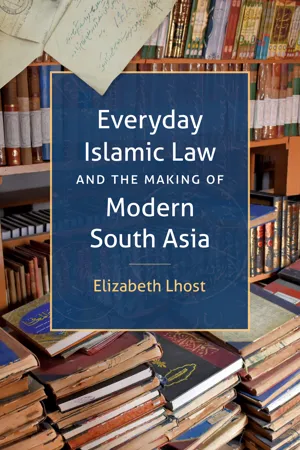
Beginning in the late eighteenth century, British rule transformed the relationship between law, society, and the state in South Asia. But qazis and muftis, alongside ordinary people without formal training in law, fought back as the colonial system in India sidelined Islamic legal experts. They petitioned the East India Company for employment, lobbied imperial legislators for recognition, and built robust institutions to serve their communities. By bringing legal debates into the public sphere, they resisted the colonial state’s authority over personal law and rejected legal codification by embracing flexibility and possibility. With postcards, letters, and telegrams, they made everyday Islamic law vibrant and resilient and challenged the hegemony of the Anglo-Indian legal system.
Following these developments from the beginning of the Raj through independence, Elizabeth Lhost rejects narratives of stagnation and decline to show how an unexpected coterie of scholars, practitioners, and ordinary individuals negotiated the contests and challenges of colonial legal change. The rich archive of unpublished fatwa files, qazi notebooks, and legal documents they left behind chronicles their efforts to make Islamic law relevant for everyday life, even beyond colonial courtrooms and the confines of family law. Lhost shows how ordinary Muslims shaped colonial legal life and how their diversity and difference have contributed to contemporary debates about religion, law, pluralism, and democracy in South Asia and beyond.
- 368 pages
- English
- ePUB (mobile friendly)
- Available on iOS & Android
eBook - ePub
Everyday Islamic Law and the Making of Modern South Asia
About this book
Trusted by 375,005 students
Access to over 1.5 million titles for a fair monthly price.
Study more efficiently using our study tools.
Information
Part I Professionals

Interlude I
Rethinking Law, Religion, and the State
That in all Suits regarding Inheritance, Marriage, Caste, and all other religious Usages or Institutions, the Laws of the Koran with respect to Mahometans, and those of the Shaster with respect to Gentoos, shall be invariably adhered to: On all such Occasions, the Moulavies or Brahmins shall respectively attend and expound the Law, and they shall sign the Report, and assist in passing the Decree.—Clause XXIII, “A Plan for the Administration of Justice,” 1772
Text and Context: The Judicial Plan of 1772
Following military victories (the Battles of Plassey and Buxar), diplomatic successes (the signing of the Treaty of Allahabad and receipt of the dīwānī—revenue collecting—rights), and protracted debates over the British East India Company’s status, the 1772 “Plan for the Administration of Justice” was the founding document for the British East India Company’s judicial system on the subcontinent.1 Crafted in consultation with the nawab, still the reigning sovereign in Bengal, the plan brought existing institutions under British authority, dispatched with other offices, and laid the foundation for the Company’s transition from trading outfit to governing body, at least insofar as Bengal was concerned.2 In addition to the passage just excerpted (Clause XXIII), the plan included thirty additional rules relating to judicial affairs.3 A symbolic and pragmatic response to the Company’s decision to “stand forth” as dīwān, the 1772 plan presupposed radical change, while largely maintaining the status quo.4
The multipart plan began by outlining a hierarchy of courts for civil and criminal cases. It summarized procedures, named and appointed personnel, and even indicated when each would be open to hear which types of cases. The Provincial Court of Dewanee (Mufaṣṣal Dīwānī ʿAdālat) would oversee matters related to property, inheritance, marriage, caste, debts, accounts, contracts, partnerships, and rent, while the Provincial Criminal Court (Mufaṣṣal Faujdārī ʿAdālat) would hear all cases of murder, robbery, theft, “and all other Felonies,” forgery, perjury, “and all sorts of Frauds and Misdemeanors, assaults, frays, quarrels, adultery, and every other Breach of the Peace, or violent Invasions of Property.”5 The plan recommended employing councils of judges and using local legal personnel—including “the Chief Câzee, the Chief Muftee, and Three capable Moulavies” in the apex court (the Nizāmat ʿAdālat) (VII) and “the Câzee and Muftee of the District, and Two Moulavies … to expound the Law” in the criminal courts (IV)—to aid councils of (European) judges.6 The plan thus drew on existing practices, personnel, and institutions to build the new judicial infrastructure of the Company-state.
The plan also included guidelines for making local justice accessible and equitable. It established procedures for receiving complaints and hearing petitions with the placement of a “Box” at the “Door of the Cutcherry [court]” to receive those complaints from the public at all hours of the day and night (IX).7 It granted the “Head Farmer” in the district (“Purgunnah”) permission to hear cases “not exceeding Ten Rupees” to make justice accessible locally (XI).8 It instituted uniform procedures for hearing cases and evaluating evidence (XII) and offered additional measures to guard against excessive litigiousness by implementing time limits (XV).9 In other words, the plan imbued the judicial system not only with symbolic content but also with practical measures to ensure open access and fair treatment.
Focusing on revenue collection and extraction as much as on facilitating just and equitable governance, the plan also altered practices related to the receipt of payments and collection of fees. It prohibited the collector from summoning “any Persons … who are in any ways connected with the Revenue” during the months of harvest, so as not to interfere with agricultural work (X).10 The plan further adjusted the interest rates for money-lending (noting that the current rates were “exorbitant”), demanded that all bonds be “executed in the Presence of Two Witnesses,” and limited the extent to which debtors were beholden to their bondsmen (XVIII–XX).11 It curtailed the practice of charging commissions and allowing arbitrators to take a cut from the suits they settled (XVI).12 It also abolished the practice of paying fees to qazis and muftis as annual tributes (“Rassooms,” rusūms) or for performing certain ceremonies and recommended replacing those fees with a “Monthly Salary” (XXXIII).13 In short, the plan introduced lasting changes while leaving preexisting local hierarchies and administrative structures in place. It was a founding document that also invited future interventions.
Rereading the Hastings Plan in the Context of Religious Freedom
In scholarship on South Asia, the 1772 “Plan for the Administration of Justice”—colloquially referred to as the Hastings Plan, in recognition of Warren Hastings’s role in its design—marks many beginnings for British rule on the subcontinent. Read for its symbolism as much as its substance, the plan tends to stand in for everything that was wrong—and for everything that went wrong—with British rule on the subcontinent, particularly in relation to religious law. Even without overstating its accomplishments, the plan signals a transition in the Company’s history and offers insights into the ideologies of British imperialism.14 The plan, for instance, gestures toward Britain’s divide-and-rule philosophy—that is, to divide local inhabitants into distinct and competing factions (with perquisites, emoluments, and entitlements distributed unevenly among them)—while also signaling the recognition of communal difference as a sign of cultural deference.15 Naming two distinct communities (here “Mahometans” and “Gentoos,” or “Muslims” and “Hindus”), the plan established Company rule through favors and special interests.16 It also demarcated the boundaries of religious legal pluralism on the subcontinent—even though those terms do not appear here and their broader implications would take decades to develop.17 Most notably, the plan announced that suits related to “Inheritance, Marriage, Caste, and all other religious Usages or Institutions” would be adjudicated according to two texts—the “Koran” [Qurʾān] and the “Shaster”—as “expound[ed]” by two groups of interpreters, “Moulavies or Brahmins,” thereby planting the seeds for future visions of legal pluralism to grow.
In and of itself, this statement of legal pluralism was odd and exceptionally narrow, compared with contemporaneous descriptions of justice on the subcontinent.18 Yet directing their attention to this moment, scholars have ascribed great importance to this statement and to the misinterpretation, misapplication, and “invention of tradition” that followed it.19 The plan provided a road map for the administration of justice but left many questions unanswered and was subject to revision, rethinking, and modification throughout the late eighteenth century and into the nineteenth. At the same time, the plan reflected specific assumptions about South Asian society and turned those observations into policy prescriptions. The plan recognized two communities (Hindus and Muslims) belonging to distinct (religious) traditions, with unique laws for settling private disputes. Accordingly, the plan dictated that within areas of private or personal law, each community’s scriptures (the “Koran” and “Shasters”), as interpreted by recognized religious leaders (“Maulvis” and “Brahmins”), would “invariably” apply to those categories of disputes for those groups of disputants.
There is much to critique here. To begin with, the formulation made the two groups it named, whitewashing local difference and diversity for the sake of simplifying judicial practice.20 It also located legal practice (qua dispute resolution) within textual sources and dictated who would interpret those texts. The plan amalgamated and simplified a diverse array of local practices, customary observances, and legal traditions under the “Gentoo” and “Mahometan” umbrellas, and ushered in new projects to know, learn, fix, and reform those categories. The legacies of these invented religio-legal traditions haunt scholars of law and religion today. For scholars of Hinduism and Hindu law, the plan’s simplistic formulations create a double bind.21 To argue that “Hinduism” as a “Hindu religion” did not exist before British rule undermines the validity of practices and precedents that defined precolonial socioreligious life, yet to challenge colonialism’s—and orientalist scholarship’s—role in making Hindu religion overlooks the changes that took place under British rule (in the consolidation of Brahmanical authority, the reification of caste hierarchies, and the denial of legitimacy for nondominant or heterodox practices).22 Likewise, for the study of legal history, denying the precolonial existence of “Hindu law” undermines and devalues the normative, moral, ethical, and legal systems that operated in precolonial South Asia and furthermore plays into imperial narratives of “backwardness” and “progress.” Yet by naming a community “Gentoos” and ascribing to them a legal tradition rooted in the text of the “Shasters,” the plan demanded an approach to law that was unlike what had existed before.23
Reference to the “Laws of the Koran” produces a similar conundrum. Here, arguments about colonial change take two forms. The first suggests that Islamic governance in precolonial South Asia (particularly with respect to the judicial institutionalization and application of Islamic legal norms) was absent or deficient. If the Mughal empire and its successor states were “Indo-Islamic” (i.e., only partially, syncretically, compositely, or “culturally” Islamic), then the plan’s emphasis on the Qurʾan—and textual understandings of Islam drawn from it—necessarily introduced (and inscribed as law) an Islamic legal ethos that was dogmatically textual.24 ...
Table of contents
- Cover
- Series Page
- Title Page
- Copyright
- Dedication
- Contents
- List of Figures, Maps, and Table
- Note on Translation and Transliteration
- Maps
- Introduction: Life, Law, and Legal History
- Part I: Professionals
- Part II: Paperwork
- Part III: Possibilities
- Conclusion: The Limits of Legal Possibilities
- Acknowledgments
- Glossary
- Notes
- Bibliography
- Index
- Series List
Frequently asked questions
Yes, you can cancel anytime from the Subscription tab in your account settings on the Perlego website. Your subscription will stay active until the end of your current billing period. Learn how to cancel your subscription
No, books cannot be downloaded as external files, such as PDFs, for use outside of Perlego. However, you can download books within the Perlego app for offline reading on mobile or tablet. Learn how to download books offline
Perlego offers two plans: Essential and Complete
- Essential is ideal for learners and professionals who enjoy exploring a wide range of subjects. Access the Essential Library with 800,000+ trusted titles and best-sellers across business, personal growth, and the humanities. Includes unlimited reading time and Standard Read Aloud voice.
- Complete: Perfect for advanced learners and researchers needing full, unrestricted access. Unlock 1.5M+ books across hundreds of subjects, including academic and specialized titles. The Complete Plan also includes advanced features like Premium Read Aloud and Research Assistant.
We are an online textbook subscription service, where you can get access to an entire online library for less than the price of a single book per month. With over 1.5 million books across 990+ topics, we’ve got you covered! Learn about our mission
Look out for the read-aloud symbol on your next book to see if you can listen to it. The read-aloud tool reads text aloud for you, highlighting the text as it is being read. You can pause it, speed it up and slow it down. Learn more about Read Aloud
Yes! You can use the Perlego app on both iOS and Android devices to read anytime, anywhere — even offline. Perfect for commutes or when you’re on the go.
Please note we cannot support devices running on iOS 13 and Android 7 or earlier. Learn more about using the app
Please note we cannot support devices running on iOS 13 and Android 7 or earlier. Learn more about using the app
Yes, you can access Everyday Islamic Law and the Making of Modern South Asia by Elizabeth Lhost in PDF and/or ePUB format, as well as other popular books in History & Indian & South Asian History. We have over 1.5 million books available in our catalogue for you to explore.