Locked away in refrigerated vaults, sanitized by gas chambers, and secured within bombproof caverns deep under mountains are America’s most prized materials: the ever-expanding collection of records that now accompany each of us from birth to death. This data complex backs up and protects our most vital information against decay and destruction, and yet it binds us to corporate and government institutions whose power is also preserved in its bunkers, infrastructures, and sterilized spaces.
We the Dead traces the emergence of the data complex in the early twentieth century and guides readers through its expansion in a series of moments when Americans thought they were living just before the end of the world. Depression-era eugenicists feared racial contamination and the downfall of the white American family, while contemporary technologists seek ever denser and more durable materials for storing data, from microetched metal discs to cryptocurrency keys encoded in synthetic DNA. Artfully written and packed with provocative ideas, this haunting book illuminates the dark places of the data complex and the ways it increasingly blurs the lines between human and machine, biological body and data body, life and digital afterlife.
- 304 pages
- English
- ePUB (mobile friendly)
- Available on iOS & Android
eBook - ePub
About this book
Trusted by 375,005 students
Access to over 1.5 million titles for a fair monthly price.
Study more efficiently using our study tools.
Information
1: Gas Chambers for Bookworms
Time loves a book—to fox its pages in lovely rust, tea, sepia, and fecal starclusters; to brittle it, to riddle it with pin-width insect labyrinths, to fade, chip, buckle, cockle, scrape and in general tick eternity away by units of wholesale decomposition; Time loves to suck a book as clean as a chicken wingbone.
—Albert Goldbarth, “Both Definitions of Save”
In late spring 1928, as the orchids and camellias burst into bloom in the Huntington Library’s gardens under the Southern California sun, librarians in the rare book collections noticed that something was feasting on the volumes in their care. Rail and utilities titan Henry E. Huntington had established the library in 1920, spending a small fortune to gobble up a number of the largest and finest rare book collections in a relatively short time, and creating a truly priceless set of artifacts.1 The collection included one of only eleven surviving Gutenberg Bibles printed on vellum; a first folio of Shakespeare’s plays, published in 1623 by the Bard’s friends and colleagues just seven years after his death; a first edition of William Blake’s Songs of Innocence and of Experience; as well as many irreplaceable newspapers, broadsides, and incunabula—books printed in Europe between 1455 and 1501.2
Though Huntington died in 1927, he intended his collection to live on long after him, but as the librarians discovered, the volumes were literally too full of life. The problem with assembling a massive collection of books—as was also the case for Huntington’s magnificent botanical gardens—is that you necessarily collect the very organisms that feed on books, or plant leaves, or leather. Huntington’s collection was infested with insects, foreign and domestic, bent on devouring the very books imbued with his spirit. These insects were steadily boring into the volumes from the outside, pausing to lay eggs somewhere in the dark heart of a closed Bible’s illuminated leaves, turning the priceless treasure itself into a food-womb. The larvae then destroyed the same book from the inside out as they set out to colonize other tomes.
Huntington librarian Thomas Marion Iiams led the preservation effort. He was in a race against time, we might say. But what is time but insects, mold, bacteria, rust, dust? Time is, for the most part, a living force, microbial, bacterial, fungal, or basic plant forms that spread and devour and digest anything made with organic materials, such as book pages composed of rag paper or wood pulp, or leather covers or vellum documents, both made of animal skins. Thus toxic chemicals in the form of pesticides can combat time itself. Iiams was new to the librarian profession and was certain that more experienced overseers of fine collections would have a solution to his bookworm problem. In haste, Iiams wrote letters to much older libraries and repositories—the Huntington itself was only eight years old—to learn precisely how they ridded their precious books of the pest. He was alarmed to find that no one, not librarians at the Vatican nor at the oldest libraries in Britain, could offer a definitive prescription for how to protect books against the hardy insect. A number of the librarians he consulted thought bookworms to be a myth, and thus offered no help at all.
The letters, telegrams, and reading recommendations Iiams received mainly offered reasons why you can’t kill bookworms. His colleagues elaborated from afar the bookworm’s astounding resistance to traditional pesticides, its voracious appetite not just for book pages but for leather covers, for even the starchy glue that holds book bindings together. From those that did not doubt the bookworm’s existence or tenacity, Iiams received suggestions that ranged from the highly toxic, such as spraying books with formaldehyde—which is effective for preserving dead humans, but a potent carcinogen for living ones—to the comical, such as sprinkling the shelves of the library with “a little fine pepper.” Other correspondents suggested that the latter tactic would have been ineffective since, according to The Principal Household Insects of the United States (1896), bookworms are actually “partial to pepper.”3
Variously known as Anobium paniceum, or the bread beetle, or drugstore beetle, bookworms had been known to eat their way through “druggists’ supplies,” from “insipid gluten wafers to such acrid substances as wormwood,” from cardamom and anise to “the deadly aconite and belladonna.” Even if arsenic dusted on books hadn’t posed a mortal danger to human readers of those books, using such a drastic method would likely have been unsuccessful. According to Iiams, the bookworm displays a “universal disrespect for almost everything, including arsenic and lead.”4 One could understand, then, when Iiams published an account of his struggles in Library Quarterly and included two photographs of the bookworm on the same page, magnified 110 times, the top image shot straight on and the bottom one in profile—a microscopic mug shot.
Iiams continued to send letter after letter to librarians around the world, but his search for answers began to transform into a kind of fruitless commiseration. One of his correspondents was a librarian working in the tropics, where abundant insects and constant humidity wreaked havoc on books and manuscripts, and was in the process of planning a trip to Europe and the United States to learn more about preservation solutions. Iiams pointed out that he might find himself disappointed.
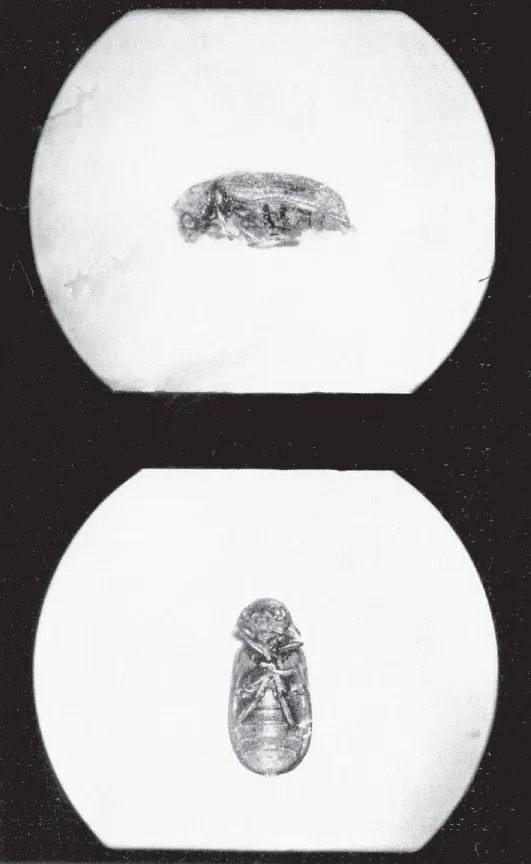
Mug shots of bookworm. From Iiams’s essay “The Preservation of Rare Books and Manuscripts in the Huntington Library,” Library Quarterly, October 1932. Reprinted by permission of Library Quarterly/ Huntington Library and Gardens.
Even the Vatican, its library one of the oldest and wealthiest in the world, did not know how to ward off bookworms both effectively and efficiently. Since 1912, when the Vatican moved its books from wooden boxes on shelves to steel stacks, the bookworms had torn through its precious volumes faster than ever. Prior to the move, the bookworms could eat the wood of the boxes in addition to the books, so when the boxes were taken away, the little insects focused their rather voracious appetites on the books alone. Closer to home, the United States Bureau of Entomology responded to Iiams’s query by admitting it had “never made a thorough study of insects affecting books.” It had, however, fumigated libraries with hydrocyanic acid gas, but mainly to destroy “such external feeding pests as cockroaches and silverfish and such nuisances as bedbugs.”5
Iiams grew up in Pasadena, just down the road from San Marino, and if he ever went to the Pasadena Public Library as a young man, he would have regularly used fumigated books. Amazingly, librarians considered the use of toxic fumigants to be consistent with a desire for “purified” air, probably because they were less concerned by air filled with toxins than the spread of contagious disease. As one epidemic after another swept through increasingly densely populated urban areas in the early twentieth century, public health officials newly empowered by a broader acceptance of germ theory sent notices to libraries when outbreaks occurred. These edicts forced libraries to close in some cases, to fumigate books in others, or even to burn books loaned to borrowers infected with yellow fever, spinal meningitis, scarlet fever, or bubonic plague. In 1908, Pasadena librarians took the precaution of fumigating “about 1200 of the most used books including any suspects.”6 Several years later, they would begin fumigating all of the library’s books as a matter of course.
Infected Books
From the beginnings of the public library system, the public and open nature of bookstacks provoked fear and the desire to purify the library’s aisles and reading rooms, to exclude both disease and social undesirables. In 1883, the same year as Carnegie’s first library construction grant, Charles Ammi Cutter, librarian of the Boston Athanaeum, opened the proceedings of the nascent American Library Association with an address called “The Buffalo Public Library in 1983.” In his futuristic vision, he first enters the delivery room: “There was nothing remarkable about it save the purity of the air. I remarked this to a friend, and he said that it was so in all parts of the building; ventilation was their hobby; nothing made the librarian come nearer scolding than impurity in the air.”7 According to Cutter, these futuristic librarians vigilantly monitor the temperature and atmosphere in all the rooms: “Every one must be admitted into the delivery-room, but from the reading-rooms the great unwashed are shut out altogether or put in rooms by themselves. Luckily public opinion sustains us thoroughly in their exclusion or seclusion.”8
The “great unwashed” were those poor and ill-clad individuals who did not conform to emergent standards of bodily hygiene. But cleanliness and purity and hygiene were terms that had deep biological connotations as well; they referred to a clean surface of the body as well as purity of character inside the body, at a time when many people believed vice and crime and immoral propensities to be inherited traits.9 The social hygiene movement attempted to stem the spread of disease, prostitution, and other social problems, with many of its proponents also being eugenicists. Prior to Andrew Carnegie’s funding a network of public libraries throughout the United States, most libraries were private and supported by subscriptions.10 Cutter’s dream of a purified library of the future, a “public” library characterized by exclusion, or seclusion, reveals a central difficulty of creating a truly democratic public space in an era where social Darwinism and eugenics shaped “public opinion.” Up until the late nineteenth century, most libraries shunned lighting by natural gas because it was a fire hazard, not to mention bringing the risk of carbon monoxide poisoning. They “preferred daylight and thus closed their doors by dark,” until the arrival of electricity. Light bulbs allowed libraries to stay open later, which brought in more working people,11 some of whom would have certainly constituted Cutter’s “great unwashed.”
Reading and touching library books brought one into contact with the bodies, germs, and contagions of others. Books, like smallpox blankets, could be infected, and like people with contagious diseases, infected books were fumigated, treated, quarantined, and in some cases destroyed. One researcher experimentally infected books with scarlet fever and found that the dreadful germs could survive for eighteen days even in “lightly infected books.” Public health officials compelled librarians, by law, to literally sterilize books during epidemics by closing libraries and fumigating the stacks with poison gas. The cover of the February 1915 monthly bulletin of the Los Angeles Public Library, Library Books, informed readers of borrowing policies on its front page, concluding with a sentence clearly intended to comfort visitors and allay fears: “The library receives notice of all cases of contagious disease. No book may be drawn or returned by anyone living in a house where there is a contagious disease until the house and the book have been fumigated.”
In Portland, Oregon, after a spinal meningitis outbreak in April 1907, the library closed for two days for the fumigation of 7,500 volumes, and any books that had been loaned out were fumigated immediately upon their return by borrowers. At the public library of Toledo, Ohio, books in homes with smallpox, diphtheria, and scarlet fever were not to be returned, and if they were returned, they were destroyed. The Free Library of Saranac Lake, New York, had “travelling libraries” of twenty-five or more books each “loaned to boarding houses for sick people in the vicinity. The books in these collections,” detailed a 1908 article in Library Journal, “are withdrawn permanently from general circulation and are never returned to the shelves of the library. Each time they are sent out they are carefully cleaned and fumigated.”12
Books and magazines sent through the mail were also suspect. In an 1895 letter to the editor in the British Medical Journal, a public health officer named Charles Porter told of the case of an illustrated newspaper sent from Denver, Colorado, to a family in Stockport, England, which seemed to have infected their four-year-old child with spinal meningitis.13 Upon reflection, Porter thought that valuable books didn’t have to be destroyed, but could be kept for use “in the isolation hospital only,” quarantined along with humans. Less valuable ones could be burned.
But neither the fumigation of individual books nor the toxic purification of a library’s air had ever been demonstrated to kill bookworms as effectively as they sterilized books of typhus and other plagues. So, even if Iiams was familiar with fumigation techniques in libraries, they wouldn’t have solved his growing bookworm problem. Ultimately for Iiams, preserving his books would require more than just the use of poison gas. He needed a technological solution that would infuse the poison deeply into the books to eradicate even bookworm eggs and larvae. Iiams’s search for answers about bookworms was turning up one frustrating response after another. Scientists at the NBS were in only the preliminary stages of the first systematic scienti...
Table of contents
- Cover
- Title Page
- Copyright Page
- Dedication
- Dedication
- Contents
- Illustrations
- Introduction: I Will Survive?
- 1: Gas Chambers for Bookworms
- 2: We the Dead
- 3: Bombproof Cavemen
- 4: The Weight of a Cloud
- 5: The Satellite Graveyard
- 6: Save File as … DNA
- Epilogue After Life
- Acknowledgments
- Notes
- Bibliography
- Index
Frequently asked questions
Yes, you can cancel anytime from the Subscription tab in your account settings on the Perlego website. Your subscription will stay active until the end of your current billing period. Learn how to cancel your subscription
No, books cannot be downloaded as external files, such as PDFs, for use outside of Perlego. However, you can download books within the Perlego app for offline reading on mobile or tablet. Learn how to download books offline
Perlego offers two plans: Essential and Complete
- Essential is ideal for learners and professionals who enjoy exploring a wide range of subjects. Access the Essential Library with 800,000+ trusted titles and best-sellers across business, personal growth, and the humanities. Includes unlimited reading time and Standard Read Aloud voice.
- Complete: Perfect for advanced learners and researchers needing full, unrestricted access. Unlock 1.5M+ books across hundreds of subjects, including academic and specialized titles. The Complete Plan also includes advanced features like Premium Read Aloud and Research Assistant.
We are an online textbook subscription service, where you can get access to an entire online library for less than the price of a single book per month. With over 1.5 million books across 990+ topics, we’ve got you covered! Learn about our mission
Look out for the read-aloud symbol on your next book to see if you can listen to it. The read-aloud tool reads text aloud for you, highlighting the text as it is being read. You can pause it, speed it up and slow it down. Learn more about Read Aloud
Yes! You can use the Perlego app on both iOS and Android devices to read anytime, anywhere — even offline. Perfect for commutes or when you’re on the go.
Please note we cannot support devices running on iOS 13 and Android 7 or earlier. Learn more about using the app
Please note we cannot support devices running on iOS 13 and Android 7 or earlier. Learn more about using the app
Yes, you can access We the Dead by Brian Michael Murphy in PDF and/or ePUB format, as well as other popular books in Social Sciences & North American History. We have over 1.5 million books available in our catalogue for you to explore.