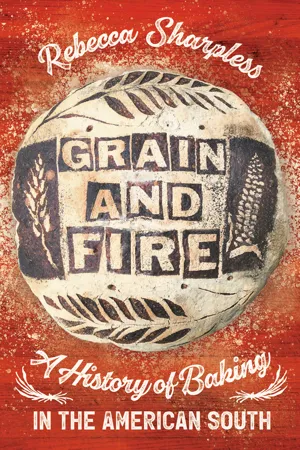
While a luscious layer cake may exemplify the towering glory of southern baking, like everything about the American South, baking is far more complicated than it seems. Rebecca Sharpless here weaves a brilliant chronicle, vast in perspective and entertaining in detail, revealing how three global food traditions—Indigenous American, European, and African—collided with and merged in the economies, cultures, and foodways of the South to create what we know as the southern baking tradition.
Recognizing that sentiments around southern baking run deep, Sharpless takes delight in deflating stereotypes as she delves into the surprising realities underlying the creation and consumption of baked goods. People who controlled the food supply in the South used baking to reinforce their power and make social distinctions. Who used white cornmeal and who used yellow, who put sugar in their cornbread and who did not had traditional meanings for southerners, as did the proportions of flour, fat, and liquid in biscuits. By the twentieth century, however, the popularity of convenience foods and mixes exploded in the region, as it did nationwide. Still, while some regional distinctions have waned, baking in the South continues to be a remarkable, and remarkably tasty, source of identity and entrepreneurship.
- 352 pages
- English
- ePUB (mobile friendly)
- Available on iOS & Android
eBook - ePub
About this book
Information
Topic
ArtSubtopic
North American HistoryNotes
Introduction
1. Cooper and Knotts, Resilience, 79.
2. Ferris, Edible South, 1.
3. Fuller and Gonzalez Carretero, “Archaeology of Neolithic Cooking Traditions,” 111.
4. Campbell, At the First Table, 15.
5. Carney and Rosomoff, Shadow of Slavery, 19, 31, 52, 57; La Fleur, Fusion Foodways, 55.
6. Benét, Western Star, 116.
7. Neal, Southern Cooking, 5.
Chapter 1
1. Stevens, “Story of Plants,” 206–7; Chapman and Shea, “Archaeobotanical Record,” 69.
2. Sassaman, “Multicultural Genesis,” 26; L. Thomas, “Gender Division of Labor,” 32.
3. Ruhl, “Spanish Mission Paleoethnobotany,” 566; Gremillion, “Human Ecology,” 24.
4. Le Page du Pratz, History of Louisiana, 213; Messner, Acorns and Bitter Roots, 14, 16.
5. Adair, History of the American Indians, 409; Bartram, Travels, 38; Messner, Acorns and Bitter Roots, 14.
6. Hamor, True Discourse, 23; Lawson, New Voyage, 99.
7. Messner, Acorns and Bitter Roots, 17–18.
8. J. Smith, Map of Virginia, 12; Hariot, Briefe and True Report, [31].
9. Bourne, Narratives of the Career of De Soto, 123.
10. J. Smith, “Description of Virginia,” 90. Pecans have thin shells that crack easily, so most of them were eaten raw rather than baked. McWilliams, Pecan, 8.
11. Scarry and Reitz, “Herbs, Fish, Scum, and Vermin,” 349–50; Ruhl, “Spanish Mission Paleoethnobotany,” 567; Milanich, “Life in a 9th Century Indian Household,” 34.
12. Messner, Acorns and Bitter Roots, 17.
13. J. Smith, “Description of Virginia,” 90.
14. Messner, Acorns and Bitter Roots, 16.
15. Milanich, “Life in a 9th Century Indian Household,” 34; Hann, “Use and Processing of Plants,” 94.
16. Laudan, Cuisine and Empire, 32.
17. J. Franklin, “Bedrock Mortar Hole Sites.”
18. Messner, Acorns and Bitter Roots, 66; Milanich, “Life in a 9th Century Indian Household,” 22.
19. Romans, Concise Natural History, 84; Stevens, “Story of Plants,” 197.
20. Stevens, “Story of Plants,” 197.
21. Strachey, Historie of Travell, 118; Romans, Concise Natural History, 84; Le Page du Pratz, History of Louisiana, 348–49.
22. Hann, “Use and Processing of Plants,” 92, 94; Fontaneda, Memoir, 15; Romans, Concise Natural History, 84; Strachey, Historie of Travell, 121.
23. Laudan, Cuisine and Empire, 30, 31, 35.
24. Hann, “Use and Processing of Plants,” 92; Messner, Acorns and Bitter Roots, 20.
25. J. Smith, Generall Historie of Virginia, 26.
26. Wright, “American Indian Corn Dishes,” 160.
27. Walls and Keith, “Cooking Connects Them.”
28. Marcoux, Cooking with Fire, 8, 10.
29. Balter, “Corn.”
30. Mann, 1491, 223.
31. Hardeman, Shucks, 6, 8; Kalm, Oxholm, and Chase, “Description of Maize,” 112; Weatherwax, Indian Corn, 86.
32. McCann, Maize and Grace, 5.
33. Milanich, Florida Indians, 23, 26; Milanich, “...
Table of contents
- Cover Page
- Title Page
- Copyright Page
- Dedication
- Contents
- Illustrations
- Introduction: The Meeting of Grain and Fire
- Acorn Bread
- Rosquetes de Azucar
- Plumb Cakes
- Hoecake
- Raison Cake
- White Mountain Cake
- Jelly Roll
- Chiffon Pie
- Pastel de Tres Leches
- Acknowledgments
- Notes
- Bibliography
- Index
Trusted by 375,005 students
Access to over 1.5 million titles for a fair monthly price.
Study more efficiently using our study tools.
Frequently asked questions
Yes, you can cancel anytime from the Subscription tab in your account settings on the Perlego website. Your subscription will stay active until the end of your current billing period. Learn how to cancel your subscription
No, books cannot be downloaded as external files, such as PDFs, for use outside of Perlego. However, you can download books within the Perlego app for offline reading on mobile or tablet. Learn how to download books offline
Perlego offers two plans: Essential and Complete
- Essential is ideal for learners and professionals who enjoy exploring a wide range of subjects. Access the Essential Library with 800,000+ trusted titles and best-sellers across business, personal growth, and the humanities. Includes unlimited reading time and Standard Read Aloud voice.
- Complete: Perfect for advanced learners and researchers needing full, unrestricted access. Unlock 1.5M+ books across hundreds of subjects, including academic and specialized titles. The Complete Plan also includes advanced features like Premium Read Aloud and Research Assistant.
We are an online textbook subscription service, where you can get access to an entire online library for less than the price of a single book per month. With over 1.5 million books across 990+ topics, we’ve got you covered! Learn about our mission
Look out for the read-aloud symbol on your next book to see if you can listen to it. The read-aloud tool reads text aloud for you, highlighting the text as it is being read. You can pause it, speed it up and slow it down. Learn more about Read Aloud
Yes! You can use the Perlego app on both iOS and Android devices to read anytime, anywhere — even offline. Perfect for commutes or when you’re on the go.
Please note we cannot support devices running on iOS 13 and Android 7 or earlier. Learn more about using the app
Please note we cannot support devices running on iOS 13 and Android 7 or earlier. Learn more about using the app
Yes, you can access Grain and Fire by Rebecca Sharpless in PDF and/or ePUB format, as well as other popular books in Art & North American History. We have over 1.5 million books available in our catalogue for you to explore.