The U.S.-Mexico border has earned an enduring reputation as a site of violence. During the past twenty years in particular, the drug wars—fueled by the international movement of narcotics and vast sums of money—have burned an abiding image of the border as a place of endemic danger into the consciousness of both countries. By the media, popular culture, and politicians, mayhem and brutality are often portrayed as the unavoidable birthright of this transnational space. Through multiple perspectives from both sides of the border, the collected essays in These Ragged Edges directly challenge that idea, arguing that rapidly changing conditions along the U.S.-Mexico border through the nineteenth, twentieth, and twenty-first centuries have powerfully shaped the ebb and flow of conflict within the region. By diving deeply into diverse types of violence, contributors dissect the roots and consequences of border violence across numerous eras, offering a transnational analysis of how and why violence has affected the lives of so many inhabitants on both sides of the border.
Contributors include Alberto Barrera-Enderle, Alice Baumgartner, Lance R. Blyth, Timothy Bowman, Elaine Carey, William D. Carrigan, José Carlos Cisneros Guzmán, Alejandra Díaz de León, Miguel Ángel González-Quiroga, Santiago Ivan Guerra, Gerardo Gurza-Lavalle, Sonia Hernández, Alan Knight, José Gabriel Martínez-Serna, Brandon Morgan, and Joaquín Rivaya-Martínez, Andrew J. Torget, and Clive Webb.
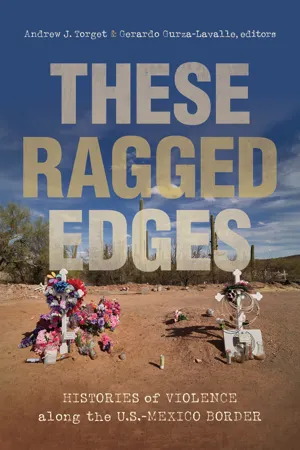
eBook - ePub
These Ragged Edges
Histories of Violence along the U.S.-Mexico Border
- 416 pages
- English
- ePUB (mobile friendly)
- Available on iOS & Android
eBook - ePub
These Ragged Edges
Histories of Violence along the U.S.-Mexico Border
About this book
Trusted by 375,005 students
Access to over 1.5 million titles for a fair monthly price.
Study more efficiently using our study tools.
Information
PART I Livestock, Markets, and Guns

Figure 1.1 “A Map of the Internal Provinces of New Spain” by Zebulon Pike, 1807. Courtesy of the U.S. Library of Congress.
Chapter 1 Smuggling and Violence in the Northern Borderlands of New Spain, 1810–1821
ALBERTO BARRERA-ENDERLE AND ANDREW J. TORGET
In early 1820, a Spanish military detachment arrested nineteen-year-old Cornelio Lozoya near the border between Texas and Louisiana, as Lozoya awaited the delivery of more than a hundred mules and horses that his patrón had bargained from nearby Comanches. Lozoya’s hazardous journey to that moment provides a revealing window into the violent realities of life along New Spain’s northeastern borderlands during the twilight of Spain’s presence in the region. Lozoya’s saga began in 1813, when, during the Mexican War for Independence, he had to flee his home in San Antonio to avoid being killed by the soldiers of José Joaquín de Arredondo. Arredondo had arrived in the region at the head of a nearly two-thousand-man-strong royalist army bent on destroying a rebellion that had burned through Texas as part of Mexico’s struggle for independence. After decimating a rebel army just south of San Antonio, Arredondo unleashed a merciless campaign of scorched-earth retribution against all Spaniards in the region suspected of supporting the rebels. Imprisoning hundreds of men, women, and children in San Antonio, Arredondo executed any Spaniards accused of disloyalty and seized their homes and property for the crown. He also sent his cavalry in pursuit of anyone who dared to run in an attempt to escape his wrath.1
Like hundreds of his neighbors, Lozoya suddenly found himself fleeing eastward along a barely visible road in a desperate bid to save his own life, until he finally crossed the international boundary into the United States, where he sought refuge in the state of Louisiana. Lozoya settled in the town of Natchitoches, where, to survive, he soon became the servant of a fellow Spanish refugee, Ignacio Góngora. Having lost nearly everything to Arredondo’s wrath, Góngora and Lozoya began supporting themselves by turning to smuggling. Illegally transporting horses and mules from Spanish Texas into the United States, they discovered, paid quite well. And so the two men began new lives centered on evading Spanish military authorities in Texas as they traveled in secret across the border in order to trade U.S.-made goods to Indian nations in New Spain for horses and mules, which they then smuggled back into the United States to be sold to merchants in Louisiana. It was a highly risky operation, one that depended on evading the Spanish military and constantly risked attack by other Indians or rogue bands of fellow smugglers. After several lucky years, Lozoya was finally discovered and arrested by Spanish authorities. He stood accused of trespassing the border illegally and trading with Comanches and other independent Indian nations in contravention of royal decrees.2
Although records of Lozoya’s ultimate fate have been lost, his experiences shine a light on the devastating violence that overtook Spain’s northeastern borderlands during the last decade of Spain’s rule in the region and how that devastation, in turn, fostered increased smuggling along the U.S.-Spanish border. Even before Arredondo arrived with his army, Spanish settlements in the region had long endured isolation from the rest of New Spain that made the marginalized and economically underdeveloped territory a haven for such illegal commerce. Yet the violence of the Mexican War of Independence and the simultaneous rapid growth of markets in neighboring Louisiana combined to greatly expand both smuggling and violence in the northern borderlands of New Spain. As Lozoya and so many of his fellow Spaniards experienced, the widespread violence of the 1810s that made him a refugee also put him into such dire economic circumstances that smuggling became deeply attractive. In order to understand the interconnected nature of violence and smuggling in the region, we need to understand the peculiar historic configuration of the northern frontier of New Spain and the role that it played within the broader economic system of the Spanish empire.
“Settling” the Northeastern Frontier of New Spain
For the whole of its existence, the northeastern frontier of New Spain was a remote territory that maintained weak ties to the political center of the viceroyalty in Mexico City. Although Spanish authorities had claimed sovereignty over that vast frontier region since the late sixteenth century, in practice the territory remained largely Indian country and a place where violent conflicts between Spaniards and independent Indians defined the daily existence of Spanish settlements in the region.
When Spain began venturing into these far-northern territories, it was largely to support and protect its ongoing—and highly profitable—mining operations in central Mexico. The colonization of what would become the territories of Coahuila and Nuevo León, for example, was the result of Spaniards moving northward at the end of the sixteenth century in search of lands and Indians needed to meet the rising demands for both materiel and labor in the more-southernly mining regions of Zacatecas and surrounding areas. The colonization of Texas and Tamaulipas (then known as Nuevo Santander) began later, during the eighteenth century, but was also an effort to defend these same interests of central New Spain, in this case by creating a distant buffer that would prevent the French or English from establishing a presence too close to the wealth coming out of colonial Mexico (which, Spanish officials feared, foreign powers might use to raid silver shipments or even attack the mines themselves). Populating Texas and Tamaulipas, then, would serve the same purpose for Spain as colonizing Coahuila and Nuevo León: they were all meant to support the mineral wealth coming out of colonial Mexico that enriched the Spanish Crown.3
Yet these settlements never prospered as Spanish authorities had hoped. The general lack of mineral wealth in New Spain’s far north made the region an unattractive territory for Spanish settlers, leaving those settlements perpetually underpopulated.4 The anemic Spanish population in the region, in turn, left those same settlements perpetually vulnerable to raids and violent resistance by the independent Indian nations who controlled most of the territory and found they could easily raid these distant Spanish outposts. Bloody clashes between Spaniards and Indians became painfully commonplace along this northern frontier, preventing the Spanish monarchy from consolidating its authority over the vast territory. Missions established in the region failed to transform local Indians into stalwart Spanish allies, and forts erected in the territory remained perennially undermanned. The colonization of northern New Spain was shaped, then, by both the geographical conditions of the territory and the fierce and violent resistance of the seminomadic Indians who inhabited it. The far-northern frontier, therefore, was not a region forged by Spanish power but was instead the product of complex and often violent encounters between Spaniards and various Indians in the region.5
By the end of the eighteenth century, Spanish authorities had resorted to making regular offers of gifts—tribute, really—to the territory’s more powerful Indian nations in exchange for promises of peace for Spanish settlements. The strategy worked for a short time as Spanish authorities achieved a precarious peace in the region at the dawn of the nineteenth century. The change in tactics also represented a strategic shift in the political agenda of Spain, as the empire moved away from exploring new territories in order to focus more energy on consolidating and protecting its northern border against both Indian raids and threats from encroaching foreign powers.6
Yet the success of the tribute strategy proved to be short-lived as the fragile peace it bought began to unravel during the early nineteenth century under the pressure of two events. First, Spain’s sale of Louisiana to the United States in 1803 meant that gifts used to pacify Indian tribes now had to be hauled overland from the much more distant—and therefore unreliable—Mexico City rather than be imported from nearby New Orleans, a shift that produced major disruptions in the flow of tribute goods to local Indians that had briefly bought peace. Second, the outbreak of the Mexican War for Independence in 1810 further exacerbated this problem when insurgents cut off roads, and therefore commercial connections, between New Spain’s northern frontier and the central provinces from which these goods were now shipped.7 The outbreak of the war, moreover, forced viceregal authorities in Mexico City to focus their attention on pacifying the insurgency rather than on attempts to continue pacifying the northern frontier, and so almost no sustained effort was made to restore shipments of tribute goods to the far-northern frontier.
The Louisiana Purchase also cut off the Spaniards who lived in northeastern New Spain from access to the New Orleans markets, with painful consequences. The Spanish frontier had always played a supportive role within the colonial economic system of New Spain and the few Spanish settlers who lived in the northern provinces supported themselves largely by exporting various products (such as lead, tallow, wheat, wool, salt, and livestock) that could sustain more profitable regions of the empire. Raising livestock was perhaps the economic activity that most closely tied the northeast with the rest of New Spain.8 Yet no local industry, not even livestock, proved very profitable, in large measure because severe geographical isolation made it almost impossible for any local industry to develop. Being so dist...
Table of contents
- Cover
- Series Page
- Title Page
- Copyright
- Dedication
- Contents
- List of Figures, Graphs, Map, and Tables
- Acknowledgments
- Introduction
- Part I: Livestock, Markets, and Guns
- Part II: State Power in Transition
- Part III: Violence at the Turn of the Century
- Part IV: Drugs and Migrants
- Contributors
- Index
Frequently asked questions
Yes, you can cancel anytime from the Subscription tab in your account settings on the Perlego website. Your subscription will stay active until the end of your current billing period. Learn how to cancel your subscription
No, books cannot be downloaded as external files, such as PDFs, for use outside of Perlego. However, you can download books within the Perlego app for offline reading on mobile or tablet. Learn how to download books offline
Perlego offers two plans: Essential and Complete
- Essential is ideal for learners and professionals who enjoy exploring a wide range of subjects. Access the Essential Library with 800,000+ trusted titles and best-sellers across business, personal growth, and the humanities. Includes unlimited reading time and Standard Read Aloud voice.
- Complete: Perfect for advanced learners and researchers needing full, unrestricted access. Unlock 1.5M+ books across hundreds of subjects, including academic and specialized titles. The Complete Plan also includes advanced features like Premium Read Aloud and Research Assistant.
We are an online textbook subscription service, where you can get access to an entire online library for less than the price of a single book per month. With over 1.5 million books across 990+ topics, we’ve got you covered! Learn about our mission
Look out for the read-aloud symbol on your next book to see if you can listen to it. The read-aloud tool reads text aloud for you, highlighting the text as it is being read. You can pause it, speed it up and slow it down. Learn more about Read Aloud
Yes! You can use the Perlego app on both iOS and Android devices to read anytime, anywhere — even offline. Perfect for commutes or when you’re on the go.
Please note we cannot support devices running on iOS 13 and Android 7 or earlier. Learn more about using the app
Please note we cannot support devices running on iOS 13 and Android 7 or earlier. Learn more about using the app
Yes, you can access These Ragged Edges by Andrew J. Torget, Gerardo Gurza-Lavalle, Andrew J. Torget,Gerardo Gurza-Lavalle in PDF and/or ePUB format, as well as other popular books in History & Mexican History. We have over 1.5 million books available in our catalogue for you to explore.