- 206 pages
- English
- ePUB (mobile friendly)
- Available on iOS & Android
eBook - ePub
About this book
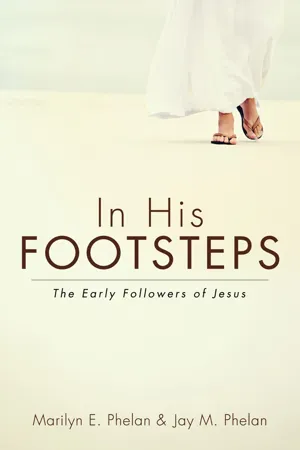
From the lengthy research and pen of two lawyers, a judge and a former law professor, this book, In His Footsteps: The Early Followers of Jesus, is a guide to understanding the early Christian movement through a study of the lives and ministries of the first believers, most of whom had met with the risen Jesus and thus knew, without doubt, that Jesus was the Christ and Savior of the world. The book cites accounts from Eusebius, a third-century Greek Christian historian, who also referenced testimony from first-century Christians about the almost unbelievable courage of the early followers of Jesus, who willingly and fearlessly, despite tremendous persecution and sufferings, brought to an otherwise lost world an assurance of life eternal for all believers. The book also refers to the fulfillment of many of the biblical prophecies, the principal ones being the restoration of the nation of Israel and the return of many Jewish people to their homeland. This book is an indispensable resource for all persons, as the tremendous sacrifices of the first believers should never be forgotten.
Trusted by 375,005 students
Access to over 1.5 million titles for a fair monthly price.
Study more efficiently using our study tools.
Information
Topic
Theology & ReligionSubtopic
Christian Theology1
The Plan of Redemption and the Message of Salvation Jesus’ First Followers Brought to the World
I. Introduction
II. Review of Jewish History as a Prelude to the Coming of the Messiah
A. Establishment of the Israelite Nation with the Twelve Israelite Tribes
1. The Northern Kingdom, the Kingdom of Israel
2. The Southern Kingdom, the Kingdom of Judah
B. Fulfilment of Prophecies
1. Prophecy of the Survival of a Remnant of the Southern Kingdom
2. Prophecy of the Coming of John the Baptist
3. Prophecy of Jesus’s Coming and Important Details of His Ministry
a. The Message of Salvation
b. The Twelve Disciples and Seventy Others
c. The Crucifixion
d. Jesus’s Burial and the Role of Joseph of Arimathea
e. Jesus’s Resurrection and Ascension and the Coming of the Holy Spirit
f. The Great Commission
g. The Reason for Twelve Disciples
4. Fulfillment of Jewish Feasts
a. Passover Feast
b. Feast of Unleavened Bread
c. Feast of Firstfruits
d. Feast of Pentecost
III. The Early Church
A. Jews of the Dispersion and Growth of the Church
B. Stephen, a First Deacon and the First Martyr
C. Spread of the Gospel to the World
I. Introduction
In reviewing the lives and ministries of the early followers of Jesus, this first chapter initially reviews scriptural prophecies and some history of the Jewish people to provide the reader with a better understanding of the faith of the early Christian patriarchs who completely changed the world with their unwavering faith in Jesus as the Savior of the world and their obedience to Jesus’ command to bring His message of salvation to the world. These first Christians knew, without doubt, that Jesus is the Christ, the Messiah; most had met personally with the resurrected Jesus, and many had witnessed Jesus’ ascension into heaven. The first believers received the blessing of the Holy Spirit ten days after Jesus’ ascension, and with the help of the Holy Spirit, were able to face the tremendous persecution and horrible deaths that were inevitable consequences of their undying devotion and service to their Lord. This first chapter provides some background in, and knowledge of, the scriptural prophecies and important events in Jewish history that precluded, and culminated in, the coming of Jesus as the Messiah and in the later creation of the early church; thus, the first part of this chapter serves as a prelude to a study of the lives and ministries of the earliest followers of Jesus who were motivated by these prophecies and their Jewish history. The chapter briefly critiques the marvelous sacrifice of our Lord who came to seek and to save the lost and to whom the first believers owed their eternal allegiance.
References to critical Scriptural prophecies that foretold God’s plan of redemption and its consummation with the birth and death of the Lord Jesus and a brief review of important events in Jewish history provide the reader with direction in studying the remaining chapters. The earliest followers of Jesus referred to prophecies from the scriptures to prove to those who had not met personally with the resurrected Jesus that He indeed is the Messiah and is one with God. It is helpful for the reader also to consider these important prophecies and to examine other critical events in Jewish history, such as the establishment of the twelve Israelite tribes and the seven Hebrew feasts, which God commanded His people to celebrate in order to meet with Him in a special manner at appointed times. A knowledge of these relevant events in the history of the Israelite people, and the Jewish practices that were based on these events, affected the ministries of the early believers and will provide guidance to the reader in studying the unwavering faith of the first followers of Jesus. This first chapter should provide the reader with a better understanding of the motivation of these early patriarchs and the substance and depth of their faith. Additionally, a study of the prophecies confirms that the Bible is the inspired word of God and the roadmap to salvation.
Except for a few Gentile first believers, such as Luke and Titus, the early followers of Jesus were, like Jesus, devout Jews. As God-fearing Jews, they read and studied the Scriptures; they were familiar with the Law of Moses as well as the scriptural prophecies. In testifying of the risen Lord, they proved to the multitude to whom they witnessed that Jesus’ coming was the fulfillment of the Law and the Prophets. In summarizing impor...
Table of contents
- 00.FrontMatter
- 01.Chapters
- 02.Bibliography
Frequently asked questions
Yes, you can cancel anytime from the Subscription tab in your account settings on the Perlego website. Your subscription will stay active until the end of your current billing period. Learn how to cancel your subscription
No, books cannot be downloaded as external files, such as PDFs, for use outside of Perlego. However, you can download books within the Perlego app for offline reading on mobile or tablet. Learn how to download books offline
We are an online textbook subscription service, where you can get access to an entire online library for less than the price of a single book per month. With over 1.5 million books across 990+ topics, we’ve got you covered! Learn about our mission
Look out for the read-aloud symbol on your next book to see if you can listen to it. The read-aloud tool reads text aloud for you, highlighting the text as it is being read. You can pause it, speed it up and slow it down. Learn more about Read Aloud
Yes! You can use the Perlego app on both iOS and Android devices to read anytime, anywhere — even offline. Perfect for commutes or when you’re on the go.
Please note we cannot support devices running on iOS 13 and Android 7 or earlier. Learn more about using the app
Please note we cannot support devices running on iOS 13 and Android 7 or earlier. Learn more about using the app
Yes, you can access In His Footsteps by Marilyn E. Phelan,Jay M. Phelan in PDF and/or ePUB format, as well as other popular books in Theology & Religion & Christian Theology. We have over 1.5 million books available in our catalogue for you to explore.