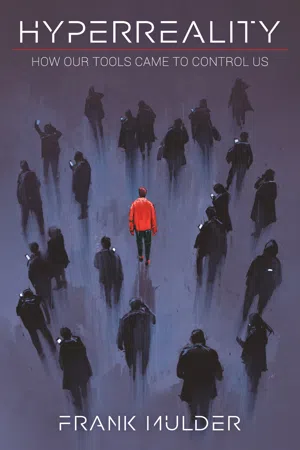
What is the similarity between battery chicken, iris scans, Facebook friends, and porn videos? They are all features of a technical system built to satisfy our desires and to suppress our fears. It is a so-called hyperreality, an improved version of natural reality, promising wealth, security, and belonging.However, behind the shiny appearance we can detect a few dangerous mechanisms. Increasingly our tools are controlling us, instead of the other way around, and we are steadily rebuilding the world into a machine with laws we are unable to change.What are the risks of this machine? How can we discern the illusions of hyperreality? With insights derived from Rene Girard and Jacques Ellul, among others, this book calls for a joyful spiritual life, in the midst of stubborn reality.
- 144 pages
- English
- ePUB (mobile friendly)
- Available on iOS & Android
eBook - ePub
About this book
Trusted by 375,005 students
Access to over 1.5 million titles for a fair monthly price.
Study more efficiently using our study tools.
Information
I
THE PROMISES OF HYPERREALITY
1
Hyperreality
How an increasing part of our lives is lived in an artificial reality designed to make us feel satisfied and comfortable.
Diagonally behind the bus driver, whom I passed with no more than an annoying beep from the scanner, a middle-aged woman is sitting, candy crushing on her phone. The driver looks bored, the radio is playing softly. He is driving a fixed route, hour after hour, with a small screen displaying the next stop and the correct arrival time, while the speaker emits an automatic female voice exactly informing the passengers about the next stop. The driver does not even glance at the incoming passengers, nor do they glance at him. They keep their eyes on the pass scanner next to him, which calculates to the cent how much must be subtracted from their account. While inserting my earphones to descend into my musical cocoon, I wonder if anyone would notice if one day the driver himself was replaced by a computer.
Technology has become our environment, our habitat. Often we do not realize how radically we are mechanizing our natural and social surroundings. In the cocoon of the music player on the bus, or in the cocoon of our acclimatized car, we travel to our work or our place of education, where we work under fluorescent light behind a screen and drink instant coffee not made by a coffee lady, but by a machine. With our eyes focused on the latest messages on our phone we walk through the shopping mall, with synthetic clothes being recommended by electronic beats and mannequins in shiny showrooms.
Our environment would be completely unrecognizable to our ancestors. Nature has been driven back. Sometimes, when the sky is clear, I take a few steps out of my door, out of a kind of ancient instinct to catch a glimpse of the Milky Way, but the only thing I see is the permanent twilight of the urban night glare. (When an earthquake knocked out the power supply in Los Angeles, in 1994, police got numerous phone calls from citizens worried about a “giant silvery cloud” over the city, which appeared to be the Milky Way.) I live by a square in a post-war neighborhood built from concrete. There is so much asphalt and stone, that even the birds keep their beaks shut. If I tell people about this, usually they look upon me with pity. But it is quite something that we have created neighborhoods where you do not see any stars twinkle or hear any bird whistle. The only thing that comes close is the soft whistle of an incoming text message.
The first time that this really struck me was when I returned from a poor country and set my feet on “developed” ground for the first time. As I was gliding on the long moving walkway at the airport, I was surrounded by walls, floors, gates and showrooms made of plastic, plate glass, aluminum and steel. Everything was artificial, everything was polished and smooth, everything smelled sterile. I had just come from a country where everything was crude. The streets stank, there was dust and dung everywhere, and the houses were made from stone or pieces of wood. In the market, there were carrots, onions, fruit, bags of flour and chunks of meat. In the supermarket here, you can find, in shining white shops with perfect lighting, twenty-three varieties of potato chip in carefully designed packages, on carefully filled shelves, consisting not only of potato and oil but also of ten other ingredients, mainly artificial. Of course, there are also carrots, but they are already cleaned, scraped, cut into pieces and prepackaged in cellophane.
This obviously colors our view of reality. To stay with these carrots for a while: when you always buy your food in the supermarket, you unconsciously start to think that all carrots are the same size and come out of the earth clean. That is why some people are disappointed when they see what kind of muddy, curved carrots I harvest in my vegetable garden. Maybe I would rather have the normal carrots, they then say. Those from the supermarket, the prepackaged ones; those are nice.1
This small example alone shows that technology does more than take over annoying tasks, like making coffee or washing clothes. Technology becomes our environment. It is the water we drink and the air we breathe. The devices create a world in which we can immerse ourselves, where we find our knowledge and shape our relationships, by watching the news, sharing family pictures on Facebook and WhatsApping with friends. For a recipe, we ask Google, and if we want to know how the economy is doing, we watch a talk show where economists play with growth figures produced by their computer programs. If our children are tired, we give them a screen showing movies suggested to them by an algorithm in a data center somewhere far off, and if we enter the bus, we pay with a device that is connected to a central computer that keeps track of where we check in and out.
This technical space becomes larger, deeper and more intense, and increasingly influences our lives. With our smartphone, we can communicate permanently with many people at the same time, and if we install the right apps, also with our thermostat, the lamps, and the baby monitor in the children’s room. For many adults this is still optional, an add-on to their normal lives, but there is a new generation growing up for whom the cloud is what used to be the school hall. For a big part of the day, students are permanently living in a virtual reality. As soon as they wake up, they plug in into a conversation that has already started and that continues until deep into the night, sometimes in the form of an actual conversation but often also in the form of a game. It has become a virtual reality that forms a new layer on top of the tangible reality. That is why education reformers are trying to move more and more lessons to this new virtual space. According to my twelve-year-old son he hardly talks to his classmates during lunch breaks, since they turn on their phones as soon as they get the chance. When I asked him about this, he asked: “Why, what else can you do during the break?” “The same as what boys have done in the past few thousand years. Play cards. Play football. Or talk.” He looked as if he couldn’t imagine anything more stupid.
We often tend to think that this virtual space is fake, but that is not true. It is a real space that exists, where we relate and communicate. However, it is a space where we are separated from our immediate surroundings by screens. In a way we become detached people. Life in the technical biotope makes our relationship with natural reality lighter. We become increasingly distanced from the ground, the earth and the nature on which our whole economy is based. Our relationship with other people also becomes less tangible or physical, and more digital.
I am writing this chapter at a table in a nice coffeehouse. At the table next to me, a sixteen-year old girl is seated, together with her parents. They have not spoken to each other for the last fifteen minutes. The girl is bent over her tablet. She is finding herself in a space different from her father, who is playing with his mobile phone and might be checking the latest news, the weather forecast or his Angry Birds app. It is a space that is made from images. The mother looks out of the window, bored. It does not seem they are having a good time together. It does not seem they are even having a together. They are together with others, in a space that you cannot feel when you are not logged in.
* * *
In the seventies, the French philosopher Jean Baudrillard coined the word hyperreality.2 It literally means over-reality. Hyperreality is a constructed world, a world made as a simulation and an improvement of natural reality. It is not a fake reality. On the contrary, it is hyper—more real than reality, in the sense that our senses experience much more.3
Baudrillard did not know Instagram or Google, but he already recognized that modern society had become an image society. He saw that we are no longer people of words and stories, but of images, design, photographs and movies. We have professors in universities researching what designs or fonts or images best convey a message to us in a leaflet or a website, and that is why we are continuously bombarded by beautiful, well-constructed images. An image is something artificial; that is to say, made by people. That does not mean that it cannot refer to a real object. An attractive Photoshopped picture of a cup of coffee on a billboard refers to real coffee, the bittersweet taste of which you can feel in your throat.
Yet in our society the image has slowly gotten its own life, says Baudrillard. The real object to which an image refers is growing increasingly distant from the original. The Balinese beach on the website is whiter than the original beach in Bali, and the poor fishermen in their torn pants are edited out. That might seem like trickery, but that is not entirely true, because in the meantime they have constructed resorts that try to mimic the website and planted palm trees on a white beach, to create the perfect tropical experience. (Believe it or not, but I have been to such a resort. I did not see any Balinese there, of course. I met some, further down the beach, fishing between the rocks, one of whom even took me on the back of his scooter to show me his hut and give me some rice served on a banana leaf. I can imagine that nowadays the resort has built a few of these huts, to give all tourists the possibility of such an authentic experience, with guides wearing traditional clothes of course, and with precooked rice so nobody gets diarrhea, which I could not avoid back then, unfortunately.)
On the coffee billboard, meanwhile, we do not even see a cup of coffee anymore, only a nicely coiffed, nonchalant, and somewhat sarcastic-looking George Clooney. He still seems to drink coffee, but that is not essential. What the image refers to is more of a certain tasteful, self-conscious manliness than the liquid that we are to pour into our throats. Interestingly, the company that uses this advertisement does not really care whether this liquid is even coffee. Much more important is the sale of expensive cups and interesting flavors for people who find it important to have a streamlined kitchen and a shiny, aerodynamic coffee machine because they are tasteful, self-conscious people. That Clooney himself tells people that he does not even like coffee just adds to his aura of coolness.4
Advertising, of course, is just one example of a whole world of images that we have created that we call media. We tend to think that this media is a certain lens through which we see reality, but according to most philosophers, that is not the case. Media—literal...
Table of contents
- Title Page
- Preface
- I: THE PROMISES OF HYPERREALITY
- II: THE MACHINE
- III: DAZZLING FREEDOM
- Epilogue: Theology and Hope
- Bibliography
Frequently asked questions
Yes, you can cancel anytime from the Subscription tab in your account settings on the Perlego website. Your subscription will stay active until the end of your current billing period. Learn how to cancel your subscription
No, books cannot be downloaded as external files, such as PDFs, for use outside of Perlego. However, you can download books within the Perlego app for offline reading on mobile or tablet. Learn how to download books offline
Perlego offers two plans: Essential and Complete
- Essential is ideal for learners and professionals who enjoy exploring a wide range of subjects. Access the Essential Library with 800,000+ trusted titles and best-sellers across business, personal growth, and the humanities. Includes unlimited reading time and Standard Read Aloud voice.
- Complete: Perfect for advanced learners and researchers needing full, unrestricted access. Unlock 1.5M+ books across hundreds of subjects, including academic and specialized titles. The Complete Plan also includes advanced features like Premium Read Aloud and Research Assistant.
We are an online textbook subscription service, where you can get access to an entire online library for less than the price of a single book per month. With over 1.5 million books across 990+ topics, we’ve got you covered! Learn about our mission
Look out for the read-aloud symbol on your next book to see if you can listen to it. The read-aloud tool reads text aloud for you, highlighting the text as it is being read. You can pause it, speed it up and slow it down. Learn more about Read Aloud
Yes! You can use the Perlego app on both iOS and Android devices to read anytime, anywhere — even offline. Perfect for commutes or when you’re on the go.
Please note we cannot support devices running on iOS 13 and Android 7 or earlier. Learn more about using the app
Please note we cannot support devices running on iOS 13 and Android 7 or earlier. Learn more about using the app
Yes, you can access Hyperreality by Frank Mulder in PDF and/or ePUB format, as well as other popular books in Computer Science & Information Technology. We have over 1.5 million books available in our catalogue for you to explore.