eBook - ePub
Global Game Change
How the Global Southern Belt will reshape our world
- English
- ePUB (mobile friendly)
- Available on iOS & Android
eBook - ePub
Trusted by 375,005 students
Access to over 1.5 million titles for a fair monthly price.
Study more efficiently using our study tools.
Information
Topic
Negocios y empresaSubtopic
Emprendimiento
Megatrends, published in 1982 ended: “My God, what a great time to be alive!”
One of the megatrends described was the shift from North to South in the United States, foreshadowing today’s global North-South shift. It said that “although the North South shift sounds like an either or choice, it is not.” It was not in the 1980s, nor is it now in its new global context. The global game change is a great opening up of the whole world, with nations in both hemispheres having unprecedented opportunities for renewal and growth.
To the nations of the Global Southern Belt it is like lifting a curtain revealing a new picture of the global community and their place in it. Many countries are feeling an awakening of self-confidence and trust in their potential. The nations of the Global Northern Belt, where most countries of the West are located, are beginning to anticipate a shift in the economic importance of the South as new opportunities for their faltering futures. Economically and culturally it can be enrichment for all. Again, what a great time to be alive!
The transition we describe will not happen without bumps on the path and nor will it happen overnight. The time frame in which we will be witnesses and actors in the global game change and the transformation from a western centric to a multicentric world will be the first half of the twenty-first century. As in any major transitions, this shift will come with the need to correct and adapt to changing conditions – often changing our mindset will trail behind events. Let us not underestimate how dramatic the change is. The United States has been the world’s largest economy since the 1880’s. Along with its Western partners, America has dominated the world economy during our lifetimes. Western culture celebrated a victorious procession into all continents with Western lifestyle, Western business practices, Western clothes and Western food. The West represents only seventeen percent of the world’s population but it holds about seventy-five percent of the world’s wealth.
The West without question has been the global helmsman. This era is coming to an end
In the coming decades the way we look at the world will change significantly. It will no longer be “the West and the rest.” The world will be watching the rise of the Global Southern Belt. Emerging nations of the GSB will not be under the dominance of the West. They are increasingly aware of their own potential and they are getting aligned to make the most of it. The most dynamic, most influential nation in the Global Southern Belt will of course be China, but it is none the less only one country in the three continents.
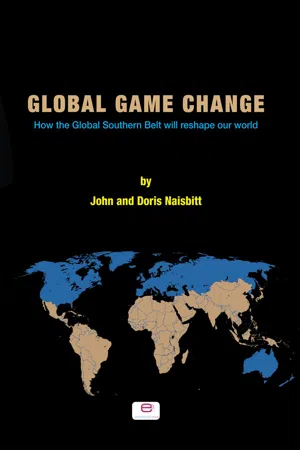
The Global Sothern Belt

The GBS encompasses Latin America, Africa and Asia.
For the West to let go of a western centric worldview will be a highly emotional process. Emotion does not like to listen to reason. The connection between heart and brain is blocked. There is widespread denial about even the possibility of a multicentric twenty-first century and the rise of the Global Southern Belt.
We are of course also not immune to Westerncentric thinking. That’s the spirit in which we grew up. But we cannot have both, a Western centric and a multi centric worldview. To let go of the Westerncentric worldview demands a farewell to the Western position of moral and economic superiority. And holding on to the claim is becoming difficult, as more and more cracks have become visible. Whether we look at annual growth rates, stagnation of per capita incomes, high unemployment, declining middle class, rising inequality or an unemployment rate of up to 50 percent among the youth in Spain, Portugal, Greece, and mounting public debts. The West is facing difficult times.
Is there even a path to “Dystopia” as Stephen D. King warns? Or is the West entering “a great degeneration,” as Niall Ferguson puts it? Is Europe facing “the end of the European dream and the decline of a continent” as Walter Laqueur fears? Or are we actors and witnesses in a great opening up, the rise of emerging nations of the Global Southern Belt and a multi centric world from which all nations can benefit?
The Global Southern Belt will shape the twenty-first century
Our thoughts about the rise of the Global Southern Belt have not evolved one rainy morning when we had nothing to do but think about what we could think about. It started slowly and has grown over years as we experienced the changing mood in countries we visited, the rising self-confidence of many leaders we have met with, their growing optimism despite current problems, increasing nationalism, slow decline of admiration for the West and pride about their own achievements as emerging economies. An entrepreneurial spirit is awakening with a growing confidence in shaping their own future.
This change has different faces, often small details that in the context of the bigger picture gain weight: The start of private home restaurants in Cuba, the strike of hotel employees in Cambodia over the percentage of tips added to bills, the self-organizing entrepreneurial structures in Brazilian slums, the growing art scene in Bogotá, the new entrepreneurial spirit in South Africa, Chinese farmers creating their own private vocational training, high school students in remote places interviewing us in very good English. Our personal experience is the background against which we measure what we read in international sources available in German and English books, newspapers, magazines, websites publications and data of private and public research firms, global institutions and organizations.
In the 2011 World Bank report “Multipolarity: The New Global Economy,” for example we read: “At no time in modern history have so many developing countries been at the forefront of a multipolar economic system. Within the next two decades the rise of emerging economies will inevitably have major implications for the global and geopolitical landscape.”
It was after all Megatrends Asia that brought us together as an author and publisher team. It was the beginning of our monitoring the shift from Western established economies to emerging economies first in Asia, and since the turn of the century in Latin America and Africa – we have watched it gain momentum ever since. During the same period the West began to slow down and to lose ground, and has continued its economic decline. These shifts and the great opening up of the Global Southern Belt will be the story of the first half of the twenty-first century.
Arvind Subramanian, senior fellow of the Peterson Institutes goes so far as to call our era “The golden Age of global growth.” He is convinced that “the golden age of global economic growth, which began in mid-to-late 1990’s, has mostly survived” and “continues to be the best of economic times.”
Already a brief overview of the economies of the Global Southern Belt gives us a sense of the global game change to a new era of economic shifts, social transformations and a changing competitive picture.
The long-term dependence of emerging economies on developed economies will increasingly shift to mutual support among developing countries with declining influence of the West
In this new picture of a multi centric world, China without doubt leads the parade. The West grudgingly registers China’s gaining influence in both Western and emerging markets. In only three decades it has become the world’s second largest economy, the biggest manufacturer in the world and the biggest global trader and soon the biggest consumer market. China has become the largest trading partner of many Asian, African and Latin American countries as well as many Western countries.
During the next five years China will account for nearly five percent of the increase in emerging economies wealth (Credit Suisse Global Wealth report 2013). Urbanization and the strategic planning of urban economic clusters have supported its growth. Many Chinese cities have higher GDPs than some countries in the world.
A World Bank report issued two years ago said that by 2025, a multipolar world will emerge in which economic clout is spread across developed and emerging economies. “Transition to a new world order with more diffuse distribution of economic power is under way,” led by three major economic trends:
1. The shift in balance of global growth from developed to emerging economies.
2. The rise of emerging market firms as a force in global business.
3. The evolution of the international monetary system to a multicurrency regime.
In the wake of China’s drumbeat, more and more GSB nations are joining the parade
It does not matter with whom we talk in China, whether they love or hate their government, all are united in the love for their motherland. But that will not result in China returning to the sinocentric world view it held up to the end of the eighteenth century, when it saw itself as the cultural center of the world. Official China even plays down its incremental influence as an economic success model for emerging economies struggling to follow its path. China represents a multicentric worldview with its own interests as the initial and endpoint of political and economic considerations in which the West continues to play an important role, but not the dominant role. Without the claim to be pulling the strings for other countries China does rightly claim to be a central player in the transformation to a multicentric global landscape.
When John traveled through China in the 1980’s, he would never take a Chinese Airline but fly from one city to another via Hong Kong. Now we see all the new airports, bullet trains and superhighways, not only allowing traveling with great comfort, but also clearing the way for industries to invest. In most Western countries individual rights often collide with investments in the public interest. Emerging markets starting from a low point of democratization and economic development can often operate more efficiently. As long as the promise of economic growth is credible, people hungry for a better life will accept and adapt to necessary changes.
To understand transition processes in emerging economies, the West has to subdue Western thinking and empathize with local conditions and culture. It is not by chance coincidence that China brought forth Peking Opera and Argentina the Tango.
The role of digitalization
As part of a generation that grew up without Internet and only conventional fixed line phones we are very much aware of how the web has opened doors to the world for billions. Especially for the poor and rural population of emerging economies it was a life changer. Digitalization is changing the macro and micro-economics globally. The Internet has already played a big role in accelerating and reinforcing the calls for reform and repair in emerging economies. The rise of China and of IT technologies went hand in hand. It is a powerful medium for economic progress and it increases and enforces transparency. Governments in the Global Southern Belt are increasingly using the Internet as a communication tool; electronic governing is connecting citizens with public services, so that this service can become more efficient.
Government Internet service is becoming a tool in creating a nourishing environment for entrepreneurs. But it will take efforts to cut down on old bureaucratic structures and transform clumsy administration into swiftly operating public services.
It will most likely be the small and middle size companies, which will be faster in applying the next stage of technology. After all, not a single one of the global social networks was created by the innovation center of a large company, but by young and creative students.
Nevertheless, established Internet technologies are opening new doors for small and middle size companies as well as creating a new group of entrepreneurs, the micro-globals. Individuals are able to leverage their better knowledge of local conditions in their collaboration with other entrepreneurs globally. John first wrote about this in 1994 in his book, Global Paradox: The Bigger the World Economy, the More Powerful the Smallest Players.
Looking back in history the first industrial revolution in the 1880’s had profound social economic influence. Mechanical production supported by steam-power transformed economies and raised GDP per capita per year from $694 to $ 2,753 in the second stage of the industrial revolution. In the third stage at the beginning decade of the twentieth century it was mass production by means of electric energy that lifted productivity dramatically. GDP per capita per year made a large jump from $2,753 to $20,042. Now we are about to face the fourth stage: production based on cyber-physical systems. The prognosis is that this industry 4.0, as it is called, will push GDP per capita to the astonishing height of $90,000 by 2020 (Data DB Research/Der Spiegel 2014).
In the summer of 2012 we gave a talk at a conference in Hangzhou. The days in Hangzhou did not only stay in our memory because of the beauty of the city and the fabulous Chinese food, but also for a visit we paid to an automobile rim factory. The company’s chief engineer was a young man in his late twenties. He had developed an automatic production line, w...
Table of contents
- Cover
- Title
- Copyright
- Table of contents
- Prologue
- Chapter 1: The Global Southern Belt
- Chapter 2: Africa-Asia-Latin America: New economic alliances and international organization alternatives
- Chapter 3: China: The Game Changer
- Chapter 4: Governance: Performing under changing conditions
- Chapter 5: Cities: The global game makers
- Epilogue
- Appendix China
Frequently asked questions
Yes, you can cancel anytime from the Subscription tab in your account settings on the Perlego website. Your subscription will stay active until the end of your current billing period. Learn how to cancel your subscription
No, books cannot be downloaded as external files, such as PDFs, for use outside of Perlego. However, you can download books within the Perlego app for offline reading on mobile or tablet. Learn how to download books offline
Perlego offers two plans: Essential and Complete
- Essential is ideal for learners and professionals who enjoy exploring a wide range of subjects. Access the Essential Library with 800,000+ trusted titles and best-sellers across business, personal growth, and the humanities. Includes unlimited reading time and Standard Read Aloud voice.
- Complete: Perfect for advanced learners and researchers needing full, unrestricted access. Unlock 1.5M+ books across hundreds of subjects, including academic and specialized titles. The Complete Plan also includes advanced features like Premium Read Aloud and Research Assistant.
We are an online textbook subscription service, where you can get access to an entire online library for less than the price of a single book per month. With over 1.5 million books across 990+ topics, we’ve got you covered! Learn about our mission
Look out for the read-aloud symbol on your next book to see if you can listen to it. The read-aloud tool reads text aloud for you, highlighting the text as it is being read. You can pause it, speed it up and slow it down. Learn more about Read Aloud
Yes! You can use the Perlego app on both iOS and Android devices to read anytime, anywhere — even offline. Perfect for commutes or when you’re on the go.
Please note we cannot support devices running on iOS 13 and Android 7 or earlier. Learn more about using the app
Please note we cannot support devices running on iOS 13 and Android 7 or earlier. Learn more about using the app
Yes, you can access Global Game Change by John Naisbitt,Doris Naisbitt in PDF and/or ePUB format, as well as other popular books in Negocios y empresa & Emprendimiento. We have over 1.5 million books available in our catalogue for you to explore.