- English
- ePUB (mobile friendly)
- Available on iOS & Android
eBook - ePub
Information
Topic
CommerceSubtopic
Stratégie commercialeCHAPTER 1
Welcome to the Wake-Up
LIVING IN AN EXPONENTIALLY ACCELERATING AGE
WHAT IT MEANS TO LIVE IN AN AGE OF DISRUPTION. HOW EXPONENTIAL CHANGE WORKS, WHICH FACTORS ARE DRIVING IT, AND HOW A NEW PHILOSOPHY OF CHANGE CAN HELP US TO BETTER NAVIGATE IT.
“WE ARE THINKING ABOUT THE FUTURE IN A LOCAL AND LINEAR FASHION…TODAY WE LIVE IN A WORLD THAT IS GLOBAL AND EXPONENTIAL…THE WORLD IS NOT CHANGING CENTURY TO CENTURY OR DECADE TO DECADE. IT IS CHANGING YEAR TO YEAR.”
Peter Diamandis
THE ELBOW
Imagine you meet a very wealthy man. He wants to hire you for a job that will take thirty days. It’s not difficult work, but it’s an entire month of your life. You ask him: What are the payment terms?
“You have two choices,” he replies. “You can either take one million dollars now, or you can drive to my house every day to collect your payment. If you choose the second option, you get paid one penny the first day, but your payment will double each day.”
You mull it over. Initially, the first option seems like the much better bet. One million dollars, no drive, and no hassle. How could the second option be worth your while?
But then you do the math.
For twenty-six days, the second option seems like the losing proposition. At the end of the first week, you have collected a cumulative $0.64. On day 15—already halfway through the month—your boss hands over a paltry $163.84. But something incredible happens around day 26...
“Exponential” is one of those words. It tends to get tossed into conversation like a hyperbolic grenade. Like “sustainability”, its meaning is hazy, its usage marked by hype and hysteria.
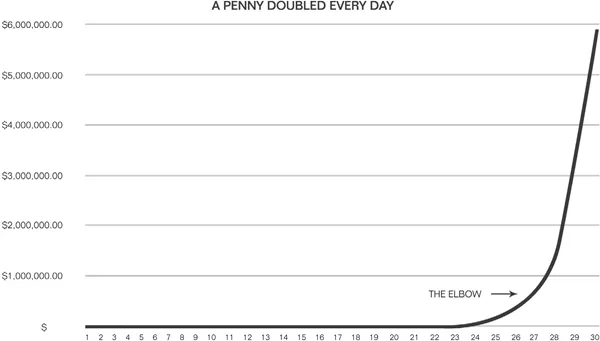
Diagram 1.1
A PENNY DOUBLED EVERY DAY
A payment of one penny doubled every day of a thirty-day month sounds small, but the outcome would shock most organizations.
Perhaps what’s most surprising about the concept of “the exponential”—and what gets overlooked or forgotten—is how extraordinarily simple it actually is. Exponential growth is achieved by a plain, old, steady, constant and compounding rate of growth or change. For example, the American Gross Domestic Product has grown by approximately 2% every year since World War II. Two percent: a predictable, long-established rate of growth that surprises no one. But over time, month by month, quarter by quarter, the impact of that yearly, compounding 2% gets steadily—and then dramatically—more significant.
If that growth is plotted on a graph, it appears as if very little is happening for a long time—growth is virtually flat, the line crawls along horizontally—then suddenly a miraculous “elbow” appears in the rate of growth, sending the line soaring upward. The line on our graph now resembles a hockey stick. In the context of the annual 2% compounded growth of American GDP, that hockey stick heralds the sudden arrival of a supreme world power on the global stage. The elbow in the hockey stick is the point at which exponential change reached a tipping point and blew up, sending American fortunes soaring.
The truth is that human beings have always lived with exponential change. Growth and development have always occurred at what appeared to be steady rates. Rates that, after a long period of time, kicked up at the end in a way that made change feel like it had just occurred. And, because a system of interconnected factors is always at play, it is never just a single change taking place. It took us 8,000 years to transition from the Agrarian Age to the Industrial Revolution, but only 120 years after that, we were manufacturing light bulbs. 90 years after that: the moon landing. 22 years after that: the Internet. 9 years after that: a sequenced human genome. The exponential factor has been with us for a long time.
When we take that bird’s eye view of human history, it is dazzling, but how often do we do that? For the most part we are submerged in the minutiae of our daily lives, where the terrain is fairly predictable. Indeed, the reality of exponential change confounds our very brains, which are wired for learning that is predicated on a linear relationship between cause and effect. We expect almost instant feedback from an action. If there is any delay outside our immediate, expected timeframe then we tend to separate effect from cause. For millennia our experience has been that in most cases what was true yesterday will be true tomorrow. our survival traditionally depended upon storing up information about the past in order to skilfully navigate the present and future.
The elbow of the exponential presents a very different environment. The magnitude of change increases so much in the elbow that it registers in the arena of daily life. At this point, what was true yesterday bears absolutely no resemblance to the potential reality of tomorrow. when this occurs, change truly feels present. It seems sudden, shocking, magical, unforseen, and confounding, like a phenomenon that “came out of nowhere.” An overnight success—or failure.
Another way of understanding the elbow is as a threshold where the magnitude or intensity of a change in conditions passes the point of no return. Change shoots up through the elbow into a place that is removed from our sense of the present and the past. At this point, fighting change is futile. going back and trying to recover the past to retain continuity is folly. In the eye of the exponential storm this simply wastes valuable resources.
This is disruption: the point at which exponential change can be felt at the level of daily life. It’s the moment in time when you can no longer ignore change even if you wanted to. It’s what occurs between Day 26 and Day 30, and it packs an unexpected punch.
HOW BIG A PUNCH? WELL, ON DAY 30, YOUR BOSS GAVE YOU YOUR LAST DAY’S PAY ACCORDING TO HIS EXPONENTIAL TERMS. ON THAT DAY, YOU RECEIVED $5,368,709.12. AND YOUR BOSS THANKS HEAVEN IT WASN’T A 31-DAY MONTH.
FEELING DISRUPTED?
We now live in a world in which obscure start-ups like YouTube, Facebook, and Airbnb each respectively secured a billion users (or a billion and a half in the case of Facebook) in a single decade. In that same decade, a “drone” went from being a military weapon system to being a toy that could be purchased for a child for $50.
Or consider the phenomenon of “the Internet of Everything” (IoE), in which experts are forecasting a 400% growth in Machine-to-Machine (M2M) connections over the next five years. By 2018 there’s likely to be over 10 billion connected devices, and by 2020 some observers predict over 70 billion. Add Big Data to IoE, and it’s tough to predict just how big the impact will be on the already complex culture of digital transactions.
Of course exponential change isn’t just expressing itself through technology or commerce. Scientists touring the Russian Artic Ocean to check for plumes of noxious methane gas recently encountered a troubling phenomenon. Where they formerly found hundreds of meter-wide plumes, now there are hundreds of kilometer-wide columns of gas bubbling out of the ocean waters. Methane gas is fifty times more damaging to the atmosphere than carbon dioxide. Warming thaws Arctic sea ice, eroding the natural “mirror” that reflects heat back into space, which then raises the temperature of the ocean even higher, and so on. Nature, too, is a matrix of elbows, threshold breaches and tipping points that are accelerating changes—in this case changes to the climatic patterns that provide a stable platform for existence as we know it.
Will digital disruption pale into insignificance relative to the climate hockey stick? Or, will digital be the disruptive influence that, if leveraged in the right way, provides us with exponential solutions to exponential climate change?
The truth is that we are living in the “exponential elbow” of many different but interconnected sectors and systems. It’s a pile-up of hockey sticks, a kind of global 26th day, when change is chronic and systemic. This is the age of disruption, in which the change that was always developing at an exponential rate suddenly and profoundly accelerates, reshaping the reality of everyday life. It’s the moment when we wake-up, startled and disoriented, in a bed we’ve been sleeping in for millennia.
So how does it feel to be an individual living at a time when exponential change registers in the arena of everyday life? how do these “elbows” manifest in your personal experience, at work or in your home? From yesterday’s rush of cloud computing, to the rapid changes in climate patterns, to a Big Data driven IOE, how is your everyday existence shifting?
PAUSE AND CONSIDER: What does your disruption look like? What are your disruptors?
THE FIVE FACTORS OF DISRUPTIVE CHANGE
If the theory of exponential change is a simple concept to understand, the reality of life in times of disruption is anything but. The lived experienced of disruptive change is awesomely disorienting and difficult to parse.
These “exponential elbows” can feel like magic, rather than mere math. But if the sum of all of these accelerating changes is so great in impact that it causes us to glaze over, blinking at the magnitude of it all without comprehension or a plan of attack, then perhaps it will serve us to break this disruptive era down in a little more detail.
In our work with organizations on the frontlines of disruption, you could say we’ve more or less gotten into the habit of reading signs of the times and making sense of them. That much scanning of the horizon does tend you give you a certain sense of perspective. So while we feel the miracle and the peril of living in this 26th day as keenly as anyone, we’ve found ways of breaking it down so that it makes more sense.
After two decades of working with organizations, we have identified five factors that are driving disruptive exponential change. They are connectivity, complexity, chaos and change cycles. At the intersection of these four factors is the fifth: technological development.
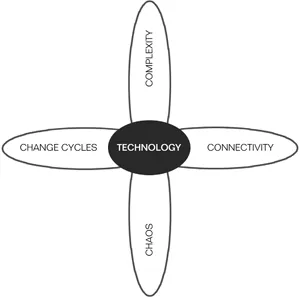
Diagram 1.2
THE FACTORS OF DISRUPTIVE CHANGE
Five intrinsically linked factors that drive disruption.
It is important to note that these factors are intrinsically connected. Together, they create a matrix of systemic change where developments in one component cause a cascade of accelerated developments in all others. But for now, let’s disconnect the dots by taking a closer look at each of the driving factors of exponential acceleration.
WELCOME TO YOUR WHISTLESTOP TOUR OF THE AGE OF DISRUPTIVE CHANGE.
Connectivity
why did Facebook acquire a billion and a half users in a little more than a decade? why have a plethora of social media businesses—from LinkedIn to SnapChat to Pinterest to Twitter to Instagram to Tumblr—exploded in influence and income over the same time period? eBay founder Pierre omidyar alludes to it elegantly in the above quote. human beings yearn to build networks. we are irrepressible connectors, the species that shares information in order to prosper. Social media merely represents an acceleration of a rather ancient human imperative.
“WE HAVE TECHNOLOGY, FINALLY, THAT FOR THE FIRST TIME IN HUMAN HISTORY ALLOWS PEOPLE TO REALLY MAINTAIN RICH CONNECTIONS WITH MUCH LARGER NUMBERS OF PEOPLE.”
Pierre omidyar
While social media is certainly the most populist expression of the great connectivity shift, this trend is working its way through all systems of information, communication, education, production, and trade. The elimination of a time lag between communicators has cranked up the speed of network building while the elimination of geographic constraints has fostered connections, transactions, and collaborations that would have been inconceivable even twenty years ago. Just as the IoE grows, so too does the incidence of radical new economic models predicated on a culture of connectivity. For example, the rise of corporation-disrupting peer-to-peer businesses like Airbnb and Uber represents a whole new class of entrepreneurs waking up to the power of local and global connectivity.
Eduardo Paes once claimed that “economic integration was the first strong evidence of a new era” and it’s hard to disagree with him. As the spaces between us narrow, the economic opportunities expand—as do the hazards of failure. Economic imperative and our irrepressible desire to connect have produced a momentum with which traditional governing bodies have a very difficult time keeping pace.
Globalization means open markets, stiffer competition, immense niche opportunities, and a world-sized market that sets the quality standards for all. It has brought us call centres staffed by immaculate English-speaking Filipinos and scandals over toxic dog treats from Chinese factories. It has created waves of fear in the “developed” world’s labor market over the ramifications of outsourcing. But it is also creating hungry new markets for a variety of goods and services.
CONSIDER THE FOLOWING:
•Emerging markets are currently projected to grow four times as fast as developed markets.
•About $20 trillion USD, or 35% of all consumer spending, will take place in emerging markets by 2020.
•270 million new households from emerging markets will enter the “global consuming class” (ie. those to whom you want to be marketing) between 2010 and 2020. This represents an increase of more than 40%.
The Boston Consulting group, whose gl...
Table of contents
- Cover
- Title Page
- Copyright Page
- Contents
- Foreword
- About Disrupted
- Chapter 1
- Chapter 2
- Chapter 3
- Chapter 4
- Chapter 5
- Chapter 6
- Chapter 7
- Chapter 8
- Glossary of Key Terms and Definitions
- Selected Sources
- Acknowledgements
- About the Authors
- About Resilient Futures
Trusted by 375,005 students
Access to over 1.5 million titles for a fair monthly price.
Study more efficiently using our study tools.
Frequently asked questions
Yes, you can cancel anytime from the Subscription tab in your account settings on the Perlego website. Your subscription will stay active until the end of your current billing period. Learn how to cancel your subscription
No, books cannot be downloaded as external files, such as PDFs, for use outside of Perlego. However, you can download books within the Perlego app for offline reading on mobile or tablet. Learn how to download books offline
Perlego offers two plans: Essential and Complete
- Essential is ideal for learners and professionals who enjoy exploring a wide range of subjects. Access the Essential Library with 800,000+ trusted titles and best-sellers across business, personal growth, and the humanities. Includes unlimited reading time and Standard Read Aloud voice.
- Complete: Perfect for advanced learners and researchers needing full, unrestricted access. Unlock 1.5M+ books across hundreds of subjects, including academic and specialized titles. The Complete Plan also includes advanced features like Premium Read Aloud and Research Assistant.
We are an online textbook subscription service, where you can get access to an entire online library for less than the price of a single book per month. With over 1.5 million books across 990+ topics, we’ve got you covered! Learn about our mission
Look out for the read-aloud symbol on your next book to see if you can listen to it. The read-aloud tool reads text aloud for you, highlighting the text as it is being read. You can pause it, speed it up and slow it down. Learn more about Read Aloud
Yes! You can use the Perlego app on both iOS and Android devices to read anytime, anywhere — even offline. Perfect for commutes or when you’re on the go.
Please note we cannot support devices running on iOS 13 and Android 7 or earlier. Learn more about using the app
Please note we cannot support devices running on iOS 13 and Android 7 or earlier. Learn more about using the app
Yes, you can access Disrupted by Larry Quick,David Platt,Kristin Van Vloten in PDF and/or ePUB format, as well as other popular books in Commerce & Stratégie commerciale. We have over 1.5 million books available in our catalogue for you to explore.