- English
- ePUB (mobile friendly)
- Available on iOS & Android
eBook - ePub
Information
Chapter 1
Introduction
Introduction
1.1 If there had been no growth
Most things about our day-to-day lives are due to economic growth. Without growth we would be living in the manner of people in England in 1700. A few would live in large houses, be looked after by servants, dress in fine clothes and eat high protein diets. Most, though, would work on the land, live in one or two room houses with no water supply or sewerage system, be illiterate and have no teeth. Women would cook, clean and have children; men would labor. Diet would be dominated by grains and beer. Mobility would be by walking. People would live and die in the village in which they were born. As life expectancy was less than 40 years there would be no concern about retirement. Food supply was so limited and death rates from infectious diseases were so high that most of us would simply not be here – populations would be a small fraction of what they are today.
Today, most people in high income countries are educated and in good health, have a life expectancy of around 80 years, live in comfortable houses with energy supply, water and sewerage systems, eat well (or even too well), be in paid work for less than half of their waking hours, have machines which drastically reduce the time and effort needed for household tasks, and have machines which provide entertainment, communication and mobility. And there are more of us – food supply, sanitation and health care are such that populations are many times greater than in 1700. These changes are all due to sustained increases in production (and its dual, income) over the past three centuries; in short, these changes are due to economic growth.
1.2 What is economic growth?
Economic growth is the continuing increase in per capita incomes or purchasing power.
These are increases continuing for many decades or for centuries. Economic growth has now been going on for 300 years. Some countries in earlier eras achieved rising per capita incomes but, when the source of the rise had been played out, were unable to continue the increase. The central feature of economic growth is that the increase is ongoing – once one source of growth has been played out another source emerges to take per capita incomes forward again, and so on and so on.
Increasing production which is totally absorbed in population increase is expansion but not growth; this is simply more people living the same way and doing the same things. Economic growth is about increasing average incomes. This allows people to increase their material standard of living, to enjoy more of more things, to be better educated, have better health, more leisure time, more entertainment and so on. Economic growth is about increasing the range and depth of choice available for people’s consumption.
Economic growth always involves change. New goods and services are introduced, patterns of spending and consumption change, production expands, new production processes are developed, production takes place in new locations, people choose to live in new locations and so on. The pre-growth world featured static economies, or economies which increased in scale or extent but not structure, whereas growth economies involve continuing structural change. In a growth economy, the only constant is change.
1.3
Measuring growth
Measuring growth
Economic growth conventionally is measured by the growth rate of constant price Gross Domestic Product (GDP) per capita. Constant price means that production is valued in different years in the prices of the base year; this takes inflation out of account, thereby indicating movements in the overall quantity of production of goods and services.
GDP is a measure of the value created in the production of traded goods and services. (Some non-traded production also is included such as the value of accommodation services from owner-occupied residential property.) This value added is the total income generated in an economy. This income is then spent on finished goods and services. Most of this final demand spending is by people consuming finished goods and services, some is by governments on producing public goods, some is directed to investment to provide increased productive capacity for the future and some (exports less imports) is spending by people in other countries. The value added in production, net incomes and final demand spending are different ways of looking at the same thing; numerically they are equal.
GDP is part of a measurement system called the National Accounts. GDP and related measures in the United States are also referred to as the National Economic Accounts. Table 1.1 shows the broad spending and income indicators of the National Economic Accounts for the United States for 2010. Total spending is Gross Domestic Expenditure (GDE), total income is Gross Domestic Income (GDI) and the value added (income created) in production is GDP. Numerically, GDE is equal to GDI and also to GDP. (The values in this Table are in current dollars, the dollars actually spent or received. For considering economic growth, production, expenditure and income are measured in constant dollars.)
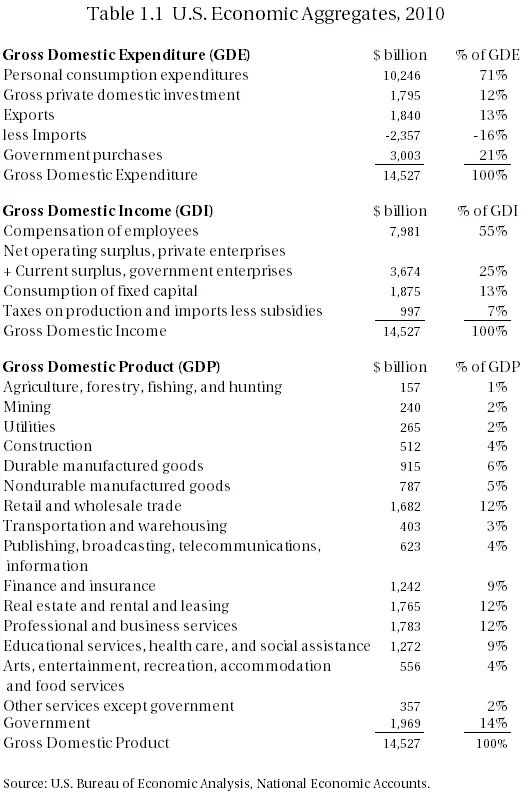
These different views also show the structure of economic activity. For example, final demand is dominated by personal consumption, labor income is greater than capital income, and spending is dominated by services.
GDP growth can also be separated into its sources in terms of productive inputs – labor, capital and everything else, the productivity of converting factor inputs (factor inputs are labor and capital) into outputs. This is called “growth accounting”. Growth accounting typically finds that most growth in GDP per capita is due to more and better capital per worker along with increases in productivity.
1.4 A history of income
As England, part of the United Kingdom, was the birthplace of economic growth, we show in Figure 1.1 the graph of U.K. per capita GDP for the past 2,000 years.
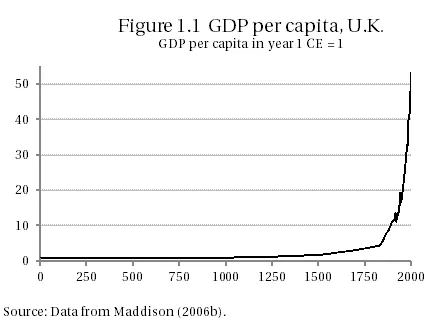
Average income today is more than 50 times larger than in the first millenium. Incomes did not change for a thousand years then very slowly began to rise. The rise accelerated in the 16th century, following the Black Death and coinciding with the European Renaissance and the Reformation. However, people were still doing the same thing, just doing it a little better, until the first half of the 18th century. This was the start of the “Industrial Revolution”, the application of capital to the production of manufactured goods. Growth rates slowly accelerated. There are only two significant blips in the growth curve – disruptions associated with the aftermath of World War I and with the Gre...
Table of contents
- Chapter 1 Introduction
- 1.3 Measuring growth
- 1.4 A history of income
- 1.7 Growth rates
- Chapter 2 The world before economic growth
- 2.3.3 Reasons for this performance
- 2.4.2 Economic performance
- Chapter 3 The start of growth - Britain
- 3.6 Coal
- Chapter 4 The leader – United States
- 4.9.2 Steel-making technology
- Chapter 5 Other countries, other systems
- Chapter 6 Effects of economic growth
- 6.3.5 Outputs
- Chapter 7 Past theories of economic growth
- Chapter 8 The mechanics of growth
- Chapter 9 Extending the theory of economic growth
- Chapter 10 Conclusions
- 10.6 Will economic growth continue?
- Appendix 1 Units of Measurement
- Appendix 2 The United Kingdom
- Appendix 3 Sources of data
- References
Trusted by 375,005 students
Access to over 1.5 million titles for a fair monthly price.
Study more efficiently using our study tools.
Frequently asked questions
Yes, you can cancel anytime from the Subscription tab in your account settings on the Perlego website. Your subscription will stay active until the end of your current billing period. Learn how to cancel your subscription
No, books cannot be downloaded as external files, such as PDFs, for use outside of Perlego. However, you can download books within the Perlego app for offline reading on mobile or tablet. Learn how to download books offline
Perlego offers two plans: Essential and Complete
- Essential is ideal for learners and professionals who enjoy exploring a wide range of subjects. Access the Essential Library with 800,000+ trusted titles and best-sellers across business, personal growth, and the humanities. Includes unlimited reading time and Standard Read Aloud voice.
- Complete: Perfect for advanced learners and researchers needing full, unrestricted access. Unlock 1.5M+ books across hundreds of subjects, including academic and specialized titles. The Complete Plan also includes advanced features like Premium Read Aloud and Research Assistant.
We are an online textbook subscription service, where you can get access to an entire online library for less than the price of a single book per month. With over 1.5 million books across 990+ topics, we’ve got you covered! Learn about our mission
Look out for the read-aloud symbol on your next book to see if you can listen to it. The read-aloud tool reads text aloud for you, highlighting the text as it is being read. You can pause it, speed it up and slow it down. Learn more about Read Aloud
Yes! You can use the Perlego app on both iOS and Android devices to read anytime, anywhere — even offline. Perfect for commutes or when you’re on the go.
Please note we cannot support devices running on iOS 13 and Android 7 or earlier. Learn more about using the app
Please note we cannot support devices running on iOS 13 and Android 7 or earlier. Learn more about using the app
Yes, you can access Economic Growth by Edward A. Hudson in PDF and/or ePUB format, as well as other popular books in Economics & Economic History. We have over 1.5 million books available in our catalogue for you to explore.