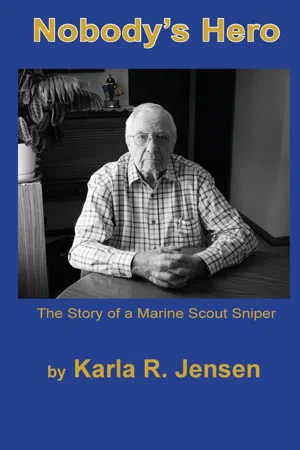
- English
- ePUB (mobile friendly)
- Available on iOS & Android
eBook - ePub
Trusted by 375,005 students
Access to over 1.5 million titles for a fair monthly price.
Study more efficiently using our study tools.
Information
Subtopic
Military BiographiesIndex
HistoryPart I: A Compartmentalized Man and His Memories

Chapter 1
Achilles Heel
Del Schultz dreams of killing every night. No matter how hard he tries, he still sees the bloodied and dead bodies of those wiped from the earth, slain by his own hand. There’s no cure, no healing, and no remission to his getting over a monumental betrayal like the one he has endured. His soul is as wounded as a buck during hunting season that can’t come back around from his injuries. His once naïve idea of patriotism passed away uneventfully along with the casualties of war and no one, let alone Del, has discovered how to revive it. And so this former sniper, scout and hand-to-hand combat killer sleeps less and lives more, betrayal a bitter motivator to erase his military history.
Del conceals his past just beneath his attractive exterior with his distinguished white hair, burly physique, and still-handsome smile. Like a chameleon, he has mastered the art of transformation to remind himself who he is rather than who he was. In his post-war persona, Del is gentle, trustworthy and upstanding. He exudes old-fashioned charm, manners, integrity and even doting devotion to his family and friends. Yet, for seventy years, this fugitive from history attempts to keep his dark past subdued, shrouded in secrecy. He doesn’t want to remember the darkness of his actions and has tried to scrub the visions from his mind as if time and forward motion can be the bristles that keep his new soul pristine.
Del is older and wiser; he is a product of his generation, one that has evolved over time. He is no longer the callous killing machine the Marines trained him to be. He has cast off the shadow of post-traumatic stress that had no name in 1944. He has sat in the lap of death and served as its footstool, though unwittingly. He has erased every shred of evidence that might have once connected him to this stealthy and deadly past, and yet there remains a slim thread, a hangnail of a menacing memory that Del would like to eradicate or at the least prune. It’s bothered him long enough.
Del is a veteran who often cannot bring himself to speak about his service in the Marines. What began as skill honed for a job where “kill or be killed” became a daily mantra and threat, his excellence at hand-to-hand combat became his Achilles heel. What military training had somehow “turned on,” Del quickly discovered he could not “turn off.”
Not quite to the point of killing for sport, Del found killing second nature, although he was not a combat man. In 1944–1946, his first and foremost chore was to locate the enemy and obtain information about them. In the shadows of night, Del spoke to his Japanese enemies in their own language, enticing them forward with his expert dialect and mimicked nuances. He did not kill every outpost. Some may have been duped into believing this scout was an ally before their lives were snuffed out, if necessary, but he did not hunt to kill. Nonetheless, Del would disappear for days, venturing out unaccompanied and sometimes without orders.
As an important asset to Headquarters, his position as Scout/Sniper was protected. When this top recruit was compromised, he was removed from harm’s way. He was also awarded special positions of leadership, including evolving into military police. Yet, as Del attempted to disengage from his role, anyone who confronted him became a target as well. What Del could not foresee is how his split-second instincts spilled over into civilian life. He encountered many close calls out of uniform and beyond the call of duty. Just the right Jujitsu move or karate chop could eliminate both innocent bystanders and enemies alike. Eventually and far too easily, lines became blurred between the two over the course of time and ongoing trauma. At home, bar flies and hitchhikers didn’t know whom they stood against… a Wisconsin farm boy with uncanny force and strength or a calculating, cold-blooded killer.
When the institution that trained him accused him of falling in love with killing, they had no idea how to stop what they had created and encouraged. In an attempt to deal with these problems, Del’s superiors removed him from service. In 1946, when Marine physicians in Hawaii and the Great Lakes Naval Hospital back home callously and literally forgot about him, his bitterness towards his Marine superiors grew like a fungus. Thus began the decline of the Marines acknowledging that this conflicted warrior was their responsibility and the rise of Del’s intense vow to erase his military history forever.
Beginning from his enlistment as a young man in the Marines at the naïve age of seventeen in 1942, Del embarked upon an unimaginable journey to the other side of the world and back. From hand-to-hand combat, Scout and Sniper training in California in 1943 to scouring the Japanese islands after the bomb was dropped in 1945, Del transformed from information gatherer and peacekeeper into a killing machine. Often emotionless and forgetful, this warrior found the only way to survive and sustain our freedom: through killing.
Chapter 2
Call to Duty
“You’re never going home. You’ll never come out of these missions alive. You will be shot or killed or taken prisoner. If you accept that reality now, you’ll make a better Marine. Kiss your future goodbye and do the right thing: serve your country and fight for the freedom of America.”
A farm boy from Dodge County, Wisconsin doesn’t grow up believing he’ll be hurled into a life and death arena, wondering if he’ll make it to twenty-one, but during the early 1940s, this was the reality of manhood. Del didn’t know with each heft of the pitchfork and every round of the thrashing machine that he came inches closer to a career… no, a sentence…of indentured servitude to the almighty military machine called the Marines. Had he known the difficult and demanding path that stretched before him like a perilous precipice, he might not have been so eager to flaunt his strength, stamina, and exceptional physique. But he did, and what his immediate family could not fathom, military recruiters could.
“My father used me on the farm as a regular slave,” Del admitted. “I worked on the farm until ten p.m., filling silo for different farmers and plowing. My father liked the idea of hunting, but didn’t accomplish it so I did all the hunting as well. When ammunition dwindled, I traded pheasant for shells. I used a shotgun and rifle at an early age. I practiced shooting small fingernail polish bottles off a ledge and soon, I became an avid marksman.”
Del tells the story of his work at a local feed mill prior to his enlistment. “In those days, wheat came in 120 pound bags, definitely a two-man job to pull from a cart and stack. I worked my ass off because I desperately wanted to prove myself to the older guys. Without assistance from anyone else, I stacked those heavy bags 10 high, 80 across. When the men who worked at the mill reappeared, they asked, ’Who helped you with these bags?’ I told them it was just me. They were floored.
“I was thrown into manhood far too young,” admits Del, reviewing his life with new insight. “Even at age twelve, I drove my sister who suffered from Rheumatic Fever to Portage for treatments. That was in 1936. My dad had bought a new Chevy, a car he thought would be easier for me to drive. I inched up the steep steps of the clinic where she would report, then returned her to the car. This occurred up to three times a week at first, then twice a week, then once a week. I drove forty miles each way.”
Del reiterated how he accepted adult-like responsibility long before he turned of age to get his license. “At 16 when I could get my license, Dad drove me into the police station for a driver’s test. The officer said, ‘I’ve been watching you drive for years,’ and issued my license.”
With brains and brawn, Del stood at the threshold of a bright future beyond the hills and lakes of Wisconsin—beyond the endless routine of farm chores, doing someone else’s bidding, or so he thought, and beyond the shadow of his father’s expectations. When the Marines came calling, he answered, attracted to this branch of the service because of the engaging and compelling propaganda he discovered in literature and in the media. When reports surfaced that the Army hadn’t been as prepared or as successful in a maneuver in the Pacific theater, Del heard, whether in actuality or imagined, that the Marines were top dog. This young man soon determined that the Marines could not only benefit from his endurance and grit, but that he might gain something marvelous yet unnamed.
1943. Twelve weeks of Basic Training proved his proficiency and power, catapulting Del ahead of his mates. When drill sergeants challenged exhausted rookies, “Who wants to do this routine again?” the boy from Wisconsin would raise his hand. “I’ll do it again, sir!” Del shouted on more than one occasion. Glutton for punishment or braggart? He was neither, just an eighteen-year-old testosterone-driven engine of a man, eager for his first assignment.
“Every Marine goes through a marksmanship training course,” recalls Del. “I waited to hear how I fared in the first phase, but heard nothing. Finally, a guy approached me one day and said, ‘You have to reshoot,’ so I did. Once again, I heard nothing. Then the same guy requested that I shoot the course again, but I would have an ANCO (a non-commissioned officer) by my side. Silence. This is when I started getting a little scared. When I received a third invite, this scared the hell out of me. At the time, I already knew I was skilled—my rifle practically grew out of my finger. I craved to be an expert rifleman. Finally, on a designated day, I reported to the range where a large set of bleachers was set up for an audience. Twenty to thirty brass lined up to watch me. I didn’t know what the hell was going on, but I knew I had to perform here and now. I did my best that afternoon, showing my skill. No one really ever stated how well I did. One officer simply said, ‘My God, we have an Annie Oakley with a gun,’ and they placed me directly in the sniper pool. After Basic, I attended the very first Scout/Sniper School the Marines offered. We trained in the hill country of California.
“The Marines were eager to get us into combat,” recalls Del sarcastically, as if only today, in this very moment, the irony of him living to tell his tale finally dawned on him. “We lived at the Scout/Sniper School in the California hill country, learning the techniques of hand-to-hand combat which included Jujitsu, Karate, and knife skills. My best knife came from back home, custom made by someone in Wisconsin my parents knew. I would be using that knife often.” Not throwing it, Del clarified. That wasn’t part of a sniper or scout’s repertoire; but slitting throats was. “I never threw a knife at an enemy because retrieving a knife would be an objective and losing the enemy as an objective would be very dangerous. I didn’t go to the enemy; I drew the enemy to me.”
The Marines trained young men in martial arts, borrowing from Jujitsu, Taekwondo, Judo, Karate and Kung Fu. Del quickly discovered how wonderfully adept his agile and resilient body took to these new wrestling maneuvers, holds, punches and kicks. What started as a unit of thirty recruits dwindled to a core group of eighteen to twenty men, the others falling away or falling apart under the pressure and high expectations for this elite group of trainees of the first Scout/Sniper School for the Marines.
According to www.thortrains.com, a resource of military close combat techniques across the generations, “Kicks were usually aimed at the lower extremities, especially feet and knees. Hand strikes were aimed at weak points and nerve centers, such as the throat, solar plexus, kidneys and philtrum (nose). Jujitsu hand strikes tend to be quick, direct blows.”1 This compelling combination of art and sport with quick injurious karate chops, Del found as enticing and intoxicating as any woman. No Geisha girl, however, would come between him and his secret weapon across the ocean. Del would be far too busy, with barely enough time to sleep, scouring every inch of enemy territory and moving toward much larger targets than his old fingernail polish bottles lined up on a fence in rural Wisconsin.
“I knew early on that my strength resided in my hands,” claims Del. “I could deliver a killing blow expertly, without a lot of thought. I could also squeeze someone’s temples to deliver the same strike that would not only instantly knock out my enemy, but truly and swiftly end his life.
“As a scout, we were trained to move forward with our combat units while as a sniper we learned how to retreat,” Del explained methodically, as if he reached back into his memory like another would simply snag a wallet from his pocket. He did so casually, without thinking, by sheer repetition, as if he had just returned from a dangerous scouting venture moments prior. Did a newsreel filled with those nighttime rendezvous unravel as he remembered those chilling, lonely quests? His eyes flashed bursts of recollections like he might have remembered every single one of those instances, or none of them at all.
Del toiled over detailed maps of islands, a vast and foreign enemy territory rife with alleged desperados equal in skill and aptitude who were also receiving training. With a vast network of islands, he became vigilant in understanding how sniping and scouting would be carried out possibly—no, surely—surrounded by the enemy. Weekly, daily, hourly, he and his company plotted to extinguish the enemy, like snuffing out a candle flame. He knew full well the opposition would have as much wherewithal, or at least hatred, to obliterate Americans. Equal scales didn’t scare him.
With the punitive upbringing Del endured as a youth, he felt like even the harshest of reprimands and warnings given by his ruthless drill instructors did not faze him. These admonishments didn’t lessen his passion to move to the top of his class nor did it unnerve him to yield in any way to his supervisors. “They couldn’t touch me or get to me in any way,” claimed Del. “I was tough like nobody else. I recall my drill instructors saying to us, ‘No man has ever gone through here—meaning training—without drawing blood.’ They’d order us to pound our hands on the pavement until our palms bled. However, my hands were so calloused from farm work that I endured far beyond every other guy without producing blood. Finally, my DI demanded that I drag my nose across the pavement instead to draw blood so that I could be done with the exercise.”
Beyond the building up of his physical stamina, Del and his counterparts spent hours studying the Japanese language. Without modern day educational tools like “Rosetta Stone” and “Learning Japanese in 10 Days” on the Internet, Marines like Del were occupied 24/7 exercising, maneuvering, troubleshooting, and studying with each other. Face-to-face on Japanese islands, Del would quickly discover the nuances of the language. “Japanese natives suck in saliva that sounds like a hissing. I learned that this way of speaking was used to show niceness or when apologizing. On the ground and even after peace was declared, I learned a lot of words that the Marines didn’t teach me.” Throughout his service, Del would become a skillful student of Japanese.
“降伏 Gōbuku” meant surrender. “あなたの武器を下に置く Anata no buki o shitanioku” meant put down your weapons. When he met the enemy face-to-face, Del was not interested in lengthy conversations. Instead, he quickly learned how to be efficient. “Early on as a scout, I learned how to entice an outpost, urging them to come closer to me merely by speaking softly. If I spoke as quietly as possible, my targets would be forced to inch toward me to hear my voice. I knew I could put myself in danger if things worked the other way around. I could locate machine gun nests easier if my target was close. The nearer the better.” With an intense schedule of scouting and sniping, Del admitted there was little time left to sleep, or ponder the reality of what was building, which might have been a blessing.
What was building had been escalating since Pearl Harbor in December of 1941, when Japan fully engaged with their attack on naval station troops in Hawaii. “I enlisted just after Pearl Harbor. I turned 18 in October of 1942 and was called to duty in early 1943. At that time, Marine enlistment was at an all time high and the Marines couldn’t keep up with the rush and turn them out fast enough, otherwise I would have gone earlier. I frankly have blacked out the exact details of how I registered and how I even got on that train to leave from Wisconsin. We must have gone through Texas and south of the Rocky Mountains, but it’s all a blank. That’s part of my history that must be difficult to face.”
Del took the train from Wisconsin to California, at least a week or more by rail, knowing that most Marines were stationed in the Pacific Islands. He trained in the mountains east of San Diego. He served on many islands, beginning with Tinian and Saipan in the Mariana Islands. By February of 1945, he then moved onto Iwo Jima, Okinawa, Naha and Iheyashima, never being told the names of smaller, less significant islands. Ultimately as a scout and sniper, he wound up in Nagasaki, Japan, by August of 1945. In early 1946, he was sent to Hawaii, not to serve, but to move about for less than obvious reasons, a ping-pong ball of a living military casualty of war.
He was unwanted by certain circles, wanted desperately by others and uncertain of any real future at all. Del, lost and found in the same breath, was not your typical post-traumatic stressed-out Marine, but one who longed to find purpose in his madness and mission, albeit an unexpected and controversial one at that. If only he could have anticipated how his strong desire to exact revenge on the foreign nation that attacked Pearl Harbor would haunt him for the remainder of his life.
Chapter 3
A Veteran’s Re-entry
Today, ladies swoon over him. Men respect him. Professionals leverage his intelligence, humor and likeability. Physicians use him as an example of longevity. Neighbors trust him. He would do just about anything for anyone and they would do the same for him.
Del is busier than ever, volunteering for a number of organizations...
Table of contents
- Cover
- Copyright Page
- Title Page
- Introduction
- Contents
- Part I: A Compartmentalized Man and His Memories
- Part II: The Big Reveal to Family
- Postscript
- End Notes
- Acknowledgements
Frequently asked questions
Yes, you can cancel anytime from the Subscription tab in your account settings on the Perlego website. Your subscription will stay active until the end of your current billing period. Learn how to cancel your subscription
No, books cannot be downloaded as external files, such as PDFs, for use outside of Perlego. However, you can download books within the Perlego app for offline reading on mobile or tablet. Learn how to download books offline
Perlego offers two plans: Essential and Complete
- Essential is ideal for learners and professionals who enjoy exploring a wide range of subjects. Access the Essential Library with 800,000+ trusted titles and best-sellers across business, personal growth, and the humanities. Includes unlimited reading time and Standard Read Aloud voice.
- Complete: Perfect for advanced learners and researchers needing full, unrestricted access. Unlock 1.5M+ books across hundreds of subjects, including academic and specialized titles. The Complete Plan also includes advanced features like Premium Read Aloud and Research Assistant.
We are an online textbook subscription service, where you can get access to an entire online library for less than the price of a single book per month. With over 1.5 million books across 990+ topics, we’ve got you covered! Learn about our mission
Look out for the read-aloud symbol on your next book to see if you can listen to it. The read-aloud tool reads text aloud for you, highlighting the text as it is being read. You can pause it, speed it up and slow it down. Learn more about Read Aloud
Yes! You can use the Perlego app on both iOS and Android devices to read anytime, anywhere — even offline. Perfect for commutes or when you’re on the go.
Please note we cannot support devices running on iOS 13 and Android 7 or earlier. Learn more about using the app
Please note we cannot support devices running on iOS 13 and Android 7 or earlier. Learn more about using the app
Yes, you can access Nobody's Hero by Karla R. Jensen in PDF and/or ePUB format, as well as other popular books in History & Military Biographies. We have over 1.5 million books available in our catalogue for you to explore.