eBook - ePub
Hidden Treasure of the Profound Path
A Word-by-Word Commentary on the Kalachakra Preliminary Practices
- English
- ePUB (mobile friendly)
- Available on iOS & Android
eBook - ePub
Hidden Treasure of the Profound Path
A Word-by-Word Commentary on the Kalachakra Preliminary Practices
Information
Topic
Theology & ReligionSubtopic
BuddhismPART ONE
Outer Preliminaries
And Lineage Invocation
CHAPTER ONE
Four Convictions of Renunciation
The Kalachakra Path to enlightenment begins with the deep contemplation of four topics known as the Four Convictions of Renunciation or the Four Thoughts which Turn the Mind towards Dharma. First we reflect on the opportunity offered by a precious human life to engage in spiritual practice. Second, we reflect on the impermanence of all things, especially the certainty that we will die and the uncertainty of the moment of death. Third, we reflect upon the fundamental nature of dissatisfaction of this and future lives, causing us to turn away from everything that leads to suffering (including what we call ordinary happiness). Finally, we contemplate the Buddha’s teachings on karma, which show how we are directly responsible for everything good or bad that happens to us in this or future lives, thereby opening the door to the possibility of following a path to liberation.
While all of these topics are covered in considerable detail in Book One of Unveiling Your Sacred Truth, the aim here is to encapsulate their meaning in a single verse:
O Think! During countless aeons, for this one time I have attained this precious human birth, which is so very hard to achieve and so easy to lose. The time of death is uncertain and the conditions leading to death are beyond my comprehension; this cherished body can die even today! So I shall abandon all worldly concerns that keep me chained to samsara, including all non-virtues and heavy heinous crimes. Instead I shall use the little time I have left wisely and practise Dharma with urgency, reflecting on the benefits of liberation.
According to the Buddha’s teachings, we are all involved in a constant cycle of suffering and uncertainty that spans across the process of birth, ageing, death and rebirth. Contrary to our limited belief that we are in control, each moment of our experience is dominated by our karmic propensities, including our emotional states and their objects. We therefore dwell in a state of anguish and uncertainty, never knowing what will happen next, bound by feelings of hope, fear and other emotions that take control of us. Even a delicious ice-cream has the potential for causing dissatisfaction when it becomes messy or leaves a nasty stain on our clothes; it can also become a source of aversion or make us sick when eaten in excess. This is what is understood as the fundamental suffering or unsatisfactory nature of life, which leads to a process called cyclic existence—or “samsara” in Sanskrit. This process condemns us to experience pain and suffering over and over again, and is likened to the movement of the wheel of a water mill or a fly trapped in a closed jar.
There is no beginning to this cycle of samsara and it only ends when we eliminate our ignorance of the true nature of reality. This ignorance refers to the fact that we hold onto a distorted idea of ourselves as being both “real” and “in-control”, when in fact the nature of reality is impermanent and there is no truly existing “person” that controls everything. Once we let go of this idea of a solid self, there is no longer any firm ground for our emotions and karma to keep influencing us without choice, from moment to moment or lifetime to lifetime. Breaking free from this cycle is what we mean by the word “liberation”.
As a human being, we have the most amazing capacity to understand the nature of our suffering. Based on this recognition, a precious human birth gives us the opportunity to practise Dharma purely and subsequently gain freedom. So long as we possess the unique set of eight freedoms and ten advantages, we will have the ability to follow the Buddha’s path. This includes certain external conditions, such as being born in a place where the Buddha’s teachings are accessible, and internal conditions which are mainly to do with having a conducive frame of mind.
These conditions, however, are very hard to achieve as they depend upon a great deal of merit accumulated over many lifetimes from actions such as maintaining a pure ethical discipline. To illustrate the rarity of this human birth, the Buddha told the story of the blind turtle who lives on the bottom of the ocean, rising up to the surface only once every hundred years. He said that the chance of a human birth is rarer than that of the turtle emerging at the exact moment for his head to poke through a wooden ring that is knocked about by the waves. To achieve all of the freedoms and advantages is even rarer than this.
Now that we have actually achieved this precious human rebirth, it is crucial to use it not only wisely, but urgently, as it is extremely easy to lose. It is so rare in fact, that this may well be our only opportunity to attain liberation. The amount of time we have left in this life to utilise in practising Dharma is extremely unpredictable as the time of death is uncertain and the conditions leading to death are beyond our comprehension. Even activities of daily life such as going to work, gardening or shopping are all potential causes of death. It rarely occurs to people to consider whether the next day or death will come first. Therefore, we must abandon all worldly concerns which are the source of suffering and keep us chained to samsara. There are Eight Worldly Dharmas which we normally seek to acquire or try to avoid: (1) gain and (2) loss; (3) pleasure and (4) pain; (5) attention and (6) being ignored; and (7) praise and (8) criticism. Instead of being led astray by these mundane concerns, we should use our time wisely and make Dharma our most important priority.
Generally speaking, there are Ten Non-Virtuous Actions you should strive to avoid. Three are of the body: (1) killing; (2) taking that which has not been freely given; and (3) sexual misconduct. Four are of the speech: (4) deceiving others through lying or misleading words; (5) divisive speech that destroys the harmony between others; (6) harsh speech that needlessly says things that are unpleasant to others; and (7) meaningless speech that is without purpose and wastes time. Finally, there are three of the mind: (8) covetousness that lusts after the belongings of others; (9) malice that wishes for others to experience suffering; and (10) holding wrong views that mistake the actual nature of things, such as supposing the existence of something that doesn’t exist, denying the existence of something that does exist, and so forth. Each of these actions involves harming others with your body or speech, or generating the minds that will lead you to engage in such actions. Therefore the essence of this conduct is to abide in non-violence.
There are also a number of different sets of negative actions that create particularly heavy karmic consequences and thus should be abandoned completely. The first set are known as the Eight Mistaken Behaviours: (1) interrupting feast offerings of the faithful, thus hindering their accumulation of virtue; (2) disturbing the virtuous intentions of others, thus harming their mind; (3) Lacking faith in virtue and deprecating it; (4) aspiring to non-virtue and rejoicing in it; (5) abandoning the samaya-bond with the guru; (6) discouraging the wish of Dharma friends to withdraw from samsara; (7) transgressing samaya bonds of the yidam deity; and (8) leaving mandala practice and retreat. The essence of this set is to not abandon the supports for achieving enlightenment.
The second set is known as the Four Heavy Actions. These are: (1) swearing to act inhumanely; (2) allowing the shravaka discipline to degenerate and breaking the root pratimoksha vows; (3) allowing the bodhisattva discipline to degenerate and breaking the root bodhisattva vows; and (4) allowing the tantric samaya to degenerate and breaking the root tantric vows. Essentially, this is saying to uphold the ethical discipline of the Three Vows.
Another version of these four focuses on the way in which you engage with very important karmic situations. They include: (1) improperly taking the heavy practices of ordination; (2) improperly developing the heavy thoughts of the scholars; (3) improperly consuming the heavy food of the faithful, and (4) improperly using the heavy wealth of tantric practitioners. Each of these actions is heavy in the sense that actions done in relation to them will have a strong impact on your mind. It is very important to be careful in these four situations to avoid generating heavy negative karma.
And finally we have the Five Heinous Crimes of: (1) killing one’s father; (2) killing one’s mother; (3) killing an arhat; (4) causing a Tathagata to bleed due to having a harmful intention; and (5) causing a schism in the Sangha. These actions result in such powerful negative karma that they will dominate your mind at the time of death, generating extreme pain and torment in your next rebirth. Therefore, they should be abandoned at all costs.
Instead of engaging in these causes for suffering we should strive to practice virtuous actions such as protecting life, being generous, speaking truthfully and gently and also cultivating virtuous mental qualities such as compassion, humility and a wise view of reality. This has nothing to do with feeling guilty or being rigid in how we act, but rather with gaining confidence in which actions are beneficial to ourselves and others. With time and experience, our trust in this natural law of karma will grow.
If we die tomorrow without developing our spiritual qualities, we will definitely continue without freedom in this endless cycle of birth, ageing, sickness and death. In the little time we have left, having reflected deeply on the benefits of liberation, we must practise the Dharma with urgency, perseverance and great discipline so as to reach the ultimate freedom of enlightenment.
What is most important with these four contemplations is that we become genuinely disillusioned or weary with samsara, realising the futile aspects of this life and aspiring to “emerge” out of this pattern with a strong determination. Fortunately, even though you see all the pain and torment, you also see a way to get out, and so you develop a great sense of hope that liberation is possible and a wish to convey this hope to others.
These four thoughts also remind us that of all the things we could do with our life, practising the Dharma in an authentic and sincere way is really the most important and beneficial activity. While it may at times feel like we are swimming against the current by doing something that others can find strange or useless, we can have confidence in the profound purpose behind our actions.
Exhaling the Foul Air
Having contemplated the Four Convictions, we can now prepare ourselves for the next practice with this simple breathing exercise:
Begin by closing the left nostril using the Pacifying Mudra and exhale three times through the right nostril, then change to the other nostril. Finish by exhaling three times through both nostrils. Visualise all afflictions and negativity leaving your body in the form of black smoke.
This technique is called exhaling the foul air. It involves visualising all your impurities in the form of black smoke being forcefully blown out through your nostrils so that you can begin your practice with a clear mind.
This helps to remove counterproductive currents of energy which are associated with the breath and carry imprints of afflictive minds like attachment, aversion and ignorance. A simple version of this practice is to take three deep breaths, each time inhaling to the pit of the stomach and holding it for a while, then forcefully exhaling through both nostrils while visualising all impure energies such as lust and hatred leaving your mind and body.
A more elaborate version involves three rounds of three exhalations making nine exhalations in total:
- First, fold the middle, ring finger and thumb of the left hand towards the palm. This will leave only the little finger and index finger of the hand pointing outward, which is known as the “pacifying mudra”. In a smooth, flowing and elegant motion, bring the left index finger up toward the left nostril. Inhale deeply but quietly through the mouth. Close the left nostril with the left index finger and release the air in three long exhalations, out through the right nostril.
- Return the left hand to a natural position in the lap while bringing the right index finger upward in the same elegant motion. After inhaling, depress the right nostril, and exhale through the left nostril in the same manner as before.
- Finally, return both hands to a natural position in the lap, inhale deeply through both nostrils, and then exhale through both nostrils in three long exhalations.
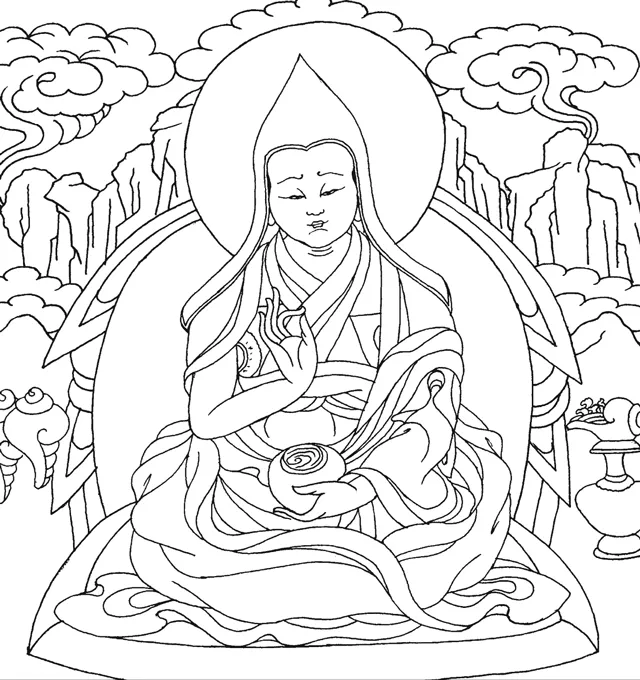
— Kunpang Thukje Tsondru —
Great Kalachakra Master who founded the Jonang Mountain Retreat
Great Kalachakra Master who founded the Jonang Mountain Retreat
CHAPTER TWO
Brief Invocation of the Jonang Lineage Masters
Having recited and reflected upon the Four Convictions of Renunciation, you then invoke eight important lamas who were responsible for founding or establishing the great monastic institutions of the Jonang Tradition. A lineage refers to the teachings that have been transmitted in an unbroken line from the Buddha up to the present day. Such a lineage is authentic if it is based on real experience or realisation of the truth of those teachings. This experiential knowledge is handed down from teacher to student over many generations, along with the transmission of authentic commentaries or scriptures based on the words of the Buddha.
Without a firm commitment to an authentic lineage, we cannot realise the final aim of full and complete enlightenment. However, by following the teachings which have been handed down through such a lineage, it is possible to gradually progress along the path and eventually achieve the final goal of Buddhahood.
In science we are familiar with the value placed on knowledge produced through preceding research into a given field. Without that body of knowledge, it is very difficult to achieve any new discoveries. Likewise, a spiritual lineage represents the continuity of discoveries made by great spiritual practitioners which we can use to replicate their experience.
The lineage of the Kalachakra teachings began when Suchandra, the King of Shambhala, requested the teachings from Buddha S...
Table of contents
- Cover
- Title Page
- Publishing Info
- Contents
- Homage
- Introduction
- Part One: The Outer Preliminaries and Lineage Invocation
- Part Two: The Inner Preliminaries
- Part Three: Unique Kalachakra Preliminaries and Main Practice
- Part Four: Two Additional Guru Yogas
- Conclusion
- Appendices
- About the Author
- Other Books from the Tibetan Buddhist Rimé Institute
Trusted by 375,005 students
Access to over 1.5 million titles for a fair monthly price.
Study more efficiently using our study tools.
Frequently asked questions
Yes, you can cancel anytime from the Subscription tab in your account settings on the Perlego website. Your subscription will stay active until the end of your current billing period. Learn how to cancel your subscription
No, books cannot be downloaded as external files, such as PDFs, for use outside of Perlego. However, you can download books within the Perlego app for offline reading on mobile or tablet. Learn how to download books offline
Perlego offers two plans: Essential and Complete
- Essential is ideal for learners and professionals who enjoy exploring a wide range of subjects. Access the Essential Library with 800,000+ trusted titles and best-sellers across business, personal growth, and the humanities. Includes unlimited reading time and Standard Read Aloud voice.
- Complete: Perfect for advanced learners and researchers needing full, unrestricted access. Unlock 1.5M+ books across hundreds of subjects, including academic and specialized titles. The Complete Plan also includes advanced features like Premium Read Aloud and Research Assistant.
We are an online textbook subscription service, where you can get access to an entire online library for less than the price of a single book per month. With over 1.5 million books across 990+ topics, we’ve got you covered! Learn about our mission
Look out for the read-aloud symbol on your next book to see if you can listen to it. The read-aloud tool reads text aloud for you, highlighting the text as it is being read. You can pause it, speed it up and slow it down. Learn more about Read Aloud
Yes! You can use the Perlego app on both iOS and Android devices to read anytime, anywhere — even offline. Perfect for commutes or when you’re on the go.
Please note we cannot support devices running on iOS 13 and Android 7 or earlier. Learn more about using the app
Please note we cannot support devices running on iOS 13 and Android 7 or earlier. Learn more about using the app
Yes, you can access Hidden Treasure of the Profound Path by Shar Khentrul Jamphel Lodrö in PDF and/or ePUB format, as well as other popular books in Theology & Religion & Buddhism. We have over 1.5 million books available in our catalogue for you to explore.