- English
- ePUB (mobile friendly)
- Available on iOS & Android
eBook - ePub
Information
Topic
Theology & ReligionSubtopic
Biblical StudiesPART 1
What is the gospel?
CHAPTER 1
Gospel confusion
GOSPEL IS A WORD YOU HEAR A LOT IN CHRISTIAN CIRCLES. Outsiders recognize it as a Christian word, even when they describe some quite ordinary assertion as “gospel” to indicate it is genuine. Ask a Christian and you will be told it means “good news”. Ask what that good news is, and prepare to be surprised by the variety of views.
Gospels galore
There are gospels whose central focus is any one or a combination of the sovereign majesty of God, the love of God, the judgement of God, Jesus’ lordship, his saving work, his resurrection, his coming again, millennial views of his return, the gift of the Holy Spirit, being born again, justification by faith, the whole Bible story, various understandings of the spiritual life, healing and miracles, material prosperity, radical obedience, the Church, upliftment of the poor, political and social revolution, inclusivism, and the list goes on.
For some “the gospel” is a way of referring to the whole of Christian truth. Others take their cue from the notion of good news and identify it with whatever to them is the most attractive aspect of Christianity or whatever originally drew them in. Sometimes, distorted understandings of Christian faith are identified with the gospel.
Amidst the divergent opinions on the content of the gospel, where one does find agreement is on its importance. Whatever it is, it is good news, and it is the essence of Christianity; that has to matter to anyone who wears the Christian name. The Decade of Evangelism is long over and the third millennium underway, but Jesus’ command to his disciples to preach the gospel to the whole world still stands – until the end of the age.[1] The gospel still matters.
Should we not rejoice in the variety and see it as a positive fruit of people’s experiences of God? Yes, and no. It is good that the whole message of Christianity be explained and understood. It is good that at different times particular truths of Christianity be highlighted. But it is not good that there should be confusion and fuzzy thinking about the exact nature of what Jesus and his followers called the gospel. For, according to Paul, that “gospel” is the instrument God uses to save people.[2]
The gospel matters because people’s lives are at stake. God’s gospel gives life, and it alone gives life.
I read that a terminally-ill American asked to have his head severed from his body and frozen in liquid nitrogen in the hope that when medical technology is better he might be unfrozen, given a new body and live again. “The task of medicine”, he is reported to have said, “is immortality”. Most would agree his is an extreme case, but when medicine finds a drug which can add even five years to the average life, most of the world lines up for it even if it only means an extension of the half life of declining old age.
According to the New Testament, immortality is not the task of medicine: Jesus “has brought life and immortality to light in the gospel.”[3] If the gospel is the instrument God uses to bring people into immortal life, understanding it is crucial; the wrong tool may not work!
In medicine the wrong drug, even if harmless on its own, could kill if it stopped someone taking the correct medicine. When it comes to the gospel, to know it, to know how to take it, and to know how to administer it are matters of life and death.
The quality of Christian life is also at stake. The health and fruitfulness of those who are citizens of God’s kingdom hangs on a true understanding of the gospel. So does the maturity of their churches. An individual or church may have enough of the gospel to save, but if this vital centre of Christianity is blurred and confused, Christian life and practice will surely suffer.
“Gospels” in the ancient world
The words in the New and Old Testaments which we translate as “gospel” were not special religious terms at the beginning. They had a meaning and a life in the ordinary culture of the ancient world, and it is there I wish to take us first. What follows are five case studies in the ancient use of the word. Understanding these will help us grasp both the meaning and the “feel” of gospel language in the Jesus story.
When we open our Bibles the first thing we meet with is words. Before we can understand the meaning of its teachings we must find out what the words mean, and in what social context they belong. To understand what the gospel is we need first to know what is meant by a gospel. Was it a Bible word – a technical term of the Christian (or Judaeo-Christian) movement – or was it an ordinary secular term?
Case Study 1: Eli dies from a gospel shock
We find “gospel” first three thousand years ago in the story of the Battle of Ebenezer between Israel and the Philistines. It appears in connection with the business of long-distance communications on one of Israel’s darkest days.
These days we get the news pretty much as it happens – televised live matches, reporters on the scene in the street, war correspondents with the troops in a foreign country. The Bible takes us back to a world without TV, radio or telephone, when the fastest way of getting news was by despatch rider or by ship, and – in many localities unsuited to horses – by long distance runners.
A courier arrived in the town of Shiloh, where the old priest-ruler Eli waited anxiously for news of the battle. It was obvious from the messenger’s appearance – torn clothes and dirt on his head – that his news was not good. Eli could not see this, for he was ninety-eight years old and blind. He sat by the roadside in desperation for news – for his two sons were at the battle and so was the ark-throne of God. He heard the wail of the townsfolk as they brought to him the young runner.
“How did it go, my son?” Eli said. At this point in the story the narrator of the First Book of Samuel uses gospel language:
The gospeller (mebasser) answered and said, “Israel has fled before the Philistines, and also there has been a great defeat among the people, and also your two sons are dead, Hophni and Phineas – and the ark of God has been captured.”[4]
It was too much for an old man. When he heard that the precious ark was gone he fell backwards and broke his neck. The shock induced premature labour in his daughter-in-law, and in her dying words she named her son Ichabod: “the glory has departed from Israel”. Never in their history had there been a more terrible day.
The Battle of Ebenezer was a monumental defeat, but the news had to be brought back. That the news of this battle is called “gospel” alerts us to the possibility that gospel news may not always be good.
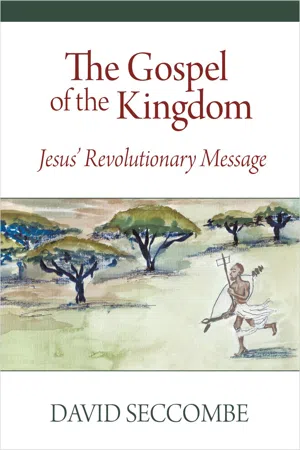
The ancient Israelite “gospeller” was a marathon runner carrying an important message, often from the scene of a battle. Getting the news through as quickly as possible was what mattered. In the next case study, we shall see that when the news was good the gospeller could expect a handsome reward.
Case Study 2: King David receives a good gospel
A thousand years before the Christian era, David fled Jerusalem from a coup led by his son Absalom, and Absalom mustered the armies of Israel to march out and crush him. David wished to accompany his own tiny army as they went out to meet Absalom in the forests of Ephraim, but they insisted David stay behind in the walled town of Mahanaim.
Joab led David’s army to a great victory and Absalom’s hosts were thrown into confusion in the dense forest. Joab found Absalom hanging helplessly in the branches of an oak tree and speared him. The army was called back from its pursuit.
At this point in the story we are introduced to two of Israel’s long distance runners, Ahimaaz the son of Zadok, and “the Cushite” (probably a Sudanese man). There was tremendous prestige and financial reward involved in being first with the news of victory. Ahimaaz wanted to run the news to David, but Joab tried to deter him and sent the Cushite instead. Ahimaaz was a favourite, and Joab knew that the death of Absalom would not be good news to the king, not withstanding the victory. “Why should you run, my son? Yo...
Table of contents
- Why I wrote this book
- PART 1: WHAT IS THE GOSPEL?
- CHAPTER 1: Gospel confusion
- CHAPTER 2: The Old Testament and the kingdom of God
- CHAPTER 3: The gospel according to Isaiah
- CHAPTER 4: Jesus’ gospel of the kingdom
- CHAPTER 5: The gospel under fire
- CHAPTER 6: The gospel breaks out
- PART 2: PROCLAIMING THE GOSPEL
- CHAPTER 7: The kingdom’s King
- CHAPTER 8: The crucified King
- CHAPTER 9: Proof of the gospel
- CHAPTER 10: Your kingdom come
- CHAPTER 11: The kingdom now
- CHAPTER 12: Justification by faith
- CHAPTER 13: Gospel life
- APPENDIX 1: The meaning of “gospel” in the Bible
- APPENDIX 2: The righteousness of God in Paul
- Works Cited
- About the Author
- Also by this author
Trusted by 375,005 students
Access to over 1.5 million titles for a fair monthly price.
Study more efficiently using our study tools.
Frequently asked questions
Yes, you can cancel anytime from the Subscription tab in your account settings on the Perlego website. Your subscription will stay active until the end of your current billing period. Learn how to cancel your subscription
No, books cannot be downloaded as external files, such as PDFs, for use outside of Perlego. However, you can download books within the Perlego app for offline reading on mobile or tablet. Learn how to download books offline
Perlego offers two plans: Essential and Complete
- Essential is ideal for learners and professionals who enjoy exploring a wide range of subjects. Access the Essential Library with 800,000+ trusted titles and best-sellers across business, personal growth, and the humanities. Includes unlimited reading time and Standard Read Aloud voice.
- Complete: Perfect for advanced learners and researchers needing full, unrestricted access. Unlock 1.5M+ books across hundreds of subjects, including academic and specialized titles. The Complete Plan also includes advanced features like Premium Read Aloud and Research Assistant.
We are an online textbook subscription service, where you can get access to an entire online library for less than the price of a single book per month. With over 1.5 million books across 990+ topics, we’ve got you covered! Learn about our mission
Look out for the read-aloud symbol on your next book to see if you can listen to it. The read-aloud tool reads text aloud for you, highlighting the text as it is being read. You can pause it, speed it up and slow it down. Learn more about Read Aloud
Yes! You can use the Perlego app on both iOS and Android devices to read anytime, anywhere — even offline. Perfect for commutes or when you’re on the go.
Please note we cannot support devices running on iOS 13 and Android 7 or earlier. Learn more about using the app
Please note we cannot support devices running on iOS 13 and Android 7 or earlier. Learn more about using the app
Yes, you can access The Gospel of the Kingdom by David Seccombe in PDF and/or ePUB format, as well as other popular books in Theology & Religion & Biblical Studies. We have over 1.5 million books available in our catalogue for you to explore.