eBook - ePub
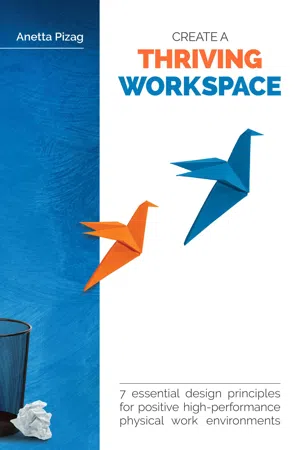
Create a Thriving Workspace
7 Essential Design Principles for Positive High-Performance Physical Work Environments
- English
- ePUB (mobile friendly)
- Available on iOS & Android
eBook - ePub
Create a Thriving Workspace
7 Essential Design Principles for Positive High-Performance Physical Work Environments
Information
Topic
ArchitectureSubtopic
Interior DesignCREATE SPACE FOR A VISIONARY BUSINESS
Creating a workspace that embodies the DNA of your organisation
Who are we? Why are we here? What is important to us? What difference are we making? ... Creating a ‘Visionary’ workspace is about asking these big questions and then translating the answers into timber and steel, furniture and paint – the physical environment. A space that embodies the essence and purpose of your business not only unifies people and makes them a stronger team, but keeps everyone on track on the company’s journey towards creating a better future for its clients, members and stakeholders.
The big picture
The ‘visionary’ workplace
By looking at the place where a person lives, we can find out a lot about them: Are they shy or outgoing? Rebellious or conforming? Adventurous or creatures of habit? Loners or team players? What are their interests and hobbies? Do they make their own path or follow others? Are they pursuing clear goals or just drifting around? ... And we get a sense of how well we would probably get along.
Similarly, when looking around a workplace, we tend to draw conclusions about the organisation: who their members are, what is important to them, how they aim to improve people’s lives, and what sort of experience they create for their own teams as well as their clients through their products, services, and the way they do business.
In a ‘visionary’ workplace these messages reflect the truth and highlight the best of the business. The space embodies the organisation’s purpose, values and brand. Everything people see and feel in the space aligns with, and even enhances, what they already know about the business.
Why is this important?
Both as workers and as customers, we don’t just want to make transactions; we want to engage with organisations that stand for something bigger than themselves – a worthwhile cause. We want to feel that through our work or purchase we contribute to a happier, fairer, more inspiring world. We want to be on a journey with those who are on our side, who share our standards, beliefs and passions.
To attract committed people, your businesses needs to present itself clearly and consistently across all communication platforms, including the work environment; it needs to demonstrate the values, beliefs and personalities you seek to attract. This will make it easier for your clients to get to know and trust you, and for your team members to commit to your vision. Imagine dealing with people who just know they are in the right place as soon as they come through the door, whether for the first time or for the thousandth time.
Miscommunication happens
Relatively few organisations operate in workspaces that speak the same ‘language’ as they do. The question I often ask of leaders, ‘What messages do you aim to communicate through the space to your teams, clients and the market?’ usually remains unanswered.
It’s a common misconception that people don’t need constant reinforcement of what the business aims to achieve; it’s assumed that those who are in touch with the business should already be clear about that.
Many leaders believe that in order to articulate who they are as a business, all they need to do is market their business well, engage in conversations with their stakeholders, and offer products or services that speak for themselves. These are of course important. However, those leaders fail to recognise that the workplace also has its role in this process – that it essentially acts as a ‘message board’, speaking either for or against them.
Some organisations don’t have clearly defined goals, values and brands, so they simply don’t have much of an identity to portray. In contrast, others have solid ideas about who they are, but are confused about how to capture certain elements of their identity through building and interior design. (For example, some people seem to be convinced that the only way to present a clean-cut image1 is to create a sterile-looking environment, or that the only way to incorporate the brand is to use the company’s corporate colours throughout the space, regardless how those colours influence people’s psychology.)
Misleading workspaces
As a result, most workplaces express messages which are incongruent with the organisation’s purpose, values and brand. Even if leaders communicate the most powerful messages through words, this lack of congruence can weaken their meaning!
For example, I know organisations that care about the resolution of environmental issues, but their workspaces waste resources such as energy and water, and send mixed messages about sustainable living and working practices. (I worked for a company in the environmental sector that encouraged its employees to cycle to work, but we were not allowed to store our bikes in the office, because that would look unprofessional.)
I have seen the workplaces of promising start-ups where confidence and belief in the company’s success were among the most appreciated personal attributes of the team. However, their office suggested that the organisation didn’t believe in itself. (The interior showed no sign of planning; every element was thrown together as a quick reaction to urgent needs of accommodating extra staff or equipment. The space communicated scarcity; it was only fitted with the bare essentials, as if spending even a little time and money on making the office nice was something the company couldn’t afford.)
And when you see all those workplaces that look alike, with no character, you just can’t get a sense of the people who work there. These spaces leave us with a feeling of void – a bit like talking to a machine instead of a real person when making a phone call.
These workplaces can erode relationships with anyone coming in. Workers may get inconsistent messages about the vision of the business, and about what sort of behaviour and attitude is expected from them. This can lead to a lack of direction, conflict and indifference – all enemies of high performance. And clients or prospects may get mixed messages about what the business really stands for and struggle to build a connection with the brand.
In such environments, businesses often struggle to attract the right people (staff, clients and business partners) and opportunities, or keep attracting the wrong ones. Clients are more likely to see the business as a commodity, so it is forced to compete on price. The space can even undermine the reputation of the business, and raise questions about its integrity.

I’ve never in the past applied for a job without researching the employer and checking out if their vision and values aligned with mine. It was always important for me that the company I worked for was committed to creating healthy, aesthetic, green environments. I was competitive; I got an offer after most of my interviews. However, I stopped counting how many times I needed to say ‘no’ to employers that I had previously seen as heroes, because their workplaces didn’t at all reflect the values they claimed to have. While they took pride in creating high quality architecture, they worked in dark, stuffy, uninspiring offices.
Some may perceive this attitude as superficial judgement, or maybe even arrogance. But would you trust working with building professionals whose own workspace was clearly a low priority for them? And how enthusiastic would you be about joining their teams?
Following our calling, finding our fellows
We all strive to make a difference in our lives, to make this world a better place somehow. But the extent to which are we able to fulfil our purpose through work varies. We view our work either as a ‘job’, a ‘career’, or a ‘mission’ / ‘calling’. Those with a ‘job’ only work to make a living, and they look forward to being somewhere else after work where real life happens. Those who pursue a ‘career’ are motivated to learn, and they want to improve their skills and succeed. But only those who see their work as a ‘mission’ or ‘calling’ find their work tru...
Table of contents
- Let’s Begin
- Principle 1: Create Space for a VISIONARY Business
- Principle 2: Create Space for a SMART Business
- Principle 3: Create Space for a PRODUCTIVE Business
- Principle 4: Create Space for a DIVERSIFIED Business
- Principle 5: Create Space for a CARING Business
- Principle 6: Create Space for an ENGAGING Business
- Principle 7: Create Space for an EVOLVING Business
- Putting the Pieces Together
- Related Readings
- Acknowledgements
- About Anetta Pizag
- Keep in touch
Trusted by 375,005 students
Access to over 1.5 million titles for a fair monthly price.
Study more efficiently using our study tools.
Frequently asked questions
Yes, you can cancel anytime from the Subscription tab in your account settings on the Perlego website. Your subscription will stay active until the end of your current billing period. Learn how to cancel your subscription
No, books cannot be downloaded as external files, such as PDFs, for use outside of Perlego. However, you can download books within the Perlego app for offline reading on mobile or tablet. Learn how to download books offline
Perlego offers two plans: Essential and Complete
- Essential is ideal for learners and professionals who enjoy exploring a wide range of subjects. Access the Essential Library with 800,000+ trusted titles and best-sellers across business, personal growth, and the humanities. Includes unlimited reading time and Standard Read Aloud voice.
- Complete: Perfect for advanced learners and researchers needing full, unrestricted access. Unlock 1.5M+ books across hundreds of subjects, including academic and specialized titles. The Complete Plan also includes advanced features like Premium Read Aloud and Research Assistant.
We are an online textbook subscription service, where you can get access to an entire online library for less than the price of a single book per month. With over 1.5 million books across 990+ topics, we’ve got you covered! Learn about our mission
Look out for the read-aloud symbol on your next book to see if you can listen to it. The read-aloud tool reads text aloud for you, highlighting the text as it is being read. You can pause it, speed it up and slow it down. Learn more about Read Aloud
Yes! You can use the Perlego app on both iOS and Android devices to read anytime, anywhere — even offline. Perfect for commutes or when you’re on the go.
Please note we cannot support devices running on iOS 13 and Android 7 or earlier. Learn more about using the app
Please note we cannot support devices running on iOS 13 and Android 7 or earlier. Learn more about using the app
Yes, you can access Create a Thriving Workspace by Anetta Pizag in PDF and/or ePUB format, as well as other popular books in Architecture & Interior Design. We have over 1.5 million books available in our catalogue for you to explore.