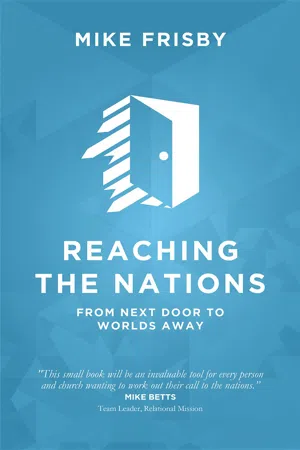
eBook - ePub
Reaching the Nations: How to
identify, prepare and support local church members to become cross-cultural servants
- English
- ePUB (mobile friendly)
- Available on iOS & Android
eBook - ePub
Reaching the Nations: How to
identify, prepare and support local church members to become cross-cultural servants
Information
Topic
Theology & ReligionSubtopic
Christian Church1
NO WELL-WORN PATHS!
In the nineteenth century friends of Dr David Livingstone, Scotland's most famous missionary and explorer wrote him the following message while he was serving in Africa: “We would like to send other men to you. Have you found a good road into your area yet?” Livingstone replied, “If you have men who will only come if there is a good road, I don't want them. I want men who will come if there is no road at all.”
These challenging and stirring words of David Livingstone provide a much needed provocation to us in this the twenty-first century. They are also a reminder of a prophetic word given in a leaders’ gathering back in the very early days of the Newfrontiers family of churches:
John Groves saw a herd of elephants running together towards a jungle. The way ahead looked totally impenetrable, but the elephants kept running forward and burst through the undergrowth, making a way where there was no way. Their combined strength broke through and a path was formed that others could subsequently use. The opening words of his prophecy were, “There are no well-worn paths ahead of you,” and it continued, “Together you can accomplish more than you could ever accomplish alone.”
Today we are looking for people to “make a way where there is no way”. Ordinary people, who possess a similar kind of pioneer spirit to that which David Livingstone was looking for; men and women who, despite the cost, are willing to work sacrificially alongside others to see the kingdom of God extended throughout the whole earth.
In many parts of the world today people are waiting to hear the good news of salvation in Jesus for the very first time. Indeed, in order for some people groups to hear the gospel a literal road will need to be cut where no path currently exists!
For some people, serving God's purposes will involve them in crossing frontiers of a different kind – it will mean crossing new linguistic, social or cultural frontiers. For others it will be the opening up of new areas by the application of scientific and technological discoveries that accelerate and extend the advance of the gospel worldwide.
Each new generation faces not only a set of new challenges, but also an abundance of fresh God-given opportunities! Let me outline a few of the current challenges, not simply to inform, but hopefully to stir your faith as a local church to become involved in God's great plan to bless all the nations!
Let's start by looking at the term ‘globalisation’. Definitions abound for this term, but it is generally agreed that globalisation is primarily about increasing economic integration.
In the developing or two-thirds world a good number of the population are so poor that they have very little to integrate and are often bypassed by new technologies, leading many commentators to suggest that globalisation is leading to a clear case of the rich getting richer while the poor get poorer!
Jimmy Carter, the former US President, called the growing disparity between rich and poor the “ultimate challenge of the twenty-first century”. He remarked that, “there is an insensitivity even an unawareness in the rich developed world about the plight of people in the poverty stricken, under-developed world. It is a chasm that's growing and I don't see any encouraging movements in the US or Europe or Japan or other rich countries to address it”.
The Bible witnesses to a God who works on behalf of the weak, the vulnerable, and the poor. He is depicted as being concerned about issues of justice, which must include global economic justice.
Scripture clearly states that part of our apostolic mission is to “remember the poor”, something the Apostle Paul was eager to do! (Galatians 2:10)
It should not surprise us then that God expects us, as His people, to demonstrate a real concern for those whose social and economic standing expose them to exploitation and oppression. Our Christian witness must involve both social and political action on behalf of the poor.
Pope Francis recently wrote, in a paper on the proclamation of the gospel in today’s world, “Each individual Christian and every community is called to be an instrument of God for the liberation and promotion of the poor, and for enabling them to be fully a part of society. This demands that we be docile (teachable) and attentive to the cry of the poor and come to their aid.”
In today's world over a billion people lack access to clean water, while further billions lack adequate sanitation. Add to this the increase in natural disasters and it is not too difficult to understand World Vision’s claim that “Every three seconds a child dies as a direct result of poverty.”
One of the ways we could help meet the needs of some of the poorest peoples of the world would be by the provision of job-creation schemes or by encouraging sustainable small-scale enterprises run by the poor. However, if the workforce in developing countries is to take full advantage of these economic opportunities, attention must be given to both their education and health. Poverty has many faces. For some it centres on a lack of ‘essentials’ like food, clean water, adequate housing, health care, employment, schools and good roads. For others its focus is a lack of education, knowledge, skills or access to new technologies. For still others the crux of their poverty may lie in their inability to have any meaningful influence over their current well-being or future life.
Disaster response and relief, community and enterprise development, and advocacy are all ways the church can respond to the needs of the poor. However, the challenge is to respond in such a way that the poor are not demeaned or devalued. Any solution must involve working together with them; empowering them to create their own solutions and enabling them to make choices about their own future.
Responding to the needs of the world's poor opens wide a door of opportunity for people in our churches – business personnel, economists, lawyers, politicians, health workers, educationalists and many, many, others.
According to Jesus the gospel is first and foremost good news for the poor! What a privilege then that the local church, through the sharing of the gospel, can see men’s and women’s lives transformed by being restored to a right relationship with God and their fellow man.
James said to the early church, “Has not God chosen those who are poor in the eyes of the world to be rich in faith and to inherit the kingdom he promised those who love him?” (James 2:5)
Another feature of life in the twenty-first century is the growing urbanisation of our planet. Vast numbers of people are moving from the countryside into towns and cities. This movement is not only due to population growth and the search for adequate resources, but also people moving in search of a ‘better’ life.
A hundred years ago, two in ten people lived in cities. By 2010 around 50% of the world was urbanised, and currently the urbanised population is growing by 60 million per year. It is estimated that by the year 2030, six in ten people will be living in cities. (N.B. Growth in urbanisation in the less economically developed nations of the world doubled in the last half of the twentieth Century, particularly in Africa, Asia & South America.)
The economic and social problems that arise from urbanisation are well known. Pictures of the ‘shanty towns’ that often spring up in or around large cities in the developing world regularly hit our media, as do documentaries on the ‘problems of the inner city’. Overcrowding, pollution, lack of housing and employment, crime, drugs, prostitution, vandalism, truancy, family and community breakdown, all combine to underline the fact that urban living in today's world is no easy option!
But, it is not all ‘doom and gloom’! In many urban communities you can find great resilience, courage, local pride and profound human loyalty. Nevertheless, these areas need people who will sow hope, break down barriers and work alongside others to resolve local concerns and conflicts. We need followers of Jesus prepared to walk in His footsteps and “pitch their tent among them” in order to show urban dwellers what God is like. (See John 1:14).
Staying with the theme of people on the move, another of the key challenges that faces us today is that of migration.
The nineteenth century witnessed a move of people from their own shores out to other countries and continents. This was particularly true of people who went from Europe out to the great continents of Africa, Asia and South America. However, the twentieth century saw a movement in the opposite direction with many people from these great Continents returning to the 'motherland' or 'home' nation. At the start of the twenty-first century the movement of people both within and across national borders continues unabated.
Some move to escape natural disasters like floods or famine, while others move for economic reasons, to escape poverty or simply to better themselves. Many more move as the result of conflict and war and the ugly resurgence of ‘ethnic cleansing’. Moving for the purposes of employment or education is not unusual in today’s world.
The United Nations High Commissioner for Refugees (UNHCR) deals with asylum seekers, refugees returning home and displaced people within their own country. In 2016 their records showed 65.6 million forcibly displaced people of which, 40.3 million were internally displaced, 22.5 million were refugees and 2.8 million were asylum seekers.
Many nations today are dealing with the problems of oppression and violence towards ethnic minorities and immigrant communities. Facilitating integration and maintaining stability where people are acutely aware of those who ‘have’ and those who ‘have not’ is no easy task.
Yet, here again is an opportunity for the church to become involved. The church can act as an agent of reconciliation and change within its local community and can seek to influence key policy makers. Practical demonstrations of love and care can build important bridges into communities so that the gospel can be shared across cultures.
The nations are no longer ‘over there’ but right on our doorstep. Opportunities for churches abound among refugees and asylum seekers, to say nothing of the many thousands of international students, tourists and business people that visit our shores each year.
Talking of “right on our doorstep”, here in the United Kingdom we must not forget the enormous needs of Europe, of which we are a part. Western Europe in particular needs re-evangelising.
Over the last hundred years or so secularism has swept through Western Europe. Many people have moved away from the certainties of Europe's Judeo-Christian heritage and many governments are dispensing with the very standards that once under-girded Europe's culture and development.
For many, God is considered to be dead or, at the very least, totally irrelevant. Christians are increasingly seen as a hindrance to social change and progress, and where the church does exist it is often considered to be a remnant of a bygone age.
Europe is seeing a breakdown in the family and the fragmentation of society. Feelings of isolation, loneliness and alienation abound and a once strong sense of community spirit is fading fast. Nevertheless, many people who are disillusioned with life are searching for a new spirituality. Some, as in the past, have turned to the occult, others to New Age thinking, new atheism, and numbers to eastern religious worldviews.
What an opportunity confronts us to show the relevance of Christ to these ‘seekers’ with their multiplicity of questions and personal struggles! We need hundreds of local churches who, by incarnation (living the truth) and by proclamation (telling the truth), demonstrate what it means to follow and live under the rule of King Jesus; vibrant communities full of the life of God, who act as salt and light and make known the manifold wisdom of God!
Another area of challenge is Europe’s children, indeed the children of the whole world. What are the future prospects for the coming generations?
At this present time millions of children are involved in child labour, many in the most appalling conditions imaginable. Countless others live on the world's streets, and millions more are involved in the sex trade.
Over the last decade many children have been forced to become child soldiers and the ravages of war have seen millions left homeless, psychologically traumatised and physically disabled. It will take much time before these mental, physical and emotional scars are healed.
Children also suffer alongside their parents as a result of famine and natural disasters but are often much more vulnerable to sickness and disease. On many continents children are carrying the HIV virus and have witnessed the death of parents and relatives.
It is a scandal that, on average, more than 25,000 children under the age of five die each day from malnutrition and easily preventable diseases. Hiroshi Nakajima, The Director General of the World Health Organisation (WHO) called this “the silent genocide on our planet”.
Over half of the world's population is now under 25 years of age, a third under 15 years of age. Of those under 15 years of age most live in the developing or two-thirds world and are often subject to many of the hardships and traumas we have just outlined.
As well as engaging in social and political action on behalf of the children and young people of the world we must also raise up key workers to specifically minister to the spiritual needs of the young.
Many believe there is evidence to show that large numbers of people take their first steps in following Christ between the ages of four and fourteen. Whether or not this view can be substantiated, there is no doubting that today among the young of the world, “the harvest is indeed plentiful but the labourers are few”!
One of the most important influences on the life of a child is its mother and in many countries women are the key agents of any social change. Some would say women are the key to reaching many of the world's resistant people groups ...
Table of contents
- Introduction
- 1 No Well-Worn Paths!
- 2 Introduction to the notes for leaders
- 3 Profiling the Personnel
- 4 Clarifying the Call
- 5 Researching the route
- 6 Sending the Servers
- 7 Maintaining the Momentum
- 8 Debriefing Questionnaire
- 9 Recommended Reading
- 10 Questionnaires
- Ten Observations on Short-Term, Long-Term and Secular Work
Trusted by 375,005 students
Access to over 1.5 million titles for a fair monthly price.
Study more efficiently using our study tools.
Frequently asked questions
Yes, you can cancel anytime from the Subscription tab in your account settings on the Perlego website. Your subscription will stay active until the end of your current billing period. Learn how to cancel your subscription
No, books cannot be downloaded as external files, such as PDFs, for use outside of Perlego. However, you can download books within the Perlego app for offline reading on mobile or tablet. Learn how to download books offline
Perlego offers two plans: Essential and Complete
- Essential is ideal for learners and professionals who enjoy exploring a wide range of subjects. Access the Essential Library with 800,000+ trusted titles and best-sellers across business, personal growth, and the humanities. Includes unlimited reading time and Standard Read Aloud voice.
- Complete: Perfect for advanced learners and researchers needing full, unrestricted access. Unlock 1.5M+ books across hundreds of subjects, including academic and specialized titles. The Complete Plan also includes advanced features like Premium Read Aloud and Research Assistant.
We are an online textbook subscription service, where you can get access to an entire online library for less than the price of a single book per month. With over 1.5 million books across 990+ topics, we’ve got you covered! Learn about our mission
Look out for the read-aloud symbol on your next book to see if you can listen to it. The read-aloud tool reads text aloud for you, highlighting the text as it is being read. You can pause it, speed it up and slow it down. Learn more about Read Aloud
Yes! You can use the Perlego app on both iOS and Android devices to read anytime, anywhere — even offline. Perfect for commutes or when you’re on the go.
Please note we cannot support devices running on iOS 13 and Android 7 or earlier. Learn more about using the app
Please note we cannot support devices running on iOS 13 and Android 7 or earlier. Learn more about using the app
Yes, you can access Reaching the Nations: How to by Mike Frisby in PDF and/or ePUB format, as well as other popular books in Theology & Religion & Christian Church. We have over 1.5 million books available in our catalogue for you to explore.