- English
- ePUB (mobile friendly)
- Available on iOS & Android
eBook - ePub
Information
Topic
PsicologíaSubtopic
Asesoramiento psicoterapéuticoCHAPTER 1
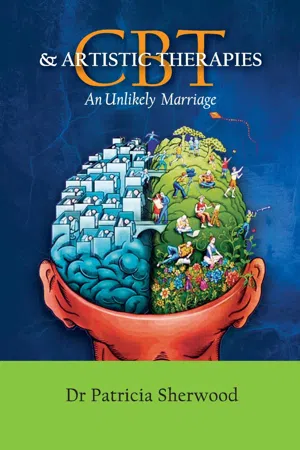
CBT and Artistic therapies: an unlikely marriage
“Logic will get you from A to B. Imagination will take you everywhere.”
It is a common misconception that art therapy and cognitive behavioural therapy (CBT) are antithetical and hence not suitable companions in the therapeutic encounter. Art therapy is seen as spontaneous, creative, irrational, illogical, non verifiable, while CBT prides itself on its controlled, directed, rational, logical, verifiable interventions that can be researched to provide evidence based interventions. While the CBT critique of art therapies may be valid for many types of art therapy, there is a select range of artistic therapy exercises that are compatible with the CBT model, which are controlled, directed, rational, and intersubjectively verifiable, and which can provide repeatable outcomes for individual clients or groups of clients. I will focus primarily on diagnostic techniques as well as artistic interventions that can be evaluated both pre and post the intervention. I will apply concrete observable methods of evaluating these somatically based artistic interventions. The sequential nature of these art therapy sequences means that they would provide a suitable research subject that in time could contribute towards establishing their verifiability in an empirical model.
Traditionally art therapies have been viewed as somewhat one off events, producing a range of outcomes that are not readily observable or repeatable. Hence priding themselves on their evidence based outcomes, CBT therapists have generally been loath to embrace the artistic therapies. To date, art therapies incorporated by CBT therapists have been used peripherally. Colouring in pictures for children, or pre-set mandalas for older clients (Cunningham, 2010, Mc Neil, 2011) are such examples and it is assumed they relax clients or create a more informal therapeutic atmosphere. Other artistic exercises used are often fairly superficial such as drawing lists or maps of change processes, often not particularly artistic but more perfunctory. They usually consist of worksheets with given artistic shapes that the clients fill or colour in. The CBT Art Activity book (Guest, 2016) epitomises this approach as does Lowenstein’s book Creative CBT interventions for children with anxiety (2016). While there is definitely a role for such art activities in CBT therapy, they remain superficial adjuncts to the CBT therapy process. They do not become in-depth interventions that at their very heart incorporate detailed CBT characteristics such as tracking bodily sensations, having precise behavioural change goals, utilising reinforcers and repetition in establishing the new social skills, and cognitive restructuring and reframing. There are no clearly defined processes for pre and post artistic interventions that are repeatable by different therapists with different clients, in a range of different environments and as such art therapy has traditionally remained a random adjunct to the CBT model of therapy.
The model of artistic therapies in this book will provide the following:
1.clear theoretical rational of how the art therapy exercise relates to the core principles of CBT
2.precise behavioural goals of the art therapy exercises
3.specific outlines of illustrated artistic therapy exercises
4.exercises that are repeatable across a wide range of clients in a wide range of therapy settings
5.clear pre and post interventions in many cases that can be observed through changes of breathing within clients.
Art therapy exercises selected are compatible with the CBT focus on one of the following: bodily sensations, behavioural change, reinforcers, repetition, imagery suggestions, behavioural activation strategies, social skills, behavioural experiments, desensitisation and cognitive restructuring. These art therapy processes will provide an additional option for CBT therapists particularly when working with challenging clients and clients with low verbal skills.
ARTISTIC THERAPIES AND CBT
The artistic therapies embrace a wide range of creative art therapies including colour and painting therapy, dance therapy, drama therapy, clay therapy, and sand play. Within each of these sub-disciplines of the artistic therapies is a great variety of approaches, techniques and theoretical foundations. Essentially, there are art therapists who focus on the process while others focus on the projected meaning. The more abstract the focus of art therapists and the more committed to the exploration of the unconscious material, the more distant the art therapy approach becomes in relation to applications compatible with the CBT models of therapy. The paths increasingly diverge when these aspects are emphasized leaving many CBT therapists unable to bridge the distance to art therapy at all as described below:
Cognitive behaviour therapy (CBT) focuses on observable behaviour and conscious thoughts. This approach only works where those thoughts and behaviours can be accessed. Art therapy taps into the unconscious, where there is no concept of time, i.e., what was relevant 30 years ago might still be as relevant at present. Art therapy attempts to make the unconscious conscious and thus enable a fundamental change in the client’s thinking. (Gray, 2015).
This art therapy model that I use and have developed, is based on a somatic psychotherapeutic foundation which means that it is clearly focused on bodily sensations, behaviour and breathing, which are all key concepts in a CBT approach. This immediately provides a bridge to connect CBT with an artistic model of therapy. The common CBT model focuses on the here and now, looking at the present moment and the contribution to the presenting issue expressed through the client’s behaviours, bodily sensations, thoughts and emotions (Ivey, Andrea, Ivey, Simek-Morgan, 2002).
In addition, the somatically based art therapy exercises elucidated in this book are presented as repeatable sequences that once mastered can be applied across a range of clients in a diversity of situations. In clay for example, there is a sequence for anger, one for grief and loss, one for speaking up for oneself, and a sequence for releasing guilt. These sequences have a number of repeatable steps, usually three to five and can be conducted by the therapist and taught to the client to repeat outside of the therapeutic environment if required. In fact, some therapeutic issues such as grief and loss recovery for example have a three stage sequence, which the client repeats over 21 days using watercolour, or clay depending on their preferences. This repetition every day acts as a strong predictor of behavioural change, a core tenant of CBT therapy. In addition, it reinforces not just a positive transformative thinking process but one, which is also reflected in bodily actions so that the likelihood of the new behaviour being sustained is increased. Selected art therapies can facilitate the embodiment of new memories. This is elucidated by some of the latest neurolinguistic research:
Daniel Casasanto of the Max Planck Institute for Psycholinguistics in Nijmegen and Katinka Dijkstra of Erasmus University in Rotterdam investigate embodied cognition – how the body shapes mental activity – and they have already found ways in which our thoughts are influenced by the shape and form of the body... in 2007, Dijkstra showed that assuming the body posture associated with a particular experience can aid recall of the memories of that experience. These studies hint at the embodiment of abstract concepts... (Mo, 2010).
Hence, art therapy that engages the body in new shapes and movements to reflect the new positive behaviour change whether through drawing, clay, movement, gesture, breathing, clay or drama contributes to the embodiment of the new desirable behaviour if repeated regularly.
Modelling of new social skills is also effected through these somatically based artistic therapy sequences which when repeated daily facilitate behavioural and cognitive change in the client’s life. Speaking up sequences and the empathy development sequences that are completed in clay demonstrate this aspect of therapy later in the book. The development of new social skills, core to the CBT therapeutic process, while taught in the therapeutic session require repetitive and continued practice, to effect the desired behaviour change. The selected art therapies, as I apply them, provide an ideal concrete, observable, tangible and interesting medium for the client to practice and ultimately embody behaviour change so that it is not just verbalized or thought about but it is manifested in the individual’s behaviour. When the artistic medium chosen is particularly meaningful to the client then the positive rewards of completing daily exercises result in a process of behavioural activation where the reinforcer consolidates the desired behavioural change. The translation from thought to behaviour, from words to behaviour is a problem that many CBT therapists face especially in the clinical environment of today with scarce resources and limited numbers of therapy sessions per client. These art sequences give the client the opportunity to embody a behaviour through practising behavioural change expressed through art forms on a regular and repetitive basis. They also provide precise and focused artistic therapy interventions to consolidate cognitive reframing and restructuring that is at the heart of many CBT therapy sessions and they work to extinguish maladaptive self-talk over time. In this way, CBT works with these artistic therapeutic sequences, as hand in glove.
Finally, some of these somatically based art therapeutic sequences facilitate clients in the process of desensitisation to trauma particularly the sequences related to entering into a trauma and exiting a trauma. They are bodily based and tracked through the body by sensing into the stressed parts of the body, where breathing is contracted. They give the client the ability to establish control over the traumatic experience so that they cease gradually to be re-traumatised by the experience. They provide precise steps for entering into the trauma, re-experiencing the trauma and exiting the trauma and transforming it with the new information acquired through the bodily experiences of these memories. As such, they are a powerful adjunct to exposure and desensitisation therapies undertaken by some CBT therapists.
In essence, in the following chapters are precise therapeutic sequences using different artistic mediums that facilitate the goals and principles of CBT therapy and add to the diversity of techniques and tools used by a CBT therapist to achieve their goals.
REFERENCES
Cunningham, L.(2010) The Mandala Book: patterns of the Universe. NY, Sterling Publishing.
Dijkstra, K., et al. (2007). Body posture facilitates retrieval of autobiographical memories. Cognition 102:139-149.
Einstein, A., (n.d.) https://artztherapy.wordpress.com/art-therapy-quotes/
Gray, R. (2015) The art of healing and healing in art therapy In Psych, Retrieved from: https://www.psychology.org.au/inpsych/2015/june/gray/
Guest, J. (2016) The CBT Art Activity Book. London: Jessica Kingsley.
Ivey, A. Andrea, M. Ivey, M. Simek -Morgan, L. (2002). Theories of counselling and Psychotherapy; a multicultural perspective Boston: Pearson.
Lowenstein, L. (2016) Creative CBT interventions for children with anxiety Toronto: Champion Press.
Mc Neill, S. (2011) Zen Mandalas: Sacred circles inspired by Zentagle. East Petersburg, PA: Fox Chapel publishing.
Mo, (2010) Bodily motions influence memory and emotions Neurophilosophy Retrieved January, 2017 from: http://scienceblogs.com/neurophilosophy/2010/04/21/motions-influence-emotions/
CHAPTER 2
Diagnostic artistic exercises and CBT
“Art is the creation of forms symbolic of human feeling.”
CBT has a strong commitment to diagnosis in therapy and has developed a battery of verbal diagnostic processes. These art therapy diagnostic processes are presented as an adjunct tool to some of these tests. They provide a sensory method for obtaining some types of information from challenging clients, clients who do not or will not talk or for whatever reason are unable to respond satisfactorily to written and/ or verbal questionnaires. They are also relevant for use with children and some adolescents. Of course, they can also be used for any clients who respond positively to the particular art medium used in each exercise. Here, are outlined, a sample of diagnostic exercises from clay therapy and art therapy used primarily with children and adolescents.
BODY MAPPING FOR DIAGNOSTIC PURPOSES WITH CHILDREN
Often with small children, it is difficult to identify the origins of the problem from the child’s perspective. It is common in this day of rapid change for young children to present with anxiety. A five year old presents with anxiety about going to school but he is unable to explain the cause of the anxiety. The immediate quest is to narrow down the potential anxious behaviour to either the classroom or the playground. I have many cases in today’s world of rising divorces, of young children presenting in therapy with anxiety or stress related issues at home that both parents believe are caused by the other parent. The child either does not know what is causing the anxiety or is unwilling to say for fear of alienating one or both parents. Body mapping is a very useful art based tool, which immediately and clearly gives direction as to the cause of the problem and usually can be used with children under the age of ten. It enables one to identify the environment in which the primary stress is arising so that one can focus the interventions more accurately.
BODY MAP SEQUENCE
Step 1: Ask the child to choose a colour to represent each of the following feelings: sad, bad, happy, scared, and angry. On a sheet...
Table of contents
- Cover
- Title page
- Copyright
- Dedication
- Contents
- Chapter 1: CBT and Artistic therapies: an unlikely marriage
- Chapter 2: Diagnostic artistic exercises and CBT
- Chapter 3: Self-regulation and relaxation: artistic therapies in CBT
- Chapter 4: Visualization/guided image making and artistic therapies
- Chapter 5: Social skills training, behavioural experiments and artistic therapies
- Chapter 6: Cognitive art exercises: cognitive restructuring and reframing
- Chapter 7: Exposure, Desensitisation and artistic therapies
- Chapter 8: Relapse Prevention, rewards and artistic therapies
- Chapter 9: About the Author
Trusted by 375,005 students
Access to over 1.5 million titles for a fair monthly price.
Study more efficiently using our study tools.
Frequently asked questions
Yes, you can cancel anytime from the Subscription tab in your account settings on the Perlego website. Your subscription will stay active until the end of your current billing period. Learn how to cancel your subscription
No, books cannot be downloaded as external files, such as PDFs, for use outside of Perlego. However, you can download books within the Perlego app for offline reading on mobile or tablet. Learn how to download books offline
Perlego offers two plans: Essential and Complete
- Essential is ideal for learners and professionals who enjoy exploring a wide range of subjects. Access the Essential Library with 800,000+ trusted titles and best-sellers across business, personal growth, and the humanities. Includes unlimited reading time and Standard Read Aloud voice.
- Complete: Perfect for advanced learners and researchers needing full, unrestricted access. Unlock 1.5M+ books across hundreds of subjects, including academic and specialized titles. The Complete Plan also includes advanced features like Premium Read Aloud and Research Assistant.
We are an online textbook subscription service, where you can get access to an entire online library for less than the price of a single book per month. With over 1.5 million books across 990+ topics, we’ve got you covered! Learn about our mission
Look out for the read-aloud symbol on your next book to see if you can listen to it. The read-aloud tool reads text aloud for you, highlighting the text as it is being read. You can pause it, speed it up and slow it down. Learn more about Read Aloud
Yes! You can use the Perlego app on both iOS and Android devices to read anytime, anywhere — even offline. Perfect for commutes or when you’re on the go.
Please note we cannot support devices running on iOS 13 and Android 7 or earlier. Learn more about using the app
Please note we cannot support devices running on iOS 13 and Android 7 or earlier. Learn more about using the app
Yes, you can access CBT and Artistic Therapies by Patricia Sherwood in PDF and/or ePUB format, as well as other popular books in Psicología & Asesoramiento psicoterapéutico. We have over 1.5 million books available in our catalogue for you to explore.