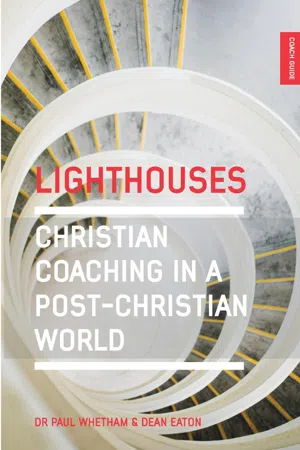
A game changer in local mission. There are already a number of useful resources in the Christian marketplace that teach you how to engage with people who are open to Christianity, even if only tentatively. Lighthouses: Christian Coaching in a Post-Christian World offers something fresh and different; it presents a model for engaging with people who are barely curious about the gospel or even openly resistant to it. Evangelist and church planter Dean Eaton has teamed up with Christian clinical psychologist Dr. Paul Whetham to propose a fresh approach to gospel-sharing based on a coaching model. Lighthouses: Christian Coaching in a Post-Christian World explains how to engage people in a ‘wellbeing conversation’ that leads naturally to an exploration of their identity in God. The book draws heavily on materials developed by Dr. Whetham for Soul Food Café (www.soulfood.cafe), an online resource centre for contemporary gospel-sharers. The basic idea is that by transforming community meeting places and church cafes into informal sacred spaces where people ‘do life together’, you can embark on the search for meaning and give voice to the deeper things of the soul. Lighthouses: Christian Coaching in a Post-Christian World is highly recommended for people looking for a fresh approach to mission and evangelism.
- English
- ePUB (mobile friendly)
- Available on iOS & Android
eBook - ePub
About this book
Trusted by 375,005 students
Access to over 1.5 million titles for a fair monthly price.
Study more efficiently using our study tools.
Information
Topic
Theology & ReligionSubtopic
Christian MinistryCHAPTER ONE
RE-IMAGINING THE ROLE OF EVANGELIST: LIGHTHOUSE COACH
Jesus never had the same conversation twice, so there is no real formula for sharing our faith.
The way evangelical Christians have tended to do evangelism has evolved over the last 100 years. Michael Moynagh in his seminal Church for Every Context: An Introduction to Theology and Practice traces the different approaches to personal evangelism in the 20th century to the present day:
We have gone from crisis conversion, to process conversion to signposts. It was assumed that there was a point at which conversion occurred, a crisis moment, in which an emotionally charged sinner was brought to release and sudden insight by the power of the Spirit. During the 1990s, perceptions in much of the West changed. The evangelistic appeal shifted from “Get up out of your seats and come forward now…” to “Join a group that will be exploring the Christian faith over the coming weeks at …” The idea of conversion at a point in time was not lost, but greater emphasis was placed on the process of conversion. Courses such as Alpha, Christianity Explored, and Emmaus led people through a movement to faith (Moynagh 2012, p. 31).6
More recently there has been a further shift. Writing about contemporary spirituality, the philosopher and intellectual historian Charles Taylor notes that when spirituality is pursued intentionally today, it takes the form of the quest:
People prefer to be on a journey than to reach a destination. Destination speaks of closure, whereas a journey keeps options open. Possibilities must not be shut down by presuming a person’s starting point or ruling something out of court. Individuals must travel their own paths and respect the paths of others. In seeking support, people would rather have resources than ready-made answers. In this climate, while some people will come to a point of conversion and many will follow the process of a structured course, an individual’s pathway to faith is of special importance. There is a greater emphasis on the personal nature of the pathway an individual is on. It is important to remember that these are not alternatives – someone’s pathway may involve a process of study at some stage, and during that process the person may come to a point of commitment. Rather, the emphasis has changed (Moynagh 2012, p. 76).7
Therefore, models of ministry bound to outdated notions of how people gain knowledge and develop their identity will hold back the evangelistic success of the church as a whole. Thus the need to re-imagine how we do evangelism in the 21st century!
Our current context suggests that effective evangelism requires a more reciprocal style involving mutual respect and dialogue with people rather than a mere monologue from us. One may argue this has ever been the way but we beg to differ. Growing up we were taught all sorts of techniques for gospel-sharing that took no account of a person’s context, apart from language. A one-size-fits-all cold-calling salesperson approach was often promoted in evangelical churches. Thankfully, it appears that such practices are less common now, but they have led many people to throw the proverbial baby out with the bathwater. Today we are more comfortable doing social justice and community service but as ‘secret Christians’ because we are unsure about how to share the gospel in a way that feels natural without compromising the message. That is why an approach to gospel-sharing based on a coaching model of spiritual development allows for a more relational, tailored and flexible co-learning approach to witnessing. This is witnessing as co-learning, which aims at discovery of the grace of God together with people, not merely proclaiming to them, as if we ourselves do not ‘sit under’ the word we preach. As the word comes to us in Jesus Christ, we are all – believer and unbeliever – equally tested and judged and in need of repentance and a fresh discovery of the grace of God.
In SENT: Seeking the Orphans of God, Dean Eaton explores this in detail. It proposes that every person is being drawn by God into new life in Christ and therefore every not-yet-Christian person needs a guide, a fellow traveller, a lighthouse to point the way. Because every person we meet is at a different place on their journey toward God, it is important that we discover the stage they have reached, as depicted in this diagram.
Diagram 1: stages to faith and stepping stones8

Once we have discovered where people are on their journey we can offer an appropriate stepping stone that will assist them to advance their understanding and faith.
For example, inviting an antagonistic atheist or apathetic agnostic to church worship will probably annoy her rather than inspire her to further gospel engagement. It may be better to be a faithful friend, declare our faith to her and be low-key in how much we share about the gospel. Over time we build trust and discover the next most appropriate stepping stone that will help her to advance her journey towards God.9
Many resources give you a short course for engaging with people who are at the investigative or converting stages of their journey towards God (S4 and S5 in the above diagram). Some of the best known are Alpha, Christianity Explained, New Life New Love, and Emmaus. However, apart from some apologetics courses that tend towards provoking a reasoned debate and assume a high level of academic ability, there are few resources that train ordinary Christians in how to work with people who are resistant to the gospel. Thus your mission team, missional community, or church-planting team needs to realise the possibility of creating ‘enriched environments’ where we thrive through dialogue and Spirit-led discovery of God and self. But what does this look like in practice?
While metaphors to describe God are limited and often unhelpful, they nonetheless may assist us to describe ourselves in the missional endeavour. Here we introduce the metaphor of a lighthouse to depict what Christian coaching to not-yet-Christian people might look like as we seek to point them to God. Jesus often used the metaphor of light to describe God’s work through people.
You’re here to be light, bringing out the God-colours in the world. God is not a secret to be kept. We’re going public with this, as public as a city on a hill. If I make you light-bearers, you don’t think I’m going to hide you under a bucket, do you? I’m putting you on a light stand. Now that I’ve put you there on a hilltop, on a light stand—shine! Keep open house; be generous with your lives. By opening up to others, you’ll prompt people to open up with God, this generous Father in heaven (Matthew 5:14–16 MSG).
In biblical teaching, Jesus Christ is the light source (John 1), and we are called to be like the reflectors in a lighthouse. In Australia there are reportedly around 350 functioning lighthouses and navigational aids. There is even an inland lighthouse at Point Malcolm in South Australia. As long as there are voyagers seeking to cross oceans, there will always be a need for lighthouses.
a.The role of a Christian coach
This lighthouse metaphor as a descriptor of coaching is, for our purposes, a recasting of the role of gospel-sharer or evangelist as a coach likened to a lighthouse. The lighthouse, originally a coaching concept by Dr Hugo Alberts, professor of psychology at the University of Maastricht (2016),10 did not include spirituality. It has been adapted here (Diagram 2) to illustrate some of the similarities between a lighthouse and a Christian coach.
Diagram 2: similarities between a lighthouse and a Christian coach
| LIGHTHOUSE | CHRISTIAN COACH |
| Does not dictate the direction or destination of the boat | Listens to the person’s journey of discovery in a calm, curious and kind way |
| Illuminates the environment of the boat | Sheds new light on the person’s circumstances |
| Helps to clarify the position of the boat | Helps the person to increase awareness of their soul story, journey of discovery, and personal strengths and weaknesses |
| Assists in navigation by signaling safe entries to harbours and marking dangerous coastlines and hazardous reefs | Assists the person to explore the spiritual world and offers instruction in the gospel to address their questions and issues |
| Always operates in service of the boat and its journey of discovery | Discusses the renewal of the mind through ongoing healing of the person’s past, which Jesus accomplished through the cross and his resurrection |
| Is particularly valuable during stormy weather and when the sea is turbulent | Discusses and prays through times of testing, doubt and disbelief; encourages the person to be the captain of their own soul and live out the Christ-centered life through using the ‘contemplative mind’ |
| Signals safe and welcoming harbours where boats can receive maintenance and captains can share their adventures | Affirms the person’s God-given strengths taken into the world; encourages the person to share their adventures, practice self-care and develop their people skills using the ‘compassionate mind’, and to become a coach or lighthouse to others |
Thus, Christian coaching in a post-Christian world facilitates a co-learning journey that eventually becomes redundant as it assists the other to realise that they are the captain of their own soul and to act accordingly.
Captain of your own soul?
Some Christians may not like the language that we are to assist people to become ‘captains of their own soul’. This is where the use of metaphors can fail us. Indeed, an atheist or agnostic might argue that this should mean that we get rid of the idea of an external deity (god) as ‘captain’ or ruler of our lives and take back control. As a Christian, our first reaction may be to ask the important question, ‘Am I the lord of my life, or is Christ the Lord of my life?’
In using the phrase ‘captain of your soul’ we intend to simply say that we are to take responsibility for our lives, not ownership, as if we are ‘self-made souls’. In other words, when our life (the sailing boat) is launched into the ocean of human experience, are we required to...
Table of contents
- Cover
- Copyright Page
- Acknowledgements
- Dedications
- Contents
- Introduction: Gospel sharing in a post-Christian world
- 1. Re-imagining the role of evangelist: lighthouse coach
- 2 Faith and the search for meaning
- 3 Resilience: developing a contemplative and compassionate mind
- 4 Enriched environments
- 5 The mission
- References
Frequently asked questions
Yes, you can cancel anytime from the Subscription tab in your account settings on the Perlego website. Your subscription will stay active until the end of your current billing period. Learn how to cancel your subscription
No, books cannot be downloaded as external files, such as PDFs, for use outside of Perlego. However, you can download books within the Perlego app for offline reading on mobile or tablet. Learn how to download books offline
Perlego offers two plans: Essential and Complete
- Essential is ideal for learners and professionals who enjoy exploring a wide range of subjects. Access the Essential Library with 800,000+ trusted titles and best-sellers across business, personal growth, and the humanities. Includes unlimited reading time and Standard Read Aloud voice.
- Complete: Perfect for advanced learners and researchers needing full, unrestricted access. Unlock 1.5M+ books across hundreds of subjects, including academic and specialized titles. The Complete Plan also includes advanced features like Premium Read Aloud and Research Assistant.
We are an online textbook subscription service, where you can get access to an entire online library for less than the price of a single book per month. With over 1.5 million books across 990+ topics, we’ve got you covered! Learn about our mission
Look out for the read-aloud symbol on your next book to see if you can listen to it. The read-aloud tool reads text aloud for you, highlighting the text as it is being read. You can pause it, speed it up and slow it down. Learn more about Read Aloud
Yes! You can use the Perlego app on both iOS and Android devices to read anytime, anywhere — even offline. Perfect for commutes or when you’re on the go.
Please note we cannot support devices running on iOS 13 and Android 7 or earlier. Learn more about using the app
Please note we cannot support devices running on iOS 13 and Android 7 or earlier. Learn more about using the app
Yes, you can access Lighthouses by Dean Alan Eaton,Paul Whetham in PDF and/or ePUB format, as well as other popular books in Theology & Religion & Christian Ministry. We have over 1.5 million books available in our catalogue for you to explore.