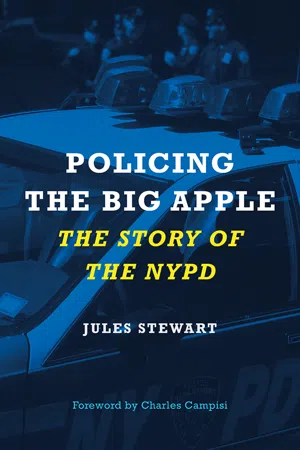
Policing the Big Apple is the story of America’s largest and the world’s most celebrated law enforcement agency. The book covers the full saga of policing New York City, from 1625 in then New Amsterdam, when Johann Lampo became the first cop on the beat, through 1930s battles with the Mafia, to 1990s Zero Tolerance and the NYPD’s role in making New York one of the safest cities in the USA. As well as giving in-depth historical insight, the narrative is peppered with films, television dramas and other cultural depictions of the NYPD.
The story concludes with the NYPD’s role in combatting terrorism, its work forging peaceful community relations with minority groups, and its efforts to enhance the role of women in the force.
- English
- ePUB (mobile friendly)
- Available on iOS & Android
eBook - ePub
About this book
Information
1
The Green Light
‘The long history of the Bowery is one of crime, misadventure, debauchery, desperation, and death. Pickpockets and thieves hung out in every bar. People were drugged, robbed, and kidnapped. Muggers lurked in the shadows.’1
This alarming portrayal of the Bowery would have left Johann Lampo scratching his head in bewilderment. Lampo was arguably the most underemployed patrolman in New York City’s history of policing, spending six years doing his rounds, during which time there is no record of him having made a single arrest. His remit was to settle minor disputes and alert colonists if fires broke out at night.
It is a tribute to the city’s long history of cultural diversity that its first law enforcement officer was a French- and Dutch-speaking Belgian from England. Johann Lampo was born of Walloon parents in Canterbury in 1591. At the age of eighteen, he sailed to the New World to seek his fortune in the Dutch trading outpost of New Amsterdam. He was followed a year later by Peter Minuit, the colony’s first governor, who purchased the island of Manhattan from the Lenape tribe for the equivalent of $24 in trinkets and beads. He struck the deal in the mistaken belief that the Native Americans held title to the land they inhabited, in the sense of Roman-Dutch Law. One of Minuit’s responsibilities was to ensure the proper policing of the colony. He engaged Lampo as schout-fiscal, a rank roughly equivalent to sheriff, a lawman charged with keeping the peace.
Lampo had established his home on a farm, or ‘bowerie’, north of Canal Street. In the seventeenth century the neighbourhood today known as the Bowery was ‘the liveliest spot of the settlement, the heart of the primitive metropolis, the society centre of wilderness.’2 Lampo spent his working hours patrolling New Amsterdam’s waterfront, later to be known as Battery Park after the artillery battery that was installed by the British. Lampo wended his way along the dirt pathways and twisting cobbled streets of Battery Park, one of which was a new highway leading north that would eventually bisect the island roughly through the middle. The Dutch called it de Brede Weg, or Broadway in English. He was empowered to administer punishment to, one might imagine, the few lawbreakers he encountered on his rounds. This ranged from the humiliation of being confined in the stocks to the more painful penalty of the whipping post. In 1632 Lampo sailed back to Amsterdam on the schooner De Eendracht, in the company of Minuit and a cargo of 5,000 beaver hides bound for the Dutch West India Company.
The schout-fiscal system was eventually replaced by the Rattle Watch, a squad of eight patrolmen and a captain charged with a sunset-to-dawn patrol in the increasingly hazardous streets of Battery Park. The team carried green glass lanterns to illuminate the poorly lit lanes. Before the invention of the whistle, they were also equipped with wooden rattles to alert citizens to impending danger, be it from criminals, fires or other threatening situations. Upon hearing this sound, the colonists would rally to defend themselves or form bucket brigades to put out fires. When the lawmen ended their rounds, they returned to the Watch House, the forerunner of the modern police station, and placed their lanterns on a hook by the front door to show they were on the job. The green light became synonymous with assistance for protection against criminal elements, and it is still placed outside the entrances of NYPD precincts to symbolize that the ‘Watch’ is present and vigilant.3
* * *
NEW AMSTERDAM expanded in size and prosperity, and with this growth came an influx of fur hunters, sailors on shore leave and runaway servants from New England or Virginia. To quench the thirst of these rough-and-tumble arrivals, the township experienced a proliferation of taverns, which frequently became the scene of scuffles and brawls in a hard-drinking community. As the settlement was a port of call for international merchant trade, it served as a sanctuary to a large transient population, from which trouble could often be expected.
Sailors on shore leave frequented low waterfront groggeries where flourished gambling and vice and drunken brawls occurred, sometimes ending in murder. Then, too, incoming ships brought hundreds [of] convicts transported fresh from English prisons to the colonies. These unfortunates, without immediate means of subsistence, would often steal or break into houses.4
The spiral in criminal activity was such that, in 1638, the municipality attempted to prevent vessels docking in the harbour from allowing their crews to spend the night in town.
The Dutch authorities responded to a surge in lawlessness by dispensing swift and unmerciful justice. In 1646 Jan Creoly, ‘Negro slave of the Honourable Company’, was convicted of sodomizing a ten-year-old boy. The defendant was condemned ‘to be brought to the place of justice, to be strangled there to death and his body to be burned to ashes, as an example to others’. In 1654 Gerrit Trompetter was convicted of sexually assaulting Anna Tymens, a servant girl, and leaving her pregnant. Trompetter also threatened another woman at knifepoint when she refused to sleep with him. ‘Therefore, the plaintiff concludes that the detainee should be whipped with rods at the customary place, also that all his wages and credited monthly allowances be confiscated for the benefit of the deflowered woman’s child.’ Around that same time, the Dutch schout-fiscal alerted the citizens of New Amsterdam that ‘inhabitants are being attacked and robbed by villainous evil doers in this city and elsewhere in this province’. As part of his crusade against crime, he arrested Hans Breyer, ‘who is notorious on suspicion of and has been convicted of various thefts, and who has sought to lure others from the path of honesty to thievery’. Breyer was turned over to the authorities ‘to carry out a more thorough examination and subjected to torture in order to extract a confession from the obstinate delinquent by customary methods’. The court subsequently ruled that Breyer ‘be punished with the rope until death follows’. Not all cases brought before the courts had so grisly an outcome. The soldier Andries Matthias was arrested for threatening his commanding officer with a knife. Before sentence could be passed, the prisoner managed to escape by leaping over a clapboard fence, while ‘pointing his backside to the fiscal and lifting his leg and slapping it’.5
* * *
WHEN THE ENGLISH took New Amsterdam from the Dutch in 1664, they renamed it New York, a tribute to the Duke of York, the future King James II. Nine years later, the Dutch briefly regained possession of the colony, which they called New Orange after the ruling House of Orange-Nassau. The Dutch reoccupation lasted but one year, after which they permanently ceded the colony to England under the terms of the Treaty of Westminster, which brought to an end the Third Anglo-Dutch War. The arrival of the English brought a heightening of ethnic tension never previously experienced in the colony, despite it being home to speakers of eighteen languages. In 1679, for instance, a party of Dutchmen involved in a brawl with a group of English were heard shouting, ‘Slay the English doggs! Slay the English doggs!’6 It was a portent of the sort of racial conflict that was to become a regular feature of policing New York City, with the law enforcers themselves often cast in the unflattering limelight as perpetrators of abuse against minorities. The colony’s English judicial authorities were forced to ensure proper behaviour by the supposed defenders of law and order. They levied fines well in excess of what had been imposed by the Dutch on officers found guilty of shirking sentinel duty or absence from the Watch, playing cards, swearing, drinking or fighting.
Under English rule, law enforcement was still carried out in much the same way as in the days of the Rattle Watch introduced by the Dutch. The colony’s population was growing swiftly, and it became clear that the homespun model of law enforcement as practised in early colonial days was becoming unworkable. The combination of crushing poverty, massive immigration and desperate crowding turned parts of Manhattan into a hotbed of crime and vice. In the Five Points district, in what is now Manhattan’s Lower East Side, there were reports of at least one murder a night, along with a proliferation of prostitution, drunkenness, pickpocketing and the occasional street riot.
In the early years of the eighteenth century, the haphazard system of the Night Watch was losing its effectiveness. Every adult male was required to undertake watch duty on a rotating basis, though none of them had undergone any semblance of police training. In 1731 the city raised what was planned as a permanent Citizens’ Watch, in which all men living south of today’s Canal Street had to serve or pay for a substitute. The alderman of each ward kept a list of those liable for service, and the constable took eight of them each night for watch duty. Women were theoretically eligible to participate, but there is no record of any ever having served. However, in 1734, one Deborah Careful complained to the press of being ‘forced to pay as much as the richest man in Town for a substitute, tho’ God knows I can hardly buy my bread. I was told I must do it, ’til there was an Act of Assembly to remedy the evil’.7 That same year, numerous complaints similar to that of Deborah Careful led to the abandonment of the Citizens’ Watch and the creation of a more professional, salaried Constables’ Watch.
Gotham on the Rise
By the mid-1700s New York was on its way to becoming an economic powerhouse. The city is located on the Atlantic seaboard, an ideal site for unloading goods shipped from Europe and the Caribbean, and it could now claim a population of 10,000 inhabitants. Of these, almost one in five was an African slave, most of whom worked as household servants or manual labourers. In 1741 tensions between the slaves and their masters reached a flashpoint. Slavery had been instituted by the Dutch, and their numbers increased sharply under the English, who recognized New York’s need for a workforce to serve the booming economy. The first recorded slave revolt took place in 1712, when a small group of Africans set fire to a white farmer’s barn. People with buckets of water who rushed to the scene were ambushed, and in the ensuing melee nine white people were killed. The rioters were rounded up by an enraged group of citizens. Of those brought before magistrates, eighteen were put to death.
Lower Manhattan fell into the grip of fright. The lawmakers reacted by enacting emergency legislation that restricted black burials to a swampy zone outside the city limits. As a further humiliation, funerals needed to be conducted before dark and could not be attended by more than a dozen mourners. It was feared that large crowds might easily be incited to riot. In this climate of mutual mistrust and animosity, it was only too foreseeable that, when in 1741 a blaze broke out at Fort George, now the home of the U.S. Custom House in Lower Manhattan, a furious public immediately pointed the finger at black arsonists. A rash of fires followed, and in less than a fortnight seven homes had been torched to the ground. In none of these instances was it proven that slaves were responsible. Nonetheless, a large number of black people were rounded up and put on trial for conspiracy. The day the guilty verdicts were handed down, seventeen of the accused were hanged and thirteen others burnt at the stake.
* * *
AT THE TIME New Amsterdam fell into English hands, the colony’s only semblance of an organized law-and-order presence was the military. Army regulars, known as the Militia Watch, made the rounds of the port until 1700. After that date they were replaced by the Constables’ Watch, a small patrol unit staffed by civilians. This team consisted of a high constable and twelve sub-constables, whose work is commemorated in the twelve stars that today figure on the NYPD Medal of Honour.8 This turned into little more than a token effort to eradicate a spreading epidemic of attacks on property, burglaries and street muggings. John Holt, a New York printer, complained in 1762 that ‘such various attempts to rob, and so many robberies actually committed, having of late been very frequent within the circuits of this city, both day and night, it has become hazardous for any person to walk in the latter’.9
During the American War of Independence, the New York authorities had little time to devote to such minutiae as raising a municipal police force. The British Army occupied the city in 1776, retaining dominion over it – and, most critically, its port – for the next thirteen years. This was crucial to their strategy of using the city’s harbour as a base for expeditions against other targets in the rebellious colonies. George Washington, commander-in-chief of the Continental Army, was humiliated in several major battles in Manhattan, and the British managed to keep control of New York until they were driven out when the war ended in 1783.
Three years after New York and the other twelve American colonies gained their independence from Britain, the city stepped up what was still a largely informal regime of guarding the streets by reinstating the Night Watch. This comprised one captain and thirty patrolmen. Later, another twenty men were added to the force, as a consequence of the frequent robberies taking place in New York. It was a perfunctory gesture at policing a city whose population in 1786 had swollen to 25,000. The proportion of police and civilian law enforcement agents to civilians at the time was not much different to that of modern New York City: one officer for every 172 citizens in the late eighteenth century, compared with one for every 236 today. The difference, it hardly needs to be emphasized, lay in the paucity of training and equipment of the early units.
The arrival of the British redcoats in 1776 had ushered in an era of unruliness, compared with which the job of keeping the lid on common criminality might have been considered a minor administrative affair. The first British troops to enter New York embarked on a rampage, ‘looting private houses and vandalising City Hall, where they smashed equipment belonging to King’s College, mutilated paintings and destroyed books. On New Year’s Eve 1777, after performing a play entitled The Devil to Pay in the West Indies, a party of drunken officers – one dressed up like Old Nick himself, complete with horns and tail – disrupted services at the John Street Methodist Church.’10 Terrified civilians bore witness to an outbreak of incidences of theft, fraud, robbery and murder, committed by the army of occupation. Along with this disorderly band of soldiers, Loyalists from surrounding war zones escaped to what they imagined to be the safety of New York. Many of these refugees turned into an unruly lot. Having abandoned their homes and the social controls of established communities, they compounded the dilemma of social disorder.
New York was placed under martial law during the war. A commandant was selected by the army to take charge of civil municipal administration. Part and parcel of this restructuring was the creation of an embryonic police corps to enforce military regulations and support the Night Watch. However, this department proved helpless in handling the frequent outbreaks of violence between ordinary citizens and the poorly disciplined troops. Civilian cases against army personnel inundated the courts, but were rarely resolved in the plaintiff ’s favour. The courts functioned without juries, leaving justice in the hands of a magistrate who was almost invariably biased in favour of the military defendants.
Wartime New York was in desperate need of a professional police force: what it lacked was a template for building one. In January 1777, with war still raging between Loyalist and Patriot armies, a group of civilians took it upon themselves to create their own patrols to make up for the lack of protection from the military. One of their greatest fears was a repetition of the arsonist attack of September 1776, which destroyed about one-third of the inhabited city and triggered an outbreak of looting and pillaging. The devastated streets between Broadway and Whitehall became a no man’s land, a place that in short order acquired a reputation for crime and vice that lasted almost to the end of the century. Hundreds of destitute refugees lived cheek by jowl in this area, called ‘Canvas Town’, a pestilent camp of makeshift tents that sprawled westward from the foot of Broad Street through the ruins left by the fire.
This group of eighty patrolmen was still thought of as inadequate. In May 1778, the commandant assigned three civilians to form a quasi-civil department of police whose duties were to suppress vice and licentiousness, support the poor, direct the night watch and regulate all matters which concerned the economy, peace and good order of the city.11
Lacking the full cooperation of the military, New York’s embryonic civilian police department was doomed to be ineffective. Locals sti...
Table of contents
- Front Cover
- Half Title
- Title Page
- Copyright
- Contents
- Foreword by Charles Campisi
- Introduction
- 1. The Green Light
- 2. Turn of the Century Blue
- 3. The Slippery Slope
- 4. ‘Don’t Be Afraid to Muss ’Em Up’
- 5. A Valentine for the Mob
- 6. Fear City
- 7. Get Those Broken Windows Fixed
- 8. Zero Means Zero
- 9. The Force Is With You
- References
- Bibliography
- Acknowledgements
- Photo Acknowledgements
- Index
Trusted by 375,005 students
Access to over 1.5 million titles for a fair monthly price.
Study more efficiently using our study tools.
Frequently asked questions
Yes, you can cancel anytime from the Subscription tab in your account settings on the Perlego website. Your subscription will stay active until the end of your current billing period. Learn how to cancel your subscription
No, books cannot be downloaded as external files, such as PDFs, for use outside of Perlego. However, you can download books within the Perlego app for offline reading on mobile or tablet. Learn how to download books offline
Perlego offers two plans: Essential and Complete
- Essential is ideal for learners and professionals who enjoy exploring a wide range of subjects. Access the Essential Library with 800,000+ trusted titles and best-sellers across business, personal growth, and the humanities. Includes unlimited reading time and Standard Read Aloud voice.
- Complete: Perfect for advanced learners and researchers needing full, unrestricted access. Unlock 1.5M+ books across hundreds of subjects, including academic and specialized titles. The Complete Plan also includes advanced features like Premium Read Aloud and Research Assistant.
We are an online textbook subscription service, where you can get access to an entire online library for less than the price of a single book per month. With over 1.5 million books across 990+ topics, we’ve got you covered! Learn about our mission
Look out for the read-aloud symbol on your next book to see if you can listen to it. The read-aloud tool reads text aloud for you, highlighting the text as it is being read. You can pause it, speed it up and slow it down. Learn more about Read Aloud
Yes! You can use the Perlego app on both iOS and Android devices to read anytime, anywhere — even offline. Perfect for commutes or when you’re on the go.
Please note we cannot support devices running on iOS 13 and Android 7 or earlier. Learn more about using the app
Please note we cannot support devices running on iOS 13 and Android 7 or earlier. Learn more about using the app
Yes, you can access Policing the Big Apple by Jules Stewart in PDF and/or ePUB format, as well as other popular books in History & North American History. We have over 1.5 million books available in our catalogue for you to explore.