John Modern offers a powerful and original critique of neurology's pivotal role in religious history.
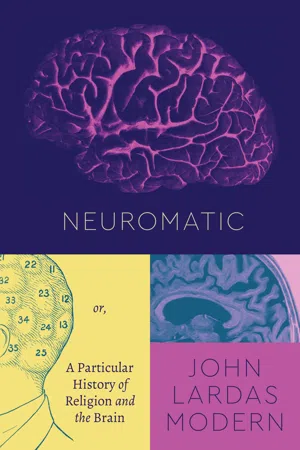
In Neuromatic, religious studies scholar John Lardas Modern offers a sprawling examination of the history of the cognitive revolution and current attempts to locate all that is human in the brain, including spirituality itself. Neuromatic is a wildly original take on the entangled histories of science and religion that lie behind our brain-laden present: from eighteenth-century revivals to the origins of neurology and mystic visions of mental piety in the nineteenth century; from cyberneticians, Scientologists, and parapsychologists in the twentieth century to contemporary claims to have discovered the neural correlates of religion.
What Modern reveals via this grand tour is that our ostensibly secular turn to the brain is bound up at every turn with the religion it discounts, ignores, or actively dismisses. In foregrounding the myths, ritual schemes, and cosmic concerns that have accompanied idealizations of neural networks and inquiries into their structure, Neuromatic takes the reader on a dazzling and disturbing ride through the history of our strange subservience to the brain.
- English
- ePUB (mobile friendly)
- Available on iOS & Android
eBook - ePub
About this book
Information
Publisher
University of Chicago PressYear
2021Print ISBN
9780226799629
9780226797182
eBook ISBN
9780226799599
Topic
Theology & ReligionSubtopic
North American HistoryIndex
Abelson, Robert P., 370n18
abjection, 18. See also submission
abnormality, 79–81, 96n63, 100n75, 114n111, 190, 201, 210, 330n114, 370. See also normalcy
abstract expressionism, 101n77
abstraction, 12, 18, 34–35, 42, 52–53, 93, 101n77, 108n93, 133, 142, 150, 202, 207, 209, 257, 271, 276–78, 283, 314, 327n105, 360. See also masculinist reason
Adams, Evangeline, 247
Adderall, 25
ADHD (Attention Deficit Hyperactive Disorder), 86–87, 92, 114n111, 198n150
Adler, Alfred, 230
Adorno, Theodor, 67n131, 72
Adrian, Edgar, 134, 188–91. See also binary logic
Advanced Research Project Agency of the Office of the Secretary of Defense, 366
affect: bliss, 94n56, 297; claustrophobia, 18n38; confidence, 41, 70–73, 332–33, 343; conjugal, 180n106; cyborg becoming, 9, 122, 373–74, 398n54; docility, 8; enthusiasm, 94, 105–11; flow of, 175, 268, 308; information processing, 18, 135, 206–7, 240, 276–77; of language, 254n90, 270; patriotic, 307; relationality, 18n38; revulsion, 177; shame, 65, 71, 79, 328, 347; technoscientific, 383–86; terror, 17, 395n51; transient emotions in the MRI, 17n36; unknowability, 36–37. See also enchantment; fear; paranoia; wonder
Africa, 58n105, 232, 247
agency: of the brain, 112, 118–23; ...
Table of contents
- Cover
- Title Page
- Copyright Page
- Dedication
- Contents
- List of Figures
- Prologue: Already Gone
- Introduction
- SYNAPTIC GAP: MEASURING RELIGION
- SYNAPTIC GAP: THE INFORMATION OF HISTORY
- SYNAPTIC GAP: TOO MUCH TOO SOON
- SYNAPTIC GAP: WHITE MACHINERY
- SYNAPTIC GAP: BELIEF MOLECULES
- Acknowledgments
- Index
- Footnotes
Trusted by 375,005 students
Access to over 1.5 million titles for a fair monthly price.
Study more efficiently using our study tools.
Frequently asked questions
Yes, you can cancel anytime from the Subscription tab in your account settings on the Perlego website. Your subscription will stay active until the end of your current billing period. Learn how to cancel your subscription
No, books cannot be downloaded as external files, such as PDFs, for use outside of Perlego. However, you can download books within the Perlego app for offline reading on mobile or tablet. Learn how to download books offline
Perlego offers two plans: Essential and Complete
- Essential is ideal for learners and professionals who enjoy exploring a wide range of subjects. Access the Essential Library with 800,000+ trusted titles and best-sellers across business, personal growth, and the humanities. Includes unlimited reading time and Standard Read Aloud voice.
- Complete: Perfect for advanced learners and researchers needing full, unrestricted access. Unlock 1.5M+ books across hundreds of subjects, including academic and specialized titles. The Complete Plan also includes advanced features like Premium Read Aloud and Research Assistant.
We are an online textbook subscription service, where you can get access to an entire online library for less than the price of a single book per month. With over 1.5 million books across 990+ topics, we’ve got you covered! Learn about our mission
Look out for the read-aloud symbol on your next book to see if you can listen to it. The read-aloud tool reads text aloud for you, highlighting the text as it is being read. You can pause it, speed it up and slow it down. Learn more about Read Aloud
Yes! You can use the Perlego app on both iOS and Android devices to read anytime, anywhere — even offline. Perfect for commutes or when you’re on the go.
Please note we cannot support devices running on iOS 13 and Android 7 or earlier. Learn more about using the app
Please note we cannot support devices running on iOS 13 and Android 7 or earlier. Learn more about using the app
Yes, you can access Neuromatic by John Lardas Modern in PDF and/or ePUB format, as well as other popular books in Theology & Religion & North American History. We have over 1.5 million books available in our catalogue for you to explore.