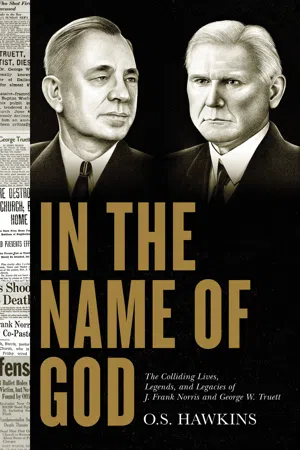
In the Name of God tells the story of two iconic figures of national lore. George W. Truett and J. Frank Norris dominated the ecclesiology and church culture of much of the first half of the twentieth century, not only in Texas, but in the whole of America. Norris, of First Baptist Church in Fort Worth, and Truett, of First Baptist Church in Dallas, lived lives of conflict and controversy. Each led one of the largest churches in the world in the 1920s and & '30s. Each shot and killed a man, one by accident and the other in self-defense. Together, their lives were a panoply of intrigue, espionage, confrontation, manipulation, plotting, scheming, and even blackmail—in the name of God. Yet together... they changed the world.
eBook - ePub
In the Name of God
The Colliding Lives, Legends, and Legacies of J. Frank Norris and George W. Truett
- 224 pages
- English
- ePUB (mobile friendly)
- Available on iOS & Android
eBook - ePub
In the Name of God
The Colliding Lives, Legends, and Legacies of J. Frank Norris and George W. Truett
About this book
Information
Topic
Theology & ReligionSubtopic
History of Christianity1 Two Cities, Two Churches, Two Pastors
Two Cities
The cities of Fort Worth and Dallas have lived side by side in perpetual competition throughout the decades. Since their respective inceptions, they have lived in rivalry with one another. Their constant competition, whether in commerce, athletics, education, or the arts, has been fierce. The Ballpark at Arlington, home of the Texas Rangers; Cowboy Stadium, home of the Dallas Cowboys; and the mammoth Dallas-Fort Worth International Airport all sit in the middle of the “Metroplex” as statements of the standoff and compromise between these two cities.
In their adolescent years, Fort Worth and Dallas fought over the railroads. To this day they continue to fight over commerce, industry, and athletics. Before Major League Baseball arrived in the area, the Fort Worth Cats and the Dallas Eagles of the old Texas League were bitter rivals. Their universities, Texas Christian University (TCU) in Fort Worth and Southern Methodist University (SMU) in Dallas, have fought it out for generations, with TCU emerging victorious most years. TCU had more wins than any football team in the nation in the 1930s and won national titles in 1935 and 1938. The Fort Worth school’s dominance has continued with eight out of ten wins in the last decade.
Dallas
In 1841 Dallas superseded Fort Worth when John Neely Bryan settled on the east fork of the Trinity River and opened a trading post to serve passersby on the old Indian trails of North Texas, which later became the first highways of the Republic of Texas. Neely was convinced the forks in the river would make an ideal spot for a town and trading post. He built a log cabin that, with some restoration, still stands on the old courthouse lawn in downtown Dallas.1
No one knows for certain where Dallas derived its name—most likely from either George Dallas, vice president of the United States from 1845 to 1849, or from Joseph Dallas, who settled near the new town in 1843.2 Because of its water source and prime location, it did not take long for the new little village to become the hub of the surrounding rural areas. Within just ten years of its founding, Dallas boasted insurance agencies, dry goods stores, shoe shops, numerous small industries, and even a weekly newspaper, The Dallas Herald. By the eve of the Civil War in 1860, the population had grown to almost two thousand and was experiencing an infusion of European immigrants and African Americans.3 One year later, the residents voted to secede from the Union and become a Confederate Army outpost. After the war the city boomed with an influx of freed slaves, and by 1870 the population had risen to more than three thousand.4
Knowing that transportation lines are the key to economic growth and expansion, many people attempted to navigate the Trinity River. Most of them failed due to the impracticality of crossing the river. Thus, the city fathers focused their efforts on attracting the railroads. Things came together quickly, and by 1873 they had brought the rail traffic to their new city. In fact, by enticing the Texas and Pacific Railroads to their city, they made Dallas one of the first significant rail crossings in the entire Southwest. Along with the Texas Central line, they had now positioned themselves to transport goods, not just north and south, but also east and west. Cotton became king and Elm Street became its throne, making Dallas the cotton capital of the country. By 1880, in less than a decade, the population had tripled to more than ten thousand.5
The natural outcome of this explosion of commerce was the growth of the banking industry, and with this Dallas was set to become the mega city it eventually became. Insurance quickly followed, and with the addition of electricity and telephones in the 1880s, the city again tripled her population in the next decade. On New Year’s Day 1890, Dallas officially boasted forty thousand citizens.6
However, the 1890s did not roar in Dallas as the national financial crisis brought the failure of several Dallas banks and a number of industries. Cotton prices bottomed out, and the job rate plummeted. But by the turn of the century, the resilient new metropolis had rebounded and was leading other cities in the Southwest in nearly every venue. In 1910, with a population now soaring to more than ninety thousand people, Dallas boasted the world’s leading inland cotton market and led the world in the manufacture and distribution of leather goods and saddles.7
Fort Worth
Meanwhile, something new was arising on the clear fork of the Trinity River, thirty miles west of Dallas. In 1849, a small contingency of Texas Rangers brought Army Major Ripley Arnold to a strategic bluff above the Trinity River. From this elevated perspective, Major Arnold could readily see that this was an ideal spot to establish an army outpost to help ward off the increasing Comanche raids on the area. On June 6, 1849, Major Arnold officially established a United States Army Post on the exact spot:
Major Arnold commanded the outpost of Fort Worth at the age of thirty-two. Six feet tall, slender and graceful, gray eyes, a dominant forehead topped with auburn hair, a good chin and a mouth set in purposeful lines—he had the bearings of youth. He was symbolic of the trait that would dominate Fort Worth’s city pioneering.8
This fort marked the original founding of what would later be known as the city of Fort Worth. This new city was named after General William Jennings Worth, a national hero of the Mexican-American War of 1846. Not only did General Worth never visit the city named in his honor, he died before its official establishment. Today his body rests in a tomb within a large monument on one of the busiest intersections in the world—Fifth Avenue and Broadway—at Worth Square in the Manhattan borough of New York City.9
The city of Fort Worth was incorporated in 1873, and by 1878, “the great American buffalo slaughter was underway, and hides began to arrive in Fort Worth. Wagon freighters often hauled full loads on each round trip, taking supplies to the Plains and returning with buffalo hides.”10 At the peak, sixty thousand hides awaiting shipment would be piled on the platform near the railroad; two hundred thousand hides were processed during the year, making Fort Worth the largest direct buffalo hide market in the world.11
During this same period the Chisholm Trail had become the superhighway for Texas cattle drives on their way to the slaughterhouses in Kansas City, going straight through the middle of town. From the “first days of spring until late summer, cattle was the heartbeat of Fort Worth. Northern cattle buyers with ready cash gathered in Fort Worth … thousands of cattle from sunrise until late afternoon passed through in continuous procession.”12 Fort Worth became the prominent rest stop for weary cattlemen along the trail. The last stop before the final destination in Kansas, the city became a virtual oasis for cowboys in search of rest and relaxation. Not surprisingly, hotels, saloons, gambling halls, and houses of ill repute sprung up on almost every corner. Thus, Fort Worth earned the name that has stuck throughout all these years—“Cowtown, Where the West Begins.” When Amon Carter founded Fort Worth’s most prominent newspaper, The Star-Telegram, he placed the slogan on the masthead: “Fort Worth … Where the West Begins.”13 This slogan has been the rallying cry for the growth and progress of the city until today.
By 1902, the Swift and Armour packing plants had moved their operations to Cowtown, and the economic fortunes of the city were running on all cylinders. The young upstart city was standing toe to toe with Dallas, its rival sister city on the east fork of the Trinity River. Fort Worth had focused every effort on enticing the lucrative company to their new and growing city. Optimism soared as the local paper prophesied that Fort Worth was destined to become “the greatest packing house center in the entire Southwest.”14
Dallas had its nationally known industrial center, and Fort Worth now had its own nationally known enterprise—a red light district known as “Hell’s Half Acre.” Made wildly famous by the likes of Butch Cassidy and the Sundance Kid, along with their female sidekick Etta Place, Hell’s Half Acre actually covered about two acres of the southeast quadrant of downtown and quickly became the home away from home for thousands of cowboys and gunslingers who, from time to time, made their way through Fort Worth. The area was inhabited by dozens of one- and two-story saloons, gambling joints, dance halls, and of course, the sporting houses (more commonly known as “places of ill repute,” among other slang terms). Fort Worth became a popular hideout for desperados, stage coach and train robbers, and every other type of motley character that can be conjured up in the mind. Hell’s Half Acre had a law unto itself. One law enforcer after another failed miserably to maintain any semblance of peace and order. For decades Hell’s Half Acre was a haven for debauchery and depravity. As late as 1911, J. Frank Norris led the First Baptist Church board to approve a statement that no member would be retained on the church rolls “who has any interest, directly or indirectly, in a disorderly house of any kind or class.”15
In 1878, C. K. Fairfax opened the luxurious and lavish three-story El Paso Hotel on the southwest corner of Third and Houston Streets. The El Paso was not only the city’s first three-story structure but also its first genuine first-class hotel. The hotel “boasted eighty rooms, each with solid walnut furniture and Brussels carpet.”16 The El Paso became the favorite attraction for the likes of Bat Masterson, Doc Holliday, and the legendary Wyatt Earp. Quanah Parker, the famous Comanche chief who persuaded his tribe to give up their battle with the white man, was a frequent visitor.17 When Earp visited Fort Worth, he always requested the room on the third floor of the old El Paso Hotel, located in what is today Sundance Square. From there, he had a direct view into one of the most popular sporting houses at night, and from that vantage point he got a free show put on by the prostitutes and their customers.18 This also provided Earp with a way to ensure that his own men were not availing themselves of the extracurricular activities of the evening hours.
Dallas got her big break when a nationwide financial crisis in 1873 brought about a national depression. This brought a stark halt to the building of the Texas and Pacific Railroad, which was supposed to run tracks to Fort Worth but was now forced to stop in Dallas due to failed funding.19 The people of Dallas could not hold back their delight in the assumed demise of their sister to the west. The Dallas media mocked Fort Worth with a caustic report that downtown Fort Worth was so sleepy and empty “a panther had been seen sleeping on the streets in the dying city of Fort Worth.”20 The city fathers in Fort Worth seized upon this and took it as a rallying cry. Fort Worth has been known as “the Panther City” ever since.21 For decades their minor league baseball team carried the mantle of “the Cats,” and a large bronze statue of a watchful panther can be seen to this day across the street from the courthouse in downtown Fort Worth.
Thus, these sister cities emerged in the twentieth century with distinct personalities. The rivalry and competition have grown fiercer over time. John Nance Gardner, former vice president of the United States, was quoted in the November 11, 1938, edition of the Saturday Evening Post as saying, “Amon [Carter, one of the most influential of all Fort Worth’s city fathers] wants the government of the United States to run for the exclusive benefit of Fort Worth and, if possible, to the detriment of Dallas.”22 Carter was “Mr. Fort Worth,” and as owner of The Fort Worth Star-Telegram, WBAP radio, and what is now KXAS (NBC5), he framed and fashioned public opinion and thought in Fort Worth for a half century until the time of his death in 1955.23 One of his most well-known position statements about Fort Worth was, “Fort Worth is where the West begins … Dallas is where the East peters out.”24 Of the lifelong rivalry between Fort Worth and Dallas, Carter was fond of saying the two cities “have tried to bury the hatchet many times but somebody always leaves the handle sticking out.”25 Former CBS television news anchor Bob Schieffer, himself a Fort Worth native and TCU graduate, once even wrote a song that contained this lyric:
Dallas, Dallas how we love you,
But why’s our airport known as DFW?
Move that D. Shift that letter.
FWD sounds so much better.26
These two cities, Dallas and Fort Worth, have grown up together across the decades with diametrically opposite personalities. Dallas is cosmopolitan and extremely class conscious. Fort Worth still strives hard to live up to her reputation of “Where the West Begins” and maintains her former pride as a haven for oil wildcatters and gunsl...
Table of contents
- Introduction
- 1: Two Cities, Two Churches, Two Pastors
- 2: J. Frank Norris: The Texas Tornado
- 3: George W. Truett: The Eternal Optimist
- 4: Conflict and Controversy
- 5: The Influence of J. Frank Norris on Modern Southern Baptist Theology, Church Growth, Evangelism, and Practice
- 6: Conclusion
- Notes
- Bibliography of Primary Sources
- Bibliography of Secondary Sources
- Name and Subject Index
- About the Author
Trusted by 375,005 students
Access to over 1.5 million titles for a fair monthly price.
Study more efficiently using our study tools.
Frequently asked questions
Yes, you can cancel anytime from the Subscription tab in your account settings on the Perlego website. Your subscription will stay active until the end of your current billing period. Learn how to cancel your subscription
No, books cannot be downloaded as external files, such as PDFs, for use outside of Perlego. However, you can download books within the Perlego app for offline reading on mobile or tablet. Learn how to download books offline
Perlego offers two plans: Essential and Complete
- Essential is ideal for learners and professionals who enjoy exploring a wide range of subjects. Access the Essential Library with 800,000+ trusted titles and best-sellers across business, personal growth, and the humanities. Includes unlimited reading time and Standard Read Aloud voice.
- Complete: Perfect for advanced learners and researchers needing full, unrestricted access. Unlock 1.5M+ books across hundreds of subjects, including academic and specialized titles. The Complete Plan also includes advanced features like Premium Read Aloud and Research Assistant.
We are an online textbook subscription service, where you can get access to an entire online library for less than the price of a single book per month. With over 1.5 million books across 990+ topics, we’ve got you covered! Learn about our mission
Look out for the read-aloud symbol on your next book to see if you can listen to it. The read-aloud tool reads text aloud for you, highlighting the text as it is being read. You can pause it, speed it up and slow it down. Learn more about Read Aloud
Yes! You can use the Perlego app on both iOS and Android devices to read anytime, anywhere — even offline. Perfect for commutes or when you’re on the go.
Please note we cannot support devices running on iOS 13 and Android 7 or earlier. Learn more about using the app
Please note we cannot support devices running on iOS 13 and Android 7 or earlier. Learn more about using the app
Yes, you can access In the Name of God by O. S. Hawkins in PDF and/or ePUB format, as well as other popular books in Theology & Religion & History of Christianity. We have over 1.5 million books available in our catalogue for you to explore.