This book shows how small countries use "big" diplomacy to advance national interests and global agendas – from issues of peace and security (the South China Sea and nuclearization in Korea) and human rights (decolonization) to development (landlocked and least developed countries) and environment (hydropower development). Using the case of Laos, it explores how a small landlocked developing state maneuvered among the big players and championed causes of international concern at three of the world's important global institutions – the United Nations (UN), the Association of Southeast Asian Nations (ASEAN) and the Mekong River Commission (MRC).
Recounting the geographical and historical origins behind Laos' diplomacy, this book traces the journey of the country, surrounded by its five larger neighbors China, Thailand, Vietnam, Myanmar and Cambodia, and influenced by superpower rivalries, from the Cold War to the post-Cold War eras. The book is written from an integrated perspective of a French-educated Lao diplomat with over 40 years of experience in various senior roles in the Lao government, leading major groups and committees at the UN and ASEAN; and the theoretical knowledge and experience of an American-trained Lao political scientist and international civil servant who has worked for the Lao government and the international secretariats of the UN and MRC. These different perspectives bridge not only the theory-practice divide but also the government insider-outsider schism.
The book concludes with "seven rules for small state diplomacy" that should prove useful for diplomats, statespersons, policymakers and international civil servants alike. It will also be of interest to scholars and experts in the fields of international relations and foreign policies of Laos, the Mekong and Asia in general.
For some, Laos is viewed as a small country sandwiched in a region of bigger neighbors, subject to the interventions, international bidding and external power play of external forces. For others, it is an undeveloped country only good for traveling to reminisce about times gone by. For many, it does not even exist – by that, we mean either by ignorance they do not know of its whereabouts, or worst, that it is too unimportant to give more than a passing thought. From this perspective, it seems trite to talk about the role the country plays in international relations.
With all perceptions, some originate in myth, while others hold elements of truth. Alas, Laos has indeed throughout its history been subjected to foreign interference and influence.1 Its small size and geostrategic location have played a role in shaping its outlook, foreign policies and international relations. Nevertheless, the disadvantages one would associate with being small and in a geopolitical hotspot can sometimes be a blessing in disguise, allowing the country to play important role in international relations.
How do Laos’ size, location and history – which together constitute the idea of a country – shape the policies and practice of its leaders and diplomats? And how do these give rise to the somewhat unique position, moves and postures of Lao foreign policy and international relations?
A small but strategic place
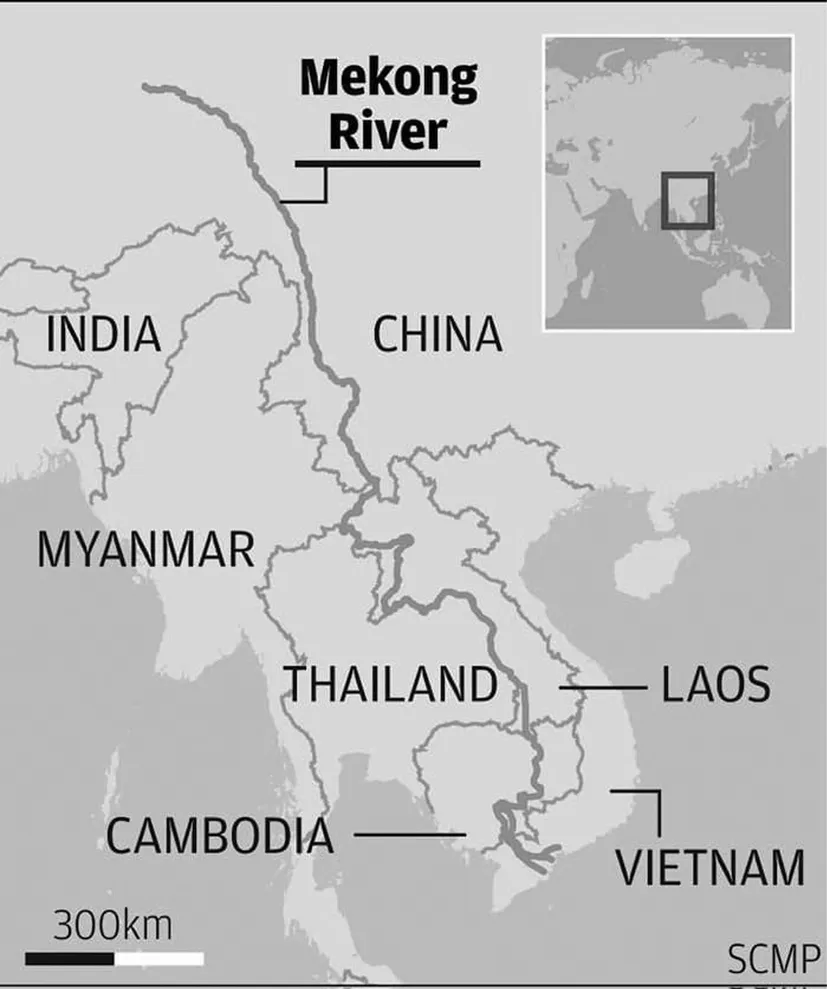
Located in Southeast Asia, landlocked Laos is bordered by Thailand to the west, Vietnam to the east, Cambodia to the south, China to the north and Myanmar to the northwest (see Figure 1.1). Throughout much of its history, the country has had to navigate shifting relations, alliances and rivalries among its neighbors. In political geography, the place of Southeast Asia is known as a geopolitical “shatterbelt,” or “a large, strategically located region that is occupied by a number of conflicting states and is caught between the conflicting interests of adjoining Great Powers.”2 For countries in a “shatterbelt,” whether it is Southeast Asia or the Middle East, it is hard to imagine, study or implement policies from “a purely national vantage point, because in almost every instance complications arise from relations with neighboring states or with extra-regional states.”3 In the case of modern Laos, its very strategic location in mainland Southeast Asia has usually invited foreign interventions of a global scale.
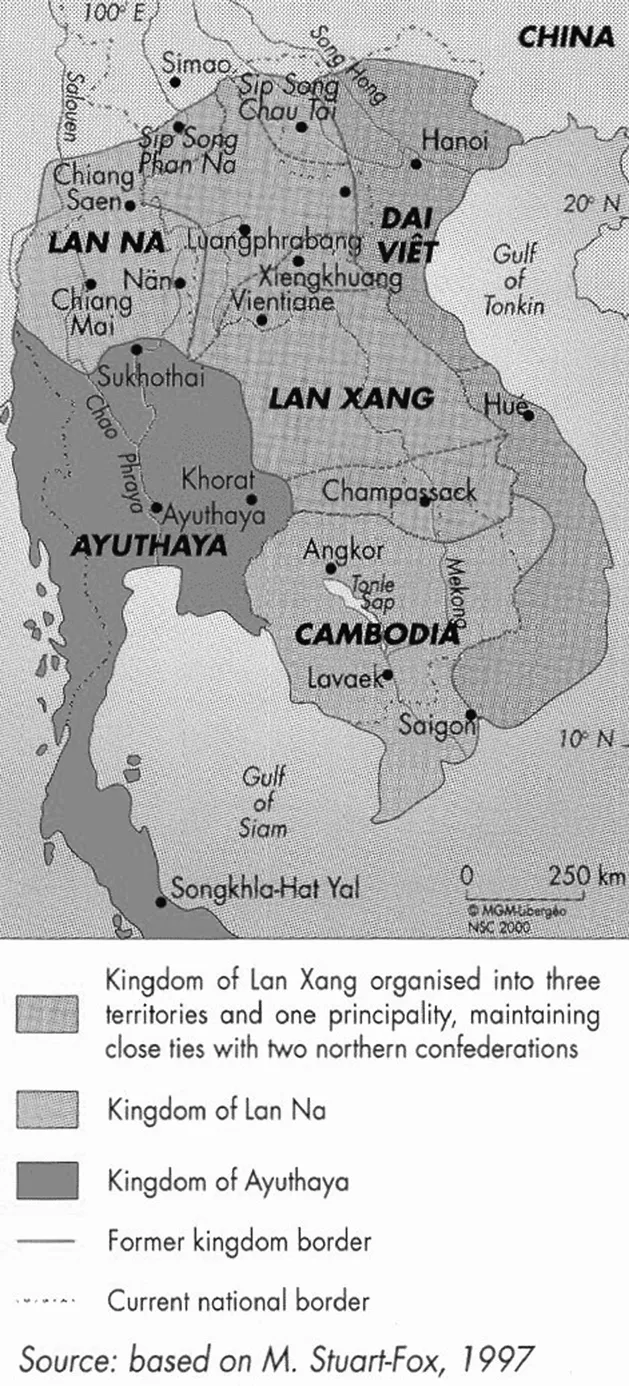
It has not always been like this. From 1353, over the next 400 years, pre-modern Laos as the Lanexang Kingdom was one of the largest in Southeast Asia. The kingdom extended from Sipsong Panna (Xishuangbanna) in southern China to Xiengtheng (Stung Treng) and Sambor in northern Cambodia, and from the Đại Việtnamese border along the Annamite Range to the western escarpment of the Khorat Plateau of present-day northeast Thailand. The Mekong River, which historically “formed the axis of the Lao world,”4 ran mostly through its entire territory after leaving China and before entering Cambodia.
While some historians question the true size of his kingdom,5 King Fa Ngum, whose statue is erected in central Vientiane, is generally regarded by the Lao people as the founder and unifier of the different Lao principalities and fiefdoms into Lanexang – “the land of a million elephants” (see Figure 1.2). That name was itself a fearsome signifier for all surrounding kingdoms, large and small, as the elephant was one of the primary instruments of Asian warfare. Among the main principalities and fiefdoms that Fa Ngum united were the three geographically distinct regions of populations and political organizations defined by the hydrological and geological features of the Mekong river basin itself – the two sets of rapids, one between Luang Prabang (in the north of Laos) and Vientiane (central Laos), the second near Savannakhet, and, third, the cataracts of the Khone falls (southern Laos) before Cambodia.6
One major kingdom, whose people were closely related to the Lao, that did not quite unite with Lanexang, save perhaps for a brief period in the late 1540s when Setthathirat was crowned its King, was Lan Na (present-day northern Thailand), with its capital Chiang Mai.7 Setthathirat, one of only four Lao kings consecrated with a statue in Vientiane, was not only known as the King of both Lan Na and Lanexang, but also the only Lao king who was not defeated in an invasion by the great Burmese conqueror Burengnong8 (who had earlier overrun the Siamese kingdom of Ayutthaya and others in the region).9
For over half a century during the reign of King Sourigna Vongsa from 1637, the Lanexang Kingdom experienced a golden period of peace and prosperity. Here, literature, art, music, religion and dance flourished, with courts established and laws strengthened. Groups ranging from European trade delegations to monks and nuns from other Asian lands visited Lanexang. While he did not make any substantial advances in converting the Lao people to Christianity, the Catholic priest Father Giovanni Maria Leria described the richness of the Lanexang palace as follows:
The structure and symmetry are admirable … truly it is of prodigious size, so large one would take it for a city, both with respect to its situation and the infinite number of people who live there … and that he … could write a whole volume if [he] tried to describe exactly all the other parts of the palace, its riches, apartments, gardens, and all the other similar things.10
Vientiane was known as a center of Buddhist studies, with the visiting Dutch tradesman Gerritt van Wuysthoff noting in the early 1640s that the number of monks visiting from all over Southeast Asia was “more numerous than the soldiers of the Emperor of Germany.”11
The kingdom never reached this height again, and was subsequently split into three sub-kingdoms, eventually becoming vassals of the expanding Ayutthaya Kingdom. Aside from royal court intrigues and succession crises documented in history books, one of the less discussed but critical factors for the fall of the kingdom, which has also proven to be a development bottleneck in modern times, was Lanexang’s landlockedness. This was in stark contrast to neighboring kingdoms that enjoyed access to sea routes and direct trade with European powers, bringing in new knowledge and technologies.12
From then on, events in the eighteenth to twentieth centuries shape the idea of Laos and the peoples’ attitudes in terms of actions, including in international affairs. Here, three layers of historical relationships are most important: between Laos and Thailand; between Laos and Vietnam; and, finally, between the Western and Eastern powers – France, the United States on the one hand; the Soviet Union, Russia and China on the other.
Same same but different: the Lao and Siamese
The relationship between Laos and Thailand, or Siam at the time, is probably the most intriguing. It is commonly believed that the two people descent from the ethnic “Tai” people, who lived in the upper Mekong region of present-day southern China. Some even state that the “Lao race” was as old as the Chinese.13 The Lao and Siamese (or Thais of today) share similar ethnicity, language, culture and religion. Even in legends, such as the Story of Khun Bourom, they have a common ancestor. Thus, one wonders, what sometimes went wrong in the relations between the two neighbors?
Three dates – or moments in history – more than any other have shaped the identity of the Lao people vis-à-vis the Thais in this regard: 1779, 1827 and 1893. As the French-educated Lao diplomat and historian, Pheuiphanh Ngaosyvathn, observes, before 1779, Lao–Thai relations were generally happy,14 where Thai kings honored Lao kings as equal to themselves.15 The relationship plateaued in 1560s during Setthathirat’s reign with the joint construction of a stupa in the border town of Dansai called Si Song Hak, meaning the love and affection of the two capitals (Si Sat Ta Nak, the ancient name of the Lao capital Vientiane, and Si Ayutthaya, the center of the Siamese realm before Bangkok).
1779 changed all this when, during the era of the expansionist King Taksin, Siam took over Lanexang after it had been weakened and split into three smaller kingdoms (Luang Prabang, Vientiane and Champasak). For the next 100 years, the Lao came under the control of Siam. The only major resistance came in 1827 by King Anouvong, the ruler of Vientiane, commemorated by a large statute erected along the Mekong River. In his war of national resistance, Anouvong’s forces fought all the way to the gates of the Siamese capital, prompting the Thai historian Sumet Jumsai, a royal family member, to admit: “I can’t help admiring the fearlessness of the Lao army.”16 In the end, “the Siamese made a complete holocaust of Vientiane,” obs...
Table of contents
Cover
Half Title
Series Information
Title Page
Copyright Page
Table of Contents
List of Illustrations
About the authors
Acknowledgments
List of abbreviations
Introduction: Do small states matter in global institutions?
1 The origins of Laos’ brand of diplomacy: Geographical, historical and ideational
2 Navigating the Cold War1
3 Shaping global issues and policies at the United Nations1
4 Embracing and leading ASEAN1
5 Leveraging the Mekong River Commission to advance national and international agendas1
Conclusion: Seven rules for small state diplomacy
Index
Trusted by 375,005 students
Access to over 1.5 million titles for a fair monthly price.
Study more efficiently using our study tools.
Frequently asked questions
Yes, you can cancel anytime from the Subscription tab in your account settings on the Perlego website. Your subscription will stay active until the end of your current billing period. Learn how to cancel your subscription
No, books cannot be downloaded as external files, such as PDFs, for use outside of Perlego. However, you can download books within the Perlego app for offline reading on mobile or tablet. Learn how to download books offline
Perlego offers two plans: Essential and Complete
Essential is ideal for learners and professionals who enjoy exploring a wide range of subjects. Access the Essential Library with 800,000+ trusted titles and best-sellers across business, personal growth, and the humanities. Includes unlimited reading time and Standard Read Aloud voice.
Complete: Perfect for advanced learners and researchers needing full, unrestricted access. Unlock 1.5M+ books across hundreds of subjects, including academic and specialized titles. The Complete Plan also includes advanced features like Premium Read Aloud and Research Assistant.
Both plans are available with monthly, semester, or annual billing cycles.
We are an online textbook subscription service, where you can get access to an entire online library for less than the price of a single book per month. With over 1.5 million books across 990+ topics, we’ve got you covered! Learn about our mission
Look out for the read-aloud symbol on your next book to see if you can listen to it. The read-aloud tool reads text aloud for you, highlighting the text as it is being read. You can pause it, speed it up and slow it down. Learn more about Read Aloud
Yes! You can use the Perlego app on both iOS and Android devices to read anytime, anywhere — even offline. Perfect for commutes or when you’re on the go. Please note we cannot support devices running on iOS 13 and Android 7 or earlier. Learn more about using the app
Yes, you can access Small Countries, Big Diplomacy by Alounkeo Kittikhoun,Anoulak Kittikhoun in PDF and/or ePUB format, as well as other popular books in Politics & International Relations & Asian Politics. We have over 1.5 million books available in our catalogue for you to explore.