* THE SUNDAY TIMES BESTSELLER * * WATERSTONES THRILLER OF THE MONTH *
'Chilling and perfectly paced, one to put on the very top of your TBR!' Sarah Pearse 'Thriller fans will be in heaven' Louise Candlish
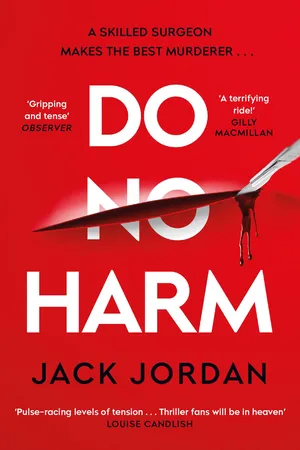
The man lies on the table in front of me. As a surgeon, it’s my job to save him. As a mother, I know I must kill him. You might think that I’m a monster. But there really is only one choice. I must get away with murder. Or I will never see my son again.
I’VE SAVED MANY LIVES. WOULD YOU TRUST ME WITH YOURS?
Readers can't get enough of Do No Harm . . . (***** five star reader reviews) ‘Absolutely phenomenal’ ‘Kept me hooked from the very start!' ‘Believe me, you’ll not want to put this down’ ‘Everything about Do No Harm was absolutely brilliant' ‘So full of tension and twists!’
Frequently asked questions
Yes, you can cancel anytime from the Subscription tab in your account settings on the Perlego website. Your subscription will stay active until the end of your current billing period. Learn how to cancel your subscription.
No, books cannot be downloaded as external files, such as PDFs, for use outside of Perlego. However, you can download books within the Perlego app for offline reading on mobile or tablet. Learn more here.
Perlego offers two plans: Essential and Complete
Essential is ideal for learners and professionals who enjoy exploring a wide range of subjects. Access the Essential Library with 800,000+ trusted titles and best-sellers across business, personal growth, and the humanities. Includes unlimited reading time and Standard Read Aloud voice.
Complete: Perfect for advanced learners and researchers needing full, unrestricted access. Unlock 1.4M+ books across hundreds of subjects, including academic and specialized titles. The Complete Plan also includes advanced features like Premium Read Aloud and Research Assistant.
Both plans are available with monthly, semester, or annual billing cycles.
We are an online textbook subscription service, where you can get access to an entire online library for less than the price of a single book per month. With over 1 million books across 1000+ topics, weāve got you covered! Learn more here.
Look out for the read-aloud symbol on your next book to see if you can listen to it. The read-aloud tool reads text aloud for you, highlighting the text as it is being read. You can pause it, speed it up and slow it down. Learn more here.
Yes! You can use the Perlego app on both iOS or Android devices to read anytime, anywhere ā even offline. Perfect for commutes or when youāre on the go. Please note we cannot support devices running on iOS 13 and Android 7 or earlier. Learn more about using the app.
Yes, you can access Do No Harm by Jack Jordan in PDF and/or ePUB format, as well as other popular books in Literature & Crime & Mystery Literature. We have over one million books available in our catalogue for you to explore.
A single drop, no bigger than a freckle. Minuscule in the grand scheme of things. A man lies before me with cut flesh and exposed bone; black, tar-stained lungs cranked apart to expose his heart. And yet for all the gore, all I can think about is that one small speck searing into me like a burn.
I switch the blade from my left hand to my right and roll my wrist until I feel the satisfying crunch beneath the skin. The room is so quiet that the sound carries a faint echo, ricocheting off the cold tiled walls.
Everyone in the room has their eyes on me, assessing the stillness of my hand, the glint of the scalpel beneath the bright strip lights, rosy at the tip from the manās blood. And yet despite the scrutiny, my palms remain dry, and my grip holds steady. But buried beneath my scrubs, my heart is pounding so fast that I can almost taste it.
Peterās heart, however, is stone cold.
Mr Downingās double coronary bypass was straightforward, until suddenly it wasnāt. After cutting and sawing my way through the chest, I bypassed the blocked arteries using veins from his leg to return healthy blood flow back to the heart. By removing the clamp from the aorta to resume blood flow, and rinsing away the cold potassium fluid injected to keep it still, Peterās heart should wake from its medically induced slumber.
I stare down at his splayed chest, waiting for a twitch, a spasm, the first jolt to signify life.
Nothing.
āLungs off, please.ā
āLungs off,ā Dr Burke repeats.
āReturn to bypass.ā
āReturning to bypass,ā Karin calls back from the perfusionistās station.
I pass the scalpel to my aide and wait in the deafening silence. When the heart is finally back on bypass, I feel the tension leave the room like a hot, stale sigh.
āLetās give it a minute,ā I say, and clamp the aorta. āPoor thingās probably knackered.ā
āArenāt we all?ā Dr Burke quips, giving me a supportive wink over the top of his glasses.
It is a thoughtful gesture, but we both know I am on my own. Each surgery is a collaborative effort up to this point: Dr Burke manages the medications, breathing tube and monitoring lines; Karin controls the heartālung machine; the surgical care practitioner standing at the foot of the bed harvests the leg veins for transplantation; each specialist with their own aide. Beside me stands my own, Margot, assisting with every tool and swab. But when it comes to the heart, the responsibility is all mine.
A wave of heat scores my back, prickling across my shoulder blades.
Focus.
I assess the chest cavity. The bypass was done well: the grafts are good, with clean, airtight joins. We have given the heart time to recuperate, administered a cocktail of drugs to try and stimulate electrical activity, and run tests for metabolic abnormalities or any other complaints we might have missed. I have checked, rechecked and tidied my work, in the hope that it was due to a mistake I made and could ultimately fix. None of it worked.
I glance at the clock on the wall. We are fast approaching the end of the four-hour window we have before damaging the heart becomes inevitable. Once passed, each second ticked off the clock might as well be a nail hammering down the lid to the patientās coffin.
My top lip tingles with approaching sweat. I fight the urge to dab it dry, and recite the advice my mentor once gave me.
Never show your nerves. If you panic, they panic. You canāt bring a ship into the dock if your crew has jumped overboard.
I squeeze the patientās heart in my fist, contracting and releasing in the rhythm it has followed so many times before, and gently lay it inside the chest cavity. The flesh has turned rosy-pink from my grip. In a strange way, it almost looks pretty, like a cheek flushed from the cold.
āLetās give it one last go,ā I say, the implications pulsing behind my words.
I reach in slowly, prolonging the patientās life for as long as I can, and release the clampās hold on the aorta. A river of blood flows into the heart.
Still, nothing happens.
I squeeze the heart repeatedly, but even with the potassium fluid flushed out it feels strangely cold; wet and slippery like a hogās snout.
Come on, Peter.
My shoulders tense where I hunch over the table and put all of my strength into manually manipulating the heart. Sweat gathers upon my face; Margot slips in silently and dabs each droplet away.
Iām not sure how much time has passed ā a minute, ten ā but when I look up from the chest cavity, glistening with perspiration and breathing heavily behind my mask, I realise that the whole team is staring at me, their eyes awash with pity. That is when it finally hits me.
This heart wonāt ever beat again.
Stress pains pulse behind my eyes, spasm in the knotted muscles of my shoulders. I look down at my hands, aching and trembling from seizing the heart so firmly, and release the smallest of sighs.
āBypass off, please.ā
Karin nods once and looks away. A man will die today, and we will orchestrate it. Me, with the command. Her, flicking the switch.
āBypass off,ā she confirms.
āLungs off, please.ā
āLungs off,ā Dr Burke replies.
And then we wait.
The heartālung machine winds to a stop. The tubes clear of blood as it returns to the patientās circulatory system. And then, the inevitable: the flatline of a motionless heart. The sound screams through all of us, piercing through the theatre in shrill echoes, ringing off every apparatus and stainless-steel tool.
I glance at the clock on the wall.
āTime of death: 16:53.ā
2
Anna
Thursday, 4 April 2019, 17:10
āIām sorry for your loss.ā
A weaker surgeon might look down at their feet at this moment. Too selfish to hold the gaze of the dead patientās loved one as their heart breaks. But I keep my eyes on Mrs Downingās and witness it all: the almost-silent gasp as the blow hits her, the tears sheening over her eyes. Nurse Val from the cardiology ward twitches nervously by my side.
I first met Mrs Downing during her husbandās initial consultation, and watched as she left my office with a hopeful bounce in her step. It was a standard procedure, with a very low risk of Peter not coming home. My reputation and experience helped her sleep at night; they are what urged her husband to sign on the dotted line prior to surgery. She will come to hate me for this, once the shock has passed.
āDid he suffer?ā she asks, her voice breaking.
āNo. He wouldnāt have felt a thing.ā
She might think me cold, meeting her eyes without flinching, but Iām merely well practised. Over time I have learnt not to look at a patientās next of kin with too much sympathy, or they might find me patronising, nor too much sadness, in case they mistake it for guilt. If I had smiled too widely on my approach, I might have given Mrs Downing false hope. Being a cardiothoracic surgeon isnāt just about fixing hearts, it is also knowing how best to break them.
āMrs Downing,ā I say calmly, stepping cautiously around her shock. āMy colleague Val is going to take you through the next stages now and answer any questions you may have. If you need anything, please donāt hesitate to ask.ā
Val takes Mrs Downingās hand and delicately guides her towards the chair; she manages to keep her sobs at bay until I shut the door behind me, that British stiff upper lip finally allowing itself to unfurl behind closed doors.
I close my eyes and take a deep breath to compose myself, before setting off down the corridor towards the changing room. I hadnāt lost a patient in a while, not until today, and I have the sudden fear that I may be at the start of a losing streak, but swiftly bat the thought away.
This is one failure after a long line of successes. Keep it in perspective.
But whether out of conditioning or habit, I know I wonāt be able to get this procedure out of my head.
I step inside the changing room and yank off my scrub top as I approach my locker, quickly losing myself in my thoughts as I strip and redress.
āYou all right?ā
Margot is stood at the locker next to mine, tying her hair into a ponytail. Her roots need doing.
āIām fine.ā
I had been going through the procedure again, obsessing over every detail in search of the moment Mr Downingās heart began to fail. Clearly, Iām not hiding my thoughts as well as I usually would. Failure often does that: it rattles the armour, revealing small glimpses of the tenderness within.
āThereās nothing more you could have done.ā
āI know,ā I lie. āThanks.ā
I feel her eyes linger on my face a beat too long. My tone had been flat and direct. Emotionless. She must think me callous. Perhaps she is right.
I am inhumanly cold before calling time of death. I rummage around a chest cavity with the same emotional attachment as an electrician rewiring a circuit. I donāt think of the person hidden beneath the surgical drapes, or pay a thought to the family members sat outside the theatre, waiting to hear if their world is about to right itself or implode. I would go mad if I did. It is only when I leave the operating theatre that the weight of the repercussions presses down upon me, and I spend the rest of the evening redoing the procedure in my mind.
āReady for Saturday?ā she asks flippantly.
I had forgotten. Mr Downingās operation had distracted me. The stress seeps back into me in an instant.
In two daysā time I will perform one of the biggest operations of my career: bypassing three blocked coronary arteries for Ahmed Shabir, MP for Redwood and, if the whispers are correct, the future leader of the Labour Party. He is referred to as Patient X by those in the know, sworn to secrecy to keep the procedure from going public so as not to affect his chances in the next election. There is nothing like having the fate of a potential prime minister dangling over oneās head while brandishing a scalpel.
āOf course.ā
Margotās phone rings. She checks the screen briefly and throws it into her handbag to ring out. I catch the name Nick before it vanishes into her locker, and take my own from my bag, reading over the messages that Zack and I sent one another earlier in the day.
Zack
Please donāt make me go. U said u would come
He had sent it at lunchtime. While my son should have been playing, he had been texting me, worrying. I sent a reply between ...