Buried
eBook - ePub

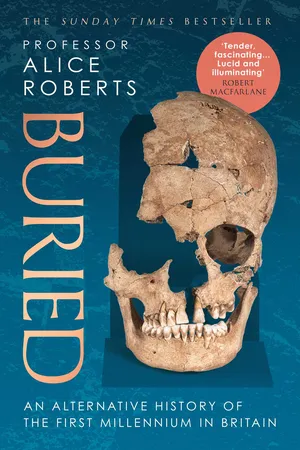
Buried

An alternative history of the first millennium in Britain

  1. 352 pages
  2. English
  3. ePUB (mobile friendly)
  4. Available on iOS & Android
eBook - ePub

Buried

An alternative history of the first millennium in Britain

About this book

A SUNDAY TIMES BESTSELLER

‘Tender, fascinating … Lucid and illuminating’ Robert Macfarlane


Funerary rituals show us what people thought about mortality; how they felt about loss; what they believed came next. From Roman cremations and graveside feasts, to deviant burials with heads rearranged, from richly furnished Anglo Saxon graves to the first Christian burial grounds in Wales, Buried provides an alternative history of the first millennium in Britain. As she did with her pre-history of Britain in Ancestors, Professor Alice Roberts combines archaeological finds with cutting-edge DNA research and written history to shed fresh light on how people lived: by examining the stories of the dead.
 

Frequently asked questions

Yes, you can cancel anytime from the Subscription tab in your account settings on the Perlego website. Your subscription will stay active until the end of your current billing period. Learn how to cancel your subscription.
No, books cannot be downloaded as external files, such as PDFs, for use outside of Perlego. However, you can download books within the Perlego app for offline reading on mobile or tablet. Learn more here.
Perlego offers two plans: Essential and Complete
  • Essential is ideal for learners and professionals who enjoy exploring a wide range of subjects. Access the Essential Library with 800,000+ trusted titles and best-sellers across business, personal growth, and the humanities. Includes unlimited reading time and Standard Read Aloud voice.
  • Complete: Perfect for advanced learners and researchers needing full, unrestricted access. Unlock 1.4M+ books across hundreds of subjects, including academic and specialized titles. The Complete Plan also includes advanced features like Premium Read Aloud and Research Assistant.
Both plans are available with monthly, semester, or annual billing cycles.
We are an online textbook subscription service, where you can get access to an entire online library for less than the price of a single book per month. With over 1 million books across 1000+ topics, we’ve got you covered! Learn more here.
Look out for the read-aloud symbol on your next book to see if you can listen to it. The read-aloud tool reads text aloud for you, highlighting the text as it is being read. You can pause it, speed it up and slow it down. Learn more here.
Yes! You can use the Perlego app on both iOS or Android devices to read anytime, anywhere — even offline. Perfect for commutes or when you’re on the go.
Please note we cannot support devices running on iOS 13 and Android 7 or earlier. Learn more about using the app.
Yes, you can access Buried by Alice Roberts in PDF and/or ePUB format, as well as other popular books in Social Sciences & Ancient History. We have over one million books available in our catalogue for you to explore.

1. WATER AND WINE

Image
I sat in the dissection room on a Wednesday afternoon. It was very quiet – the students always had a sports afternoon on Wednesdays. The specimens from the morning’s teaching session had all been put away: the bones in their cupboards, small dissections in buckets, large ones in huge steel tanks. A couple of the demonstrators were working away, dissecting cadavers laid on long, steel tables. The sickly sweet smell of formalin hung in the air.
At the other end of the long room, I pulled a spare table out, applied the brakes to the wheels, and lifted a tall stool down from one of the neat stacks that the students had left them in. I carried a box over to the table, then went to find a couple of large white trays and a pair of forceps. I spent a bit of time choosing a perfect pair for the job, with narrow tips – and not bent out of shape, as so many were in the towers of small crates in the prep room.
Back at the table, I opened my notebook and lifted the lid off the large box. It was full of small, clear plastic bags, carefully laid out with sheets of tissue paper between them. I took one of the bags, pulled its seal open, and very, very gently, emptied out its contents onto the plastic tray. A pile of fragments, the largest of them 2 centimetres across. They sounded like pieces of porcelain, chinking as they tipped out and I moved them around on the tray. But they were bone. Human bone.

In the year 43 CE, the Roman Empire was no longer content with simply trading with the inhabitants of a large island lying off the northwest coast of Europe. Those islanders had control of precious resources – grain, cattle, gold, silver and iron – and had also assisted with uprisings in northern Gaul a century before. Aside from that, Claudius was just two years into his emperorship. He could do with a military victory to strengthen his position in Rome.
The Atrebates of southern England – whose territory broadly coincided with modern-day Hampshire and Sussex – had been friendly with the Roman Empire for some time. One deposed leader had even sought military assistance from Rome in the year 7 CE. His appeal to Emperor Augustus at that time fell on deaf ears. Augustus was too busy to get embroiled in such tussles for scraps of power on a remote island at the distant edge of the Empire. Around the same time, the Greek historian Strabo was writing his Geography. In it, he described how some of the British chieftains had pledged allegiance to Rome, and were happily paying duties on exports and imports between Britain and Gaul, managing ‘to make the whole of the island virtually Roman property’.
But in 43 CE, the Atrebates were back asking Rome for help – this time, wanting some military support to sort out their troublesome neighbours, the Catuvellauni. That lot, led by Caratacus, had seized much of the territory of the Atrebates, and their king, Verica (as he appeared on his own coins) or Berikos (as Dio Cassius calls him), now appealed to Claudius for help getting his kingdom back.
It was perfect timing for Claudius – he could respond to this request for assistance and make everything a lot simpler by bringing Britain under Imperial rule. He sent four legions, supported by an equivalent number of auxiliaries – some forty thousand soldiers in all. The Romans were essentially invited into southeast Britain, but then they met with opposition from factions not yet amenable to their rule. The Romans were by now pretty good at this sort of thing. You don’t create and maintain an empire without some strategic prowess. The invasion was led by Aulus Plautius, who pushed in as far as the Thames, before waiting for his emperor, Claudius, to come – and symbolically lead the Roman forces to victory at Colchester.
What we don’t know is what happened to Verica. Perhaps he was reinstated as king of the Atrebates. By the time history catches up with what was happening in this southern part of Britain, Togidubnus is the king there. He may have been Verica’s son, or some other relative.
Despite the fact that Togidubnus looms large in just about any modern account of Roman Britain, his name only appears twice in the historical and archaeological record. There is a single documentary source – Tacitus’s biography of Agricola, in which he writes, ‘Certain municipalities were given to Togidubnus (who stayed loyal over time) according to the successful tradition of using kings as agents of servitude.’ And the other mention is written in stone, an inscription carved into a great slab of Purbeck marble discovered in Chichester, during building work in 1723. It’s effectively a dedication plaque, and though it has suffered the ravages of time, it appears to say something like:
The guild of artisans provide this temple to Neptune and Minerva for the protection of the Divine House on the authority of Tiberius Claudius Togidubnus, great king of Britain…
What do we learn from this? Chichester might have been Togidubnus’s capital. Togidubnus may have spent his childhood in Rome, as any good client king-in-waiting should do – being instructed in Roman ways just like the princes of the British Empire’s colonies being trained at Eton. His loyalty to Rome was enshrined in those extra names, Tiberius and Claudius – the first two names of the emperor (which might even suggest it was Claudius himself who granted Roman citizenship to the Briton). Did Togidubnus arrive back in Britain on the deck of one of the ships of the Claudian invasion fleet?
The granting of civitates – states or municipalities – to Togidubnus perhaps suggests that his territory was not only restored but enlarged, within the newly created Roman province. But some scholars have argued that it simply relates to the original territory that Togidubnus could claim some hereditary right to rule – and that Tacitus is being cynical or condescending: Rome deigns to gift Togidubnus’s own kingdom back to him.
He may have ruled that region from a base in Chichester, and perhaps that base was the palace at Fishbourne – the largest Roman palace anyone’s ever found north of the Alps, larger even than Buckingham Palace. Silchester is another important administrative capital – which may have come under his control as well. But then, everything now was under the Empire, ultimately. And when Togidubnus dies, those civitates are just absorbed into the wider province of Britannia. Old kings were useful intermediaries for a time, then forgotten.
The name of Togidubnus’s kingdom was, according to a map of Roman roads in Britain, ‘Regno’. Some have interpreted this simply as a version of regnum, ‘kingdom’ – a kingdom existing with Roman support, part of the Imperial system. Others suggest it is an old Celtic name, meaning ‘proud’. Historians argue about this distinction – perhaps because it seems relevant to whether some sort of ‘British’ identity was maintained while ‘British’ kings invited Roman troops into the land of their fathers. But for ordinary people, I wonder if they would have even noticed the difference. Roman goods had been coming into the region for a century or more; the locals could export their livestock, grain and metal to the continent. The rulers changed from time to time. The tariffs changed. The economy might falter – then recover. Whether officially in or out of the Empire, in or out of the wider European economic union, life in Britain – would go on.
The effect on ordinary life in southeast England – of becoming more closely affiliated with the economic hub in Rome – might not have made much of a difference to most people. There would have been economic gains for some – perhaps trade across the Channel became even easier. But further away from that point of contact with the continent, the Empire would surely have been seen very differently. A foreign power that was flexing its muscles now, on British soil. A way of life that might entice you in with nice things – pretty pottery, wine and olive oil. But then there would come a sword, and a threat. Render unto Caesar those taxes that you suddenly now owe him.
Perhaps you accept it, with a shrug of your shoulders. But perhaps the tariffs are too much, and you resist. Well, that’s certainly how the people of south Wales reacted. The Silures – the people who had grown out of the land, seeded in the valleys, united by ties of kinship across the Brecon Beacons – were not going to take Roman expansionism lying down.
The Romans reacted in a way that was completely typical of a colonising superpower – they weren’t about to give up either. After some thirty years of military campaigning against the Silurian freedom fighters, the Roman army finally crushed the resistance in southeast Wales. And then they built a fortress, to maintain a permanent military presence there. A presence which very definitely said, Hey, you Silurian barbarians – resistance is futile. They built this fortress on the Usk, close to an existing Iron Age stronghold. A Roman roadmap dating to the second century, the Antonine Itinerary, labels it ‘Iscae leg.ii Augusta’ – the fort of the Second Augustan Legion on the Usk. William Camden’s Britannia, published in 1586, records that the original local name of the fortress was ‘Kaer Lheion on Wysk’ – the Fortress of the Legion on the Usk. Geoffrey of Monmouth, writing his History of the Kings of Britain in the twelfth century, says that an ancient British king, Belinus, founded a city even earlier than that – in the fourth century BCE – called Kaerusc, and that the Romans then renamed it the ‘City of Legions’. It’s kept that name, even though the legion left long ago: Caerleon. The legionary fortress lay on a road called the Julia Strata – and that must have been named after Sextus Julius Frontinus, the governor of Britain, who originally led the forces into south Wales to subjugate those recalcitrant Silures.
The Second Augustan Legion had moved around a bit before they settled at Caerleon. They’d fought in the Cantabrian Wars as Rome extended its empire into Spain in the first century BCE, and then in Germany, in the early first century CE, after which they were stationed at Argentoratum, now Strasbourg. After dealing with an insurgency in Gaul, they became one of the four legions involved in the invasion of Britain in 43 CE. Marching westwards through southern England, under the leadership of Vespasian, they brought Dorset and Devon – the territories of the Durotriges and Dumnonii – under Roman control. They are said to have been stationed at another Isca for a while – Isca Dumnoniorum. So there was a River Isca in Devon and another in south Wales. It seems that the Celtic root of the name simply means ‘water’ – just as uisge still means ‘water’ in Gaelic (as in uisge beatha, ‘water of life’ – whisky). Whereas the Isca in the Brecons became the Usk, the Devonian Isca became the Exe. From the fort of Isca Dumnoniorum, at present-day Exeter, the legion moved northwards to Glevum, Gloucester, for a while. And then in the seventies of the first century, they were dispatched to south Wales, to sort out the Silures and build their fortress on the Usk.
Caerleon would become one of three permanent legionary fortresses in Roman-occupied Britain – the other two being Chester and York. It would be the primary base for the Second Augustan Legion for almost two centuries – though during that time, detachments would be sent up to Hadrian’s Wall and over to Londinium. And then, in the early third century, most of the legion moved up to Scotland, as the emperor Septimius Severus launched another attempt to bring the Caledonians under the yoke of Rome. In 210 it seemed he’d been successful, as the northern tribes agreed to some sort of peace treaty. But just a year later, in 211, they were rebelling again, and Severus was dying of gout in Eboracum, York. And then we lose sight of the Second Augustan Legion, until a document dating to the early fifth century mentions them having been stationed at Richborough, in Kent, the fort at Caerleon having long since been abandoned.
The peak for Roman Caerleon really was the second century, when there were over five thousand soldiers garrisoned in the fortress, which contained a massive barracks, a huge bath-house, a hospital, latrines, training grounds and workshops. Outside the fortress walls, a civilian town grew up. And there was even an amphitheatre.
Once the legion left, the place began to fall apart – but a much-diminished population continued to live amongst the ruins, keeping their cattle in the bath-house of the old fortress. (History doesn’t record whether the cows preferred the steamy caldarium or the chilly frigidarium.) The amphitheatre became grown over, and the circle of grassy mounds was linked in legend to King Arthur – as his round table, no less. Geoffrey of Monmouth, in his (somewhat fanciful and not terribly reliable) History of the Kings of Britain, describes how Arthur chooses the City of Legions ‘upon the River Usk, near the Severn Sea’ as the venue for his coronation. It was a city, he wrote, whose ‘magnificent royal palaces, with lofty gilded roofs, made it even rival the grandeur of Rome’. That ‘history’, penned centuries later, doesn’t quite fit with the picture of post-Roman Caerleon that the archaeological record provides us with, where people lived in shacks amongst the crumbling barracks and cattle cooled their hooves in the ruined bath-house. Into the medieval period and beyond, Caerleon remained small – occupying just a fraction of the original footprint of the fortress. And although the grassy banks of ‘King Arthur’s Round Table’ provided a convenient source of dressed stone, ready for use in much less ambitious building projects in the town, much of Roman Caerleon lay undisturbed, underground, forgotten.
In 1908, antiquarians from Liverpool became interested in the circular earthwork on the edge of Caerleon. Interested enough to dig it. A tithe map from 1840 suggests that they should have known what to expect – the circular feature was labelled ‘amphitheatre’. But apparently they weren’t sure whether it was just an earth structure or would contain stone when they started; perhaps the locals had forgotten where much of the building stone in the town had actually come from. Very quickly, they found that the banks concealed two massive, concentric elliptical walls. The outer walls were 2 metres thick and supported with regular buttresses. The 11-metre gap between the inner and outer walls was filled with earth – presumably to create a raised platform for timber seating around the central arena, which was floored in cobbles covered with a deep layer of sand. The structure was so well preserved that the decision was taken to leave it uncovered – and it’s still the best, most complete example of a Roman amphitheatre in Britain today. It’s well worth a visit.
In the year following those initial excavations, there were plans to extend the nearby churchyard into an adjacent field, and the Liverpool Antiquarian Society teamed up with the Monmouthshire Antiquarian Society to excavate, before the church began to fill up the field with bodies. The antiquarians uncovered the hefty base of a watch tower, together with well-built latrines and a haul of small finds including brooches – and coins of Vespasian and Domitian. Vespasian – following military successes in Britain, and then in Judaea – had become emperor in 69 CE, with his eldest son, Titus, succeeding him in 79. Just two years later, when Titus died of a fever, Vespasian’s younger son, Domitian, succeeded him, and would reign for fifteen years. The coins, then, were from a time when the fortress at Isca had just been founded.
Further excavations, on the amphitheatre, were carried out in the winter of 1926 into 1927, after the Daily Mail raised funds, with additional financial support coming in from – quite bizarrely – American fans of King Arthur. There’s a wonderful sepia-tinted photograph of the excavation team: twenty-three men, one small boy and – in the centre, holding a book – one woman. She is the ‘trowelblazing’ Tessa Wheeler – the wife of Dr (later Sir) Mortimer Wheeler, but an accomplished archaeologist in her own right. Over her career, she worked with Mortimer on many excavations, including Segontium – the Roman fort at Caernarfon – and later, Verulamium (St Albans) and Maiden Castle in Dorset. But Caerleon was her own project, and the summary monograph on the amphitheatre, published in 1928, bears just her name.
Shortly after those excavations at Caerleon itself, some building work was happening on the southern side of the river, in the village still known at that point as Ultra Pontem (‘Over the Bridge’), turning up more evidence from Roman times. A cesspit was being dug for some new bungalows, and nearly a metre down, the workmen came across a stone slab. It turned out to be part of a small stone-lined chamber or cist. Inside it was a rectangular lead canister. The workmen downed tools and Mortimer Wheeler was called in to inspect the find. Having recorded everything in situ, Wheeler dug the canister out and took it to Caerleon Museum.
A piece of red samian-ware pottery recovered from the earth just above the canister in its cist suggested an early second-century date. And when the canister itself was opened, it was found to be full of fragments of cremated bone. The anatomist Arthur Keith, curator at the Hunterian Museum of the Royal College of Surgeons, inspected the fragmentary remains. His verdict:
‘Amongst the contents of the urn I can trace parts of only one individual, apparently a man – so I judge from the largeness of the fragments; and, as the sutures of the skull are partly closed, at least over 35 years of age. The cremation was imperfectly done, the bones being less reduced than usual.’
There was another odd feature in this cremation burial. The canister had a lead pipe sticking out of the top of it. ‘The upper end of the pipe’, Wheeler wrote, ‘was found at a depth of about a foot beneath the present surface, but to this depth the soil was merely surface-mould, and there is no doubt that the pipe originally reached the open air.’
Only one other vaguely similar burial had ever been discovered in Britain – a lead coffin in Colchester, with a lead pipe sticking out of it. But across the rest of the Roman world, there were several other examples known to Mortimer Wheeler – from western France to Italy and Sicily – some with lead pipes, others with earthenware pipes. And the second-century Greek geographer and travel writer Pausanius recorded a ritual in central Greece that seemed to provide an explanation for this very particular style of burial: a ceremony where blood from sacrifices was offered to the dead, poured ‘through a hole into the grave’.
So is this the significance of the Caerleon pipe burial? It’s a very particular type of grave which allows the dead to be sealed away – yet still open to be provided with sustenance from time to time. ‘These facts’, wrote the folklorist Sir James Frazer, discussing such burial rites in typically expansive terms, ‘bring vividly before us the belief of the Greeks and Romans that the souls of the dead still lived and retained their bodily appetites in the tomb.’ Whatever the friends and relatives of the deceased were pouring down that pipe – blood, or wine, perhaps – this was clearly a funerary rite which didn’t stop with the cremation of the body, or the burial of the cremated remains. It was done with the expectation that the bereaved would continue communing with the dead. You could visit the cemetery where old Grandpa Pontus was buried, have a picnic, chat about family memories and the old country, and share some of your wine with him, down the tube. As archaeologist Miles Russell told me, some tombstones from the first and second century show this communion quite explicitly – with the deceased person lying on a couch, as in life, inviting visitors to dine with them.
I mentioned the pipe burial to my friend Natasha, who grew up in Siberia. She told me about a tradition in Russia where families gathered in graveyards each year, on a ‘Parents’ Day’, to eat a meal and drink. She said that as a child, she’d been told it was important to eat some of the food, and that the adults were drinking alcohol as well. And then a portion of food was left on the grave. Her recollections prompted me to find out more. It seems that this was a ritual which persisted right through the Soviet era, eve...

Table of contents

  1. Cover
  2. Title Page
  3. Dedication
  4. Prologue: A Blessing and a Curse
  5. Chapter 1: Water and Wine
  6. Chapter 2: Death in the Villa
  7. Chapter 3: Off with Their Heads
  8. Chapter 4: The Beautiful Buckets of Breamore
  9. Chapter 5: The Meaning of Bling
  10. Chapter 6: The Vikings in the Ditch
  11. Chapter 7: The Birth of Churchyards
  12. Chapter 8: Belonging
  13. Postscript: A Note on the Use of the Term ‘Anglo-Saxon’
  14. Photographs
  15. Acknowledgments
  16. References
  17. Index
  18. The Chapter Illustrations
  19. Copyright