This examination of six usurper kings of England, and the people and circumstances surrounding them, is "a masterpiece of academic scholarship" (
Midwest Book Review).
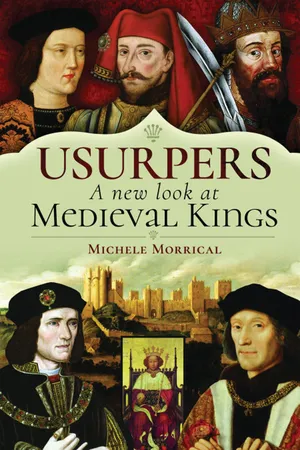
In the Middle Ages, England had to contend with a string of usurpers who disrupted the British monarchy—and ultimately changed the course of European history by deposing England's reigning kings and seizing power for themselves. Some of the most infamous usurper kings to come out of medieval England include William the Conqueror, Stephen of Blois, Henry Bolingbroke, Edward IV, Richard III, and Henry Tudor. Did these kings really deserve the title of usurper, or were they unfairly vilified by royal propaganda and biased chroniclers?
This book examines the lives of these six medieval kings, the circumstances that brought each of them to power, and whether or not they deserve the title of usurper. Along the way readers will hear stories of some of the most fascinating people of medieval Europe, including Empress Matilda, the woman who nearly succeeded at becoming the first ruling Queen of England; Eleanor of Aquitaine, the queen of both France and England, who stirred her own sons to rebel against their father, Henry II; Richard II, whose cruel and vengeful reign caused his own family to overthrow him; Henry VI, Margaret of Anjou, Richard of York, and Edward IV, who struggled for power during the Wars of the Roses; the notorious Richard III and his monstrous reputation as a child-killer; and Henry VII, who rose from relative obscurity to establish the most famous royal family of all time: the Tudors.
- 216 pages
- English
- ePUB (mobile friendly)
- Available on iOS & Android
eBook - ePub
Usurpers, A New Look at Medieval Kings
About this book
Information
Subtopic
Historical BiographiesIndex
HistoryPart I
William the Conqueror (1066–1087)
1
The Anglo-Saxons
Life in early medieval England was often a frightening, brutal experience for its residents. Between the years 410 to 1066, England’s inhabitants endured repeated invasions from Continental intruders, resulting in the loss of land, the slaughter of their families, and forced submission to foreign kings.1 Prior to the centuries of invasions, England had some manner of safety and protection as it was under the rule of the mighty Roman Empire. When the Roman Empire fell in 410 AD, England found itself isolated and unprotected with no overlord to protect it from the threat of foreign invaders. Having no cohesive united defence, such as a standing army or castles to protect its people, England found itself in a power vacuum that many foreign countries were quick to take advantage of. After the fall of Rome, the vulnerable island of Great Britain became an easy target for invasion.
The first large scale foreign invasion came from a group of German and Danish migrants who later became known as the Anglo-Saxons. Their three tribes, the Angles, Saxons, and Jutes, sailed to England shortly after the fall of the Roman Empire and conquered both the eastern and southern territories.2 They hadn’t just come to England to conquer it and return home with their booty: they had come to stay. England had a wealth of natural resources and with no English ruler to oppose them, it was quite easy for them to move in, establish rule over all the occupants, and divide the land up among themselves.
The Anglo-Saxons organised England into seven separate kingdoms: East Anglia, Northumbria, Mercia, Wessex, Sussex, Essex, and Kent. The seven kingdoms of the Anglo-Saxons operated independently from each other, meaning they had their own rulers, their own policies, customs, and even languages. They spent the entirety of the 400-year establishment fighting against each other to expand their territories because more land meant more income from taxes. It was one of the easiest ways to quickly enrich themselves and more money meant more power.
In the 860s, a new, more serious threat emerged: the Vikings. These Nordic warriors had begun terrorising all of Europe with their technologically advanced longships and their superior military skills. By 871 they had successfully overtaken every single Anglo-Saxon kingdom except for Wessex which at that time was ruled by King Alfred. Alfred successfully fought off the Vikings for many years and also held them back by negotiating peace treaties. Alfred was unrelenting in the defence of his kingdom and after fifteen years of conflict, the Vikings finally gave up and the last of the invaders left England. Alfred was the last ruler standing and in 886, he was appointed King of the Anglo-Saxons, having rule over all the seven kingdoms of England.3
Over the next thirteen years of his reign, Alfred managed to establish England as a single, unified kingdom. He organised its military defences, established boroughs, and built large fortifications to protect citizens and soldiers. Not only was he a brilliant military strategist, he was also a very educated man. He had personally translated many important religious works into English and encouraged the Anglo-Saxons to adopt English in the vernacular rather than Latin which was a language only the nobility could read.4 He was a very pious man and felt it his duty to convert his people from the old pagan ways to his newly adopted religion: Christianity.5
King Alfred the Great died on 26 October 899 from an unknown abdominal illness or disease that had plagued him throughout his life.6 He was succeeded by his eldest son, Edward the Elder, and thereafter King Alfred’s bloodline ruled England for the next 130 years.7 These years were marked by a constant state of war against Scandinavian invaders as evidenced by the relatively short reigns of Alfred’s descendants. During those 130 years, nine of Alfred’s heirs ruled which gives them each an average reign of only fourteen years. It was indeed a dangerous life, not just for the inhabitants of England but especially for the rulers.
The rule of Alfred’s descendants ended in 1016 when the king of Denmark, Cnut the Great, took over England and added ‘King of England’ to his title. Just three years earlier, Cnut’s father, King Sweyn Forkbeard had successfully deposed the current reigning English king, Aethelred the Unready, great-great-grandson of King Alfred. Aethelred was a terrible king. He was badly advised and ill-prepared to deal with the Viking invaders who had renewed their invasions early in his reign. He had no military strategy in place to protect the citizens of England and they hated him for leaving them helpless against the Viking raiders. Even Aethelred’s own son, Edmund Ironside, revolted against his father’s incompetent rule.8
Aethelred did have one strategy for dealing with Viking invaders: paying them off. In 991, Aethelred paid £16,000 to King Olaf of Norway for him to abort his invasion of England. When word got out that England was handing out money to invaders, they were hit by even more raiders looking to get their fair share of the king’s money. Throughout the remainder of his reign, Aethelred spent at least £250,000 paying the Vikings just to leave, the equivalent of hundreds of millions of pounds today.9
It wasn’t long before the Vikings decided they wanted more than just money, they wanted to rule this rich kingdom of England themselves. After many more years of relentless war, the kingdom was on the brink of collapse as King Cnut of Norway neared the city of London with his army. Aethelred and his reconciled son, Edmund Ironside, tried to defend London but were defeated and King Aethelred died shortly after the battle. Edmund Ironside inherited the throne and continued fighting off the Vikings but was defeated badly by Cnut at the Battle of Assandun in Essex and was forced to name Cnut as his own heir. Just one month after the agreement was made, Edmund mysteriously died, and Cnut succeeded him. England was now ruled by a Danish king.
One of Cnut’s first acts as king of England was tradition in Viking culture: marrying the widow of the defeated enemy, which in this case was Emma. Emma was a Norman princess who had first been married to Aethelred the Unready in 1002 when she was 17 years old. Despite hating each other, Aethelred and Emma managed to produce two male heirs: Edward and Alfred.10 Emma’s second marriage to Cnut also produced a son: Harthacnut. In the Viking tradition, polygamy was totally acceptable, so Cnut kept his first wife, Aelfgifu, and together they had two sons: Swein and Harold Harefoot. This messy family tree triggered a succession crisis when the 40-year-old King Cnut died unexpectedly on 12 November 1035 without officially naming his heir.11
To be fair to Cnut, he did have a succession plan in mind, he just never put it in writing. He wanted to divide up his many possessions among his three sons. Swein, his eldest son by his first marriage, was sent to Norway to rule as his regent. Harold Harefoot would be made regent in England. For Hathacnut, his son with second wife Emma, Denmark would be the location of his regency. Since Cnut never made these assignments official, his councillors were forced to select the next king of England. This must have been a nerve-racking task considering the king had no less than three sons competing for their father’s inheritance. They believed Harthacnut to be Cnut’s true heir, however, Harthacnut was stuck in Denmark fighting off an invasion from King Magnus of Norway. Instead, the council decided to make Harold the temporary regent in England until such time as Harthacnut returned to England from Denmark to begin his official reign.
Harold had different plans. Since he was the only son physically located in England when his father died, he took full advantage of the situation and immediately started manoeuvring to have himself coronated as king of England. Queen Emma tried but failed to raise a resistance against Harold (she instead favoured her own son Harthacnut) but was forced to flee to Flanders. Harold’s path to the throne was now clear and he was coronated as Harold I, King of England on 12 November 1035. He was not to be a popular king though. The Prose Brut Chronicle disparaged him in the following passage: ‘He went astray from the qualities and conduct of his father King Cnut, for he cared not at all for knighthood, for courtesy, or for honour, but only for his own will.’12 He should have taken more care because he had a lot of brothers waiting in the wings to take his place should he be deposed.
Aside from Cnut’s three sons, there were two other young boys who were in the running for king of England: Edward (later known as Edward the Confessor) and his brother Alfred. As sons of the former king of England, Aethelred the Unready, most people considered them to be the true heirs to the throne, not the Danish king’s sons. Cnut considered Emma’s two sons enough of a threat that he sent them out of the realm, and they were raised with cousins in Normandy. Some chroniclers suggest he meant to have them killed but experienced an emotion rare to him: mercy.13 Now, their mother Emma was about to toss them into the drama.
In the fall of 1036, Emma wrote to Edward and Alfred in Normandy encouraging them to mount an invasion against King Harold. As sons of King Aethelred, they had more than enough blood-right to rule the kingdom of England. Edward followed his mother’s request and mounted a half-hearted attempt at an English invasion but returned to Normandy when he realised his forces would be insufficient to get the job done. His brother Alfred then made an invasion attempt of his own but was captured by Earl Godwin, the most powerful nobleman and land magnate in England who was a close ally of King Harold’s. Godwin turned Alfred over to the king’s men and he was brutally tortured, blinded, and killed.14
2
William the Bastard
The murder of his own wife’s son did very little for King Harold’s popularity. He was already widely hated throughout England and the cruel execution of Alfred only served to compound the problem.1 However, there was someone who hated King Harold far more than the citizens of England: his half-brother Harthacnut.
Harthacnut expected to be king of England upon King Cnut’s death in 1035, according to his father’s verbal wishes, but Harold was in the right place at the right time and took the throne for himself rather than being his brother’s regent. In 1039 after finally signing a treaty with King Magnus of Norway, Harthacnut turned his attention to deposing his brother Harold and claiming the throne of England for himself. He had prepared a large invasion fleet in Denmark and his mother Emma was drumming up support for him in Flanders. All the invasion preparations turned out to be quite unnecessary when in March 1040 King Harold died and messengers came to Harthacnut asking him to be the next king of England. Even though he had won back the Crown, his hatred of Harold had not been extinguished. He openly displayed his disgust for his brother by dumping his dead corpse in the River Thames, which was a terribly undignified ending for a king. 2
If the citizens of England were looking forward to the return of the rightful king after the deposition of the usurping brother, they were about to be utterly disappointed. Harthacnut didn’t exactly have a soft touch, he was more of a bull in a china shop, and his reign ended up being an utter failure.3 As the new king of England, he set about punishing all the people he believed to be involved in his stepbrother Alfred’s murder. Next, he quadrupled taxes on his people which caused the people of Worcester to rise up in rebellion against their king. Harthacnut’s not-so-subtle response was to lay waste to the town, killing the citizens, and burning down their houses.4
With his kingdom seemingly out of control and on the brink of collapse, the unmarried and childless King Harthacnut invited his half-brother, Edward, to come to England and help him hold the kingdom. It was quite possible that Harthacnut knew he had a fatal illness, and having fathered no children, had no heir.5 It seems that his invitation to Edward was a clear attempt to bring him into the fold of royal government in preparation to take it over himself one day. Harthacnut’s decision to bring Edward to England was a prudent choice because just one year later, King Harthacnut dropped dead at a wedding feast on Easter Sunday 1043.
On 3 April 1043 at Winchester Cathedral, Edward the Confessor was crowned King of England and the English monarchy was back in the hands of a descendent of King Alfred the Great. Edward the Confessor reigned for twenty-six years, longer than any other of King Alfred’s descendants. While Edward was a much more capable ruler than his half-brothers, he didn’t exactly set the world on fire. He was known mostly for his monkish piousness but was also described by some chroniclers as weird and weak.6 He was likely a somber guy due to the circumstances of his upbringing. He had lived in exile most of his life and his own mother abandoned him to marry his father’s enemy, so it’s no doubt this affected his personality.
The two main focuses of Edward the Confessor’s reign were fighting off Viking invasions and trying to gain the support of the powerful Godwins of England, former allies of the hated King Harthacnut. Earl Godwin had only been in his early twenties when he rose to power as a close companion and adviser to King Cnut, Harthacnut’s father. King Cnut often left Godwin in control of England while he was abroad on business. Since Godwin was the most powerful man in England and held virtually all the power in northern England, it was imperative for Edward to win him to his side.
The first order of business in this endeavor was to settle the matter of the murder of Edward’s brother, Alfred, which Godwin had been accused of participating in. Edward gave his forgiveness to Godwin and from that point the two sides were reconciled. They sealed their new alliance with a marriage. On 23 January 1045, Edward married Earl Godwin’s daughter Edith. But the peace wouldn’t last for long. Godwin was an overmighty lord and King Edward struggled to keep in under submission.
Trouble between the men came to a head in the fall of 1051 when Godwin refused King Edward’s command to harry the towns of Kent and Dover after their people attacked the king’s brother-in-law, Count Eustace of Boulogne, and killed nineteen of his men. After Godwin’s refusal, Edward called a special council meeting in London to address the issue, and probably intended to put Godwin on trial but sensing the danger, Godwin was a no-show. As punishment, King Edward stripped the family of all their earldoms, exiled them, and sent his own wife Edith, Earl Godwin’s daughter, to a nunnery.
Earl Godwin would not be deterred. He spent his time in exile planning a rebellion against King Edward. In the spring of 1052 Godwin attempted to invade England, however, the English coast was heavily guarded by the king’s men and a storm forced Godwin to abort. He was back with another invasion attempt in August 1053 and this time King Edward was forced to reconcile and restore the Godwin’s earldoms rather than face a new civil war. Edward also restored his wife Edith and took her back in. Despite this difficulty, Edward and Edith had a seemingly happy marriage and a cordial relationship, although they remained childless. It’s no wonder since all the chroniclers of that time wrote about how their relationship had more of a father and daughter dynamic than that of a husband and wife.7 In all actuality, he was probably too devout to his religion to give his wife a child. Plus, there was a big age difference. Edward was 42 when they were married and Edith was only 20, so it’s not surprising that the pious Edward took on a fatherly role towards her.
The combined trouble with Godwin and the lack of children from his marriage wi...
Table of contents
- Cover
- Title
- Copyright
- Contents
- Introduction
- Part I: William the Conqueror (1066–1087)
- Part II: King Stephen (1135–1154)
- Part III: King Henry IV (1399–1413)
- Part IV: King Edward IV (1461–1470 & 1471–1483)
- Part V: Richard III (1483–1485)
- Part VI: Henry VII (1485–1509)
- Conclusion
- Acknowledgements
- Notes
- Bibliography
- Plate section
Trusted by 375,005 students
Access to over 1.5 million titles for a fair monthly price.
Study more efficiently using our study tools.
Frequently asked questions
Yes, you can cancel anytime from the Subscription tab in your account settings on the Perlego website. Your subscription will stay active until the end of your current billing period. Learn how to cancel your subscription
No, books cannot be downloaded as external files, such as PDFs, for use outside of Perlego. However, you can download books within the Perlego app for offline reading on mobile or tablet. Learn how to download books offline
Perlego offers two plans: Essential and Complete
- Essential is ideal for learners and professionals who enjoy exploring a wide range of subjects. Access the Essential Library with 800,000+ trusted titles and best-sellers across business, personal growth, and the humanities. Includes unlimited reading time and Standard Read Aloud voice.
- Complete: Perfect for advanced learners and researchers needing full, unrestricted access. Unlock 1.5M+ books across hundreds of subjects, including academic and specialized titles. The Complete Plan also includes advanced features like Premium Read Aloud and Research Assistant.
We are an online textbook subscription service, where you can get access to an entire online library for less than the price of a single book per month. With over 1.5 million books across 990+ topics, we’ve got you covered! Learn about our mission
Look out for the read-aloud symbol on your next book to see if you can listen to it. The read-aloud tool reads text aloud for you, highlighting the text as it is being read. You can pause it, speed it up and slow it down. Learn more about Read Aloud
Yes! You can use the Perlego app on both iOS and Android devices to read anytime, anywhere — even offline. Perfect for commutes or when you’re on the go.
Please note we cannot support devices running on iOS 13 and Android 7 or earlier. Learn more about using the app
Please note we cannot support devices running on iOS 13 and Android 7 or earlier. Learn more about using the app
Yes, you can access Usurpers, A New Look at Medieval Kings by Michele Morrical in PDF and/or ePUB format, as well as other popular books in History & Historical Biographies. We have over 1.5 million books available in our catalogue for you to explore.