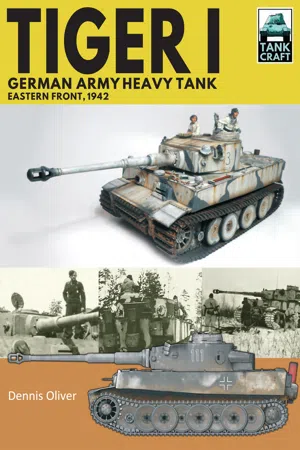
This illustrated guide examines the famous WWII German tank and its operations in the Eastern Front, with extensive resources for modeling enthusiasts.
The Tiger I tank might have been a break-through—and even war-winning—weapon if Germany had produced it in sufficient numbers and introduced it earlier on the Eastern Front. Instead, the Tiger played a mainly defensive role as the Wehrmacht struggled to withstand the advances of the Red Army. In his third book on the Tiger in the TankCraft series, Dennis Oliver focuses on this fascinating period in the tank's short history.
Oliver uses archive photos and extensively researched color illustrations to examine the tanks and units of the German army's heavy panzer battalions. A large part of the book showcases available model kits and aftermarket products, complemented by a gallery of beautifully constructed and painted models in various scales.
Technical details as well as modifications introduced during production and in the field are also examined providing everything the modeler needs to recreate an accurate representation of the Tigers of 1943.
- 64 pages
- English
- ePUB (mobile friendly)
- Available on iOS & Android
eBook - ePub
About this book
Information
Subtopic
Military & Maritime HistoryIn 1937 the Heereswaffenamt, the German army’s weapons procurement and development office, asked the firm of Henschel und Sohn of Kassel to design a tank in the 30 to 33-ton class that would eventually replace the Pzkpfw IV medium tank which was just then entering service. Christened Durchbruchswagen, or breakthrough tank, the first proposal was essentially a Pzkpfw III hull with a Pzkpfw IV turret fitted with a 7.5cm L/24 gun. Just one example of Durchbruchswagen I was completed before work began on Durchbruchswagen II, a still heavier design, and although the project was officially shelved in 1938, a number of features influenced future projects.
Through the last months of peace and into 1940, Henschel, Daimler-Benz, Porsche and MAN worked on the development of entirely new designs for medium and heavy tanks which would utilise the Schachtellaufwerk torsion bar suspension system which was made up overlapping and interleaved road wheels. This arrangement was a significant departure from the system of roadwheels supported on double bogies which characterised German tank development up to that time.
The battles of 1940 had shown that the Pzkpfw IV, the heaviest German tank then in service, was at a decided disadvantage when confronted with the French Char B and British Matilda II but the campaign had been such a spectacular success that weapons development slipped lower on the scale of priorities. Tasked with almost doubling the number of Panzer battalions in preparation for the invasion of the Soviet Union the army focused on production. But in June 1941 the Wehrmacht was suddenly confronted with armoured vehicles which combined thick, sloped armour with mobility and firepower.
The shock caused by the first encounters with the Russian T-34 and KV series of heavy tanks cannot be underestimated and Hitler demanded that while development of the Schachtellaufwerk designs continue, work begin immediately on a still heavier vehicle with armour that would withstand any anti-tank gun then in use. In addition, the proposed tank was to have the capability of destroying any enemy tank at ranges of 1,500 metres and to achieve this a tapered-bore gun firing a tungsten-core projectile, an innovation for its day, was to be fitted.
This weapon would have more than adequately fulfilled the role but the supply of tungsten could not be guaranteed and the only other comparable weapon was the 8.8cm KwK36 which was based on the Flak 18 anti-aircraft gun. In the production version of the Tiger I this gun was fitted with the T.Z.F.9b sight manufactured by Ernst Leitz of Wetzlar which endowed the weapon with exceptional accuracy (1). Working day and night, the designers and engineers at Henschel and Porsche succeeded in completing prototypes in under a year and both were transported by rail to Hitler’s headquarters at Rastenburg in East Prussia, arriving on 19 April 1942 (2).
Notes
1. In trials conducted during the war by the British army using a captured Tiger, the 8.8cm gun was able to consistently hit a 1-metre square stationary target at ranges of over 1,000 metres. The rate of accuracy was only diminished when the target was moving and obscured by smoke.
2. The deadline had been imposed on both companies so that the prototypes could be view by Hitler on his birthday, 20 April.

Fgst Nr. V1, the first Henschel prototype photographed in April 1942 at the company’s Kassel assembly plant. This vehicle had several features which were not included on the production models including the Vorpanzer spaced armour (A) which could be pivoted forward and down to offer additional protection to the front plate. Although it was very quickly rejected a number of initial production tanks retained modifications to the hull front extensions that would have allowed for the fitting of the Vorpanzer shield. Note also the snorkel (B) for submersible running installed in its socket on the engine deck. Just visible is a horn (C) which was also not mounted on the production vehicles.

Captured by the Russians on 18 January 1943, this initial production Tiger I was one of four tanks sent to the Eastern Front in August 1942 with 1.Kompanie, schwere Panzer-Abteilung 502. The battalion’s unit insignia is just visible on the rear of the turret. A number of fittings are missing including the 15-ton jack, which would have been held in the brackets on the right side of the hull rear plate, and the right side stowage bin. The metal beams which held the latter in place are still attached. Note that the pistol port has apparently been removed and replaced in the wrong position with the aperture facing forward.
Notes
1. The Henschel vehicle had actually been built in two versions, the H1, which was fitted with the 8.8cm gun, and the H2 which was armed with a 7.5cm weapon.
2. Speaking after the war, the Henschel designers admitted that they had been able to persuade Speer, and through him Hitler, that manoeuvrability was a key factor.
The Henschel design received the official classification VK 4501(H) while the Porsche prototype was referred to as VK 4501 (P) and while both utilised the same turret, the hull and suspension layouts were markedly different (1). The turret and gun of both prototypes was designed by Friedrich Krupp AG of Essen in consultation with the engineers at Porsche, originally for the company’s Typ 100 Leopard.
As the Porsche tank was offloaded from its rail car it immediately sank into the soft ground and, despite several attempts, it could not be extricated under its own power.
Dr Ferdinand Porsche, who accompanied the prototype, is supposed to have been approached by Erwin Anders, Henschel’s chief designer, who offered to have his tank tow the Porsche vehicle free. If this story is true it was very much an idle boast on Anders’ part as both tanks crawled the final 11 kilometres to Rastenburg, breaking down continuously and having to be nursed through the entire length of the journey.
On the following day both prototype tanks were presented to Hitler and put through their paces. In many respects the Porsche vehicle proved the be the most impressive, but both Hitler and Speer, his armaments minister, were swayed by the superior manoeuvrability displayed by the Henschel prototype, just as its designers knew they would be and it was ordered into production (2). As 100 hulls and turrets had already been ordered for the Porsche design from Krupp it was anticipated that these would go into service, specifically with schwere PanzerAbteilungen 501 and 503, but design problems and lagging production had convinced Hitler by November 1942 that Henschel should be the sole manufacturer of the Tiger and the Porsche programme was officially terminated in the same month. Just one completed vehicle saw combat as a Befehlspanzerwagen with Panzerjäger-Abteilung 653 and was destroyed in July 1944 on the Eastern Front. The hulls were used in the Panzerjäger Elefant/Ferdinand project.
The Henschel production vehicle consisted of an armoured hull, or Panzerwanne, made up of a fighting compartment, a closed engine compartment and two side panniers. The latter were necessary to accommodate the width of the Krupp turret. The turret drive, steering gear, brakes, transmission, driver’s and radio operator’s positions, hull machine gun and the complete ammunition stowage for the 8.8cm gun were located in the fighting compartment. The driver’s front plate and front nose plate were of 100mm thickness while the glacis was of 60mm thickness but angled to provide greater protection. The superstructure side plates and hull side plates, behind the wheels, were of 80mm and 60mm thickness respectively. A machine-gun ball mount, or Kugelblende, was inset into the driver’s front plate in front of the radio operator’s position. To support the Tiger’s weight the suspension was constructed as a so-called Schachtellaufwerk where the road wheels were interleaved. The outer row of road wheels could be easily removed to facilitate rail transport by reducing the overall vehicle width and sets of narrow tracks were also provided. A fully traversable turret was mounted centrally on the hull deck and this contained the main gun and a machine gun. The turret roof contained a forward-opening hatch for the loader and a cylindrical cupola for the commander. On the hull deck, in front of the turret, were hatches for the driver and radio operator. The fully-assembled chassis, incorporating the Panzerwanne and suspension, were identified by a unique number which was referred to as a Fahrgestellnummer (Fgst Nr.) and the Tiger I series began with 250001. The turrets were manufactured by Wegmann & Co., and transported to the Henschel plant, just over a kilometre away, where the final assembly took place. Each turret was also identified by an individual number, here referred to as a Turm Nr, and these began at 1 (1).
The Tiger I engines were produced by Maybach of Friedrichshafen and the main guns, the famous 8.8cm KwK 36 L/56, were assembled by Dortmund Hoerder Hüttenverein and R. Wolf AG at their Magdeberg-Buchau factory.
The first production models were referred to as Panzerkampfwagen VI H (8.8cm) ausf H1, with the ordnance designation SdKfz 182, and the title Tiger I is not encountered in official documentation until October 1942, probably to differentiate the tank from the Tiger II project which by then in the early planning stages. On 27 February 1943 a personal order from Hitler directed that the tank should henceforth be referred to as the Panzerkampfwagen Tiger ausf E SdKfz 181 and this designation remained in force until the end of the war. As a matter of convenience I have referred to the tank as Pzkpfw VI ausf H or Tiger I throughout this book.
In August 1942 the first production Tiger tanks to see combat left the assembly lines at the massive Henschel und Sohn plant at Kassel in western Germany and it should be said that the eight tanks completed during that month, including the four vehicles of 1.Kompanie, schwere PanzerAbteilung 502 operating near Leningrad, were essentially at the prototype stage. Many modifications were made during the assembly of subsequent vehicles and the most important of these are listed below. A number of these, particularly field modifications, are also highlighted in the Camouflage & Markings section. But I should mention that as the purpose of this chapter is to enable the reader to confidently determine when a particular tank was manufactured, the many internal changes are for the most part not listed. It should also be noted that the terms initial and early production are modern inventions and were not in use during the war.

This early production Tiger I of 1.Kompanie, schwere Panzer-Abteilung 503 was photographed during the fighting for Kharkov and may have been one of the tanks finished in the North Africa camouflage colours with patches of Dunkelgrau RAL 7021 as discussed in the Camouflage & Markings section of this book. Features to note are the Pzkpfw III stowage box, the early pattern hull track guards, smoke candle dischargers, brackets for the long-handled shovel on the glacis and early style hull extensions.
Notes
1. This is a simplified explanation of what is a rather complicated system which is explained further in the production and allocation tables presented on pages 62 and 63.

An initial production Tiger I assembled in August 1942. Note the angle of the hull front extensions, the method of welding the hull side plates, the bent front fender attached to the hull by hinges, the exhaust mufflers and the lack of brackets on the hull side to hold the track changing cable. Note also the fixtures to hold a turret stowage box behind the pistol port.
April 1942. Fgst...
Table of contents
- Cover
- Title
- Contents
- Copyright
- Introduction
- The Eastern Front August 1942-March 1943
- The Tiger Units
- Camouflage & Markings
- Model Showcase
- Modelling Products
- Technical Details and Modifications
- Product Contact Details
Trusted by 375,005 students
Access to over 1.5 million titles for a fair monthly price.
Study more efficiently using our study tools.
Frequently asked questions
Yes, you can cancel anytime from the Subscription tab in your account settings on the Perlego website. Your subscription will stay active until the end of your current billing period. Learn how to cancel your subscription
No, books cannot be downloaded as external files, such as PDFs, for use outside of Perlego. However, you can download books within the Perlego app for offline reading on mobile or tablet. Learn how to download books offline
We are an online textbook subscription service, where you can get access to an entire online library for less than the price of a single book per month. With over 1.5 million books across 990+ topics, we’ve got you covered! Learn about our mission
Look out for the read-aloud symbol on your next book to see if you can listen to it. The read-aloud tool reads text aloud for you, highlighting the text as it is being read. You can pause it, speed it up and slow it down. Learn more about Read Aloud
Yes! You can use the Perlego app on both iOS and Android devices to read anytime, anywhere — even offline. Perfect for commutes or when you’re on the go.
Please note we cannot support devices running on iOS 13 and Android 7 or earlier. Learn more about using the app
Please note we cannot support devices running on iOS 13 and Android 7 or earlier. Learn more about using the app
Yes, you can access Tiger I, German Army Heavy Tank by Dennis Oliver in PDF and/or ePUB format. We have over 1.5 million books available in our catalogue for you to explore.