What is knowledge? Who decides what is important? Who owns it? These key questions are central themes in this accessible book that aims to change perceptions and the understanding of education. Using historical and contemporary examples the authors examine the motivations, conflicts, and contradictions in education. Breaking down the structures, forces, and technologies involved in education they chart an alternative approach.
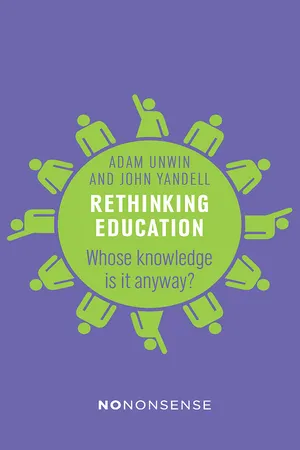
- 144 pages
- English
- ePUB (mobile friendly)
- Available on iOS & Android
eBook - ePub
About this book
Information
Topic
EducationSubtopic
Educational Policy1 What is the point of school?
‘Education is the most powerful weapon which you can use to change the world.’
Nelson Mandela
Education is still widely seen as a liberating force – not least by children in poorer countries who are denied access to it. But all too often students experience school as a place that constricts and controls rather than inspires – and that has little relevance to life in the ‘real world’. Schools are places where competing interests clash – and where the needs of pupils do not always have priority.
Schools are deeply contradictory places. They offer possibilities of emancipation and development, of learning to become more fully human – and they are places of coercion and belittlement, places where human spirits are crushed. This tension in what schools represent is nothing new. For an optimistic view, here’s Sherlock Holmes, looking out of a train window:
Holmes was sunk in profound thought and hardly opened his mouth until we had passed Clapham Junction.
‘It’s a very cheery thing to come into London by any of these lines which run high and allow you to look down upon the houses like this.’
I thought he was joking, for the view was sordid enough, but he soon explained himself.
‘Look at those big, isolated clumps of buildings rising up above the slates, like brick islands in a lead-colored sea.’
‘The board-schools.’
‘Lighthouses, my boy! Beacons of the future! Capsules with hundreds of bright little seeds in each, out of which will spring the wiser, better England of the future…’1
Holmes was looking at the board schools built in London in the aftermath of the 1870 Education Act, the legislation that established a universal right to elementary education in England and Wales. In his view, the well-built, large-windowed, airy three-story Victorian buildings represented an advance – an indication of the state’s investment in education and its commitment to the betterment of the working class: a reason to take a bright view of the future.
For a contrary view, here are the words of Barrie, a 19-year-old mineworker, in conversation with his former teacher, reflecting on his experience of schooling in the 1970s:
I think a teacher’s a person that wants to put intelligence into someone like a bloody factory animal. I think the perfect teaching system would be to have kids there with built-in impulses to be sat in rows, take it all in, write it all down and remember it for ever. I mean they’re trying to make them like ruddy little computers.2
Here, school is experienced as an instrument of repression, of domination and the denial of individuality, of freedom, of agency or motivation.
What are the reasons for these radically different views of schooling? To address this question, we have to consider both the internal operation of school and how schools are situated in the wider society. What kind of system is the school system? What does it do – and how does it do it?
There is also the glaring issue of disparities: how wealth, whether at individual, regional, national or international level, determines a person’s educational opportunities; how gender can similarly influence educational chances. These disparities are particularly acute in the Global South, as has been recognized by the Education for All (EFA) movement:
Launched in 1990 by UNESCO, UNDP, UNICEF and the World Bank. Participants endorsed an ‘expanded vision of learning’ and pledged to universalize primary education and massively reduce illiteracy by the end of the decade.3
Ten years later these goals were far from being achieved. The World Education Forum in Dakar, Senegal, in 2000 reaffirmed its commitment to achieving Education for All by the year 2015. UNESCO was to lead this with a focus on six key education goals, including comprehensive and free primary education for all, eliminating gender disparities and a focus on numeracy and literacy. In 2014 the UNESCO global monitoring reports pointed to some progress; yet in sub-Saharan Africa there are still 30 million children out of school. There is no doubt about the challenges, the inequalities and the lack of entitlement that continue to be the experience of many in the Global South. These are real, material disparities – and they matter. But access to education is only one aspect of what is at stake. Always and everywhere, it is necessary to ask about the purposes of education: whose interests are being served?
What, then, is the contribution that school can make? It has long been assumed that improving educational outcomes is all about schooling, and this, as we can see from the EFA agenda (above), is represented as a question of mass access. But we might want to ask: universal provision of what? What actually happens in schools and classrooms? Whose knowledge is it anyway?
These questions will recur throughout the book. Here, though, to illustrate something of the complexity of the issues involved, let’s look at a key moment in the history of schooling as a global phenomenon. It is a moment that reveals education as a battleground, fought over by very powerful vested interests. And it is a moment with far-reaching consequences: its effects are still evident today.
The language of imperialism
Back in the 1830s, when the British Empire was reaching into every corner of the world, a debate was raging between the civil servants and the missionaries. The argument was about what an appropriate education system would look like in the Indian subcontinent. The missionaries were in favor of using the indigenous learned languages of Arabic and Sanskrit, the languages into which they were already translating the Bible, as the medium of instruction and indoctrination. This approach, they believed, would be one that would most readily enable them to win hearts and minds (and converts).
The civil servants had other ideas. They favored the use of English, arguing that money should be diverted away from existing Arabic- and Sanskrit-medium schools and put towards the development of an English-medium education system.4 One of the civil servants, Thomas Babington Macaulay, made the case in a trenchantly expressed ‘Minute on Indian Education’.5
I have conversed both here and at home with men distinguished by their proficiency in the Eastern tongues… I have never found one among them who could deny that a single shelf of a good European library was worth the whole native literature of India and Arabia…
The claims of our own language it is hardly necessary to recapitulate. It stands pre-eminent even among the languages of the West. It abounds with works of imagination not inferior to the noblest which Greece has bequeathed to us, – with models of every species of eloquence, – with historical composition, which, considered merely as narratives, have seldom been surpassed, and which, considered as vehicles of ethical and political instruction, have never been equalled – with just and lively representations of human life and human nature, – with the most profound speculations on metaphysics, morals, government, jurisprudence, trade, – with full and correct information respecting every experimental science which tends to preserve the health, to increase the comfort, or to expand the intellect of man. Whoever knows that language has ready access to all the vast intellectual wealth which all the wisest nations of the earth have created and hoarded in the course of ninety generations. It may safely be said that the literature now extant in that language is of greater value than all the literature which three hundred years ago was extant in all the languages of the world together.
Even from this historical distance, the claims that Macaulay makes on behalf of English language and literature are breathtaking. The superiority of English language and culture over all others is both taken for granted and enacted in the argument. Here, at a moment that is close to the beginning of European nation states’ involvement and investment in schooling, education is not just implicated in the history of British imperialism, it is integral to the imperialist project. Here, too, it is pretty clear that what knowledge is valuable depends on one’s point of view – and how much power one has to enforce this view on others.
Macaulay’s arguments prevailed. English became the medium of instruction, not only in schools in the subcontinent but across the Empire, thereby helping to construct an indigenous cadre, loyal to the imperial center, whose efforts would ensure the efficient operation of a global bureaucracy, as vital to the business of government as to commerce itself. This, of course, was what was at stake, and perhaps rather more important than Macaulay’s overt emphasis on the civilizing virtues of English.
Also in the 1830s, the British state established a national school system in Ireland. As with British policy in India, this was not intended to emancipate but to control. A series of textbooks, or ‘readers’, was published, initially for use in Ireland. Over the following 30 years or so, the same readers were to be found in schools in Canada, in England, and across the Empire. These readers provided the basis for a centralized, homogeneous curriculum – one that paid no attention whatsoever to local circumstances, cultures or histories and promoted ‘a view of the world that placed Britain, Christianity and the English language at the normative centre’.6 The textbooks, like the schools in which they were used, were instruments of imperial domination. And they might reasonably be regarded as having contributed to the contemporary position of English as a global language.
Things have moved on, of course. The fact that there are 350 million students of English in Chinese schools is only distantly related to the history of British (or American) imperialism. But it would be a mistake to imagine that, in this postcolonial era, schooling is always and everywhere designed to further the interests – material, intellectual or spiritual – of the learners.
Postcolonial schooling: the ‘Diploma Disease’ era
The term ‘diploma disease’ was coined in 1976 by Ronald Dore as the title of what is now seen as a seminal book.7 Dore was a sociologist with a long-term interest in how countries that are part of what we now would refer to as the Global South approached economic development. The particular focus of his 20-year research was on the role of education and qualifications in this development. Dore used an example to explain the spread of the disease:
A bus company may ‘normally’ require a junior secondary leaving certificate for bus conductors and a senior secondary leaving certificate for the slightly better paid clerks. But as the number of senior certificate holders grows far larger than the number of clerkships that are available, some of them decide that £5 a week as a bus conductor is better than nothing at all. The bus company gives them preference. Soon all the available conductor slots are filled by senior certificate holders: a senior certificate has become a necessary qualification for the job.8
This is sometimes called qualification inflation, where increasingly one needs higher qualifications for entry to certain jobs – not because of the skills required to do the job but because the qualification starts to function as a filtering mechanism. Dore was interested in how this featured in and influenced the labor markets of these ‘modernizing’ economies. Dore’s work challenges the notion that there is a simple, rational and socially progressive causal relation between apparent improvements in the level of schooling and economic benefits. There is, though, another aspect of his work that is interesting, which is how this qualification inflation affects the educational experience itself – what it means for the learners. One might expect that the need for higher qualifications would lead to schooling being seen as more important and thus improve the quality of both provision and participation in educational processes. If it had this effect then, as Dore argued, education would produce be...
Table of contents
- Cover
- About the Authors
- Acknowledgements
- Title Page
- Copyright
- Contents
- Foreword
- Introduction
- 1. What is the point of school?
- 2. How we learn – in and out of school
- 3. Technology is the question, not the answer
- 4. Knowledge, curriculum and control
- 5. Instituting difference: how schools reproduce inequality
- 6. Neoliberalism: education as commodity
- 7. Another education is possible
- Index
Trusted by 375,005 students
Access to over 1.5 million titles for a fair monthly price.
Study more efficiently using our study tools.
Frequently asked questions
Yes, you can cancel anytime from the Subscription tab in your account settings on the Perlego website. Your subscription will stay active until the end of your current billing period. Learn how to cancel your subscription
No, books cannot be downloaded as external files, such as PDFs, for use outside of Perlego. However, you can download books within the Perlego app for offline reading on mobile or tablet. Learn how to download books offline
Perlego offers two plans: Essential and Complete
- Essential is ideal for learners and professionals who enjoy exploring a wide range of subjects. Access the Essential Library with 800,000+ trusted titles and best-sellers across business, personal growth, and the humanities. Includes unlimited reading time and Standard Read Aloud voice.
- Complete: Perfect for advanced learners and researchers needing full, unrestricted access. Unlock 1.5M+ books across hundreds of subjects, including academic and specialized titles. The Complete Plan also includes advanced features like Premium Read Aloud and Research Assistant.
We are an online textbook subscription service, where you can get access to an entire online library for less than the price of a single book per month. With over 1.5 million books across 990+ topics, we’ve got you covered! Learn about our mission
Look out for the read-aloud symbol on your next book to see if you can listen to it. The read-aloud tool reads text aloud for you, highlighting the text as it is being read. You can pause it, speed it up and slow it down. Learn more about Read Aloud
Yes! You can use the Perlego app on both iOS and Android devices to read anytime, anywhere — even offline. Perfect for commutes or when you’re on the go.
Please note we cannot support devices running on iOS 13 and Android 7 or earlier. Learn more about using the app
Please note we cannot support devices running on iOS 13 and Android 7 or earlier. Learn more about using the app
Yes, you can access Rethinking Education by Adam Unwin,John Yandell in PDF and/or ePUB format, as well as other popular books in Education & Educational Policy. We have over 1.5 million books available in our catalogue for you to explore.