
eBook - ePub
The Story of Sidonie C.
Freud's famous "case of female homosexuality"
- English
- ePUB (mobile friendly)
- Available on iOS & Android
eBook - ePub
The Story of Sidonie C.
Freud's famous "case of female homosexuality"
Information
CHAPTER 1 ·
LEONIE
An elegant woman paces rapidly back and forth in the inner courtyard of a prison in Vienna, a fur coat draped loosely over her shoulders. The fact that she's accompanied by armed guards doesn't seem to bother her. The paint flaking off the enclosing walls in scrofulous patches is the victim of damp and mildew. The first green shoots are showing between lingering patches of snow, but the ground remains sodden, and the prisoner's shoes make a smacking sound on the well-worn path. Stopping briefly to glance up, she looks straight into the appalled eyes of her friend, who has, it seems, finally gotten the long-hoped-for visitor's pass and is waving from a second-floor window. Waving back quickly, the prisoner shrugs and gives a tired smile, as if none of this concerns her.
Spring 1924 has just begun in Vienna, and for the past few days the city's newspapers have been slavering over the beautiful, and notorious, thirty-three-year-old prisoner they've labeled "wild and sensation seeking." Baroness Leonie von Puttkamer, from Old Prussian nobility, is married to Albert Gessmann Jr., president of the Austrian Farming Association, and he has accused her of trying to murder him by poisoning his coffee. The couple is in the midst of vicious divorce proceedings, with both parties' lawyers hurling accusation upon accusation and the police recording transcript after transcript, and now Leonie von Puttkamer has finally ended up in jail.
On March 31, 1924, the Neue Freie Presse dissects the couple's marriage, which Albert Gessmann initially characterizes to reporters as "exceedingly happy." A few days later, he acknowledges that, yes, there have been difficult moments; especially because his wife "has been under the disastrous influence of girlfriends who have been exploiting her." Leonie Puttkamer-Gessmann is rumored to have had an intimate relationship with the dancer Anita Berber, the newspaper points out, and "is said to have been interned repeatedly in psychiatric wards" during her youth.
The Neue Montagsblatt picks up the story the same day and focuses on Leonie's girlfriends. "When talking with a similarly inclined girlfriend, she [Leonie] is said to have remarked that her husband should be sidelined as soon as he has written a will."
According to the police, Mr. Gessmann has stated that his wife "has been so under the demonic influence of her lesbian girlfriend that she went after her own husband with genuine hatred."
On April 1, 1924, the Neue Freie Presse, hoping to one-up the other papers, states that Leonie Puttkamer-Gessmann is "a woman poisoned to the soul by gender aberration and the use of morphine and cocaine." Under interrogation, she has denied any involvement in causing her husband's poisoning symptoms, but, the paper stresses, "a human being with the notorious peculiarities of Baroness Puttkamer apparently cannot be made to take responsibility. Taking everything into consideration, including the police report, one cannot find any motive for such a serious crime, save Mrs. Gessmann's so-called aversion to men."
At this juncture, the police decided that due to the additional charge of illicit sexual relations, the baroness's circle of female friends—who refer to her exclusively as Leo—will also be questioned.
The baroness's young friend who stands at the window has also been mentioned in the media, although thanks to her father's influence, not by name. Her reputation in respectable society has already suffered greatly, and had her name found its way into print, she would have been ostracized permanently.
She is Sidonie Csillag, Sidi to friends and family, who will soon celebrate her twenty-fourth birthday. The daughter of an upper-middle-class family, she has never been to a jail before, and it has cost her considerable effort to come here. The pointed, derogatory looks the guards gave her when she signed in seemed almost compromising. The long, echoing hallways with their worn slate tiles, the stale smell of laundry room, latrine and cold meals all turned her discomfort into disgust. She has not been given permission to speak to Leonie, only to look at her from the window.
Leonie's face has grown so thin! See how she clutches her arms around herself and paces in an endless circle as if nothing could stop her! She seems to be looking at nothing, as if she has willed herself outside the walls and is already someplace else. Sidonie has to repress a laugh at the absurdity of the guards who stumble along behind Leonie with a kind of dull zeal. What is it they are trying to guard? What do they want to keep hold of?
She has been allowed to keep her fur coat, that's good; but underneath she is wearing a thin, grey institutional dress—and her shoes are so inappropriate for the slushy ground.
Sidonie looks at this beloved woman with a mixture of wistfulness, horror and disgust. How could her adored Leonie have ended up here? Where does the truth lie—in what the newspapers report or in what she herself has always seen in this elegant, beautiful woman?
Sidonie has never actually understood the baroness's strange appetites, or, more specifically, her contradictory, anchorless ways. At the age of seventeen, when she first met Leonie Puttkamer, Sidi had been an "innocent creature," a sheltered girl with no sexual experience who knew nothing about erotic affections. But the first time she saw the baroness, she felt as if she'd caught fire—not a sexual fire but a deep and burning desire to adore and to worship.
It was high summer 1917. Wartime rationing laws had just been passed. Foodstuffs got harder to obtain; the previous February, all gas-powered vehicles had been confiscated for the war effort; the number of trains had been reduced; and travel by ship on the Mediterranean was no longer safe. All this forced even the well-to-do to stay closer to the capital than usual during their annual summer escape to the countryside.
At the beginning of June that year, Sidonie's mother had given birth to her third son, a late comer after her three nearly grown children, and to recuperate she was spending time at a sanatorium. Sidonie, just turned seventeen, was tall, though still slightly plump, and pretty, with a cascade of long dark hair—the perfect image of an upper-class daughter. She didn't yet know what to make of the newcomer to the family, but soon he would reduce even further the already small share of love Frau Csillag allocated to her only daughter. She adores all her sons but always keeps Sidonie at a certain distance.
Sidonie can recall that summer vividly. Having just finished school, she sees the summer as a time of transition, after which she will surely start a new stage in life. Her older brother has been drafted into the army, her father is away on business seeing to the affairs of his paraffin oil business, which is essential to the war effort, and so together with her younger brother and a governess, she is sent off to Semmering. This resort, traditionally favored by Vienna's bourgeoisie, isn't as beautiful as the Adriatic island of Brioni, which the Csillags and their circle preferred, but most of her girlfriends are at Semmering this year, though the young men are not.
The war is entering its fourth year, with an end in sight only at the Russian front, and the young men are away in war-related positions or on the battlefield—sacrificing their lives for the moribund monarchy. The voices raised against the war, and also against the ruling dynasties, have recently grown louder.
Three years earlier, on June 28, 1914, in the Bosnian capital of Sarajevo, a Serbian nationalist fatally shot Archduke Franz Ferdinand, the heir to the Austro-Hungarian throne, and his wife Sophie. A month later Austria-Hungary declared war on Serbia. Shortly thereafter, Czarist Russia, France and Great Britain—all Serbia's allies—declared war on Austria-Hungary and its ally, the German Empire. By the summer of 1914 most of Europe had been swept up in a tide of war enthusiasm. Confident that the war would only last a short while, many were willing to contribute to the cause: the wealthy bought war bonds and the general population participated in collections such as "give gold for iron." Few listened to the early voices speaking out against the war, but by 1915 their numbers had started to grow steadily. Karl Kraus, publisher of Die Fackel (the torch) and a staunch anti-militarist, started writing Die letzten Tage der Menschheit (the last days of mankind) during the summer of 1915. Sidonie had met the famous "Fackel-Kraus" several times while visiting his niece, her friend Marianne Kraus. Despite his fame, he hadn't impressed her.
The well-known Viennese merchant Julius Meinl II had invited like-minded business people to launch a peace initiative, and at Sidonie's home her father's guests and business partners had discussed Meinl's proposals seriously. They had been divided on the question of whether war or peace would bring them more profit.
Sidonie paid little attention to the on-going unpleasant events, but by late 1916 there was no escaping them. On October 21 she watched her father turn pale as he learned that Friedrich Adler, the son of Viktor Adler, a founder of the Austrian Social Democratic Party, had shot the prime minister, Count Karl Stürgkh. The new prime minister was to be Ernest von Koerber, who hadn't instilled much confidence in business circles. Exactly one month later, Emperor Franz-Joseph died of pneumonia, and his grand-nephew, Karl, took charge of the army two days after the funeral. Neither the army nor the industrialists nor the politicians put much faith in this devout young emperor. Then in the spring of 1917, Russia was inundated by the first wave of revolution. At the same time, the supply situation in Vienna was rapidly deteriorating, and even though Sidonie didn't have any personal day to day worries, she frequently had to witness scenes that she found quite unpleasant, and so she was glad when she passed her school leaving exams and was free to spend the summer—as usual—outside Vienna.
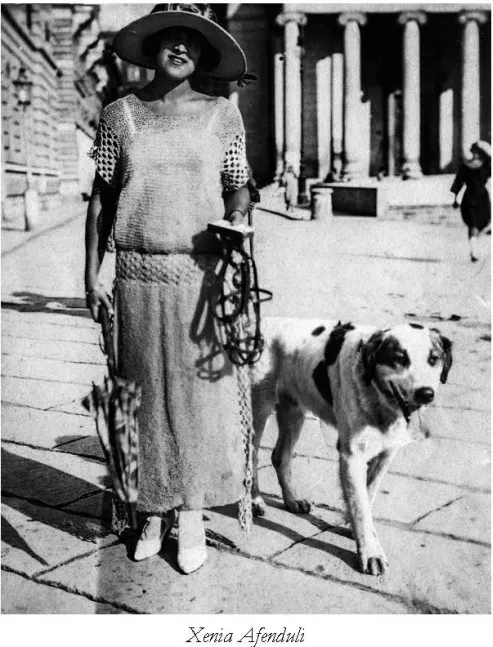
Sidonie's closest friend at Semmering is a cheerful brunette named Xenia Afenduli. The Afendulis are among the many Greek trading families that had settled in the harbor city of Trieste and accumulated considerable wealth. When war-time Trieste became problematic, the whole family—with personal effects and staff—moved into Vienna's Grand Hotel. Like their counterparts, they summered in the countryside.
SEMMERING
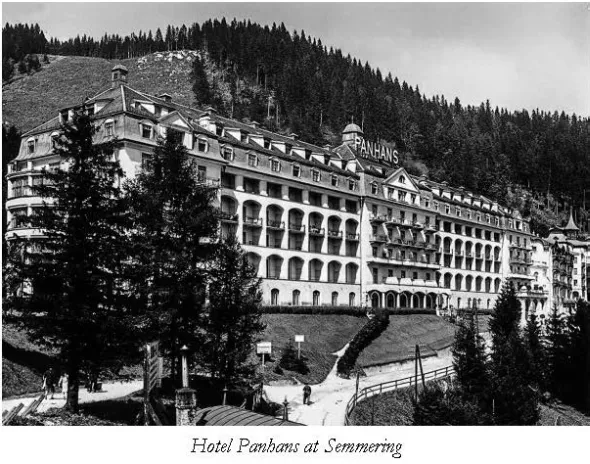
Two Semmering hotels compete for this upper-class clientele: the old, established Südbahnhotel and its rival, Hotel Panhans. The Panhans was enlarged in 1912 in a style reminiscent of the Riviera—a mighty central building is flanked by two large additional buildings in a mixture of imitation Italianate styles that sport an opulence of little towers, gables, trim, carvings and other bric-a-brac.
The nouveau riche, Vienna's and Budapest's high society and by 1917 war-time profiteers and their pretty companions as well, all find accommodation in the Panhans's 400 rooms; but the hotel particularly prides itself on its titled visitors—this is noted on the hotel stationery— and each summer welcomes the German Imperial Chancellor, Prince von Bülow.
Great luxury is available here—giant suites, magnificent dining halls, a large café and separate salons for games, reading, conversation and the ladies. The luxury extends outdoors to private hunting grounds, fishing ponds, horse stables, tennis and croquet courts, and in the winter months ski slopes, ice-skating rinks and sledding hills. The Catholics among the guests can attend daily mass in the small adjacent church and ask for forgiveness for sins committed in the course of conducting secret transactions, profiteering, spreading malicious gossip and cavorting with concubines at holiday flings. For everyone's pleasure, there is also a spa in the forest, where, amid the sounds of chirping birds and the wind in the trees, one might take the waters, enjoy some hydrotherapy or a steam bath ... an idyllic spot, the Panhans.
A few hundred meters downhill, in the village of Schottwien, bitter people grumble because it has been months since they have had flour, let alone meat, while above them, refugees from the purgative "cures" at spas such as Karlsbad and Marienbad relax and refuel at culinary orgies. Their war is far away, and it is enough just to be alive ... who knows for how much longer.
Sidonie and Xenia soon grow bored with the daily routine. It is far more entertaining to escape their governesses, roam the neighborhood and gossip about the other guests. During their forays, they often encounter the same two women walking arm in arm; occasionally they are in the company of an older man, on whom they seem to heap flattery in a rather odd way. Sidonie dismisses as uninteresting the woman she thinks of as fat and ugly, but she is fascinated by the other—tall, slender, elegant and with an easy, somewhat swaying gait. When their paths cross, the girl admires the woman's beautiful hands, which always hold a pair of kid gloves, and her uncommonly short, slightly wavy hair style. The herbal scent of her perfume lingers after she passes by and always triggers a warm pull inside Sidonie.
But the sharp, almost hard look in her pale blue-gray eyes and the stubborn yet sensual set to her mouth are what make this stranger seem extraordinary. She is unlike any woman Sidonie has ever encountered.
The governesses close down whenever Sidonie asks about the oddly matched couple, in particular about the beautiful stranger. They let fall a bit of gossip but seem determined to keep Sidonie and Xenia well away from the women in question. The hotel doorman is more forthcoming. The two ladies often frequent the hotel. Klara Waldmann is the one Sidonie has dismissed; the other is Baroness Leonie von Puttkamer, from a quite noble Old Prussian family.
Sidonie is keen to concoct a meeting and drags the good-natured Xenia along at impossible hours to track down Leonie Puttkamer. The governesses grow more watchful; they reprimand the girls and repeat cryptic comments about the couple, mentioning dependency, depravity and triangles. They drop the word cocotte into the conversation.
Sidonie doesn't understand such outrage. What are Frau Waldmann and Baroness Puttkamer doing besides going for walks? "That's it exactly," is the governesses' snappish reply. Xenia, already eighteen and better informed about such secrets, enlightens Sidonie, who has always been attracted to women and now, finally, has a name for the tumultuous yearning she sometimes feels. Now she understands that she is not the only human being with such feelings.
Klara Waldmann and Leonie Puttkamer check out of the hotel before Sidonie can engineer an introduction. For the rest of the slowly passing summer Sidonie spends hours every day thinking about the baroness, writing letters and poems to her that she can never mail. She must see her again but has no idea how to make that happen.
The first time Sidonie visits Xenia at the Grand Hotel after returning from Semmering, she learns that the baroness has supper there every evening. No girl her age could show up there on her own without a good reason, so Sidonie has to concoct one. Perhaps if she offered to accompany her health-conscious mother on her daily walk around the Ring and then suggested tea at the Grand Hotel ...
Emma Csillag is a bit surprised by her daughter's sudden enthusiasm for exercise and her uncharacteristic display of devotion; but the hotel's panache and the comings and goings of its noble guests are a strong draw. The beautiful and quite spoilt wife of a wealthy industrialist, Emma likes to be seen and admired, and if she is in the company of her daughter, she can respond innocently to occasional glances from good-looking men.
She soon discovers Sidonie's ruse, but she plays along for some time before her daughter's pubertal puppy love and lingering glances at the outré lady begin to make her nervous. These women who use too much mak...
Table of contents
- COVER
- ACKNOWLEDGEMENTS AND TRANSLATOR'S NOTE
- PREFACE
- FOREWORD
- CHAPTER 1 · LEONIE
- CHAPTER 2 · BERGGASSE NR. 19
- CHAPTER 3 · ARSENIC, COCAINE AND LONG NIGHTS
- CHAPTER 4 · DANCES OF VICE, HORROR AND ECSTASY
- CHAPTER 5 · WAY STATIONS: 1922-26
- CHAPTER 6 · WOMEN'S BODIES, MEN'S BODIES
- CHAPTER 7 · WJERA
- CHAPTER 8 · "... ANYWAY, I'M NOT ONE OF THEM."
- CHAPTER 9 · CUBA, MI AMOR
- CHAPTER 10 · LEADEN TIMES
- CHAPTER 11 · MONIQUE
- CHAPTER 12 · "NOT ONE DAY GOES BY WHEN I DON'T THINK OF HER..."
- BIBLIOGRAPHY
- SOURCES OF PICTURES
Trusted by 375,005 students
Access to over 1.5 million titles for a fair monthly price.
Study more efficiently using our study tools.
Frequently asked questions
Yes, you can cancel anytime from the Subscription tab in your account settings on the Perlego website. Your subscription will stay active until the end of your current billing period. Learn how to cancel your subscription
No, books cannot be downloaded as external files, such as PDFs, for use outside of Perlego. However, you can download books within the Perlego app for offline reading on mobile or tablet. Learn how to download books offline
Perlego offers two plans: Essential and Complete
- Essential is ideal for learners and professionals who enjoy exploring a wide range of subjects. Access the Essential Library with 800,000+ trusted titles and best-sellers across business, personal growth, and the humanities. Includes unlimited reading time and Standard Read Aloud voice.
- Complete: Perfect for advanced learners and researchers needing full, unrestricted access. Unlock 1.5M+ books across hundreds of subjects, including academic and specialized titles. The Complete Plan also includes advanced features like Premium Read Aloud and Research Assistant.
We are an online textbook subscription service, where you can get access to an entire online library for less than the price of a single book per month. With over 1.5 million books across 990+ topics, we’ve got you covered! Learn about our mission
Look out for the read-aloud symbol on your next book to see if you can listen to it. The read-aloud tool reads text aloud for you, highlighting the text as it is being read. You can pause it, speed it up and slow it down. Learn more about Read Aloud
Yes! You can use the Perlego app on both iOS and Android devices to read anytime, anywhere — even offline. Perfect for commutes or when you’re on the go.
Please note we cannot support devices running on iOS 13 and Android 7 or earlier. Learn more about using the app
Please note we cannot support devices running on iOS 13 and Android 7 or earlier. Learn more about using the app
Yes, you can access The Story of Sidonie C. by Ines Rieder,Diana Voigt, Jill Hannum in PDF and/or ePUB format, as well as other popular books in Psychology & World History. We have over 1.5 million books available in our catalogue for you to explore.