eBook - ePub
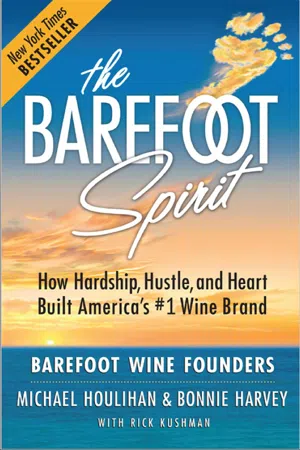
The Barefoot Spirit
How Hardship, Hustle, and Heart Built America's #1 Wine Brand
- English
- ePUB (mobile friendly)
- Available on iOS & Android
eBook - ePub
The Barefoot Spirit
How Hardship, Hustle, and Heart Built America's #1 Wine Brand
Information
Chapter One
How Hard Could It Be?
Michael Houlihan drove to the far end of the Piggly Wiggly parking lot in Columbia, South Carolina. That’s what he did in every parking lot, and it’s what all good salespeople do, park as far away as they can. The spots by the door are for customers. Store managers notice the courtesy.
It was mid-May. The sky loomed thick and close, a dark, steely greenish gray. Michael didn’t so much see the clouds as feel them—hot, heavy, and steamy. It was the kind of day that discourages movement. Ah, spring in the American South.
Michael is a tall man, 6-foot-2, a bit gangly, with reddish hair and an air that says he spent some time on a surfboard. He was wearing a dark suit, carrying Barefoot wine samples in a bag over his shoulder, and holding a large, foam-core sign with a 5-foot-tall purple foot. This was not a guy they saw every day at the Piggly Wiggly.
When Michael had driven up, a dark-haired teenager was collecting stray shopping carts and wheeling them back to the store. By the time Michael started lugging his wine and sign across the 30-yard lot, the kid had abandoned his carts and was sprinting for the supermarket door.
“Hey buddy,” he said as he flashed past Michael, “you better run.”
Say what? Run? Michael looked left and right. All he saw were parked cars. Did he hear the kid right?
Then, BOOM! The thunderclap almost knocked him over. Michael felt it in his spine. “Whoa,” he thought, “was that it?” He stood there shaking it off. Maybe five seconds later, it began to rain. Not gentle, soothing, wimpy spring rain like he knew in Northern California. This was rain from a fire hose or a falling river. Buckets and buckets in seconds. Drops that felt like walnuts. “Got it,” Michael thought.
In seconds, his suit was soaked. His tie was soaked. His shoes and socks and pockets filled with water. He started running for the store.
Then came the wind. Huge, uneven blasts, blowing hard from the left, then hard from the right. Michael’s sign turned into a sail. It yanked him west halfway across the parking lot. Then it pulled him east. Then another gust pulled him west again. He was hanging on, figuring if he let go, the sign would land in Georgia. Left, right, lurch, wobble, just don’t let go.
Inside the store, people had stopped. No one was checking out or bagging groceries or moving. They were watching this tall, fair-haired California-looking guy in a suit, getting hammered by rain and staggering back and forth, wrestling with a giant purple foot. He disappeared out of view for a moment, then re-appeared and heaved off in the other direction. He was barely making progress toward the door.
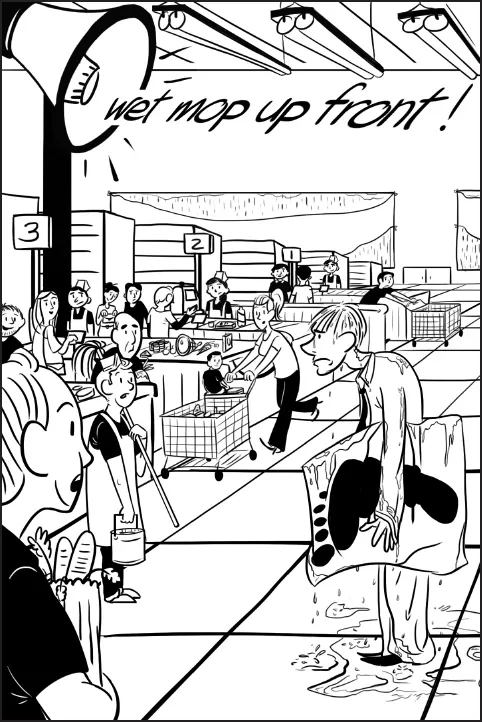
“Wet mop up front!”
The whole show took maybe four minutes. Michael tottered into the store, through the automatic doors, and just stood for a second, catching his breath. He was leaking water onto the floor like a broken barrel. He looked up. The whole store, the shoppers, the clerks, the bag boys, the kid who’d been pushing carts stared at him wide-eyed. No one moved. Just people staring.
Michael stared back, dazed and dripping. That was the only sound, the dripping. No cash registers, no rustling, no chatter. Just drip, drip, drip. Above them, out of the ceiling, that supermarket mechanical voice broke in. “Wet mop,” it said. “Up front.”
A few seconds later, the store manager, a tall man with a Southern gentleman’s manner, walked up to Michael.
“Son,” he said, “I know you have something to sell me. And I know you want to sell it real bad.”
“Yes sir,” Michael said. “I do.”

Before there were wine labels with dogs and bears and kangaroos, before there were viral campaigns or guerrilla marketing on any scale, before the wine industry had any sense of humor, there was Barefoot.
This is the story of Barefoot’s unlikely rise, its against-all-odds survival, and its surprising impact on a wine world that had not yet learned to smile. It is a snapshot of the American spirit California style. It’s about following your own path and having faith in your ideas, and about how hard work, creativity, good humor, and concern for people can both create a special kind of business and change the world.
And it’s the story of Michael Houlihan and Bonnie Harvey, Michael’s business partner and long-time love. They stumbled into the wine business trying to help a friend. They started in a laundry room, with piles of debt and only a hint of what they were in for. But, as their new friend at the Piggly Wiggly could see, they always wanted to sell their wine real bad.
Two decades later, they had created an iconic national brand and a company with a big-hearted, cheerful soul. Along the way, they came to the aid of hundreds of worthy causes across the country, made friends for life in the wine industry, and helped make the world of wine something it rarely had been before—fun.
Their tale is a modern success story, and it’s a parable for this new age of the entrepreneur. This book is also an operating manual filled with ideas and guidance for any business—beyond the rather obvious advice to stay out of South Carolina thunderstorms.
Michael and Bonnie started Barefoot Cellars in the mid-1980s, but the name goes back to 1965 and an old plumbing warehouse along the San Francisco Bay.
It began with Davis Bynum, a former newspaper reporter and editor, who started a winery on a busy street in an industrial stretch of Albany, a blue-collar town on the north end of Berkeley. He was, at least metaphorically, about as far from wine country as you could get. This was the ’60s, and if the area around him was headed for one kind of revolution, Davis was on the road toward something almost as radical.
There was nothing close to a fine wine industry in California, or America, in 1965. (It wasn’t until 1966 that Robert Mondavi built his winery in Napa Valley—and though Mondavi had been in the wine business and in Napa for decades, people called him crazy for constructing a new place.) But Davis loved wine. He had been making it at home for a dozen years and wanted to try the wine business, though he would tell anyone who asked, “Any idiot can start a winery, but you have to be a tireless idiot.”
He bought quality grapes from Sonoma County and bottled some quality wines. People who knew him as a home winemaker knew about a slightly less distinguished wine he had made that he playfully called Barefoot Bynum. Those friends may have liked the name more than the actual wine, but they convinced Bynum to make Barefoot Bynum at his new “winery” along with his better offerings.
So Davis resurrected Barefoot Bynum, brewed it up from low-cost grapes, and sold it in gallon jugs. And because Davis was both a guy with a sense of humor and a sense of his market, he called it the “Chateau La Feet of California wine,” just to be sure people knew the stuff was not particularly serious.
The problem for Davis—and it was a problem Michael and Bonnie would battle on a much larger scale—was that many of the costs of making, bottling, and shipping wine are the same whether the wine is pricey or not. The taxes, the costs of glass, storage, packing, trucking and more don’t change much no matter what’s in the bottle, and those fairly fixed costs added up to more than Davis could charge for his jugs.
In 1973, Davis moved to Healdsburg in Sonoma County—genuine, beautiful wine country—where he would become one of the pioneers of the Pinot Noir movement in Northern California and particularly the Russian River area. Meanwhile, his accountant kept reminding him that the purpose of being in business was to earn money, not lose it. So in 1974, he stopped making Barefoot Bynum and the name went dormant.
In the spring of 1985, Bonnie and Michael were living in a small, rented farmhouse on a hillside of the MacMurray Ranch in west Sonoma County wine country above the beautiful Westside Road. They were just over one hill from Davis Bynum’s winery, and Michael knew Davis because he was pals with his son, Hampton, going back to their days together in the East Bay.
But Bonnie and Michael were only vaguely connected to the wine industry and they didn’t know much about the stuff inside the bottles. Actually, wine scared Bonnie.
She was like many people, especially in the early 1980s. Wine seemed encased in an impenetrable code and culture, and she was embarrassed to ask about it. She couldn’t pronounce most grape names and she figured some snoot would make fun of her if she tried. She loved wine country but didn’t like feeling that she needed a master’s degree to order wine in some restaurants.
But Bonnie knew business, and her company, In Care Of, organized the offices and dealings of a few people in the wine industry, including her friend, Mark Lyon, an accomplished, unassuming winemaker who is now the head of winemaking at Sebastiani Vineyards. Back then, he was already working at Sebastiani, plus he owned 98 acres of grapes in Sonoma County’s Alexander Valley. But in 1985, Mark had a problem.
Although Mark was widely respected as a winemaker who brought an artist’s outlook to wine, he was never enthralled with the business side of the industry. That’s why he hired Bonnie to handle his office, and how she found that one of his biggest grape-buying customers, a winery in Alexander Valley named Souverain, owed him for his 1984 crop. Souverain was rolling toward bankruptcy and had not paid for about 300 tons of Mark’s grapes.
Michael at the time was working around the edges of the wine business, too, consulting on contracts, financing, and negotiations with government agencies, but he didn’t know loads more than Bonnie about actual wine.
Still, Bonnie figured Michael could help Mark get at least some of his money back, so in summer 1985 Michael started negotiating with Souverain. Problem was, the winery had been taken over by creditors. The people running the place were mostly trying to salvage some of their own money before the ship sank.
It was a sunny day in July when Michael sat in a big conference room at Souverain talking about their debt to Mark. He was getting nowhere.
It was the kind of conference room you see in lots of wineries, with big windows looking over barrel rooms or winemaking equipment. This one had a view of tanks and a large, white, twostory room. In the middle of the room was a massive, polished metal machine with gears and levers and tracks.
Michael had never seen anything like it. He got up and looked out the window. He’d been getting stumped for a while, so he was vamping a bit to diffuse the tension.
“Excuse me, guys,” he said. “What’s with the chrome locomotive in the handball court?” Partly, he was making conversation, but Michael was also curious. This thing was huge.
“We call that a clean room,” one of the Souverain guys said. “And that’s a bottling line.”
“A what?”
“A bottling line. It bottles 3,000 cases of wine a day.”
Wow, Michael thought. He kept looking out at the winery’s interior. He was thinking maybe he could claim something for Mark—cables, hoses, benches, anything to ease the loss.
“What’s in those tanks?” he asked.
Funny he should bring that up, the Souverain ...
Table of contents
- Cover
- Title
- Copyright
- Dedication
- Contents
- Acknowledgments
- Introduction
- Chapter 1 How Hard Could It Be?
- Chapter 2 Now What?
- Chapter 3 Taking on the Behemoth
- Chapter 4 Have You Had Your Brick for the Day?
- Chapter 5 Hit the Enemy Where the Enemy Is Not
- Chapter 6 Mama Mabel, Surfers, and Monks
- Chapter 7 The “Romance” of the Wine Business
- Chapter 8 Never Waste a Perfectly Good Mistake
- Chapter 9 A Smaller Slice of a Larger Pie
- Chapter 10 The Spirit Lives On
- About the Authors
Trusted by 375,005 students
Access to over 1.5 million titles for a fair monthly price.
Study more efficiently using our study tools.
Frequently asked questions
Yes, you can cancel anytime from the Subscription tab in your account settings on the Perlego website. Your subscription will stay active until the end of your current billing period. Learn how to cancel your subscription
No, books cannot be downloaded as external files, such as PDFs, for use outside of Perlego. However, you can download books within the Perlego app for offline reading on mobile or tablet. Learn how to download books offline
Perlego offers two plans: Essential and Complete
- Essential is ideal for learners and professionals who enjoy exploring a wide range of subjects. Access the Essential Library with 800,000+ trusted titles and best-sellers across business, personal growth, and the humanities. Includes unlimited reading time and Standard Read Aloud voice.
- Complete: Perfect for advanced learners and researchers needing full, unrestricted access. Unlock 1.5M+ books across hundreds of subjects, including academic and specialized titles. The Complete Plan also includes advanced features like Premium Read Aloud and Research Assistant.
We are an online textbook subscription service, where you can get access to an entire online library for less than the price of a single book per month. With over 1.5 million books across 990+ topics, we’ve got you covered! Learn about our mission
Look out for the read-aloud symbol on your next book to see if you can listen to it. The read-aloud tool reads text aloud for you, highlighting the text as it is being read. You can pause it, speed it up and slow it down. Learn more about Read Aloud
Yes! You can use the Perlego app on both iOS and Android devices to read anytime, anywhere — even offline. Perfect for commutes or when you’re on the go.
Please note we cannot support devices running on iOS 13 and Android 7 or earlier. Learn more about using the app
Please note we cannot support devices running on iOS 13 and Android 7 or earlier. Learn more about using the app
Yes, you can access The Barefoot Spirit by Michael Houlihan,Bonnie Harvey,Rick Kushman in PDF and/or ePUB format, as well as other popular books in Business & Entrepreneurship. We have over 1.5 million books available in our catalogue for you to explore.