This book is available to read until 23rd December, 2025
- English
- ePUB (mobile friendly)
- Available on iOS & Android
eBook - ePub
Available until 23 Dec |Learn more
About this book
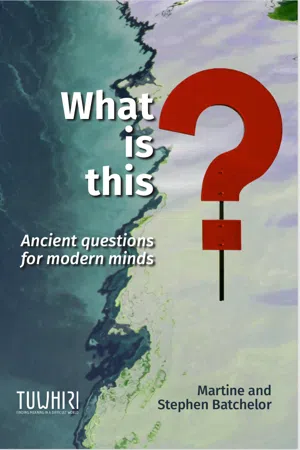
What is this? Ancient questions for modern minds presents talks given by Martine and Stephen Batchelor during a Son (Chan/Zen) retreat in England in 2016.
Leading us through the practice of radical questioning at the heart of this Korean Buddhist tradition, the authors show how anyone at all can benefit from this form of radical inquiry today.
These talks demonstrate clearly how a practice with origins in China a thousand years ago can meld with insights from the natural sciences, classical and modern western philosophy, Romantic poetry, and early Buddhism.
The reader can use this book as a companion in facing the challenge of living a fully human life in our complex contemporary world, or as a practice manual, or both.
Frequently asked questions
Yes, you can cancel anytime from the Subscription tab in your account settings on the Perlego website. Your subscription will stay active until the end of your current billing period. Learn how to cancel your subscription.
At the moment all of our mobile-responsive ePub books are available to download via the app. Most of our PDFs are also available to download and we're working on making the final remaining ones downloadable now. Learn more here.
Perlego offers two plans: Essential and Complete
- Essential is ideal for learners and professionals who enjoy exploring a wide range of subjects. Access the Essential Library with 800,000+ trusted titles and best-sellers across business, personal growth, and the humanities. Includes unlimited reading time and Standard Read Aloud voice.
- Complete: Perfect for advanced learners and researchers needing full, unrestricted access. Unlock 1.4M+ books across hundreds of subjects, including academic and specialized titles. The Complete Plan also includes advanced features like Premium Read Aloud and Research Assistant.
We are an online textbook subscription service, where you can get access to an entire online library for less than the price of a single book per month. With over 1 million books across 1000+ topics, we’ve got you covered! Learn more here.
Look out for the read-aloud symbol on your next book to see if you can listen to it. The read-aloud tool reads text aloud for you, highlighting the text as it is being read. You can pause it, speed it up and slow it down. Learn more here.
Yes! You can use the Perlego app on both iOS or Android devices to read anytime, anywhere — even offline. Perfect for commutes or when you’re on the go.
Please note we cannot support devices running on iOS 13 and Android 7 or earlier. Learn more about using the app.
Please note we cannot support devices running on iOS 13 and Android 7 or earlier. Learn more about using the app.
Yes, you can access What is this? by Martine Batchelor, Stephen Batchelor in PDF and/or ePUB format, as well as other popular books in Teologia e religione & Filosofia orientale. We have over one million books available in our catalogue for you to explore.
Information
Topic
Teologia e religioneSubtopic
Filosofia orientale
Sunday evening
talk
Questioning and responding
I’m going to start with where we find ourselves at this moment. And since I don’t know how you find yourselves, I’m afraid I will have to talk about myself.
What I’m experiencing right now is that thing I encounter each time I sit down on a cushion and pay attention to what is happening. Yet every time I find myself utterly incapable of putting whatever it is I’m experiencing into words. There’s something about the practice of meditation, whether it be Sŏn or any exercise where we are asked just to pay attention to what is happening, in which we find ourselves confronted with what philosophers call the sheer facticity of our existence.
This is the inescapable fact of being this being that I am. When I look inside, or say to myself, ‘I’m looking inside’ – whatever that might mean, I seem to hit up against something that is intimately present to me, but impossible to define. It always strikes me in the first instance as a particular sensation in the body, in the chest or stomach somewhere. It depends. I was reminded a few days ago of a passage by William James who said:
...it may be truly said that the ‘self of selves’, when carefully examined, is found to consist mainly of the collection of these peculiar motions in the head or between the head and throat… it would follow that our entire feeling of spiritual activity, or what commonly passes by that name, is really a feeling of bodily activities whose exact nature is by most men overlooked.5
Anyone who has spent time doing such introspection, whether in meditation or just out of curiosity about who you are, can probably recognise what James was on about. It’s curious that in pursuing such ‘deep’ questions about the nature of who I am, in the end, if I’m utterly honest with myself, what presents itself is a completely banal physical sensation.
Some years ago in the 1990s I spent a couple of days in Nagi Gompa, a nunnery up in the hills above Kathmandu in Nepal, where I went to study Dzogchen with a teacher called Urgyen Tulku.6 From him I received what is called the ‘pointing out instruction’ in which one is initiated, as it were, into the practice of Dzogchen.
This instruction entails listening to a direct presentation from the teacher who points out to you the nature of your mind, or – even more than that – the nature of what they call rigpa, a primordial, pristine awareness that is more than your ordinary, everyday mind. But the problem was that no matter how much Urgyen Tulku tried to point this out to me, what I found myself actually aware of was a physical sensation somewhere in my body.
Of course, when I told him this, he said ‘No! Look! It is without form, without shape, without colour, without sensation’, and so on. But however much I was told what rigpa was, I could not get beyond a physical sensation somewhere in my body. Before I could think of mind or consciousness or awareness I felt this strange, indefinable sensation – like William James’ funny sensations in the back of the throat. I wasn’t cut out to be a Dzogchen practitioner. I experience exactly the same thing when doing mindfulness or any meditative practice that supposedly brings one into a greater understanding of one’s mind or mental states. In my Sŏn training in Korea, my teacher Kusan Sunim was very keen on what he called shin (or maum in colloquial Korean), which is the Chinese-
Korean-Japanese word for the Pali word citta – ‘mind’, or ‘heart-mind’ if you wish, but in his teaching it was really not very different from the rigpa of Dzogchen. When Kusan Sunim taught us to ask ‘What is this?’ for him the ‘this’ meant shin.
Korean-Japanese word for the Pali word citta – ‘mind’, or ‘heart-mind’ if you wish, but in his teaching it was really not very different from the rigpa of Dzogchen. When Kusan Sunim taught us to ask ‘What is this?’ for him the ‘this’ meant shin.
He made it very clear that shin was not our ordinary, everyday consciousness or awareness. Shin, like rigpa, was somehow far more. It lay behind the scenes, hidden from view, and the purpose of meditative enquiry was to break through to it, to experience it directly. And such would be – in my teacher’s understanding – the experience of enlightenment. But from the beginning of my training I found myself highly sceptical of this language. I was resistant to the idea of there being ‘something more’, something beyond what we can see-hear-smell-taste-touch and know with our ordinary mind.
There is a tension in the Sŏn tradition between an emphasis on the everyday specificity of experience – all the talk about cypress trees in the courtyard, pounds of flax and so on, and a rather mystical teaching about a transcendent or universal mind or consciousness – similar to what you might find in Advaita Vedanta: the notion of some non-dual awareness. As much as I’ve tried to figure out what my teacher meant by shin, I’m still just as confused about it as I was on day one. I’m not at all persuaded that it is a useful way of presenting this practice.
By ‘this practice’ I don’t just mean the particular meditation we’re doing on this retreat, but ‘practice’ in the wider sense of trying to be fully human, to lead a life in which I’m completely honest with myself. A practice in which I’m cautious about taking on trust claims about the nature of some transcendent awareness or reality that I consistently fail to have any immediate sense of in my life.
What often creeps into Buddhism, including Sŏn, is the notion that there is something more than this experience that we’re having right now, that we need to break through into this something else. It’s a very seductive idea that’s characteristic of most traditions that would consider themselves to be ‘mystical’. Whether they speak in terms of ‘God’, ‘the Absolute’ or ‘the Unconditioned’, there’s often an underlying assumption that what we’re experiencing now is somehow not enough, it’s inadequate, at best only a tiny bit of something far vaster. And the practices that are taught in these traditions provide us with a methodology, which if we follow enables us to reach this ‘something else’.
I’m reminded here of a short sutta, a discourse, in the
Connected discourses of the Buddha, which is called the Sabba sutta. Sabba means ‘everything’ or ‘the all’. Gotama says:
Connected discourses of the Buddha, which is called the Sabba sutta. Sabba means ‘everything’ or ‘the all’. Gotama says:
Mendicants, I will teach you the all. Listen to this. And what is the all? The eye and forms, the ear and sounds, the nose and odours, the tongue and tastes, the body and tactile sensations, the mind and dharmas. This is called the all. If anyone, mendicants, should speak thus: ‘Having rejected this all, I shall make known another all’ – that would be a mere empty boast on his part. If he were questioned he would not be able to reply and, further, he would meet with vexation. For what reason? Because, monks, that all would not be within his domain.7
Now I find this passage terribly engaging. You find a similar approach in the writings of Nāgārjuna and Madhyamaka philosophy, where there’s also a deep suspicion of the idea that the purpose of practice is to lead us to something outside of what we can see, hear, smell, taste, touch and know within our own moment-to-moment, ordinary consciousness. And it’s this, I feel, that characterises the early Sŏn tradition. My sense is that Sŏn started life in China as an explicit rejection of a grandiose mysticism that had begun seeping into Buddhism. The early Sŏn masters had no time at all for notions of an ‘Ultimate Truth’ that lies beyond our ordinary experience. Instead, it sought to recover the simplicity and the primacy of the experience we’re having in this body, in these senses, in this flesh, right now. That’s where we begin.
The legend of the Buddha himself points to the same thing. It was by waking up to the existential facts of his own life that prompted him to embark on his quest. The fact of birth, the fact of sickness, the fact of ageing and the fact of death became questions for him. These experiences are utterly of this breathing, feeling body. And that’s where we begin too. That’s what we come back to, again and again and again when our minds wander off into the past, into the future, or simply into unstructured threads of associated thought. We come back to the dull, blunt immediacy that is intimate but inarticulate: in other words, what we are experiencing right now.
When I ask myself the question ‘What is this?’, by ‘this’ I don’t mean some sort of mystical citta, or shin, or rigpa. By ‘this’ I mean the totality of what you’re experiencing in this moment right now. Whatever that might be.
To try and understand better what Kusan Sunim meant by shin as the object of ‘What is this?’, I went back to the Ming edition of the Chinese text of the Platform sutra where the account of the story behind ‘What is this?’ is found. What I discovered was that the text makes no mention at all of shin or mind. It simply speaks of this ‘thing’ – bulgon, in Korean. The question ‘What is this?’ is presented as ‘What is this thing?’ I like the word ‘thing’. ‘Thing’ has a kind of gritty immediacy to it. It’s one of those words we use all the time, but rarely stop to consider what it means. What is a thing? It’s a terribly difficult question, just as hard to answer as ‘What is consciousness?’, or ‘What is the mind?’.
So what is a thing? What is this thing? What is this thing in all of its stripped-bare vulnerability, ineffability, banality? What is that? What is this thing that was thrust into the world ...
Table of contents
- What is this?
- Contents
- Preface
- Sat p.m. Entering the retreat
- Sun a.m. The basis of meditation
- Sun p.m. Questioning and responding
- Mon a.m. What is this?
- Mon p.m. Three symbols of awakening
- Tue a.m. Effortless effort
- Tue p.m. Good snowflakes...
- Wed a.m. I don’t know
- Wed p.m. Emptiness
- Thu a.m. Courage and questioning
- Thu p.m. The four great vows
- Fri a.m. Waiting and listening
- Fri p.m. The path of compassion
- Sat a.m. Practice in daily life
- References
- About Gaia House
- About Tuwhiri
- Notes