Exploring the controversial history of an aesthetic – realism – this book examines the role that realism plays in the negotiation of social, political, and material realities from the mid-19th century to the present day.
Examining a broad range of literary texts from French, English, Italian, German, and Russian writers, this book provides new insights into how realism engages with themes including capital, social decorum, the law and its politicisation, modern science as a determining factor concerning truth, and the politics of identity.
Considering works from Gustave Flaubert, Charles Baudelaire, Émile Zola, Henry James, Charles Dickens, and George Orwell, Docherty proposes a new philosophical conception of the politics of realism in an age where politics feels increasingly erratic and fantastical.
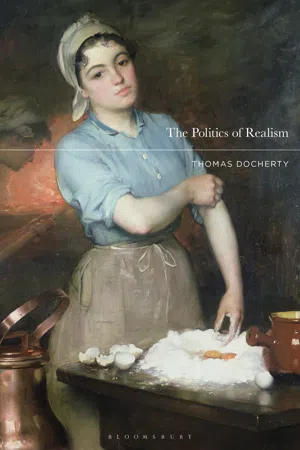
- 288 pages
- English
- ePUB (mobile friendly)
- Available on iOS & Android
eBook - ePub
The Politics of Realism
About this book
Information
Part I
Controlling the real and its representations
1
Assembly
Reality and the commerce of censorship
1
What is it that lies behind a recurring and insistent fear over representations? Why is it that some cultures fear representation so much that they determine to prohibit it, or at least to circumscribe it? In many cultures, at many historical moments, there has been an insistence on taming the power of representation, as if representation as such poses a fundamental and even an existential threat. Why is that so?
An anxiety about the power of the image has been with us for a long time, both in advanced and in developing economies. This extends beyond the visual image, and includes the imagining of speech or behaviour. The image has always been considered as something that exerts power or that is the source of a power that is mysterious, not immediately available to consciousness or to linguistic explanation. We have thus been suspicious of its ability to enchant us, to charm or seduce us, perhaps against our conscious or rational will. At the same time, aware of such power, we have often tried to overcome our anxiety by harnessing images – manipulating and controlling them – to make them instrumental in the furthering of our own ends, and to make use of them to exert our own power over others.
It is often mooted, further, that images have come more and more to dominate our culture and our social and political lives. W. J. T. Mitchell rightly reminds us that ‘it is a commonplace of cultural criticism that images have a power in our world undreamed of by the ancient idolaters’. Historically, one way of dealing with these anxieties has been to attack images directly; and it is pretty clearly true to say that ‘iconoclasm has a history at least as old as idolatry’.1 With this in mind, we might even suggest that one way of understanding history – at least in its cultural manifestations – is to see it as being primarily a constant battle between rival images. If we want to be more precise and specific, we might say that the history of culture is the history of struggles over rival images and their respective power, and that material history is really the history of representations of what constitutes the realities of the world and of our lives. A contestation around images is also, intrinsically, a contestation over the status of reality itself: the image is an instrument in the determination of an individual or group to control historical realities. There can be little doubt that our anxieties about representation are really the symptomatic evidence of a much more fundamental issue regarding the way we construct our polities.
Famously, Plato exiles the poets from his ideal Republic on the stated and entirely clear and simple grounds that they are good at representing things. Indeed, the ostensible logic of Socrates’s argument in Republic is that the better the poets are at representation, the more dangerous they become in the ideal State. The Guardians of the ideal State – who turn to poetry for their education – ‘should neither do a mean action, nor be clever at acting a mean or otherwise disgraceful part on the stage for fear of catching the infection in real life’, argues Socrates.2 The power of the image and of representation poses an especial risk, it might seem from this, to our processes of education and of acculturation. Such thinking reveals a good deal about what we consider to be the purposes of education, of course; but it also reveals an intrinsic link between education and modes of censorship.
As Plato’s argument develops in Republic, Socrates ‘proves’ that it is imitation as such (mimesis) – as opposed to narration (diegesis) – that is inherently risky. That is an important distinction, not always adequately noted in the standard understanding of this ancient text. Socrates/Plato does not, in fact, banish the poets as such; rather, he argues that while narrative representation might be useful, mimetic representation poses a threat. In narrative, there is a significant aesthetic distance between the reader/listener and the actions that the narrative describes: the actions are events carried out by others. Narratives yield descriptions of events over which we can stand in detached judgement. By contrast, in imitated speech, an intimacy is achieved, through which the reader/audience can identify with the author/speaker of a text or an individual speech. There is therefore the strong possibility, in mimetic modes of representation, that we will suffer from what Dominick LaCapra has usefully characterized – following Socrates in this, even if he does not explicitly note the fact – as a form of ‘mimetic contagion’.3 If we repeat – or represent – an immoral character, say, then we run the risk of so imbibing the immorality that we in turn become ‘really’ immoral, not in a fiction but in material living. The representation, via mimetic imitation, of anything other than the good (or even perfection), is thus to be forbidden in the logic of Plato’s account of Socratic teaching.
Plato is not unique, of course, in raising these or similar fears. Some of the world’s major religions express, deep in their early formulations, a similar concern about representation. There is an anxiety that ‘false gods’ and any other figural representations might supplant the supposedly ‘real thing’, and lead people into iconophilia or idolatry. In Judaism, for instance, the logic can be straightforwardly expressed. By definition in Judaism, first and foremost God is incorporeal: spirit in the purest form. God, in this logic, exceeds the bounds of space and time, since these are things that can be understood materially. If we hold these two things together, we find that God cannot be represented, since there is no bounded ‘presence’ there to be re-presented in the first place; and therefore, any claim to represent that which has no initial bounded presence must be, intrinsically, a falsification. Representation is therefore prohibited, quite simply because it would be a falsification of the very essence of God and thus tantamount to the undermining of divine being. From thi s, a generalized anxiety – about the validity of representation and the possibility that it will always be tinged not just by falsehood but also by the very denial of the reality that it purports to represent – becomes more widespread.
Representations, in the kind of logic that shapes such religious or philosophical beliefs, need to be policed in some ways: we need the imposition of laws, or at least of shared norms, if we are to establish the priority of the correct over the wrong, and the good over the bad. In fact, the proposition is even greater than this: we need such laws if we are to hang onto reality itself, to prioritize the claims of ‘how things really are’ over ‘how things might be’ or ‘how they are not’. Laws – and censorship – become fundamental to the ‘protection’ of something that asserts its logical priority. In religions, that prior reality is spiritual; but, once we leave the sphere of religion, this changes. We remain influenced by the logic, but in the secular condition – beyond religion – laws and censorship operate to protect the very priority of material and historical reality itself over the ostensibly immaterial ‘unreality’ of imagination in its literal sense as image-making. As we will see in this book, the consequence is that we enter the domain in which reality itself is intrinsically politicized, such that we have, for the first time, a politics of realism. The politics of realism is basic to a culture in which there is a struggle over representations of the world, for those representations are a vehicle for the gaining and retention of political power. Representations ‘of’ the real become central to a struggle for control ‘over’ the real, by the indirect means of aesthetic images.
2
The Judaic injunction against ‘graven images’ – like the Koranic suspicion of figural representations – leads religiously inspired thought to move away from sensuality to abstraction, from sensibility to sense, or from emotional engagement to detached reasoning. One reason why Judaism is considered by many to be so centred on ‘the book’ is because of the Mosaic necessity of translating sensual figural representations into the abstraction of words.
A proscription against images similar to that which exists in Judaism – or at least a warning regarding their power – appears to be advanced also in the Koran, in Surah 21, verses 52–69, where the worship around images is described as a ‘manifest error’. However, in this case, the logic is that the images and idols are themselves intrinsically weak, indeed so weak that they cannot protect themselves against their own destruction. Yet the images and idols are seductive nonetheless; and to be seduced by them is to be diverted from attending to the reality of a deity and thus to be led astray from a supposed path of truth and reality.
As in Plato, it is as if perfection – here, theologically considered in Islam and Judaism – is itself negated, demeaned and denigrated by representation, because a representation can never be the original, even and especially as it aspires to yield up, or pretends to yield up, that very original and make it available to us in material terms. This is all the more the case when the original is itself materially absent (like the supposed perfection of a hidden god, say), and when all that we might have to go on to warrant its existence is, indeed, a representation.
Although Christianity too is suspicious of idolatry, it has nonetheless historically demonstrated a complex relation to images, hovering uncertainly between Calvinist Presbyterian austerity and gorgeous Roman luxuriousness. Historically, many wars of religion are wars that are fundamentally conditioned by the status that we give to bodily sensuality. A Christian crusade, for example, is fought literally under the leading sign of a body on a cross, whose complex iconography is intended not just to signify a religious responsibility but also literally to embody it. Signification invites words and disputed meanings; the sensuous immediacy of the body on a cross is intended to deny the very possibility of disputed meaning; and this is because what is at stake here is not discursive meanings but rather the supposed facts that underpin and justify faith and of a felt and experienced immediacy of belief, a belief immediately given through the image itself. Such wars are centred on the relative status that a religion gives to the power of the senses and to the attitudes that we might have to the primacy of sensuality over abstraction, emotion over reason, bodily feeling over rational thinking. That is to say – and this is a significant logical corollary of the foregoing observations – such wars are conditioned by our attitude to aesthetics itself, by our attitudes to bodily perceptions and sensualities.
War itself, historically, has been shaped by a very specific priority of aesthetics. Virtually all war strategy is conditioned by one dominant feature: the determination to make oneself unseen or invisible, occluding one’s physical presence, while simultaneously trying to reveal, as clearly as possible, the body of the enemy. It is a struggle over transparency, we might say, or over the control of appearance and disappearance. Camouflage enables a soldier to disappear or to have no representation of herself or himself. The self in camouflage – while actually being there – is not represented, instead merging into a ‘natural’ background that renders a military threat invisible. Paul Virilio, urbanist and theorist of war, cites the case of the French Maquis during the Second World War. The maquisard, he writes, has to melt into a general topography; and so ‘he sits under the cover of grass and tree, atmospheric disturbances, night itself’,4 and in this way the maquisard ‘self-censors’, as it were, merging the presentation of herself or himself into a background.
Indeed, Virilio mounts an entire model of society based on this foundational observation. It is an observation that illustrates the primacy of war or struggle – themselves based upon the representability of the military – as fundamental to the politics of realism. The whole of society, he argues, depends upon the regulation of what he calls ‘the aesthetics of disappearance’: our daily human and socio-political relations depend on the play of appearance and disappearance, in the establishment of a kind of society of strategic subterfuge. Such strategic subterfuge depends on a mode of censorship: the rendering invisible of that whose presence might change our social hierarchies. The intrinsic war-mentality underlying this – that play of forces that regulates all social relation – has its roots in a logic of aesthetics, or the play of appearance and disappearance.
Controversially, Virilio writes that, in the guise of war, we find a basic socio-sexual relation. War-paint or camouflage is a model for the daily presentation of the body and face under make-up, such that war becomes a precedent for love. It follows, in his logic, that
the seduction of the disguised warrior is . . . the characteristic of the male, and thus the homosexuality of the duel is the foundation of the beautiful, the beautiful that is itself but the first degree of torture inflicted upon the body, in marks and scarifications, scars, up to and including mutilation and death. Perhaps the beautiful is the first uniform. 5
In this respect, war links censorship to matters as fundamental as the religious veil, or religious ritual, or any forms of official ceremony and pageantry; and many of these, of course, are also fundamental to the ways in which we represent to ourselves our political States, and the place of our bodies within those States.
I have grounded some of this introductory section on Plato; but modern and contemporary Greece is also illustrative of some of the issues here around the censorship of the image and of...
Table of contents
- Cover
- Half-Title
- Dedication
- Title
- Contents
- Introduction
- Part I Controlling the real and its representations
- Part II Making the real
- Part III Making the unreal
- Bibliography
- Index
- Copyright
Trusted by 375,005 students
Access to over 1.5 million titles for a fair monthly price.
Study more efficiently using our study tools.
Frequently asked questions
Yes, you can cancel anytime from the Subscription tab in your account settings on the Perlego website. Your subscription will stay active until the end of your current billing period. Learn how to cancel your subscription
No, books cannot be downloaded as external files, such as PDFs, for use outside of Perlego. However, you can download books within the Perlego app for offline reading on mobile or tablet. Learn how to download books offline
Perlego offers two plans: Essential and Complete
- Essential is ideal for learners and professionals who enjoy exploring a wide range of subjects. Access the Essential Library with 800,000+ trusted titles and best-sellers across business, personal growth, and the humanities. Includes unlimited reading time and Standard Read Aloud voice.
- Complete: Perfect for advanced learners and researchers needing full, unrestricted access. Unlock 1.5M+ books across hundreds of subjects, including academic and specialized titles. The Complete Plan also includes advanced features like Premium Read Aloud and Research Assistant.
We are an online textbook subscription service, where you can get access to an entire online library for less than the price of a single book per month. With over 1.5 million books across 990+ topics, we’ve got you covered! Learn about our mission
Look out for the read-aloud symbol on your next book to see if you can listen to it. The read-aloud tool reads text aloud for you, highlighting the text as it is being read. You can pause it, speed it up and slow it down. Learn more about Read Aloud
Yes! You can use the Perlego app on both iOS and Android devices to read anytime, anywhere — even offline. Perfect for commutes or when you’re on the go.
Please note we cannot support devices running on iOS 13 and Android 7 or earlier. Learn more about using the app
Please note we cannot support devices running on iOS 13 and Android 7 or earlier. Learn more about using the app
Yes, you can access The Politics of Realism by Thomas Docherty in PDF and/or ePUB format, as well as other popular books in Literature & Film & Video. We have over 1.5 million books available in our catalogue for you to explore.