101 Rules of Thumb for Low-Energy Architecture
eBook - ePub

101 Rules of Thumb for Low-Energy Architecture

  1. 128 pages
  2. English
  3. ePUB (mobile friendly)
  4. Available on iOS & Android
eBook - ePub

101 Rules of Thumb for Low-Energy Architecture

About this book

Buildings and construction are a major contributor to the climate and biodiversity emergency. They account for nearly 40% of energy-related carbon dioxide (CO2) emissions. It is more important than ever for architects to design responsibly and create low-carbon, low-energy buildings for a sustainable future. 101 Rules of Thumb sets out the essential elements of low-energy architecture in a fresh, intuitive way. Where ever-changing technology and complex legislation can cloud the designer's thought-process, this book equips you with the fundamentals you need to minimise CO2 emissions, design for low-energy use and work with, not against, the forces of nature. With reliable, simple rules of thumb, each page focuses on a single piece of guidance along with a clear hand-drawn illustration. The emphasis is on passive low-energy principles, and the rules of thumb cover all the design fundamentals from site and location to orientation and form, peppered with ideas to help the designer think outside the box, drawing inspiration from traditional methods, photoperiodic plants, and the black-tailed prairie dog. An extended, fully updated narrative bibliography explores the sources in detail and provides a valuable springboard for further study. Applicable throughout the world in any climate region, 101 Rules of Thumb is a global primer to be dipped into at any time as a quick means of re-focusing on what's important when designing a new or retrofitted low-energy building. The rules cover:

  • Site and location
  • Orientation and form
  • The low-energy building envelope
  • Carbon free heating, cooling and lighting
  • Passive low-energy principles.

Frequently asked questions

Yes, you can cancel anytime from the Subscription tab in your account settings on the Perlego website. Your subscription will stay active until the end of your current billing period. Learn how to cancel your subscription.
At the moment all of our mobile-responsive ePub books are available to download via the app. Most of our PDFs are also available to download and we're working on making the final remaining ones downloadable now. Learn more here.
Perlego offers two plans: Essential and Complete
  • Essential is ideal for learners and professionals who enjoy exploring a wide range of subjects. Access the Essential Library with 800,000+ trusted titles and best-sellers across business, personal growth, and the humanities. Includes unlimited reading time and Standard Read Aloud voice.
  • Complete: Perfect for advanced learners and researchers needing full, unrestricted access. Unlock 1.4M+ books across hundreds of subjects, including academic and specialized titles. The Complete Plan also includes advanced features like Premium Read Aloud and Research Assistant.
Both plans are available with monthly, semester, or annual billing cycles.
We are an online textbook subscription service, where you can get access to an entire online library for less than the price of a single book per month. With over 1 million books across 1000+ topics, we’ve got you covered! Learn more here.
Look out for the read-aloud symbol on your next book to see if you can listen to it. The read-aloud tool reads text aloud for you, highlighting the text as it is being read. You can pause it, speed it up and slow it down. Learn more here.
Yes! You can use the Perlego app on both iOS or Android devices to read anytime, anywhere — even offline. Perfect for commutes or when you’re on the go.
Please note we cannot support devices running on iOS 13 and Android 7 or earlier. Learn more about using the app.
Yes, you can access 101 Rules of Thumb for Low-Energy Architecture by Huw Heywood in PDF and/or ePUB format, as well as other popular books in Architecture & Sustainability in Architecture. We have over one million books available in our catalogue for you to explore.

CHAPTER 1
WORKING WITH SITE AND LOCATION

fig0001
Sun and shade
Climate and microclimate
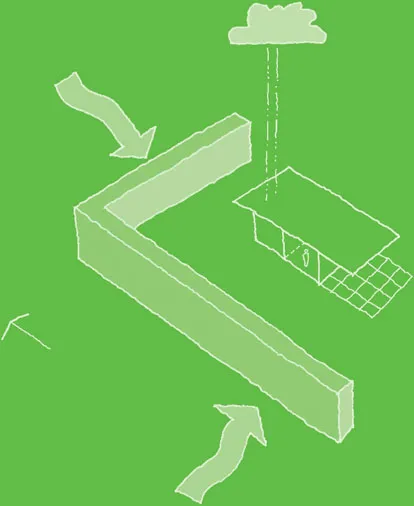
Shelter from wind and rain

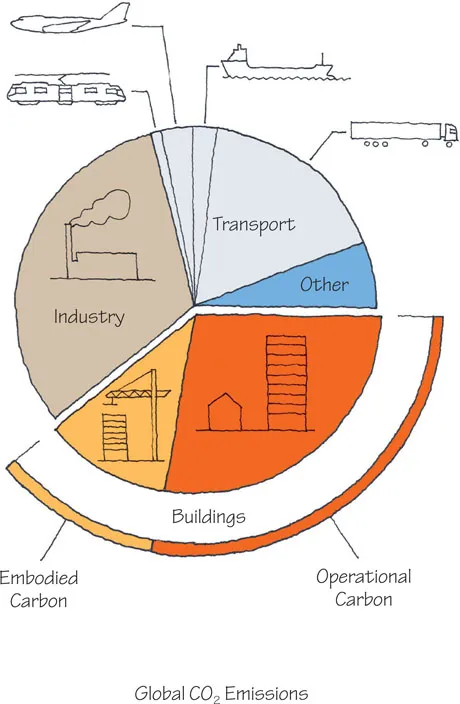
1 BUILDINGS USE HALF THE WORLD’S ENERGY AND EMIT 40% OF ALL CO2

Half of all energy generated in the world is used to make and run our buildings, and three-quarters of all energy is still derived from fossil fuels. Our buildings are responsible for 40% of all global CO2 emissions. Clearly, decarbonisation of the building and construction sector, the single biggest producer of greenhouse gases in the world, is paramount if we are to meet urgent climate change objectives.
ifig0001
Rule 34
fig0002
RULE 1

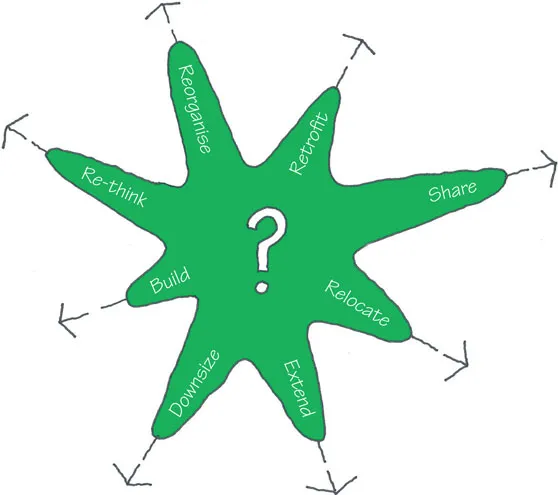
2 THINK BEFORE YOU BUILD

Buildings last an age and consume energy throughout their lives, so whether to build or not to build is a big question. The answer might be to refurbish, reorganise, change business strategy or change your life rather than build something new – it might be the lowest long-term energy-use solution, and the lowest-carbon solution too. Consider all options.
fig0003
RULE 2

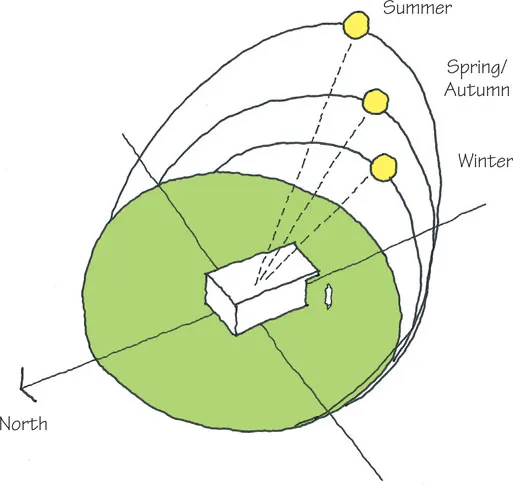
3 THE SUN RISES IN THE EAST AND SETS IN THE WEST

It is worth reminding ourselves of this most basic rule. However, it is also worth remembering that, even outside the equatorial regions, in the mid-latitudes of the northern-hemisphere winter the sun rises south of east and in the summer it rises north of east. This means that in summer the north face of a building in these regions might be very briefly exposed to the sun, but in the winter the sun will never warm that building’s northern face. In the northern hemisphere, after rising, the sun will be seen traversing the sky in the south. The reverse is true south of the equator.
fig0004
RULE 3

4 THE HEIGHT OF THE SUN ABOVE THE HORIZON DETERMINES MANY ASPECTS OF CLIMATE-RESPONSIVE ARCHITECTURE

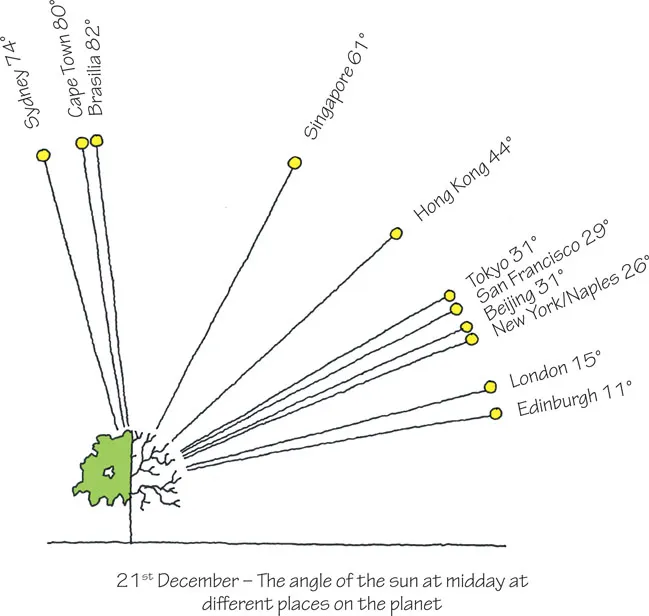
In December the highest altitude of the sun above the horizon at midday in London is around 15°. This angle varies according to latitude, and that is part of what makes every individual location on earth unique. The diagram gives December sun angles for cities around the world. Using sun-path diagrams or simple-to-use web-based calculators, the position of the sun at any time of day or any time of the year can be found out. Knowing the relative position of earth and sun, or solar geometry, is an important aspect of climate-responsive architecture.
ifig0002
Rules 7, 8, 27
fig0005
RULE 4

5 THE SUN’S RAYS TURN TO HEAT ON CONTACT WITH ANY SURFACE

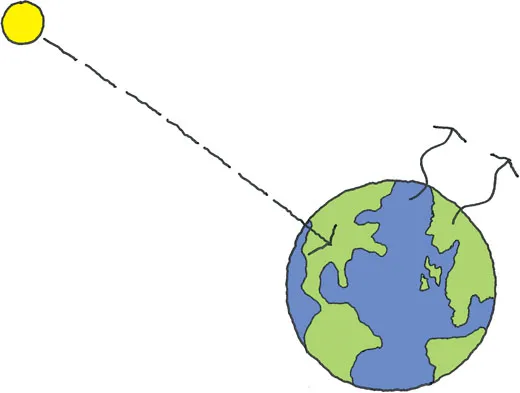
The way this happens is rooted in quantum mechanics, but the simple result is that the earth – and everything on it – is warmed by the sun, making all life possible. The heating of the earth also results in climate and weather, which vary greatly depending upon where we are on the planet.
fig0006
RULE 5

6 IF YOU DO NOT WANT HEAT INSIDE, KEEP THE SUN OUT

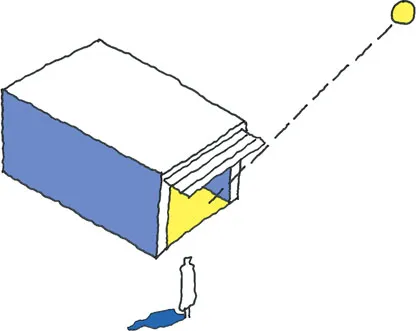
Just as the earth is warmed by the sun, so is any other surface that the sun’s rays reach. This is an important rule, because if you are trying to avoid overheating in a building you must prevent direct sunlight from entering: once direct sunlight has entered a building, it’s too late to stop it becoming heat.
ifig0003
Rules 8, 27
fig0007
RULE 6

7 HARNESS THE POWER OF THE LOW WINTER SUN – IT IS A FREE SOURCE OF HEAT

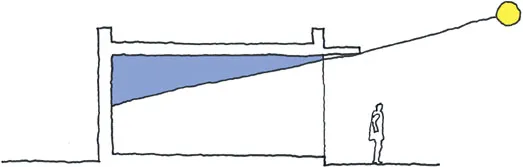
In the winter the sun is low in the sky, so the sun can penetrate deep into a space, if it is allowed to, bringing free, zero-carbon heat with it.
ifig0004
Rules 3, 43
fig0008
RULE 7

8 PREVENT OVERHEATING IN SUMMER

In the summer the sun is high in the sky, reaching, in June, a maximum angle of about 62° above the horizon in London, 73° in both Beijing and New York, and 83° in Cairo. In Sydney in December the sun reaches about 80° above the horizon. For solar-oriented windows a simple, external horizontal s...

Table of contents

  1. Cover
  2. Title Page
  3. Copyright Page
  4. Contents
  5. Dedication and Acknowledgements
  6. Preface
  7. Introduction
  8. Chapter 1. Working with Site and Location
  9. Chapter 2. Manipulating Orientation and Form
  10. Chapter 3. The Low-Energy Building Envelope
  11. Chapter 4. Energy and the Internal Environment
  12. Chapter 5. Rules and Strategies for Different Climatic Regions
  13. Notes, Observations and References – A Narrative Bibliography
  14. Top Ten Reads
  15. Bibliography
  16. Web-Based Resources
  17. Index