Create Stunning Renders Using V-Ray in 3ds Max
eBook - ePub

Create Stunning Renders Using V-Ray in 3ds Max

Guiding the Next Generation of 3D Renderers

  1. 210 pages
  2. English
  3. ePUB (mobile friendly)
  4. Available on iOS & Android
eBook - ePub

Create Stunning Renders Using V-Ray in 3ds Max

Guiding the Next Generation of 3D Renderers

About this book

Create Stunning Renders using V-Ray in 3ds Max: Guiding the Next Generation of 3D Renderers is a step-by-step guide on how to create realistic renderings using V-Ray in 3ds Max. The potentials of V-Ray are detailed using a bedroom scene as an example. The book introduces the 3ds Max interface and the basic commands, allowing readers to familiarize themselves with the work environment from the very beginning.

This book is intended for architects, interior designers, and anyone else wanting to create photorealistic renderings using V-Ray in 3ds Max. The reader does not need experience to follow this book, but any prior knowledge of working in 3ds Max will help the reader jump right in.

Margarita Nikita is the co-founder of High Q Renders LLC, an award-winning creative company based in San Francisco, CA, with offices in Greece. Nikita has published several design books on 2D and 3D graphic design, some of which are used in university courses, actively contributing to the formation of the new generation of 3D modelers in her native country, Greece. She shares her knowledge, advice, and tips and tricks on her YouTube channel, Margarita Nikita. More of her work is available at her Instagram account, @margarita.nikita.
Frequently asked questions

Yes, you can cancel anytime from the Subscription tab in your account settings on the Perlego website. Your subscription will stay active until the end of your current billing period. Learn how to cancel your subscription.
No, books cannot be downloaded as external files, such as PDFs, for use outside of Perlego. However, you can download books within the Perlego app for offline reading on mobile or tablet. Learn more here.
Perlego offers two plans: Essential and Complete
  • Essential is ideal for learners and professionals who enjoy exploring a wide range of subjects. Access the Essential Library with 800,000+ trusted titles and best-sellers across business, personal growth, and the humanities. Includes unlimited reading time and Standard Read Aloud voice.
  • Complete: Perfect for advanced learners and researchers needing full, unrestricted access. Unlock 1.4M+ books across hundreds of subjects, including academic and specialized titles. The Complete Plan also includes advanced features like Premium Read Aloud and Research Assistant.
Both plans are available with monthly, semester, or annual billing cycles.
We are an online textbook subscription service, where you can get access to an entire online library for less than the price of a single book per month. With over 1 million books across 1000+ topics, we’ve got you covered! Learn more here.
Look out for the read-aloud symbol on your next book to see if you can listen to it. The read-aloud tool reads text aloud for you, highlighting the text as it is being read. You can pause it, speed it up and slow it down. Learn more here.
Yes! You can use the Perlego app on both iOS or Android devices to read anytime, anywhere — even offline. Perfect for commutes or when you’re on the go.
Please note we cannot support devices running on iOS 13 and Android 7 or earlier. Learn more about using the app.
Yes, you can access Create Stunning Renders Using V-Ray in 3ds Max by Margarita Nikita in PDF and/or ePUB format, as well as other popular books in Architecture & Architecture General. We have over one million books available in our catalogue for you to explore.

Information

1

Getting Started

DOI: 10.1201/9781003144786-1
V-Ray is a plugin that can be used in several design software like 3ds Max, Sketchup, Maya, etc. In this book, we will explore the use of V-Ray in 3ds Max 2020. If this is your first experience with 3ds Max, it is useful to get familiar first with the interface, before getting into the rendering process. Thus, in this chapter, the basic features of the 3ds Max interface are presented. The chapter concludes with the creation and modification of standard primitives as well as the description of the transform commands, i.e., the commands related to the selection, movement, rotation, and scale of an object since these commands are used extensively in the upcoming chapters. Finally, the different ways that a project can be saved, depending on whether it will be stored or shared, are described.

1.1 3ds Max Interface Overview

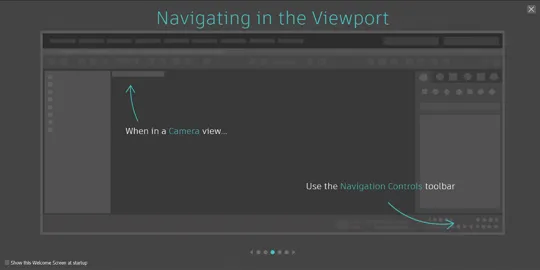
When you open Autodesk 3ds Max 2020, a Welcome Screen appears. It is a set of slides designed to provide new users with basic information to help them get started (Figure 1.1).
Figure 1.1
Figure 1.1

Welcome Screen.
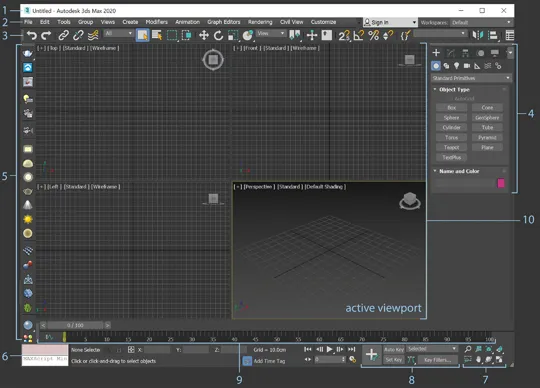
When you close the Welcome Screen, you see the 3ds Max interface (Figure 1.2), which consists of the following items:
  1. Title bar: Shows the name of the project and the version of the 3ds Max. Every new project is named by default Untitled and you need to Save the project to rename it (see Section 1.6).
  2. Menu bar (File, Edit, Tools, …): Contains drop-down menus with commands. The name of each menu indicates the purpose of the commands.
  3. Main Toolbar: Provides quick access to some of the most commonly used commands in 3ds Max, like the commands Undo, Redo, Move, Rotate, or Scale.
  4. Command Panel: Consists of six sub-panels: Create, Modify, Hierarchy, Motion, Display, and Utilities. They include controls for creating objects, editing them, animation and display options, and miscellaneous utilities. You use this panel mainly to create and edit the cameras and the lights in a scene.
  5. V-Ray Toolbar: Contains shortcuts for some of the most commonly used V-Ray commands.
  6. Status Bar: On the left side there is a two-line interface, where you can create scripts and execute commands. On its right, there is the Status line, which displays the number and type of object(s) selected, and below the Status line, there is the Prompt line, giving instructions on what your next step should be. On the right of the Status line, there is the Coordinate Display area with the X, Y, and Z fields indicating the coordinates of the selected object and allowing you to control its position (see Section 1.5).
  7. Viewport Navigation Controls: Includes buttons that control the display and navigation of the viewports. Some of the buttons change depending on which viewport is active. See more details in Chapter 3.
  8. Animation and Time Controls: Contains the main controls for animation. However, this book will not cover any animation techniques.
  9. Time Slider: Allows you to move through any frame of the animation.
  10. Viewports: Everything in 3ds Max is located in a three-dimensional world that is viewed through one or more (up to 4) viewports. By using multiple viewports, you can have the best possible visualization of objects in a scene (see Sections 1.2 and 1.5).
Figure 1.2
Figure 1.2

3ds Max interface.
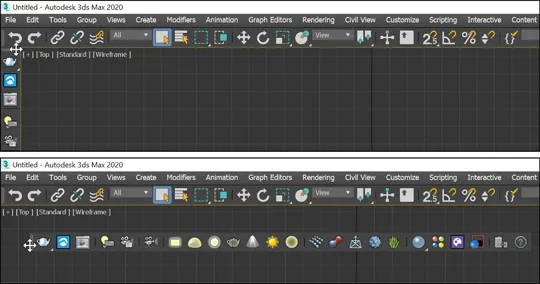
If you look at the various toolbars, you will notice a double dotted line at the beginning of each toolbar. If you move the cursor there, it changes appearance to a double-cross, and you can click and drag to reposition the toolbar in the 3ds Max interface (Figure 1.3).
Figure 1.3
Figure 1.3

Repositioning the V-Ray Toolbar.
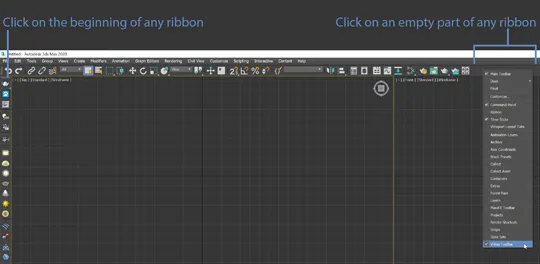
To hide or unhide a toolbar, right-click on the double dotted line at the beginning of a toolbar or on an empty area at any toolbar's ribbon and select/deselect from the pop-up menu any toolbar (Figure 1.4).
Figure 1.4
Figure 1.4

Ways to hide/unhide a toolbar.

1.2 Viewports

When you open 3ds Max 2020, there are by default four viewports displayed— Top, Front, Left, and Perspective. The multiple viewports help to observe different aspects of the scene...

Table of contents

  1. Cover
  2. Half Title
  3. Title Page
  4. Copyright Page
  5. Dedication
  6. Contents
  7. Acknowledgments
  8. My Story
  9. Author Bio
  10. 1 Getting Started
  11. 2 Rendering Settings
  12. 3 Cameras
  13. 4 Natural Lighting
  14. 5 Artificial Lighting
  15. 6 Material Editor
  16. 7 Materials
  17. 8 Libraries
  18. Index