This handbook on Greening the Roofs: A Guide for Solar Entrepreneurs deals with the subject of how an individual can enter the solar PV domain, which includes the major topics such as, carry out market research and prepare a cost estimate for a rooftop solar photovoltaic plant, prepare site feasibility report, manage solar PV project for its entire lifecycle, entrepreneurship skills, maintain personal health and safety at project site. Solar developers, EPCs, and other stakeholders have provided their guidance and support in detailing the activities to be performed by aspiring entrepreneurs in the solar PV domain, which has helped in the development of this manual and making it a practical guide.
- 343 pages
- English
- ePUB (mobile friendly)
- Available on iOS & Android
eBook - ePub
About this book
Trusted by 375,005 students
Access to over 1.5 million titles for a fair monthly price.
Study more efficiently using our study tools.
Information
1. Introduction to Rooftop Solar Photovoltaic Sector in India
UNIT 1.1 Overview of Renewable Energy Sector in India
UNIT 1.2 Overview of Rooftop Solar Sector in India
UNIT 1.3 Overview of Rooftop Solar PV Technology
UNIT 1: INTRODUCTION TO ROOFTOP SOLAR PHOTOVOLTAIC SECTOR IN INDIA
1.1 OVERVIEW OF RENEWABLE ENERGY SECTOR IN INDIA
1.1.1 Renewable Energy Technologies
Renewable energy means the grid quality electricity generated from renewable energy sources. Renewable energy systems means those systems other than the conventional systems generating grid quality electricity from renewable energy sources. Renewable energy sources means renewable sources such as solar, wind, small hydro, biomass, including its integration with combined cycle, bio fuel cogeneration, urban or municipal waste, and other such sources as approved by the Ministry of New and Renewable Energy (MNRE).
Renewable Energy is derived from the natural processes that are replenished constantly. In its various forms, it derives directly from the sun, or from heat generated deep within the earth. Included in the definition is electricity and heat generated from solar, wind, ocean, hydropower, biomass, geothermal resources and biofuels and hydrogen derived from renewable resources. (Source: International Energy Agency)
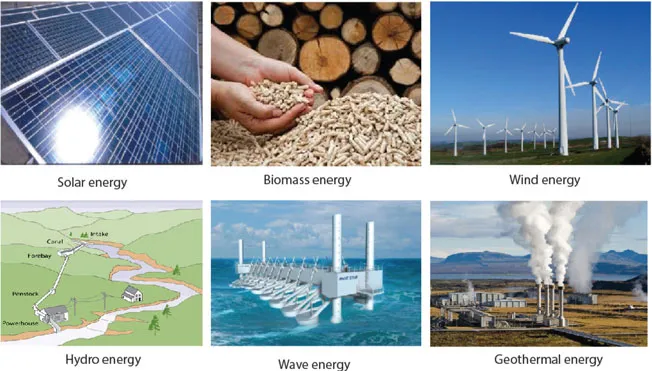
In the following sections, we discuss renewable energy sources that supply energy for sustenance of modern civilization.
Solar Energy
Solar energy that is being received as heat and light can be converted into thermal energy and electricity. Solar PV power means the solar photo voltaic power project that uses sunlight for direct conversion into electricity through photo voltaic technology. Solar thermal power project refers to solar thermal power that uses heat to heat water or other fluid, which indirectly is used for producing electricity through concentrated solar power technology.
Biomass Energy
Biomass energy is a term that includes all energy materials derived from biological sources, including wood waste, agricultural residues, food industry waste, sewage, municipal solid waste (MSW), and dedicated herbaceous or woody energy crops. Biomass gasification means a process of incomplete combustion of biomass resulting in production of combustible gases consisting of a mixture of Carbon monoxide (CO), Hydrogen (H2) and traces of Methane (CH4), which is called producer gas. This gas can be used as fuel for running dual-fuel engines.
Wind Energy
Energy harnessed from the velocity of wind is known as wind energy. Wind technologies convert the energy of moving air masses at the earth’s surface to rotating shaft power that can be directly used for mechanical energy needs (e.g. milling or water pumping) or converted to electric power in a generator. Two major types of turbines exist and are defined based on the axis of blade rotation: horizontal-axis (which currently dominates commercial markets) and vertical-axis turbines. Evaluating the quality of wind resource at a specific location is critical in determining the suitability of wind turbines.
Hydro Energy
Hydropower facilities exploit the kinetic energy in flowing or falling water to generate electricity. Conventional hydropower facilities use water from a river, stream, canal, or reservoir to continually produce electrical energy. Few reservoirs that are dedicated to power production can quickly adjust water release to match electricity demand.
Geothermal Energy
The energy harnessed from the stored thermal energy below the earth’s surface is known as geothermal energy. We can also use geothermal energy to make electricity. A geothermal system works by harnessing steam or hot water reservoirs underground; the heat is used to drive a generator to produce electricity.
Wave Energy
Wave energy is produced when electricity generators are placed on the surface of the ocean. The energy provided is most often used in desalination plants, systems and water pumps. Energy output is determined by wave height, wave speed, wavelength, and water density.
A number of technologies have been developed as alternative energy resources, that supplement our energy needs through renewable and environmentally friendly energy source, on the background of fast-depleting fossil fuels and their adverse impact on environment.
Solar Radiation
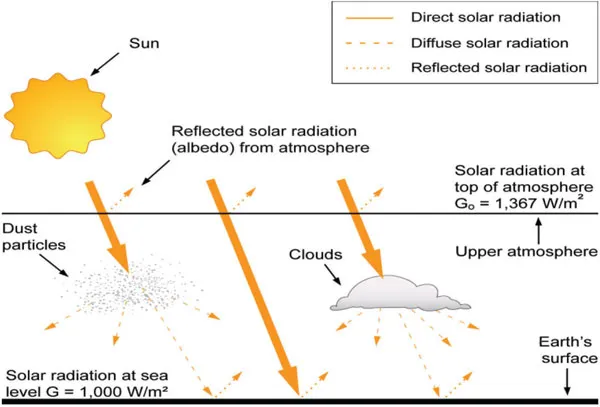
The energy produced by the sun is emitted to the PV system primarily as radiation. The radiation that falls directly on the earth’s surface is termed as direct radiation. The fraction of solar radiation that is reflected back into space is known as the albedo of the atmosphere, and the radiation that passes through clouds and gases in the atmosphere is known as diffused radiation.
Movement of Sun Across the Sky
Solar radiatio...
Table of contents
- Cover
- Half Title
- Disclaimer
- Title Page
- Copyright Page
- Dedication
- Table of Contents
- List of Figures and Tables
- Contributors
- Certificate
- Preface
- Acknowledgement
- 1. Introduction to Rooftop Solar Photovoltaic Sector in India
- 2. Carry Out Market Research and Prepare a Cost Estimate for a Rooftop Solar Photvoltaic Plant
- 3. Prepare Site Feasibility Study Report
- 4. Manage Solar PV Project Lifecycle
- 5. Entrepreneurship Skills
- 6. Maintain Work Safety of Solar PV System
- 7. Annexures
- References
Frequently asked questions
Yes, you can cancel anytime from the Subscription tab in your account settings on the Perlego website. Your subscription will stay active until the end of your current billing period. Learn how to cancel your subscription
No, books cannot be downloaded as external files, such as PDFs, for use outside of Perlego. However, you can download books within the Perlego app for offline reading on mobile or tablet. Learn how to download books offline
Perlego offers two plans: Essential and Complete
- Essential is ideal for learners and professionals who enjoy exploring a wide range of subjects. Access the Essential Library with 800,000+ trusted titles and best-sellers across business, personal growth, and the humanities. Includes unlimited reading time and Standard Read Aloud voice.
- Complete: Perfect for advanced learners and researchers needing full, unrestricted access. Unlock 1.5M+ books across hundreds of subjects, including academic and specialized titles. The Complete Plan also includes advanced features like Premium Read Aloud and Research Assistant.
We are an online textbook subscription service, where you can get access to an entire online library for less than the price of a single book per month. With over 1.5 million books across 990+ topics, we’ve got you covered! Learn about our mission
Look out for the read-aloud symbol on your next book to see if you can listen to it. The read-aloud tool reads text aloud for you, highlighting the text as it is being read. You can pause it, speed it up and slow it down. Learn more about Read Aloud
Yes! You can use the Perlego app on both iOS and Android devices to read anytime, anywhere — even offline. Perfect for commutes or when you’re on the go.
Please note we cannot support devices running on iOS 13 and Android 7 or earlier. Learn more about using the app
Please note we cannot support devices running on iOS 13 and Android 7 or earlier. Learn more about using the app
Yes, you can access Greening the Roofs by Tanmay Bishnoi in PDF and/or ePUB format, as well as other popular books in Education & Education General. We have over 1.5 million books available in our catalogue for you to explore.