The Rise of Modern Despotism in Iran
eBook - ePub

The Rise of Modern Despotism in Iran

The Shah, the Opposition, and the US, 1953–1968

  1. 528 pages
  2. English
  3. ePUB (mobile friendly)
  4. Available on iOS & Android
eBook - ePub

The Rise of Modern Despotism in Iran

The Shah, the Opposition, and the US, 1953–1968

About this book

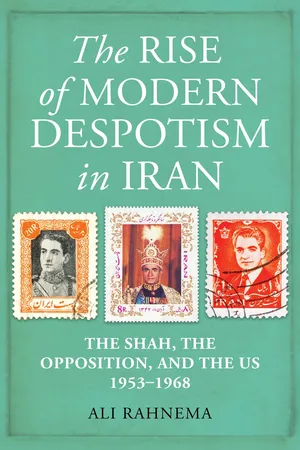
How did the Shah of Iran become a modern despot?

In 1953, Iranian monarch Mohammad-Reza Shah Pahlavi emerged victorious from a power struggle with his prime minister, Mohammad Mosaddeq, thanks to a coup masterminded by Britain and the United States. Mosaddeq believed the Shah should reign not rule, but the Shah was determined that no one would make him a mere symbol.

In this meticulous political history, Ali Rahnema details Iran’s slow transition from constitutional to despotic monarchy. He examines the tug of war between the Shah, his political opposition, a nation in search of greater liberty, and successive US administrations with their changing priorities. He shows how the Shah gradually assumed control over the legislature, the judiciary, the executive, and the media, and clamped down on his opponents’ activities.

By 1968, the Shah’s turn to despotism was complete. The consequences would be far-reaching.
Frequently asked questions

Yes, you can cancel anytime from the Subscription tab in your account settings on the Perlego website. Your subscription will stay active until the end of your current billing period. Learn how to cancel your subscription.
No, books cannot be downloaded as external files, such as PDFs, for use outside of Perlego. However, you can download books within the Perlego app for offline reading on mobile or tablet. Learn more here.
Perlego offers two plans: Essential and Complete
  • Essential is ideal for learners and professionals who enjoy exploring a wide range of subjects. Access the Essential Library with 800,000+ trusted titles and best-sellers across business, personal growth, and the humanities. Includes unlimited reading time and Standard Read Aloud voice.
  • Complete: Perfect for advanced learners and researchers needing full, unrestricted access. Unlock 1.4M+ books across hundreds of subjects, including academic and specialized titles. The Complete Plan also includes advanced features like Premium Read Aloud and Research Assistant.
Both plans are available with monthly, semester, or annual billing cycles.
We are an online textbook subscription service, where you can get access to an entire online library for less than the price of a single book per month. With over 1 million books across 1000+ topics, we’ve got you covered! Learn more here.
Look out for the read-aloud symbol on your next book to see if you can listen to it. The read-aloud tool reads text aloud for you, highlighting the text as it is being read. You can pause it, speed it up and slow it down. Learn more here.
Yes! You can use the Perlego app on both iOS or Android devices to read anytime, anywhere — even offline. Perfect for commutes or when you’re on the go.
Please note we cannot support devices running on iOS 13 and Android 7 or earlier. Learn more about using the app.
Yes, you can access The Rise of Modern Despotism in Iran by Ali Rahnema in PDF and/or ePUB format, as well as other popular books in Politics & International Relations & Middle Eastern History. We have over one million books available in our catalogue for you to explore.

1

A traumatized post-coup society

Mohammad Mosaddeq was the prime minister of Iran from 1951 to 1953. A Swiss-educated student of law, turned politician, he firmly believed in a veritable constitutional monarchy where the Shah should reign and not rule. In the last eleven months of his twenty-eight-month government, Mosaddeq gradually eroded Mohammad-Reza Shah Pahlavi’s authority as a constitutional monarch with special rights and privileges. The events of 16–21 July 1952 demonstrated that in a stand-off between the Shah, who wished to impose his customary privilege of vetoing Mosaddeq’s minister of war, and Mosaddeq, who challenged his traditional dominion, the people on the street took Mosaddeq’s side.
After Mosaddeq resigned over the Shah’s objection to his choice of minister of war, the Shah appointed Qavam ol-saltaneh as prime minister. The pro-Mosaddeq demonstrations that followed forced Qavam to resign. To the chagrin of the British and US ambassadors who staunchly supported Qavam’s premiership and wished Mosaddeq’s departure, Mosaddeq returned to power on a wave of popular support. This was a clear loss of face for the Monarch. The Shah drew an important lesson from this setback. He learnt that to be taken seriously, he needed to rule firmly.
After 21 July 1952, the Monarch and his Prime Minister were on a collision course. Mosaddeq wished to help Iran’s baby democracy stand up and walk steadily on its two feet, while the Shah saw the practice of democracy as a threat to his personal rule. The vision of good governance, as well as the road to securing Iran’s interest in the face of vested foreign interests, led to irreconcilable differences between the Shah and his Prime Minister. Mosaddeq’s increasing reliance on people’s power became worrisome. British financial interests, oil politics, and finally the US fear of communism, the clincher, hastened the showdown.
The Shah left the country after the failure of a first coup against Mosaddeq on 16 August 1953. Before leaving, the Shah had dismissed Mosaddeq and named Fazlollah Zahedi as his replacement. When Mosaddeq refused to acknowledge the Shah’s royal edict, considering it outside the Shah’s prerogative and the responsibility of the parliament, new demonstrations in support of Mosaddeq broke out. Three days later, on 19 August 1953, a second coup, masterminded by the US and the UK and executed by pro-Shah Iranians, succeeded in removing Mosaddeq from power. An outwardly triumphant, but deeply shaken Shah returned home.
The following day, on Thursday, 20 August 1953, Iranians in big cities woke up to a new reality. The political hustle and bustle of the Mosaddeq days, typical of a society experimenting with democratic principles and modes of behaviour, albeit muddled, had given way to a deadly silence. Tanks watched over the comings and goings on the main streets of Tehran. The military rule followed its proper logic, and its expectations of correct conduct were different from what the people in the cities of Iran had been used to under Mosaddeq. The people needed to adjust quickly.
The problem, however, was that urban Iranians had become used to and were invested in the political environment Mosaddeq had created. Both his proponents and opponents had been respected as citizens and political participants by the government as they played their respective role in the parliament, in the press, and on the streets. The democratic channels of expression had been open to all, and the due process of law had been respected more than ever before. On the morrow of the coup, Iranian urbanites were stunned by the abrupt events of the previous day.
It had been some thirty-two years since Tehran had been last occupied by military forces, when Reza Khan and Seyyed Ziaeddin (Zia) Tabatabaʾi had occupied Tehran on Monday, 21 February 1921. They had marched on Tehran from Qazvin at the head of some 2,000 Iranian Cossacks and 100 Gendarmes. Seyyed Zia and Reza Khan’s seizure of power came to be known as the Sevvom Hoot (or 3 Esfand) coup. In 1921, both winners and losers had been close friends of the British.
The 1921 and 1953 coups did have similarities. Seyyed Zia Tabatabaʾi had candidly admitted that he had received money from the British to pay out to Reza Khan for his Cossack forces and the Gendarmes who marched on Tehran.1 The forces defending Tehran had been either bought off by Seyyed Zia or instructed to stand down by a coalition of top British military and diplomatic personnel in Tehran. The British had hoped to entrust the government to a strong politico-military leadership team capable of repelling the communist threat in the North of Iran and freeing the British troops to leave the country. Seyyed Zia and Reza Khan were spurred by the British to carry out the coup and had their full support, provided Ahmad Shah was not deposed.2
The 1953 coup was similarly financed by the US, and its puppeteers were the US and the UK with the help of Iranian accomplices, politicians, clerics, military, and thugs. General Fazlollah Zahedi, a known military and political figure, played the role of the strongman, just as Reza Khan had during the 1921 coup. The coup leaders against Mosaddeq could not publicly acknowledge their debt to the US as the coup had been carried out in the name of the Shah. The 1953 coup removed a nationalist prime minister who had remained unyielding to British interests and unaccommodating to US recommendations for reconciliation with the British. The Shah returned, indebted to his patrons. During his private meeting with Loy Henderson, the US Ambassador to Iran, the Shah “expressed deep appreciation of the fr...

Table of contents

  1. Preface and acknowledgements
  2. Introduction
  3. 1 • A traumatized post-coup society
  4. 2 • General Zahedi takes power
  5. 3 • Complications of securing an oil agreement
  6. 4 • Hoseyn ʿAla, a prime minister in name
  7. 5 • Eqbal, the obedient prime minister
  8. 6 • Political earthquakes and ad hoc remedies
  9. 7 • Eqbal’s bunglings
  10. 8 • Engineer Sharif-Emami, the Shah’s new political fixer
  11. 9 • When autocrats sing quasi-democratic serenades
  12. 10 • Amini’s premiership: promises, promises
  13. 11 • The Mosaddeqist opposition mobilizes
  14. 12 • Political illusionism
  15. 13 • Amini against all shades of opposition
  16. 14 • The Shah gets his way
  17. 15 • By the Shah’s grace Amini rules
  18. 16 • Settling scores with Tehran University
  19. 17 • National Front students looking out of the box
  20. 18 • Land reform: the believer, the reluctant facilitator, and the political beneficiary
  21. 19 • ʿAlam hands over the country to its owner
  22. 20 • The Shah blows hot and cold on the opposition
  23. 21 • The last National Front Congress
  24. 22 • Government-sponsored celebration of emancipated peasants
  25. 23 • The three-headed monster opposing the White Revolution
  26. 24 • Political and religious authorities clash
  27. 25 • Khomeyni’s partisans take to the streets
  28. 26 • From democratic politics to armed struggle
  29. 27 • Changing of the guard
  30. 28 • The year of flying bullets
  31. 29 • The beloved sun of the Aryans (Aryamehr)
  32. 30 • The euphoria of wearing the Pahlavi Crown
  33. Conclusion
  34. Bibliography
  35. Copyright Page