
- 240 pages
- English
- ePUB (mobile friendly)
- Available on iOS & Android
eBook - ePub
About this book
Lama Zopa Rinpoche, the respected and beloved cofounder of the Foundation for the Preservation of the Mahayana Tradition, offers us a significant book that is both a beautiful tool for experienced practitioners and a how-to for beginners.
Revitalize your practice with the potent energy of mantra.
In this book, beloved teacher Lama Zopa Rinpoche guides us through the most popular mantras in Tibetan Buddhism: Shakyamuni Buddha, Chenrezig, Manjushri, Tara, Medicine Buddha, Vajrasattva, and more.
A mantra—literally “that which protects the mind”—is a series of Sanskrit syllables that evoke the energy of a particular buddha or bodhisattva. It works as a sacred sound that brings blessings to ourself and others, and as a tool to transform our mind into one that is more compassionate and wise.
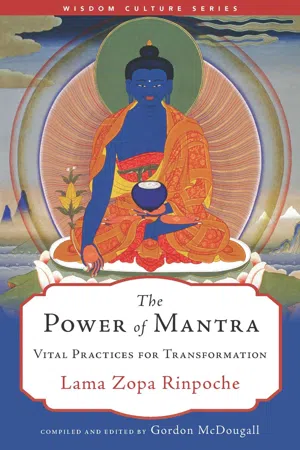
In clear and succinct teachings, Lama Zopa shows us why we need different mantras and how each mantra works. He also explains their importance and power, giving specific instructions for practicing them. The exquisite, full-color illustrations of the deities that accompany the text make this book a beautiful guide, one suitable for both beginners and experienced practitioners.
Revitalize your practice with the potent energy of mantra.
In this book, beloved teacher Lama Zopa Rinpoche guides us through the most popular mantras in Tibetan Buddhism: Shakyamuni Buddha, Chenrezig, Manjushri, Tara, Medicine Buddha, Vajrasattva, and more.
A mantra—literally “that which protects the mind”—is a series of Sanskrit syllables that evoke the energy of a particular buddha or bodhisattva. It works as a sacred sound that brings blessings to ourself and others, and as a tool to transform our mind into one that is more compassionate and wise.
In clear and succinct teachings, Lama Zopa shows us why we need different mantras and how each mantra works. He also explains their importance and power, giving specific instructions for practicing them. The exquisite, full-color illustrations of the deities that accompany the text make this book a beautiful guide, one suitable for both beginners and experienced practitioners.
Frequently asked questions
Yes, you can cancel anytime from the Subscription tab in your account settings on the Perlego website. Your subscription will stay active until the end of your current billing period. Learn how to cancel your subscription.
No, books cannot be downloaded as external files, such as PDFs, for use outside of Perlego. However, you can download books within the Perlego app for offline reading on mobile or tablet. Learn more here.
Perlego offers two plans: Essential and Complete
- Essential is ideal for learners and professionals who enjoy exploring a wide range of subjects. Access the Essential Library with 800,000+ trusted titles and best-sellers across business, personal growth, and the humanities. Includes unlimited reading time and Standard Read Aloud voice.
- Complete: Perfect for advanced learners and researchers needing full, unrestricted access. Unlock 1.4M+ books across hundreds of subjects, including academic and specialized titles. The Complete Plan also includes advanced features like Premium Read Aloud and Research Assistant.
We are an online textbook subscription service, where you can get access to an entire online library for less than the price of a single book per month. With over 1 million books across 1000+ topics, weâve got you covered! Learn more here.
Look out for the read-aloud symbol on your next book to see if you can listen to it. The read-aloud tool reads text aloud for you, highlighting the text as it is being read. You can pause it, speed it up and slow it down. Learn more here.
Yes! You can use the Perlego app on both iOS or Android devices to read anytime, anywhere â even offline. Perfect for commutes or when youâre on the go.
Please note we cannot support devices running on iOS 13 and Android 7 or earlier. Learn more about using the app.
Yes, you can access The Power of Mantra by Lama Zopa Rinpoche in PDF and/or ePUB format, as well as other popular books in Theology & Religion & Buddhism. We have over one million books available in our catalogue for you to explore.
Information
1. SHAKYAMUNI BUDDHA
AS A YOUNG PRINCE, Siddharthaâs life was as perfect as a life in samsara could be. His father, the king, received a prophecy that his son would either be a great king or a great sage, and because he was determined that Siddhartha would become king, he hid all suffering from him and totally immersed him in sense pleasures.
Despite his father trying to shield him from all suffering, there came a time as a young man when he saw four things in quick succession, one at each of the gates of the palace. First he saw an old person and he realized that we all have to age. Next he saw a sick person, something he had never seen before. Then he saw a dead body, and he understood that death comes to us all. This was a terrible revelation for a young man who had never seen the slightest suffering. At the fourth gate he saw a poor monk, a person who had none of the luxuries that Siddhartha had but nonetheless seemed incredibly happy. This was a like a light going on in a dark place for the prince. He saw all his palace life for the empty thing it was, and he knew that samsaric happiness was meaningless, something that only ever led to old age, sickness, and death. But he also knew there was a way out of this trap, if it could be found, and that it had something to do with the monk. This was the start of his spiritual quest.
Siddhartha chose the life of the ascetic, practicing with hardly any food in the most trying circumstances. He practiced concentration without moving, his whole body becoming like a tree, as if carved from wood, so much so that ants and insects made nests in his ears. After doing this for six years, he realized that austerity was as harmful as indulgence. When he was given milk and rice by a young girl, Sujata, his energy returned, and he went to the bodhi tree nearby to meditate. This led to that amazing night when he attained full enlightenment. Then he sought the companions from his ascetic days, finding them in Sarnath, near Varanasi in north India, where he gave his first teaching, the first turning of the Dharma wheel, on the four noble truths.17 Then, for over forty years he gave over 84,000 teachings and formed a great sangha around him, before passing away at Kushinagar.
The death of the Buddha was his last teaching to us, a lesson on impermanence. When it was time to die, he took off his robes, lay down, and said,
All causative phenomena are impermanent.
Work out your salvation with diligence.
This is the last teaching of the tathagata.18
Everything is transient, subject to change, not just on a gross level but moment by moment. And every impermanent phenomenon is unsatisfactory; it is suffering by nature. Therefore why should we be attached to something that by its very nature will only bring us dissatisfaction and suffering? This is the most important lesson the Buddha could leave us. Then he passed away, entering parinirvana.
After that, all the arhats assembled and wrote down what they had learned by heart of his teachings and this became the core of the Buddhadharma we have today. From India, Buddhism spread to the other Asian countries and to Tibet, where it brought light to a dark country, and great teachers such as Padmasambhava, Lama Atisha, and Lama Tsongkhapa19 helped make Buddhism an essential part of the Tibetan peopleâs lives. In the West, before the middle of the last century, the teachings of the Buddha were almost unheard of, and so the causes of happiness and suffering were virtually unknown. Now the Buddhaâs teachings are widely available, from the basic lamrim teachings to the most advanced tantric practices with which we can attain enlightenment in one brief lifetime. None of this would have been possible without the achievements of the founder, Guru Shakyamuni Buddha.20
For followers of the individual liberation vehicle,21 such as those in the Theravada countries like Sri Lanka and Thailand, the Buddha was like us and, by enacting the twelve deeds,22 he attained enlightenment. From the Mahayana perspective, he had already become enlightened eons ago and the life he led as Siddhartha was an enactment in order to perfectly teach us what we must do if we want to likewise attain enlightenment. Furthermore, in this form, in the nirmanakaya, or emanation body, he was able to form the sangha around him and teach the holy Dharma to his followers for more than forty years.
We owe everything to the Dharma and the holy beings who came after the Buddha, who kept the teachings completely pure, and that means we owe everything to the holy being called Shakyamuni Buddha. The enlightened being he became arose from the bodhisattva who practiced for three countless great eons in myriad bodies, and that bodhisattva came from bodhichitta, which in turn grew from the compassion he felt for sentient beings. If, since we have met the Buddhadharma, our wisdom has grown enough to discriminate what is right and to be practiced from what is wrong and to be abandoned, all this comes from Buddhaâs compassion.
VISUALIZING SHAKYAMUNI BUDDHA
It is very good to visualize Guru Shakyamuni Buddha as clearly as possible, whether you are reciting the Shakyamuni mantra, doing a short meditation practice, or even an extended Shakyamuni puja.23 Even though you might find the visualization too complex at first, donât worry. With time and practice it will come. Gradually, as the mind becomes more purified, the visualization becomes clearer. Even if you just have some sense that Guru Shakyamuni Buddha is there in front of you, that is an excellent start.
Straight in front of you, at about the height of the forehead and about a bodyâs length away, visualize Guru Shakyamuni Buddha sitting on a throne. Everything is in the nature of light.
First visualize the beautiful throne, very large and square and adorned with many jewels. The throne is raised up by eight white snow lions, two at each corner. The snow lions look a little like Chinese lions, but with white fur and a green mane and tail. These are not statues but living, breathing animals. They are in reality manifestations of bodhisattvas, the holy beings who have attained bodhichitta. They also signify the wisdom of the Buddha, because of all animals, snow lions are the only ones that have absolutely no fear at all. This is shown by the droopy ears. All other animals must keep their ears pricked for danger, but the snow lion has no such need.

On the throne is a large, beautiful, open lotus, upon which is a sun and moon seat. These are very radiant, very bright, with the colors of the sun and moon respectively, but flat, like disks or cushions. These three objects, the lotus, sun, and moon, represent the attainment of the three principal aspects of the path, renunciation (the lotus), emptiness (the sun), and bodhichitta (the moon).
Seated on this is the omniscient mind of all the buddhas, manifested as Guru Shakyamuni Buddha, who has attained these realizations. You can see the Buddha as the absolute guru. The Buddha is in the aspect of a monk. You should not see his body as something solid, like a bronze or plaster statue, but made of radiant golden light, representing his holy mind. Light rays radiate out from it. He wears the saffron robes of a monk. The robes donât actually touch his body. Our clothes cling to our body and always feel sort of uncomfortable, even if just a little, whereas the Buddhaâs robes float just free from his holy body. This is the power of his wisdom.
He is seated in a vajra or full-lotus position with the feet resting on the opposite thighs, soles upward. The palm of his right hand rests on his right knee, the fingers extended down and touching the moon cushion. This is called the earth-controlling mudra,24 signifying that he has great control and that he is in touch with reality.
His left hand is in his lap in the meditation mudra, holding a bowl filled with nectar. The nectar is medicine capable of curing all the disturbing emotions, traditionally called the maras. It has the power to control death as well as purify the mind and body aggregates, caused by karma and delusion, from which all suffering arises. This bowl of nectar is not there to purify Guru Shakyamuni Buddhaâs delusionsâhe is already entirely free from themâbut to purify ours. It is medicine for us.
His face is very beautiful, with smiling, compassionate, elongated eyes and a gentle look, just like a loving father, gazing at you and at the same time at all sentient beings. It is a face you can never tire of looking at, no matter how much you look, you can always look more, it is just so beautiful and so magnificent. Just seeing it brings incredible bliss. His look seems to tell you, âMy child, if you want to be free from suffering, I will guide you.â
He has long ears and reddish lips, and his hair is blue-black, with each hair individually curled to the right. At his forehead, between his eyebrows, there is a curl. It is unique in that it can be stretched out and it naturally curls again, like rubber. Every feature has significance, each part of the thirty-two major signs and eighty minor exemplifications of an enlightened being.25
Rays of light emanate out from every pore of the Buddhaâs holy body, touching every part of the universe. These rays are actually countless tiny emanations of the Buddha, going out to help all sentient beings and then dissolving back into his body.
THE MANTRA
The Meaning of the Mantra
Shakyamuni Buddhaâs mantra is this:
TADYATHA OM MUNE MUNE MAHA MUNEYE SVAHA

The first word of the mantra is TADYATHA (pronounced tie-yata). This is the introduction to many mantras; it means âthis contains,â and thus it tells us that what comes after contains the infinite knowledge of the Buddhaâs holy body, holy speech, and holy mind.
The second word, OM, contains the essence of all the Buddhaâs knowledge. By actualizing the paths of method and wisdom, all gross and subtle defilements cease, and our body, speech, and mind are purified, becoming the vajra holy body, vajra holy speech, and vajra holy mind of a buddha. This is signified by a, o, and ma respectively, the three syllables integrated into the one sound OM.
Next comes MUNE. Shakyamuni Buddhaâs name means âthe subduerâ (muni) of the Shakya clan and the word muni forms an important part of the Buddhaâs mantra. It used to be written in the mantra as âmuniâ but Kyabje Khunu Lama Rinpoche Tenzin Gyaltsen, the great bodhisattva His Holiness received many teachings from, clearly corrected this in a public teaching, saying it should be written and pronounced âmune.â He also said that the last MUNE, MUNEYE, should be pronounced âmun-i-ye.â26
MUNE is repeated three times, which relates to the graduated paths of the three capable beingsâthose of lower, middle, and higher capacity, who have the respective aims of a higher rebirth, nirvana, and enlightenment. This shows the route that the Buddha took over the three countless great eons until he became enlightened. It is the route we all must take.
The first MUNE, relating to the path of the lower capable being, signifies that the Buddha completely subdued attachment to this lifeâs happiness. Through understanding subjects such as impermanence and karma, he was able to avoid rebirth in the lower realms and continue his spiritual journey.
The second MUNE relates to the path of the middle capable being; this is when the Buddha saw the shortcomings of the whole of samsara, even ...
Table of contents
- Cover Page
- Title Page
- Contents
- Editorâs Preface
- Introduction: The Power to Transform the Mind
- 1. Shakyamuni Buddha
- 2. Chenrezig
- 3. Manjushri
- 4. Tara
- 5. Medicine Buddha
- 6. Vajrasattva
- 7. The Thirty-Five Confession Buddhas
- 8. The Five Great Mantras
- Conclusion: The Benefits of Reciting Mantras are Uncountable
- Appendices
- Glossary
- Notes
- Bibliography
- About the Author
- Copyright