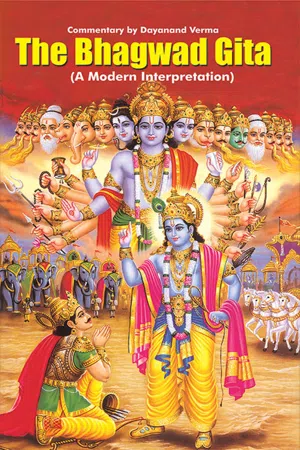
In the age when the right to learn the Vedic Literature was confined to only a particular class, Lord Krishna conveyed the gist of knowledge enshrined in our scriptures to Arjuna through the divine message called the GITA. Thus He made this supreme knowledge accessible to all classes of the society. In this sense the Gita is a revolutionary creation if its age and for all the ages. Dayanand Verma (1931) He has published books/articles on subjects like spiritualism, psychology etc. His deep knowledge of spiritualism and yoga won him the Vishwa Yoga Sammelan 1986 award and the title YOGARATNA. This interpretation of Gita is culmination of his deep study and thinking.
eBook - ePub
The Bhagwad Gita
About this book
Information
Topic
Theology & ReligionSubtopic
Religion1
CHAPTER
The Sorrow of Arjuna
[ARJUNA VISHAD YOGA]
It is a recent practice to introduce the main topic of a chapter along with the title of a chapter, but in ancient times, it was customary to mention the subject of a chapter in its conclusion. The line summarizing a chapter is known as the pushpika.
In the pushpika of the first chapter the subject has been mentioned as “The Sorrow of Arjuna” (Arjuna Vishad Yoga). Let us first discuss the prevalent meaning of the word yoga in this title.
Yoga
The word yoga has been often repeated in the Gita. The narrator of this discourse, Shri Krishna, is also called Yogeshwara Krishna. Usually the meaning of the word yoga is taken from Patanjali’s Yoga-Darshana. According to Patanjali, yoga is keeping the instincts of the mind under control. Some people describe the union of the soul with the ‘ultimate’ as yoga. In the Gita it has been used to indicate a broader meaning.
In Chapter 2, sloka 48, Shri Krishna has said “Yoga is the state of maintaining equanimity in the face of success and failure”. In the same chapter in sloka 50, it is described as “proficiency of action”. This proficiency can be achieved only when there is complete focus on one subject. When a dancer is immersed in his/her dance, when an author withdraws his/her attention from everything extraneous and concentrate on the writing at hand, when the scientist is completely lost in his/her investigations, they are all in the highest state of yoga.
If you delve deeper into the meanings of the word, you will learn that yoga is neutral. The adjective attached to that word renders its different meanings. Being absorbed in the worship is (Bhaktiyoga) the Yoga of Devotion. Losing oneself in good actions is (Karmayoga) the Yoga of Actions and withdrawing attention from all else while perusing any particular subject with, compelling curiosity is (Jnanayoga) the Yoga of Knowledge. To sum up, being single-mindedly absorbed in any subject is — yoga. It is only with concentration that one becomes increasingly proficient in whatever s/he does.
Let us now consider the title of this chapter. It is called the Yoga of the Sorrow of Arjuna (Arjuna Vishad yoga). The word “Sorrow” or “Distress” do not fit with the word yoga. Hence, there is a new meaning applied to the word yoga here. It means the main subject or topic. We shall interpret in the same manner the word yoga in the pushpika of each of the chapters here, that is, we shall look upon it as the main subject of the chapter.
In the early part of Chapter 1, we find the descriptions of the two armies. The main subject is the sorrow of Arjuna. In today’s parlance we may interpret Arjuna’s sorrow or distress as depression.
IMPORTANCE OF THIS CHAPTER
Shri Krishna does not utter a single word in this chapter. It is only Arjuna who pours out his emotions and on finding no response from Shri Krishna, finally lays down his bow and arrow and retire to the rear of the chariot.
A valiant warrior, thus abandoning the determination to fight even before the start of the war sets up the stage for the sermon of Gita. Shri Krishna has touched upon every aspect of life with a view to draw Arjuna out of his depression.
èk`rjk"Vª mokpA
èkeZ{ks=ks oqQ#{ks=ks leosrk ;q;qRlo%A
ekedk% ik.Mok'pSo fdeoqQoZr lat;AA1AA
èkeZ{ks=ks oqQ#{ks=ks leosrk ;q;qRlo%A
ekedk% ik.Mok'pSo fdeoqQoZr lat;AA1AA
dhrtarāṣṭra uvācha dharmakṣetre kuruksetre samavetā yuyutsavāḥ māmakāḥ pāṇḍavāśchaiva kimakurvata sanjaya: 1
Meaning: Dhritarashtra said, oh, Sanjaya, what did my and Pandu’s sons do when they gathered on the sacred battlefield of Kurukshetra with the intention to wage a war?: 1
Commentary: Kurukshetra has been described as the sacred battlefield in this sloka. It has been named the sacred field because Kuru kings themselves had ploughed the land and made it fertile. They believed that anyone who died on that piece of land reaches heaven.
lat; mokp
n`"V~ok rq ik.Mokuhad O;w<a nq;ksZèkuLrnkA
vkpk;ZeqilaxE; jktk opueczohr~AA2AA
n`"V~ok rq ik.Mokuhad O;w<a nq;ksZèkuLrnkA
vkpk;ZeqilaxE; jktk opueczohr~AA2AA
sanjaya uvācha
dṛṣṭvā tu pāṇdavānikam vyudharh duryodhanastadā āchāryamupasamgamya rājā vachanamabravit: 2
dṛṣṭvā tu pāṇdavānikam vyudharh duryodhanastadā āchāryamupasamgamya rājā vachanamabravit: 2
Meaning: Sanjaya said at that time, King Duryodhana had a look at the Pandava army which stood ready in the strategic position. Then going straight to Acharya Drona he said: 2
Commentary: Here, Sanjaya has referred to Duryodhana as “King” although it was Dhritarashtra who was the ruling king. Thereby, he indicates that he was only the ceremonial head and Duryodhana actually called the shots.
i';Srka ik.Mqiq=kk.kkekpk;Z egrha pewe~A
O;w<ka nzqiniq=ks.k rc f'k";s.k èkherkAA3AA
O;w<ka nzqiniq=ks.k rc f'k";s.k èkherkAA3AA
paśyaitāṁ pāṇduputrāṇamāchārya mahatiṁ chamūm vyūdhām drupadaputreṇa tava śiṣyeṇa dhimatā: 3
Meaning: Oh, Acharya, just look at this huge army of the Pandavas. It is standing in readiness according to the strategic arrangement planned by the son of Drupada who is your intelligent pupil: 3
Commentary: Bhishma was the general of the Kaurava army while the leader of the Pandava army was Dhrishtadyumna. According to this sloka, instead of going to the commander of the Kaurava army, Druyodhana went to Acharya Drona. He referred to Dhrishtadyumna not directly by his name but called him the “son of Drupada” and “your intelligent pupil”. Thereby, intending to arouse in Dronacharya’s mind his old time animosity with King Drupada. This hostility which was provoked by the following incident:
Prince Drupada and young Drona were fellow disciples and good friends. In the course of time, Drupada ascended the throne of Panchala Desha but Drona continued to live in poverty.. Once unable to bear his poverty stricken existence, he had approached his friend now King Drupada. He reminded the king of their old friendship, he sought help from him. But intoxicated by authority, Drupada refused to accept Drona as his friend and insulted him. As a result Drona was seized with the feeling of vengeance.
Drona too got his chance. He was appointed as the teacher to train the Kauravas and the Pandavas in the art of military warfare. When their training was completed, Drona with his pupils, invaded the Kingdom of Drupada. He conquered it, but later freed him and returned half the kingdom to him.
On the other hand King Drupada summoned brahmins to avenge this humiliation. He made arrangements for a yajna on the advice of the brahmins. The purpose of the yajna was to have such a progeny who would be able to slay Drona. From the sacrificial pit of the yajna emerged Dhrishtadyumna and a girl called Krishna who was better known as Draupadi.
Drona extended a particular fondness for Arjuna. With a view to impress the guru, Duryodhana went to him and not to Bheeshma. He referred to Dhrishtadyumna not by his name but as “Drupada’s son” and “your intelligent pupil” and thus flung at him a sarcastic remark that Dhrishtadyumna who is born to take his life, was first his pupil, but now the Pandavas made him the commander-in-chief. The indirect implication of this remark is that in his simplicity, Drona took on the son of his arch enemy as his pupil. Now he stands in the enemy camp, and Drona has prepared a sure ground for his own death. Therefore, he should not nurture any soft feelings for the Pandavas.
In the slokas that follow, Duryodhana is describing the great warriors in the Pandava camp.
v=k 'kwjk egs"oklk HkhektqZulek ;qfèkA
;q;qèkkuks fojkV'p nqzin'p egkjFk%AA4AA
;q;qèkkuks fojkV'p nqzin'p egkjFk%AA4AA
atra śūrā maheṣvāsā bhimārjunasamā yudhi yuyudhāno viratāścha drupadaścha mahārathaḥ : 4
èk`"VosQrq'osfdrku% dkf'kjkt'p oh;Zoku~A
iq#ftRoqQfUrHkkst'p 'kSC;'p ujiqaxo%AA5AA
iq#ftRoqQfUrHkkst'p 'kSC;'p ujiqaxo%AA5AA
dhṛṣṭaketuśchekitānaḥ kāśirājaścha viryavāṇ purujitkuntibhojaścha saibyaścha narapungavah : 5
;qèkkeU;q'p foØkUr mÙkekStk'p oh;Zoku~A
lkSHknzks nzkSiksns;k'p loZ ,o egkjFk%AA6AA
lkSHknzks nzkSiksns;k'p loZ ,o egkjFk%AA6AA
yudhāmanyuścha vikrānta uttamujāścha viryavāṇ saubhadro draupadeyāścha sarva eva mahārathāḥ : 6
Meaning: In the Pandava army, there are a large number of valiant warriors, great archers and warriors like Yuyudhamna, Satyaki, Virata, Maharathi Drupada, Dhrishtaketu, Chekitan, brave Kashiraja, Purujit, Kuntibhoja, great Shaibya, valiant Yudhamnyu, powerful Uttamauja, Subhadra’s son Abhimanyu and Draupadi’s sons, all comparable to Bhima and Arjuna and all are the great warriors: 4-6.
vLekda rq fof'k"Vk ;s rkfUucksèk f}tksÙkeA
uk;dk ee lSU;L; laKkFkZ rkUczohfe rsAA7AA
uk;dk ee lSU;L; laKkFkZ rkUczohfe rsAA7AA
asmākam tu viśiṣṭā ye tānnibodha dvijottama nāyakā mama sainyasya samjñārtham tānbravimi te: 7
Meaning: Oh, the highest among the brahmins, let me now recount to you the leading warriors in the Kaurava army: 7
HkokUHkh"e'p d.kZ'p d`i'p lfefr×t;%A
v'oRFkkek fod.kZ'p lkSenfÙkLrFkSo pAA8AA
v'oRFkkek fod.kZ'p lkSenfÙkLrFkSo pAA8AA
bhavānbhiṣmaścha karnaścha kṛpaścha samitiñjayaḥ aśvatthāmā vikarnaścha saumadattistathaiṿa cha : 8
Meaning: One of them is your own good self, then Bheeshma Pitamaha and Karna. Also, there are Ashwathama, Vikarna and the victorious Kripacharya as well as Somadatta’s son Bhurishrava: 8
vU;s p cgo% 'kwjk enFksZ RDrthfork%A
ukuk'kL=kizgj.kk% losZ ;q¼fo'kkjnk%AA9AA
ukuk'kL=kizgj.kk% losZ ;q¼fo'kkjnk%AA9AA
anye cha bahavaḥ śurā madarthe tyaktajivitāḥ nānāśastrapraharaṇāḥ sarve yuddhaviśāradāḥ : 9
Meaning: There are countless other brave warriors who have come fully armed forgetting their attachments for my sake. All of them are very well-versed in warfare: 9
vi;kZIra rnLekda cya Hkh"ekfHkjf{kre~A
i;kZIra fRonesrs"kka cya HkhekfHkjf{kre~AA10AA
i;kZIra fRonesrs"kka cya HkhekfHkjf{kre~AA10AA
aparyāptam tadasmākaṁ balam bhiṣmābhirakṣitam paryāptaṁ tvidameteṣāṁ bālam bhimābhirakṣitam: 10
Meaning: Our army, is protected by Bheeshma Pitamaha and it is adequately equipped in every way. It is not the same with the army of the Pandavas which is protected by Bheema: 10
v;us"kq p losZ"kq ;FkkHkkxeofLFkr%A
Hkh"eesokfHkj{kUrq HkoUr% loZ ,o fgAA11AA
Hkh"eesokfHkj{kUrq HkoUr% loZ ,o fgAA11AA
ayaneṣu cha sarveṣu yathābhāgamavasthitāḥ bhiṣmamevābhirakṣantu bhavantaḥ sarva eva hi: 11
Meaning: Hence, all of you should stand firm on your respective positions and protect Bheeshma from all sides: 11
Commentary: After introducing his heroic warriors, Duryodhana commands all of them, including Drona, to protect Bheeshma, the commander in chief. Duryodhana particularly feared about Bheeshma’s safety because the Pandava army included Shikhandi (Drupada’s son) who was born as a woman to take a revenge. Bheeshma had taken a vow never to aim his arrow at a woman. Duryodhana was worried that if by chance Bheeshma came face to face with Shikhandi, he would not raise his weapons and in that case, the Pandavas would be able to slay Bheeshma easily. Though Bheeshma had been granted the power to die at will, in other words, he would not die as long as he did not embrace death by choice. But, if the general fell wounded, it could bring down the morale of the army. Hence, Duryodhana had been warning his army that Shikhandi should not...
Table of contents
- Cover
- Title
- Dedication
- Introduction
- Mahabharata and The Gita
- Table of Contents
- 1. The Sorrow of Arjuna [Arjuna Vishad Yoga]
- 2. The Path of Knowledge [Sankhya Yoga]
- 3. Virtue of Action [Karma Yoga]
- 4. Knowledge, Action and Renunciation [Jnan Karma Sanyasa Yoga]
- 5. True Renunciation [Karma Sanyasa Yoga]
- 6. Meditation [Dhyana Yoga]
- 7. Knowledge of the Spirit and the Mundane [Jnan Vijnan Yoga]
- 8. Imperishable Brahma [Akshara Brahma Yoga]
- 9. The Highest Learning — The Highest Mystery [Rajavidya — Rajaguhya Yoga]
- 10. The Supernatural Power [Vibhuti Yoga]
- 11. Revelation of God’s Universal Form [Vishwaroopa Darshan Yoga]
- 12. The Path of Devotion [Bhakti Yoga]
- 13. About the Body and the Soul [Kshetra, Kshetrajnya, Vibhaga Yoga]
- 14. The Three Attributes [Gunatraya Vibhag Yoga]
- 15. The Supreme Spirit [Purushottama Yoga]
- 16. Divine and Demonic Tendencies [Daivasura Sampad Vibhaga Yoga]
- 17. Threefold Faith [Shraddha Traya Vibhaga Yoga]
- 18. Salvation and Renunciation [Moksha Sanyasa Yoga]
- Appendix
Trusted by 375,005 students
Access to over 1.5 million titles for a fair monthly price.
Study more efficiently using our study tools.
Frequently asked questions
Yes, you can cancel anytime from the Subscription tab in your account settings on the Perlego website. Your subscription will stay active until the end of your current billing period. Learn how to cancel your subscription
No, books cannot be downloaded as external files, such as PDFs, for use outside of Perlego. However, you can download books within the Perlego app for offline reading on mobile or tablet. Learn how to download books offline
Perlego offers two plans: Essential and Complete
- Essential is ideal for learners and professionals who enjoy exploring a wide range of subjects. Access the Essential Library with 800,000+ trusted titles and best-sellers across business, personal growth, and the humanities. Includes unlimited reading time and Standard Read Aloud voice.
- Complete: Perfect for advanced learners and researchers needing full, unrestricted access. Unlock 1.5M+ books across hundreds of subjects, including academic and specialized titles. The Complete Plan also includes advanced features like Premium Read Aloud and Research Assistant.
We are an online textbook subscription service, where you can get access to an entire online library for less than the price of a single book per month. With over 1.5 million books across 990+ topics, we’ve got you covered! Learn about our mission
Look out for the read-aloud symbol on your next book to see if you can listen to it. The read-aloud tool reads text aloud for you, highlighting the text as it is being read. You can pause it, speed it up and slow it down. Learn more about Read Aloud
Yes! You can use the Perlego app on both iOS and Android devices to read anytime, anywhere — even offline. Perfect for commutes or when you’re on the go.
Please note we cannot support devices running on iOS 13 and Android 7 or earlier. Learn more about using the app
Please note we cannot support devices running on iOS 13 and Android 7 or earlier. Learn more about using the app
Yes, you can access The Bhagwad Gita by Dayanand Verma in PDF and/or ePUB format, as well as other popular books in Theology & Religion & Religion. We have over 1.5 million books available in our catalogue for you to explore.