For years, there has been uncertainty regarding Paul Young's The Shack. Some have suspected heresy but have been unable to pin down exactly what Paul Young believed. James De Young, Th.D., who has known Paul Young for a couple decades, wrote Burning Down the Shack to expose Christians to the fact that Paul Young espoused universalism.Now "the cat is out of the bag." In his newest book, Lies We Believe about God, Young blatantly confesses adherence to universal reconciliation, as well as twenty-seven other beliefs that are heretical. Here are some of Paul Young's unbiblical claims: •God is not in control of everything
•God submits to human beings
•God is a Christian
•God is a sexual being, equally male and female
•People do not need to get saved
•Sin and hell do not separate people from God
•The cross was man's idea, not God's
•People have a second chance to believe after death
•Everyone is a child of God
•Universal reconciliation has been accomplished for all people
•The God of evangelical faith tortured his child, Jesus, and is the perpetrator of evilDrawing upon his life-long teaching of the Bible and the original languages, James De Young appeals to the Bible to expose Paul Young as a heretic. In appendices, he also furnishes proof that Paul Young violates the Nicene Creed and the beliefs of the early church father Athanasius. Finally, we have a book written by one who is both personally and academically qualified to expose the true nature of Young's writings. De Young will empower you to: •Discover the heresy in Young's book, Lies We Believe About God
•Expand your ability to answer the lies found in universal reconciliation
•Enhance your capacity to discern between the truth and falsehood
•Strengthen your confidence in the truth of the Bible
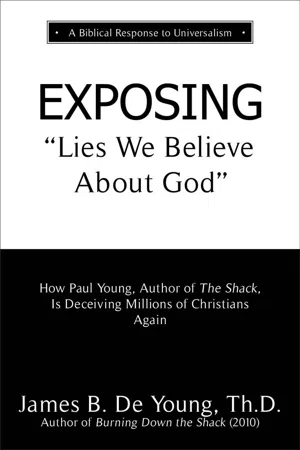
eBook - ePub
EXPOSING Lies We Believe About God
How the Author of The Shack Is Deceiving Millions of Christians Again
- English
- ePUB (mobile friendly)
- Available on iOS & Android
eBook - ePub
EXPOSING Lies We Believe About God
How the Author of The Shack Is Deceiving Millions of Christians Again
About this book
Information
Subtopic
Théologie chrétienneINTRODUCTION
The Author of The Shack Writes a New Book Filled with Universalism/Heresy
Unless otherwise stated, all page numbers at the end of sentences are from Lies We Believe about God, referenced below.1 Likewise, the first reference to The Shack will be footnoted, and after that only the title with page number will follow the sentence.
What would you think of a book written by someone who claims to be a Christian (57) and . . .
- Who believes that all people are “fundamentally good” and not sinners (35)?
- Who does not believe that God is in control of everything (42)?
- Who believes that God submits as much to our plans as we do to his (43)?
- Who redefines God’s nature as a sexual being (93)?
- Who claims that the “feminine/masculine nature of God is a circle of relationship” in which all humans participate (73)?
- Who believes that the God of Christian faith is a “torture-devising” God (149)?
- Who claims that neither hell nor sin brings separation from God (134; 231)?
- Who claims that the cross – the death of Christ – was not in God’s plan, but was man’s idea (149)?
- Who claims that the sacrifice of Christ on the cross was “cosmic abuse” of a child (149)?
- Who believes that unsaved people can still choose to turn to God after they die (185-186)?
- Who thinks that the institutions of the church, the government, and marriage are man-created and even demonic (103, 111-113; The Shack, 122-124, 179)?
- Who thinks that bearing a weapon and killing in war is murder (104-105)?
- Who claims that every human being is a child of God, already saved and reconciled to God (120)?
- Who claims that the evangelical Christian view of the Trinity embraces a distant deity who originated evil and whose plan included the torture of a child (238)?
- Who claims that the early church father Athanasius and the Nicene Creed support his beliefs (see appendices)?
You may ask, “Who would ever write such things?” You would guess that this is some obscure author who has virtually no impact on the Christian world. You would be wrong. The author is Wm. Paul Young, the most successful author of the last decade! His novel The Shack, along with his other novels, have sold over twenty million copies. The Shack has also been made into a Hollywood film.2
Yes, in his new book, Paul Young has made not only the preceding assertions but many more. His newest book is Lies We Believe about God (to be referred to as simply Lies from here on), released in early March 2017. Lies is about doctrine. It is not a fictional novel.
In this book, Young has twenty-eight brief chapters, with each chapter title being a “lie” that he believes is an erroneous belief of Christians, particularly evangelical Christians. Then he seeks to demolish each “lie” and show that each one is false. For support, Young sometimes appeals to the Bible, but more often he appeals to personal experiences.
Other Radical Theology from Lies We Believe about God
As if it weren’t enough that Paul Young has provocative titles for his twenty-eight chapters, even more radical ideas are scattered within these chapters. Here is a sampling, seventeen in number. In many instances, Young first raises a question, and then answers it for us.
All people are “fundamentally good” because they were “created in Christ” (35).
“The Golden Rule is . . . the way God is. God treats me exactly the way God wants to be treated” (46).
“What is the incarnation – God becoming fully human – if not complete and utter submission to us? What about the cross, in which God submits to our anger, rage, and wrath?” (48).
“The image of God in us (imago dei) is not less feminine than masculine. The feminine/masculine nature of God is a circle of relationship, a spectrum, not a polarity” (73).
“Where do you think sexuality originates? It originates in the very being of God” (93).
“When the New Testament tells us that the divine nature of God has been placed within us, the Greek word used is sperma” (95).
“The Good News is not that Jesus has opened up the possibility of salvation and you have been invited to receive Jesus into your life. The Gospel is that Jesus has already included you into His life, into His relationship with God the Father, and into His anointing in the Holy Spirit. The Good News is that Jesus did this without your vote, and whether you believe it or not won’t make it any less or more true” (117-118).
In answer to the questions, “Are you suggesting that everyone is saved? That you believe in universal salvation?” Young’s answer is, “That is exactly what I am saying! This is real good news!” (118).
“Here’s the truth: every person who has ever been conceived was included in the death, burial, resurrection, and ascension of Jesus” (119).
“We don’t offer anyone what has already been given; we simply celebrate the Good News with each one: We have all been included” in salvation (120).
“Doesn’t it seem intuitively wrong to be desperately afraid of a torture-devising God and yet hope to spend eternity with this God?” (132). Young continues, “. . . perhaps hell is hell not because of the absence of God, but because of the presence of God, the continuous and confrontational presence of fiery Love and Goodness and Freedom that intends to destroy every vestige of evil and darkness that prevents us from being fully free and fully alive” (136).
In reply to the question “Who originated the Cross?” Young replies, “If God did, then we worship a cosmic abuser, who in Divine Wisdom created a means to torture human beings in the most painful and abhorrent manner. . . . Better no god at all, than this one” (149).
Does belief in Love, Life, and Truth, even by an atheist, make him “a child of God? No, it doesn’t. He already was a child of God” (205).
Young’s definition of sin (Greek hamartia) is this: “Sin is anything that negates or diminishes or misrepresents the truth of who you are” (229).
If the idea that sin separates us from God “is a lie, does it mean that no one has ever been separated from God? That is...
Table of contents
- Contents
- PREFACE
- INTRODUCTION
- ANTHROPOLOGY: THE STUDY OF HUMANITY
- “GOD LOVES US, BUT DOESN’T LIKE US”
- “GOD IS A CHRISTIAN”
- “GOD CREATED (MY) RELIGION”
- “GOD DOESN’T CARE WHAT I’M PASSIONATE ABOUT”
- “NOT EVERYONE IS A CHILD OF GOD”
- THEOLOGY PROPER: THE STUDY OF GOD
- “GOD IS GOOD. I AM NOT.”
- “GOD WANTS TO USE ME”
- “GOD IS MORE HE THAN SHE”
- “GOD WANTS TO BE A PRIORITY”
- “GOD IS A MAGICIAN”
- “GOD IS A PRUDE”
- “GOD BLESSES MY POLITICS”
- “GOD IS NOT GOOD”
- “GOD IS A DIVINE SANTA CLAUS”
- “GOD IS NOT INVOLVED IN MY SUFFERING”
- “YOU WILL NEVER FIND GOD IN A BOX”
- “GOD IS DISAPPOINTED IN ME”
- “GOD LOVES ME FOR MY POTENTIAL”
- “GOD IS ONE ALONE”
- THE SOVEREIGNTY OF GOD
- “GOD IS IN CONTROL”
- “GOD DOES NOT SUBMIT”
- “THE CROSS WAS GOD’S IDEA”
- “THAT WAS JUST A COINCIDENCE”
- “GOD REQUIRES CHILD SACRIFICE”
- SOTERIOLOGY: THE STUDY OF SALVATION
- “YOU NEED TO GET SAVED”
- “HELL IS SEPARATION FROM GOD”
- “DEATH IS MORE POWERFUL THAN GOD”
- “SIN SEPARATES US FROM GOD”
- ADDITIONAL MATTERS, OBSERVATIONS, AND QUESTIONS
- IS PAUL YOUNG’S CLAIM TRUE THAT HIS BELIEFS ARE ORTHODOX BY THE NICENE CREED?
- DOES THE CHURCH FATHER ATHANASIUS SUPPORT UNIVERSAL RECONCILIATION?
- DOES THE ATHANASIAN CREED SUPPORT UNIVERSAL RECONCILIATION?
- THE MANY CONTRADICTIONS OF PAUL YOUNG AS A UNIVERSALIST
- THREE FINAL QUESTIONS
- MEET THE AUTHOR
Trusted by 375,005 students
Access to over 1.5 million titles for a fair monthly price.
Study more efficiently using our study tools.
Frequently asked questions
Yes, you can cancel anytime from the Subscription tab in your account settings on the Perlego website. Your subscription will stay active until the end of your current billing period. Learn how to cancel your subscription
No, books cannot be downloaded as external files, such as PDFs, for use outside of Perlego. However, you can download books within the Perlego app for offline reading on mobile or tablet. Learn how to download books offline
Perlego offers two plans: Essential and Complete
- Essential is ideal for learners and professionals who enjoy exploring a wide range of subjects. Access the Essential Library with 800,000+ trusted titles and best-sellers across business, personal growth, and the humanities. Includes unlimited reading time and Standard Read Aloud voice.
- Complete: Perfect for advanced learners and researchers needing full, unrestricted access. Unlock 1.5M+ books across hundreds of subjects, including academic and specialized titles. The Complete Plan also includes advanced features like Premium Read Aloud and Research Assistant.
We are an online textbook subscription service, where you can get access to an entire online library for less than the price of a single book per month. With over 1.5 million books across 990+ topics, we’ve got you covered! Learn about our mission
Look out for the read-aloud symbol on your next book to see if you can listen to it. The read-aloud tool reads text aloud for you, highlighting the text as it is being read. You can pause it, speed it up and slow it down. Learn more about Read Aloud
Yes! You can use the Perlego app on both iOS and Android devices to read anytime, anywhere — even offline. Perfect for commutes or when you’re on the go.
Please note we cannot support devices running on iOS 13 and Android 7 or earlier. Learn more about using the app
Please note we cannot support devices running on iOS 13 and Android 7 or earlier. Learn more about using the app
Yes, you can access EXPOSING Lies We Believe About God by James B. De Young in PDF and/or ePUB format, as well as other popular books in Théologie et religion & Théologie chrétienne. We have over 1.5 million books available in our catalogue for you to explore.