Teaching children things of the Lord is an honor and a high calling. Children have boundless energy and may appear distracted, but they are capable of understanding biblical truths even adults have a hard time grasping. Children's minds are easily impressed with new thoughts, whether good or bad, and will remember many of their young lessons for the rest of their life. Adults and churches tend to provide entertainment to occupy the children, but children ought to have our undivided attention. Jesus said, let the little children come to me. They were worthy of His time and devotion, and they are worthy of ours.Expect to be challenged and inspired as you read this classic from Charles H. Spurgeon. Learn how to enlarge your heart for all types of children, learn what lessons are best, and learn what results to expect. May this helpful little book be the catalyst for many new or improved shepherds of the Lord's lambs.
eBook - ePub
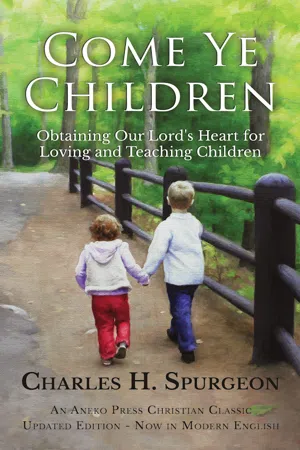
Come Ye Children
Obtaining Our Lord's Heart for Loving and Teaching Children
- English
- ePUB (mobile friendly)
- Available on iOS & Android
eBook - ePub
About this book
Information
Print ISBN
9781622455263
Chapter 20
Some Good Thing – Part 1
Jeroboam had disparaged the Lord who had placed him upon the throne of Israel, and the time had come for his overthrow. The Lord, who usually brings forth the rod before He lifts the ax, sent sickness into his house; Jeroboam’s son Abijah became severely sick. Then Jeroboam remembered an old prophet of God and wanted to know through him what would happen to the child. Fearful that the prophet would bring plagues upon himself and his child if he knew that the inquirer was the wife of Jeroboam, the king begged his wife to disguise herself and seek from the man of God a favorable prediction. Poor foolish king, to imagine that a prophet who could see the future could not also see through any disguise with which his queen might surround herself! So anxious was the mother to know the fate of her son that she left his sick room to go to Shiloh to hear from the prophet. Her clever disguise was useless. The blind prophet was still a seer and not only recognized her before she entered the house but also saw the future of her family. She came full of superstition to be told her fortune, but she went away heavyhearted, having been told her faults and her doom.
In the terrible message that the prophet Ahijah delivered to this wife of Jeroboam, there was only one bright spot, only one word of solace, but it gave no kind of comfort to the mother of Abijah. The child was mercifully appointed to die, for in him there was found some good thing of the LORD God of Israel in the house of Jeroboam (1 Kings 14:13).
We know little of the young prince Abijah. His name was a suitable one. A good name may belong to a very bad man; but in this case, a gracious name was worn in a worthy manner. He called God his Father, and his name signifies that fact. Abba (Ab) is the word for Father, and Jah is Jehovah – Jehovah was his Father. I mention the name only because his life made it true. If you bear a good Bible name, see that you do not dishonor it.
In this child was some good thing of the LORD God of Israel, but what was it? Who will define it? A boundless field for conjecture opens before us. We know some good thing was in him, but what form that good thing took we do not know. Tradition has made assertions, but as these are mere inventions, they are not worth mentioning. Our own reflections will probably be as near the mark as any other probable traditions. We may learn much from the silence of Scripture; we are not told precisely what the good thing was, because any good thing towards the Lord is a sufficient sign of grace. Though the child’s faith is not mentioned, we are sure that he had faith in the living God, since without it nothing in him would have been good towards God, for without faith it is impossible to please God (Hebrews 11:6). He was a child believer in Jehovah, the God of Israel; perhaps his mother left him at his own request to go to the Lord’s prophet about him. Many false prophets were around the palace; his father might not have sent to Shiloh if the boy hadn’t pleaded for it. The child believed in the great, invisible God who made the heavens and the earth, and he worshipped Him in faith. The child’s love may have been more apparent than his faith, for converted children talk of loving Christ more than they do of trusting in Him, not because faith is not in them, but because the emotion of love is more suited to the child’s nature than the more intellectual act of faith.
A child’s heart is large, and therefore love becomes his most conspicuous fruit. I have no doubt this child showed an early affection towards the unseen Jehovah and a distaste for the idols of his father’s court. He might have displayed a holy horror of the worship of God under the figure of a calf. Even a child would have intelligence enough to perceive that it was wrong to liken the great and glorious God to a bullock, which has horns and hooves. Perhaps the child’s refined nature also started back from those corrupt priests of the land whom his father had brought together. We do not know exactly the form it took, but some good thing was in the child’s heart towards Jehovah, God of Israel.
Moreover, it was not merely a good inclination that was in him or a good desire, but a really good, substantial virtue. A true and substantial existence of grace was in him, and this is far more than a transient desire. What child is there that has not at some time or other, if he has been trained in the fear of God, felt tremblings of heart and desires towards God? Such goodness is as common as the early dew, but alas, it passes away quite quickly. The young Abijah possessed something within him sufficiently real and substantial to be called a good thing. The Spirit of God had wrought a sure work upon him and left within him a priceless jewel of grace. Let us admire this good thing, though we cannot precisely describe it.
Let us also realize that this some good thing would have been in the child’s heart, for its entrance is unknown. We cannot tell how grace entered the palace of Tirzah and gained this youthful heart. God saw the good thing, for He sees the least good thing in any of us, since He can perceive anything that looks toward Himself. But how did this gracious work come to the child? We are not told, and this silence is a lesson to us. It is not essential for us to know how a child receives grace. We don’t need to be anxious to know when, where, or how a child is converted; it may even be impossible to tell, for the work may have been so gradual that day and hour cannot be known. Even those who are converted in later years cannot always describe their conversion in detail. Even less can we expect to map out the experience of children who have never fallen into outward sin, but under the guidance of godly education have kept the commandments from their youth like the young man in the gospel.
How did this child acquire this good thing in his heart? God may have placed it there, but by what means? The child, in all probability, did not hear the teaching of the prophets of God; he was never like young Samuel who was taken to the house of the Lord. His father was among the most wicked of men, and yet the grace of God reached his child. Did the Spirit of the Lord operate upon his heart through his own thoughts? Did he think the matter over and conclude that God was God and that He must not be worshipped as his father worshipped Him – under the image of a calf? Even a child might see this.
Had some hymn to Jehovah been sung under the palace wall by some lone worshipper? Had the child seen his father on that day when he lifted up his hand against the prophet of Jehovah at the altar of Bethel and suddenly his right hand withered at his side? Did the tears start from the boy’s eyes when he saw his father thus paralyzed in his strong arm? And did he laugh and rejoice when by the prophet’s prayer his father was restored again? Did that great miracle of mercy cause him to love the God of Israel? Is it a guess that this may have been so? A withered right hand in a father, and that father a king, is a thing a child is pretty sure to be told about; and if it was restored by prayer, the wonder would naturally fill the palace and be spoken of by everybody. The prince would hear of it.
Or what if this little child had a godly nurse? What if some girl, like the one who waited on Naaman’s wife, was the messenger of love to him? As she carried him, did his nurse sing one of the songs of Zion and tell him of Joseph and Samuel? Israel had not forsaken her God so long ago as to be without many faithful followers of the God of Abraham. Perhaps by one of these, sufficient knowledge was passed to the child to become the means of receiving the love of God into his soul. We may conjecture, but we may not pretend to be sure that it was so, nor is there any need that we should be. If the sun has risen, it doesn’t matter when the day first dawned.
Likewise, when we see in children some good thing, may we be content with that truth, even if we cannot tell how it came there. God’s electing love is never short of means to carry out its purpose. He can send His effectual grace into the heart of Jeroboam’s family, and while the father lies prostrate before his idols, the Lord can find a true worshipper for Himself in the king’s own child. Out of the mouths of babes and sucklings hast thou ordained strength because of thine enemies (Psalm 8:2). Your footsteps are not always seen, O God of grace, but we have learned to adore You in Your work, even when we cannot discern Your way.
This good thing is described with a restriction. It was a good thing of the LORD God of Israel. The good thing looked towards the living God. In children there will often be found good things towards their parents; let these be cultivated, but these are not sufficient evidences of grace. Sometimes the good things of sweetness and moral excellence will be found; let all good things be commended and fostered, but they are not sure fruits of grace. The good thing that saves the soul must be towards God.
Remember how we read in the New Testament of repentance towards God and of faith in our Lord Jesus Christ. The way the face of the good thing looks is a primary characteristic; there is life in a look. If a man is straying away from God, every step he takes increases his distance from Him. But if his face is toward the Lord, he might only be capable of a child’s tottering step, but he is still moving nearer and nearer every moment.
There was some good thing in this child towards God, and that is the most distinguishing mark of a truly good thing. The child had love, and it included love for Jehovah. He had faith, but it was faith in Jehovah. His religious fear was the fear of the living God; his childlike thoughts, and desires, and prayers, and hymns went towards the true God. This is what we desire to see not only in children but also in adults; we wish to see their hearts turned to the Lord and their minds and wills moving towards the Most High.
In this dear child, that good thing produced such an outward character that he became exceedingly beloved. We are sure of that, because the prophet said, all Israel shall mourn for him (1 Kings 14:13). He was probably the heir to his father’s crown, and there were godly but grieved hearts in Israel who hoped to see times of reform when that young child would come to the throne. Perhaps even those who did not care about religion but had noticed the youth and observed his actions had said, “He is Israel’s hope. There will be better days when that boy becomes a man.” Therefore, when Abijah died, he alone of all his generation received both tears and a tomb; he was lamented when he died and was buried with respect, whereas all the rest of Jeroboam’s house were devoured by dogs and vultures.
How blessed we are when there is such a good thing in our children that they are beloved in their little spheres. They don’t have the range of contacts which this young prince enjoyed to receive universal admiration, but the grace of God in a child is still a very lovely thing and draws general commendation. Youthful devotion is a touching thing to me; I see the grace of God in men and women with much thankfulness, but I cannot perceive it in children without shedding tears of delight. An exceeding beauty surrounds these rosebuds of the Lord’s garden; they have a fragrance which we don’t find in the fairest of earth’s lilies. Love is won for the Lord Jesus in many hearts by these tiny arrows of the Lord, whose very smallness is a part of their power to penetrate the heart. The ungodly may not love the grace that is in the children, but since they love the children in whom that grace is found, they are no longer able to speak against belief in God as they otherwise would have done. Yes, the Holy Spirit uses these children for higher ends, and those who see them are often impressed with desires for better things.
Chapter 21
Some Good Thing – Part 2
He did not wear the broad phylactery, but he had a meek and quiet spirit. He may not have been much of a speaker, or it might have been said, “He has spoken good things concerning the God of Israel.” He may have been a timid, retiring, almost silent boy, but the good thing was in him. And this is the kind of thing which we desire for every one of our friends, a work of grace within them. The grand point is not to wear the robes nor use the dialect of religion, but to possess th...
Table of contents
- Contents
- Feed My Lambs
- Let the Children Come
- Children Desperately Need the Lord
- The Children’s Shepherd
- Of Such is the Kingdom of Heaven
- The Fertile Ground of a Child’s Heart
- Teach the Children
- Timothy and His Teachers
- Look at Everything Through the Cross
- Samuel and His Teachers
- Instructions for Teachers and Parents
- Be an Upright Example for Children
- Always Remember These Three Things
- Children’s Capacity to Believe
- Not Just a Sunday School Teacher
- Children Can Understand the Bible
- The Sooner the Better
- Obadiah’s Early Faithfulness
- Obadiah and Elijah
- Some Good Thing – Part 1
- Some Good Thing – Part 2
- The Shunammite’s Son – Part 1
- The Shunammite’s Son – Part 2
- About the Author
Trusted by 375,005 students
Access to over 1.5 million titles for a fair monthly price.
Study more efficiently using our study tools.