Why are many Christians often defeated? Because they pray so little. Why do most Christians see so few brought out of darkness to light by their ministry? Because they pray so little. Why are our churches simply not on fire for God? Because there is so little real prayer.We may be assured of this: The secret of all failure is our failure in secret prayer. This book explores, in depth:
•God's wonder at our lack of prayer
•God's incredible promises concerning those who do pray
•God's condition for providing signs
•God's desire for earnest prayer
•God's perspective on hindrances to prayerThe Lord Jesus is as powerful today as ever before. The Lord Jesus is as anxious for men to be saved as ever before. His arm is not shortened that it cannot save, but He does not stretch forth His arm unless we pray more – and more genuinely. Prayer, real prayer, is the noblest, the sublimest, and the most stupendous act that any creature of God can perform. Lord, teach us how to pray.
eBook - ePub
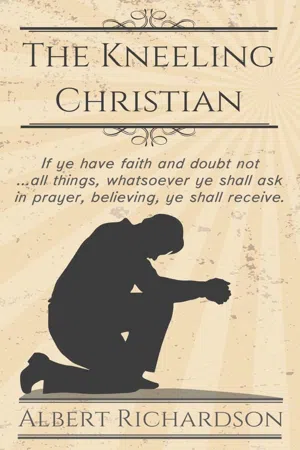
The Kneeling Christian
If ye have faith and doubt not … all things, whatsoever ye shall ask in prayer, believing, ye shall receive.
- English
- ePUB (mobile friendly)
- Available on iOS & Android
eBook - ePub
The Kneeling Christian
If ye have faith and doubt not … all things, whatsoever ye shall ask in prayer, believing, ye shall receive.
About this book
Information
Print ISBN
9781622453290
Topic
Theology & ReligionCHAPTER 5
WHAT IS PRAYER?
Mr. D. L. Moody was once addressing a crowded meeting of children in Edinburgh. In order to get their attention, he began with a question: “What is prayer?” Looking for no reply, he expected to give the answer himself.
To his amazement, scores of little hands shot up all over the hall. He asked one lad to reply, and the answer came at once, clear and correct: “Prayer is an offering up of our desires unto God for things agreeable to His will, in the name of Christ, with confession of our sins and thankful acknowledgment of His mercies.”
Mr. Moody’s delighted comment was, “Thank God, my boy, that you were born in Scotland.” But that was half a century ago. What sort of answer would he get today? How many English children could give a definition of prayer? Think for a moment and decide what answer you would give.
What do we mean by prayer? I believe the vast majority of Christians would say, “Prayer is asking things from God.” But surely prayer is much more than “getting God to run our errands for us,” as someone puts it. It is a higher thing than the beggar knocking at the rich man’s door.
The word prayer really means “a wish directed towards,” that is, towards God. All that true prayer seeks is God Himself, for with Him we get all we need. Prayer is simply “the turning of the soul to God.” David describes it as the lifting up of the living soul to the living God. Unto Thee, O Lord, do I lift up my soul (Psalm 25:1). What a beautiful description of prayer that is. When we desire the Lord Jesus to behold our souls, we also desire that the beauty of holiness may be upon us.
When we lift up our souls to God in prayer, it gives God an opportunity to do what He will in us and with us. It is putting ourselves at God’s disposal. God is always on our side, but we are not always on His side. When man prays, we give God the opportunity.
Prayer is the soul’s sincere desire,
Uttered or expressed,
The motion of a hidden fire
That trembles in the breast.3
“Prayer,” says an old Jewish mystic, “is the moment when heaven and earth kiss each other.”
Prayer, then, is certainly not persuading God to do what we want Him to do. It is not bending the will of a reluctant God to our will. It does not change His purpose, although it may release His power. “We must not conceive of prayer as overcoming God’s reluctance,” says Archbishop Richard Trench, “but as laying hold of His highest willingness.”
For God always purposes our greatest good. Even the prayer offered in ignorance and blindness cannot swerve Him from that, although, when we persistently pray for some harmful thing, our willfulness may bring it about, and we suffer accordingly. And he gave them their request, says the psalmist, but sent leanness into their soul (Psalm 106:15). They brought this leanness upon themselves. They were “cursed with the burden of a granted prayer.”
Prayer, in the minds of some people, is only for emergencies. Danger threatens, sickness comes, things are lacking, difficulties arise, and then they pray. Like the infidel down in a coal mine: when the roof began falling, he began praying. An old Christian standing by quietly remarked, “Aye, there’s nothing like cobs of coal to make a man pray.”
Prayer is, however, much more than merely asking God for something, although that is a very valuable part of prayer, if only because it reminds us of our utter dependence upon God. It is also communion with God, intercourse with God, and talking with (not only to) God. We get to know people by talking with them. We get to know God in like manner. The highest result of prayer is not deliverance from evil or the securing of some thing, but knowledge of God. And this is life eternal, that they might know thee the only true God (John 17:3). Yes, prayer discovers more of God, and that is the soul’s greatest discovery. Men still cry out, Oh, that I knew where I might find him! that I might come even to His seat! (Job 23:3).
The kneeling Christian always “finds” Him and is found of Him. The heavenly vision of the Lord Jesus blinded the eyes of Saul of Tarsus on his downward course, but he tells us, later on, that when he was praying in the temple at Jerusalem, he fell into a trance and saw him (Jesus) (Acts 22:18). Then it was that Christ gave him his great commission to go to the Gentiles. Vision is always a precursor of vocation and venture. It was so with Isaiah. I saw the Lord sitting upon a throne, high and lifted up, and his train filled the temple (Isa. 6:1). The prophet was evidently in the sanctuary praying when this happened. This vision also was a prelude to a call to service: Go and tell … Now, we cannot get a vision of God unless we pray. And where there is no vision the soul perishes.
A vision of God! Brother Lawrence once said, “Prayer is nothing else than a sense of God’s presence,” and that is just the practice of the presence of God.
A friend of Horace Bushnell was present when that man of God prayed. There came over him a wonderful sense of God’s nearness. He says, “When Horace Bushnell buried his face in his hands and prayed, I was afraid to stretch out my hand in the darkness, lest I should touch God.” Was the psalmist of old conscious of such a thought when he cried, My soul, rest thou only in God (Psalm 62:5)? I believe that much of our failure in prayer is due to the fact that we have not looked into this question, “What is prayer?” It is good to be conscious that we are always in the presence of God. It is better to gaze upon Him in adoration. But it is best of all to commune with Him as a Friend, and that is prayer.
Real prayer at its highest and best reveals a soul thirsting for God, just for God alone. Real prayer comes from the lips of those whose affection is set on things above. What a man of prayer Nicolaus Zinzendorf was. Why? He sought the Giver rather than His gifts. He said, “I have one passion: it is He, He alone.” Even the Muslim seems to recognize this thought. He says that there are three degrees in prayer. The lowest is that spoken only by the lips. The next is when, by a resolute effort, we succeed in fixing our thoughts on divine things. The th...
Table of contents
- GOD’S GREAT DESIRE
- ALMOST INCREDIBLE PROMISES
- ASK OF ME AND I WILL GIVE
- ASKING FOR SIGNS
- WHAT IS PRAYER?
- HOW SHALL I PRAY?
- MUST I AGONIZE?
- DOES GOD ALWAYS ANSWER PRAYER?
- ANSWERS TO PRAYER
- HOW GOD ANSWERS PRAYER
- HINDRANCES TO PRAYER
- WHO MAY PRAY?
Trusted by 375,005 students
Access to over 1.5 million titles for a fair monthly price.
Study more efficiently using our study tools.
Frequently asked questions
Yes, you can cancel anytime from the Subscription tab in your account settings on the Perlego website. Your subscription will stay active until the end of your current billing period. Learn how to cancel your subscription
No, books cannot be downloaded as external files, such as PDFs, for use outside of Perlego. However, you can download books within the Perlego app for offline reading on mobile or tablet. Learn how to download books offline
Perlego offers two plans: Essential and Complete
- Essential is ideal for learners and professionals who enjoy exploring a wide range of subjects. Access the Essential Library with 800,000+ trusted titles and best-sellers across business, personal growth, and the humanities. Includes unlimited reading time and Standard Read Aloud voice.
- Complete: Perfect for advanced learners and researchers needing full, unrestricted access. Unlock 1.5M+ books across hundreds of subjects, including academic and specialized titles. The Complete Plan also includes advanced features like Premium Read Aloud and Research Assistant.
We are an online textbook subscription service, where you can get access to an entire online library for less than the price of a single book per month. With over 1.5 million books across 990+ topics, we’ve got you covered! Learn about our mission
Look out for the read-aloud symbol on your next book to see if you can listen to it. The read-aloud tool reads text aloud for you, highlighting the text as it is being read. You can pause it, speed it up and slow it down. Learn more about Read Aloud
Yes! You can use the Perlego app on both iOS and Android devices to read anytime, anywhere — even offline. Perfect for commutes or when you’re on the go.
Please note we cannot support devices running on iOS 13 and Android 7 or earlier. Learn more about using the app
Please note we cannot support devices running on iOS 13 and Android 7 or earlier. Learn more about using the app
Yes, you can access The Kneeling Christian by Albert Richardson in PDF and/or ePUB format. We have over 1.5 million books available in our catalogue for you to explore.