This book considers the transmission of the Sunna through the lens of the great Madinan legal scholar, Imam Malik ibn Anas (d. 179 AH/795 CE), in his renowned book al-Muwatta', or 'The well-trodden path'. It considers not only the legal judgements preserved in this book, but also the key scholars involved in the transmission of these judgements, namely, Malik's teachers and students. These different transmissions provide very strong evidence for the reliability of Malik's transmission of the Sunna.
Overriding these textual considerations is the concept of 'amal, or the Practice of the People of Medina. This is accepted as a prime source by Malik and those following him, but is effectively rejected by the other schools, who prefer hadith (textual reports) as an indication of Sunna. Given the contested nature of 'amal in both ancient and modern times, and the general unawareness of it in contemporary Islamic studies, this source receives extended treatment here. This allows for a deeper understanding of the nature of Islamic law and its development, and, by extension, of Islam itself.
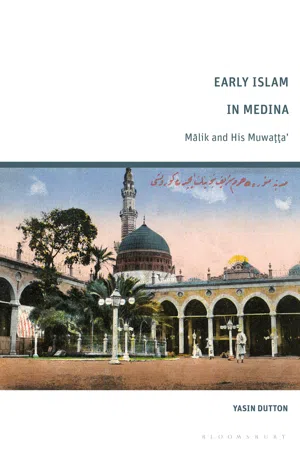
- 152 pages
- English
- ePUB (mobile friendly)
- Available on iOS & Android
eBook - ePub
About this book
Information
1 The man and his family
Mālik is known by the honorific title of Imām Dār al-Hijra, or ‘the Imam of the Abode of Emigration’. This ‘Abode of Emigration’ is the city of Medina in western Arabia, to which the Prophet Muhammad and his Companions emigrated after being forced to leave Mecca in the early days of the nascent Muslim community. ‘Imam’ is a title of respect which means, literally, ‘one who goes in front, one who leads the way’. This can be either in the sense of a political leader, or someone leading others in the prayer, or – as in our present context – one who is above, or in front of, others in the excellence of his knowledge. Mālik is also known as the ‘scholar (ʿālim) of Medina’, referring to the well-known ḥadīth in which the Prophet said, ‘The time is nigh when people will beat the livers of their camels [i.e. urge them on] in search of knowledge, but they will not find anyone more knowledgeable than the scholar of Medina’ (this is related by, amongst others, Aḥmad in his Musnad and al-Tirmidhī in his Ṣaḥīḥ).1 Imam Mālik was thus the religious leader and expert in Medina in his time, having inherited knowledge of the principles and precepts of Islam in the very place where those principles and precepts had been first formulated and acted upon by the first community of Muslims, both during the lifetime of the Prophet and in the first hundred years or so after his death.
Mālik (d. 179/795) is one of the Four Imams associated with the four main Sunni schools of law (madhhabs) recognized as authoritative by Muslims up until this day. These four schools are as follows: the Mālikīs, named after our imam; the Ḥanafīs, named after Imam Abū Ḥanīfa (d. 150/767); the Shāfiʿīs, named after Imam al-Shāfiʿī (d. 204/820); and the Ḥanbalīs, named after Imam Aḥmad ibn Ḥanbal (d. 241/855). The Mālikī school, or madhhab, is particularly dominant today in North and West Africa, although it is still represented to a lesser degree in Egypt, the Sudan and parts of Arabia. Formerly, it was also widespread in Iraq and some areas further east, but for various reasons it began to decline there until, by the end of the fifth/eleventh century, it effectively no longer had an active presence in the east of the Muslim world. In the present day, we note several newly established outliers of this madhhab in Europe (particularly France, Germany, Italy, Russia, Spain, Switzerland and the UK), but also in South Africa, South-East Asia (Indonesia and Malaysia) and the Americas (Mexico and the United States).
Mālik’s birth
As is usual with the birthdates of individuals in the early Islamic period, when recording such events was of little importance, there is uncertainty as to the exact date of Mālik’s birth. The dominant opinion, however, is that he was born either in the year 93/711 or during the caliphate of Sulaymān ibn ʿAbd al-Malik (r. 96–99/715–17) of the Umayyad dynasty.2 There is also uncertainty about his place of birth: many sources suggest that he was born in Medina, but some specify that he was born in Dhū l-Marwa, a village lying some eight mail-stages – approximately 100 miles – to the north of Medina in the Wādī l-Qurā region.3 However, this was considered an outlying district of Medina, since it was under Medinan political control, and so the general attribution to Medina remains valid.
Mālik’s family
Mālik’s full name, using the style of our sources, is Mālik ibn (‘son of’) Anas ibn Mālik ibn Abī ʿĀmir al-Aṣbaḥī. ‘Al-Aṣbaḥī’ refers to the Yemeni tribe of Dhū Aṣbaḥ, highlighting that Mālik’s ancestors were originally from the Yemen. We are told that it was either his great-grandfather, Abū ʿĀmir, or his grandfather, Mālik, who moved north to Medina, becoming affiliated by invitation to the Qurayshi clan of the Banī Taym ibn Murra. We do not hear much about his mother’s side of the family, except that his mother’s name was al-ʿĀliya bint (‘daughter of’) Shurayk ibn ʿAbd al-Raḥmān ibn Shurayk al-Azdiyya, this last adjective indicating that she was from the tribe of Azd. Our sources tell us – not without a degree of pride – that Mālik was therefore of pure Arab ancestry on both his father’s and his mother’s side.
Mālik’s great-grandfather, Abū ʿĀmir, is said to have been a Companion, although there is doubt about this as a number of key works listing the Companions do not mention him.4 The sources note, however, that he was one of those who related ḥadīth from the third caliph, ʿUthmān, and he would therefore have been one of the older Successors, even if he was not a Companion. (Companions are those who met the Prophet, even if only briefly, and believed in him; Successors are Muslims who met one of the Companions, even if only briefly.) This connection with ʿUthmān is more apparent with Mālik’s grandfather, Mālik ibn Abī ʿĀmir, who was one of the older Successors and a respected man of learning in Medina: not only did he relate ḥadīth from ʿUthmān (and from other Companions as well), but he was also involved in writing out copies of the Qur’an following ʿUthmān’s decision to unify the Muslims on one written form of the text. The connection is further emphasized by reports that he was involved in the conquest of North Africa under the direct orders of ʿUthmān, and that, on ʿUthmān’s death, he was one of the four people who carried the body to the grave.5 Some ḥadīths from him are included by Mālik in his book the Muwaṭṭaʾ (see further Chapter 2).
Mālik’s grandfather, Mālik ibn Abī ʿĀmir, had four male children: Anas, the eldest (and the father of our Mālik), Uways, Nāfiʿ (known as Abū Suhayl) and al-Rabīʿ. Of these four, Nāfiʿ Abū Suhayl is particularly noted for his knowledge of ḥadīth, and Mālik includes a number of reports from him in the Muwaṭṭaʾ, including nearly all the above-mentioned ḥadīths narrated from Nāfiʿ’s father, Mālik ibn Abī ʿĀmir. Both al-Rabīʿ and Anas, the father of our Mālik, also appear in the sources as transmitters of ḥadīth, but only very infrequently.
In short, Mālik was born into a family whose forebears had settled in Medina in time to experience the full flourishing of the early Muslim community there, especially under the first years of ʿUthmān’s caliphate before civil strife set in. Furthermore, although he was born two generations after ʿUthmān, he had direct access not only to the memories and experiences of his own family but also to the memories and experiences of those around him, and especially – as one interested in learning – to those of the men of knowledge in his native city.
His early life
We know little about Mālik’s early life. The few reports we have suggest that he began studying early – probably in his early teens or earlier. One report, for example, tells of his mother dressing him up in the ‘clothes of learning’ and sending him to study under Rabīʿa, one of the main scholars of Medina at that time and possibly, by virtue of this report, Mālik’s first teacher (for Rabīʿa, see further, Chapter 2). The report suggests that Mālik was young enough to have his mother help him get ready to go out and begin to study, although exactly what age he was we cannot say. Whatever his age, it seems that he quickly amassed a solid body of knowledge such that he himself was able to teach it in the mosque in Medina while still in his early twenties – ‘in the lifetime of Nāfiʿ’, as our sources put it.6 (Nāfiʿ the mawla of Ibn ‘Umar, and one of Mālik’s main teachers [see further Chapter 2], died c. 117/735, when Mālik – assuming a birthdate of 93 AH – would have been 23 or 24 years of age.)
His children
We do not hear much about Mālik’s own family life. The sources mention three sons, Yaḥyā, Muḥammad and Ḥammād, and Yaḥyā is listed as one of those who related the Muwaṭṭaʾ from Mālik. So, too, is a daughter named Fāṭima, who also seems to have been well versed in her father’s teaching: the story is told of her standing behind the door while a student was reading out a text to her father; when he made a mistake, she tapped on the door to alert her father to the error that, it seems, had gone unnoticed.7
His death
Mālik died in 179/795, in Medina, where he is buried in the graveyard of al-Baqīʿ, which lies just to the east of the main mosque. Ibn Jubayr, in his Riḥla, mentions that the Imam’s grave had a small dome over it when he visited it in the year 580/1184.8 This, and similar domes, remained until they were razed to the ground by the Wahhābīs in 1221/1806. They were then reconstructed in the later Ottoman period, when Mālik’s was one of the few graves that had a white dome over it as a mark of distinction, as was also the case with the graves of the Prophet’s family, and of the caliph ʿUthmān, and several early martyrs. His grave lies next to that of Imam Nāfiʿ, the main Qur’an reciter of Medina in Mālik’s later life.9 With the entry of the Wahhābīs into the Ḥijāz a second time in 1924, and then into Medina in 1925, these domes were again demolished.10 Now all that remains are a few stones marking these graves, including Mālik’s, as a mute testimony to the excellence of those buried there.
2 His teachers
We have seen how Mālik was known as the scholar, or man of knowledge, of Medina. This knowledge, of course, was dependent on others before him. Following the practice of traditional biographers – but without intending a biography – we first consider the people from whom he gained this knowledge and then consider what this knowledge was.
Mālik had many teachers. The Muwaṭṭaʾ alone contains reports transmitted by him from well over ninety shaykhs, and other teachers of his are represented in other sources.
An excellent idea of these teachers can be obtained from the book al-Tamhīd written by the Andalusian scholar Ibn ʿAbd al-Barr (368–463/978–1070). In this book, Ibn ʿAbd al-Barr presents in alphabetical order all the scholars from whom Mālik relates Prophetic ḥadīth in the Muwaṭṭaʾ, as well as providing a commentary on each of these ḥadīths. (By ‘Prophetic’, we mean those ḥadīths that are related from the Prophet rather than what might be otherwise simply Companion or Successor ḥadīths which only go back to a Companion or Successor.) All in all he includes 791 ḥadīths from 98 shaykhs, ranging from those from whom Mālik relates many ḥadīths to those from whom he only relates one or two. (It should be borne in mind that we are talking here only about ḥadīths with either a full or partial chain of authorit...
Table of contents
- Cover
- Half-title Page
- Series Page
- Title Page
- Contents
- List of Tables
- A Note on the Text
- Introduction
- 1 The man and his family
- 2 His teachers
- 3 The Muwaṭṭaʾ
- 4 The ʿamal of the people of Medina
- 5 Controversies, ancient and modern
- Conclusion
- Glossary
- Notes
- Bibliography
- Index
- Copyright Page
Trusted by 375,005 students
Access to over 1.5 million titles for a fair monthly price.
Study more efficiently using our study tools.
Frequently asked questions
Yes, you can cancel anytime from the Subscription tab in your account settings on the Perlego website. Your subscription will stay active until the end of your current billing period. Learn how to cancel your subscription
No, books cannot be downloaded as external files, such as PDFs, for use outside of Perlego. However, you can download books within the Perlego app for offline reading on mobile or tablet. Learn how to download books offline
Perlego offers two plans: Essential and Complete
- Essential is ideal for learners and professionals who enjoy exploring a wide range of subjects. Access the Essential Library with 800,000+ trusted titles and best-sellers across business, personal growth, and the humanities. Includes unlimited reading time and Standard Read Aloud voice.
- Complete: Perfect for advanced learners and researchers needing full, unrestricted access. Unlock 1.5M+ books across hundreds of subjects, including academic and specialized titles. The Complete Plan also includes advanced features like Premium Read Aloud and Research Assistant.
We are an online textbook subscription service, where you can get access to an entire online library for less than the price of a single book per month. With over 1.5 million books across 990+ topics, we’ve got you covered! Learn about our mission
Look out for the read-aloud symbol on your next book to see if you can listen to it. The read-aloud tool reads text aloud for you, highlighting the text as it is being read. You can pause it, speed it up and slow it down. Learn more about Read Aloud
Yes! You can use the Perlego app on both iOS and Android devices to read anytime, anywhere — even offline. Perfect for commutes or when you’re on the go.
Please note we cannot support devices running on iOS 13 and Android 7 or earlier. Learn more about using the app
Please note we cannot support devices running on iOS 13 and Android 7 or earlier. Learn more about using the app
Yes, you can access Early Islam in Medina by Yasin Dutton in PDF and/or ePUB format, as well as other popular books in Theology & Religion & Islamic Theology. We have over 1.5 million books available in our catalogue for you to explore.