- English
- ePUB (mobile friendly)
- Available on iOS & Android
eBook - ePub
About this book
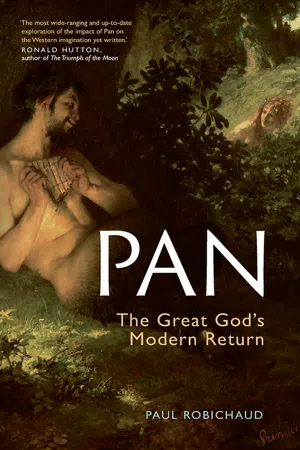
Part-goat, part-man, Pan bridges the divide between the human and animal worlds. In exquisite prose, Paul Robichaud explores how Pan has been imagined in mythology, art, literature, music, spirituality and popular culture through the centuries. At times, Pan is a dangerous, destabilizing force; at others, a source of fertility and renewal. His portrayals reveal shifting anxieties about our own animal impulses and our relationship to nature. Always the outsider, he has been the god of choice for gay writers, occult practitioners, and New Age mystics. Though ancient sources announced his death, he has lived on through the work of Arthur Machen, Gustav Mahler, Kenneth Grahame, D. H. Lawrence and countless others. Pan: The Great God's Modern Return traces his intoxicating dance.
Information
1
MYTHIC PAN
Pan’s written story begins with the ancient Greeks and the conflicting myths they told about the god’s parentage. Before those myths were recorded, however, archaeological evidence in the form of bronze statues dedicated to Pan show that he was worshipped by shepherds in the region of Arcadia. His earliest representations in visual art depict him as an upright goat with human arms and torso, often with a prominent phallus. These start to appear in the fifth century BC as the cult of Pan begins to spread across Greece. At the same time, Pan makes his earliest literary appearance in the poetry of Pindar. A roughly contemporaneous hymn (mis-attributed to Homer by the Greeks) records the first known myth of Pan, an account of his birth, reception by the Olympians and pastoral character. That pastoral character is also reflected in the etymology of Pan’s name, which clearly links him to pastures but was early on confused with the Greek word for ‘all’, a confusion with long-lived consequences for his later development. The god enters history in the work of the historian Herodotus, who records how Pan appeared to an Athenian runner, promising to help the Greeks in the Persian Wars – a promise that he fulfilled by instilling panic in the Persian army. The power to induce panic fear is among Pan’s oldest attributes, persisting in his appearances through classical myth and literature, including pastoral poetry. His later mythology included the pursuit of several nymphs, but writers such as Longus and Apuleius portrayed him as a compassionate helper. In later antiquity, the misunderstanding of Pan’s name as ‘all’ led to a variety of philosophical and mystical interpretations of the god that would echo down the centuries. In the reign of Tiberius, rumours of Pan’s death began to circulate but, as this book will show, such rumours were greatly exaggerated.
ARCADIAN ORIGINS
With the horns and legs of a goat but the torso of a man, Pan is a god whose very form confounds the distinction between animal and divine. From his earliest appearances in the written record, Pan has been imagined in ways that are often irreconcilable. Even the stories of his birth and parentage vary wildly. According to the Homeric hymn ‘To Pan’, which may date from as early as the fifth century BC, when the newborn Pan’s nurse first saw his goatish face, shaggy legs and cloven hooves she fled in terror, never to return. His father, Hermes, delighted by any sign of mischief, burst out laughing and picked up the strange child at once. He brought him straight to Mount Olympus, where the gods all shared in his mirth and welcomed Pan to their divine company, especially Dionysus. That is how he got his name, the hymn tells us, for the meaning of ‘pan’ is ‘all’.1
Other ancient sources are not so sure. The Athenian playwright Aeschylus (525/524–456/455 BC) believed there were two Pans, one whose father was Cronos and one the son of Zeus. An Arcadian tradition identifies Pan’s father as Aither, but pagan theologians knew this was just a local name for Cronos, the father of Zeus. It was because he was Zeus’ half-brother that Pan was able to fight alongside him during the war with the Titans. As for Pan’s mother, she may have been Amaltheia, Zeus’ wet nurse, who was either a goat or a nymph who was changed into one.2 It could also have been a nymph, such as Thymbris or Sose, or perhaps the famous Kallisto, who was transformed into a bear by Zeus and set among the stars.3 Then there’s Arcadian Penelope, also known as Dryope, daughter of Dryopos, himself either a mortal or a local oak-god from Mount Kyllene, sacred to Pan. This Penelope was the one whose beauty led Hermes to work as a labourer on her father’s farm in order to win her hand. Some people confuse her with that other Penelope, wife of Odysseus, and tell a story about her that sounds more like a sailor’s yarn than a proper myth. They say she wasn’t the patient wife that the Odyssey would have us believe, but slept with all 108 suitors who courted her on Ithaca while Odysseus made his long way home from the Trojan War. It’s no wonder Penelope’s child looked more animal than human, given that she couldn’t restrain her own bestial appetites – but surely that absurd tale is just an example of the same ancient misogyny that blamed the Trojan War on Helen? If Penelope, wife of Odysseus, was Pan’s mother, it was more likely to have been because Hermes visited her in the form of a ram.4
There is no authorized version of the Greek myths, and most have several variants recorded across the ancient sources, but the multiplicity of accounts surrounding Pan’s parentage is remarkable even by Greek standards. His outsider status may explain the conflicting attempts to bring him into the mythology of the dominant Greek pantheon, while the many accounts of his parentage might reflect intensely local cults of Pan in Arcadia itself. Never one of the Twelve Olympians – that quarrelsome family headed by Zeus – he was originally worshipped in Arcadia, although his cult would eventually spread throughout southern Greece. Arcadia is a forested and mountainous region in the centre of the southern Peloponnese, with pastures for grazing but little arable farmland. For most ancient Greeks, it was a wilderness whose rough inhabitants seemed to have survived from an earlier age. From this perspective, the Arcadians existed midway between a barbaric past and the full civic life typical of other Greek states. They spoke a dialect closer to Mycenaean than to classical Greek, and were believed to be the first Greeks in the Peloponnese. Regarded as ‘older than the moon’, Arcadians were hunters and eaters of acorns, suggesting to other Greeks that they were survivors from a time before farming was invented. In fact, the Arcadians did live in settlements surrounded by farms, as did other Greeks, but the difficult landscape meant they had to seek resources elsewhere. They had a reputation for being formidable warriors, and many sought their fortunes as mercenaries. Arcadians also – and perhaps most famously – herded goats and sheep, a major source of wealth.5 For his earliest worshippers, Pan acted as sacred guardian of the flocks and presided over the hunt, the Arcadians’ other major source of food. Mount Mainalos was especially sacred to Pan and there, according to the second-century AD geographer Pausanias, local people still heard him play on his pipes.6
The earliest archaeological evidence of the worship of Pan dates from the late sixth century. Discovered on Mount Lykaion in Arcadia, two bronze statuettes bear votive inscriptions to Pan, one of which identifies a ram and a jug as offerings.7 These would have been costly to obtain, suggesting that at least some shepherds had considerable wealth. A fifth-century bronze sculpture from northern Arcadia depicts Pan with a goat head, shaggy mane and large testicles (goatish and suggesting fertility), although the lower parts of his legs are missing. The image conveys the inherently unsettling nature of the god, the way his divinity allows him to transgress the boundary between human and animal. He shields his eyes from the sun with one hand as though looking out over his flocks.8 Although outside Arcadia Pan was generally worshipped in wild spaces such as grottoes and caves, there was an Arcadian temple dedicated to Pan and Apollo in the gorge where the River Neda runs down from Mount Lykaion.
Pan’s name (in Greek, Πάν) provides some clues about his probable origins. As noted in the Homeric ‘Hymn to Pan’, the Greeks early on confused his name with their word for all, πᾶν, familiar to us as the prefix pan-, as in ‘pandemic’ and ‘pan-European’. This confusion would eventually lead to elaborate speculation about Pan’s true nature, as we’ll see.
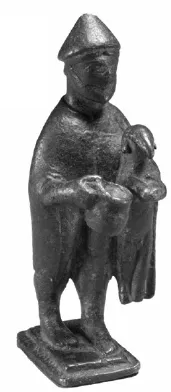
Bronze statuette from Arcadia, c. 525–500 BC, inscribed with a dedication to Pan from ‘Aineas’. Statuettes such as this one are the earliest surviving evidence of Pan worship in Arcadia.
Today the derivation of Pan’s name is generally acknowledged as πάϵιν (paean), a verb meaning ‘to pasture’.9 His name may also be cognate with ὀπάων (opaōn), ‘companion’.10 Considered together, these linguistic clues might suggest a deity who is first and foremost a companion to flocks and those who pasture them, which seems to fit well with the earliest archaeological and literary evidence. With some notable exceptions (such as Basque and Finnish), European and Indic languages all derive from a common ancestor, called by linguists ‘Proto-Indo-European’, that was probably spoken from about 4500 to 2500 BC on the Pontic-Caspian steppe north of the Black Sea. As its speakers became separated through migration, Proto-Indo-European gradually evolved into distinct languages. For example, the Irish máthair, Sanskrit mā’tṛ and English ‘mother’ all derive from a common Proto-Indo-European ancestor that accounts for their similarities. At one time scholars believed that Pan could be linked to the Indian Vedic god Pushan (Pūṣán) through a common reconstructed ancestor, but this has been rejected on linguistic grounds by scholars such as Willy Alfred Borgeaud.11 Nonetheless, his son Philippe Borgeaud notes that the names of both Pan and Pushan ‘refer to their pastoral function’ and are ‘approximate homonyms’.12 According to the hymns in the Rig Veda (c. 1500– 1200 BC), Pushan was a guardian of livestock, drove a solar chariot pulled by goats, and rewarded his worshippers with wealth and pasture land.13 Pan and Pushan thus possess a few shared attributes – they both protect grazing animals and are associated with goats and pastures.
In addition to his name, Pan’s epithets or cult titles provide clues about his early religious attributes. These include Agreus (‘of the hunt’ or ‘hunter’); Agrotas (‘giver of pasture’); Haliplanktos (‘Sea-roaming’); Lytêrios (‘releasing’); Nomios (‘of the pasture’); Phorbas (‘Terrifying One’); Sinoeis (‘mischief’ or ‘bane’); and Skoleitas (‘crooked’).14 While several of these are fairly straightforward, describing Pan’s role as god of hunting and pastures and the source of panic terror, others are more mysterious. Why, for example, is he described as ‘Sea-roaming’? Philippe Borgeaud points out that fishermen venerated ‘Pan Aktios as god of riverbanks and ocean promontories where the goats come for fresh water and salt’, so perhaps they imagined Pan roaming the seas just as shepherds envisioned him upon the mountains.15 The epithet Lytêrios is explained by Pausanias as having the sense ‘deliverer’, and was a title given to Pan at his shrine in Troezen, where he had appeared in dreams to give people a remedy for the plague that was devastating their town.16 Skoleitas may allude to Pan’s goat horns or legs, or even his gait while walking. Like his purported father Hermes, Pan was fond of mischief, with an added twist of sudden fear, which would explain Sinoeis as a title.
GREECE AND BEYOND
Hermes’ identity as Pan’s father is described in what is probably the first literary or religious work specifically devoted to Pan, the Homeric ‘Hymn to Pan’ mentioned above. The first half of the hymn describes Pan in his natural habitat, while the second recounts the myth of his birth. Like many ancient Greek hymns, this one was mistakenly attributed to the poet Homer; its actual author is unknown. Its most recent translator, Peter McDonald, suggests that it may have been composed as the cult of Pan spread throughout Greece.17 Addressing the Muse, the speaker asks to be told ‘about Pan, the dear son of Hermes, with his goat’s feet and two horns – a lover of merry noise’.18 Here, Pan’s characteristic physical features are noted, as is his preference for loud revelry – ‘his taste for noisy parties’ in McDonald’s lively version.19 Just as Pan’s appearance crosses the line between human and animal, so his fondness for making noise resists the limits on behaviour imposed by civilized society. The hymn emphasizes the wild setting of Pan’s rites: ‘Through wooded glades he wanders with dancing nymphs who foot it on some sheer cliff’s edge, calling upon Pan, the shepherd-god, long-haired, unkempt.’ The cliffside setting adds an element of danger, while Pan’s long, messy hair connects him with the wilderness, a domain including ‘snowy crest and the mountain peaks and rocky crests’ as well as ‘close thickets’. These are all places uninhabitable by humans, but home to Pan.
The god has not forgotten us, however; at the end of his journey he ‘climbs up to the highest peak that overlooks the flocks’, presumably to strike the pose we see in the early Arcadian bronze, gazing out over the sheep and goats.20...
Table of contents
- Front Cover
- Half Title
- Title Page
- Copyright
- CONTENTS
- PREFACE
- 1. MYTHIC PAN
- 2. MEDIEVAL AND EARLY MODERN PAN
- 3. PAN’S ROMANTIC REBIRTH
- 4. PAN IN THE TWENTIETH CENTURY
- 5. PAN AS OCCULT POWER
- 6. CONTEMPORARY PAN
- CONCLUSION
- REFERENCES
- SELECT BIBLIOGRAPHY
- ACKNOWLEDGEMENTS
- PHOTO ACKNOWLEDGEMENTS
- INDEX
Trusted by 375,005 students
Access to over 1.5 million titles for a fair monthly price.
Study more efficiently using our study tools.
Frequently asked questions
Yes, you can cancel anytime from the Subscription tab in your account settings on the Perlego website. Your subscription will stay active until the end of your current billing period. Learn how to cancel your subscription
No, books cannot be downloaded as external files, such as PDFs, for use outside of Perlego. However, you can download books within the Perlego app for offline reading on mobile or tablet. Learn how to download books offline
Perlego offers two plans: Essential and Complete
- Essential is ideal for learners and professionals who enjoy exploring a wide range of subjects. Access the Essential Library with 800,000+ trusted titles and best-sellers across business, personal growth, and the humanities. Includes unlimited reading time and Standard Read Aloud voice.
- Complete: Perfect for advanced learners and researchers needing full, unrestricted access. Unlock 1.5M+ books across hundreds of subjects, including academic and specialized titles. The Complete Plan also includes advanced features like Premium Read Aloud and Research Assistant.
We are an online textbook subscription service, where you can get access to an entire online library for less than the price of a single book per month. With over 1.5 million books across 990+ topics, we’ve got you covered! Learn about our mission
Look out for the read-aloud symbol on your next book to see if you can listen to it. The read-aloud tool reads text aloud for you, highlighting the text as it is being read. You can pause it, speed it up and slow it down. Learn more about Read Aloud
Yes! You can use the Perlego app on both iOS and Android devices to read anytime, anywhere — even offline. Perfect for commutes or when you’re on the go.
Please note we cannot support devices running on iOS 13 and Android 7 or earlier. Learn more about using the app
Please note we cannot support devices running on iOS 13 and Android 7 or earlier. Learn more about using the app
Yes, you can access Pan by Paul Robichaud,Robichaud, Paul in PDF and/or ePUB format, as well as other popular books in Social Sciences & World History. We have over 1.5 million books available in our catalogue for you to explore.