It is not possible to teach someone to be creative. It is not possible to teach someone to be intelligent. It is, however, possible to teach students to use the creativity and intelligence they already have. Students can be taught to think more creatively or intelligently, and can also learn strategies for thinking more rationally or imaginatively.
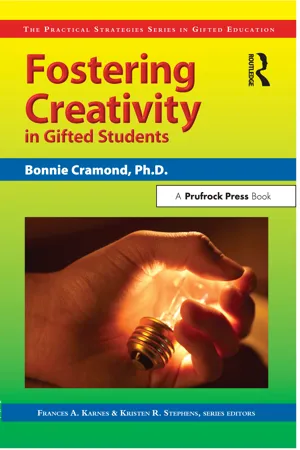
Encouraging creative thinking in the classroom is an exciting component of any effective gifted education program. This guide offers basic foundations required for supporting creativity. From establishing the right classroom environment, to using creative teaching strategies, to assessing student outcomes, this book is filled with practical information. The book also includes a listing of competitive contests and programs and an extensive list of resources.
This is one of the books in Prufrock Press' popular Practical Strategies Series in Gifted Education. This series offers a unique collection of tightly focused books that provide a concise, practical introduction to important topics concerning the education of gifted children. The guides offer a perfect beginner's introduction to key information about gifted and talented education.
eBook - ePub
Fostering Creativity in Gifted Students
The Practical Strategies Series in Gifted Education
- 54 pages
- English
- ePUB (mobile friendly)
- Available on iOS & Android
eBook - ePub
Fostering Creativity in Gifted Students
The Practical Strategies Series in Gifted Education
About this book
Information
Competitive Programs
DOI: 10.4324/9781003235231-6
In order to synthesize the creative components of person, product, process, and press into the curriculum, educators might consider adopting one of the competitive programs that address these components. These programs promote creativity through systemized processes that encourage the development of creative products. The products are then entered into competitions with other students and judged according to high standards.
There are several well-developed programs that provide instructional materials and opportunities for students to be engaged in creative activities in a systematic way and compete with other students. The best known in this category are the Future Problem Solving Program, Odyssey of the Mind, and the Invention Convention. For information on these and other types of competitions, see the Resources section at the end of this book.
Future Problem Solving Program (FPSP)
Using Parnes’ (1981) Creative Problem Solving method, the goal of the Future Problem Solving Program (FPSP) is to help students learn about world problems and apply critical and creative problem-solving strategies to try to solve them. Students can compete at the local, state, and international levels in teams or as individuals. It is also possible for schools to participate and choose not to compete.
E. Paul Torrance began this program in 1974 to raise students’ awareness of the future while teaching them communication, research, problem-solving, and group-work skills (Torrance, 1974a, 1974b). Crabbe (1982) found that the program was effective for these purposes.
Participants are grouped into one of three levels—Junior (grades 4–6), Intermediate (grades 7–9), and Senior (grades 10–12)—so they can investigate problems suitable to their developmental level and compete with others of approximately the same age. When teams register with the FPSP, they receive a copy of the first practice problem in the form of a “fuzzy” and a list of possible resources for research. Participants then use the six steps of the process to investigate the problem and propose a plan of action.
For example, the “fuzzy” might be about the problem of water shortages that are predicted to become critical in the next few years. A simplified version of what the steps might be follows:
- Problem Finding. After researching the issue, students try to find all of the potential problems inherent in the fuzzy situation. These might include lack of water resources, overuse of fresh water, inefficient methods for purifying water, and the effects of pollution on the water supply.
- Problem Stating. Students choose the problem they think is essential to the issue, the most important problem, or the most inclusive problem and word it for attack. This typically follows the format In What Ways Might We (IWWMW), followed by the chosen problem and any delimiters. For example, in what ways might we decrease the overconsumption of fresh water without destroying life?
- Idea Finding. At this point, students brainstorm possible solutions to their stated problem by drawing upon the knowledge gained from the research. It is important to note that this process is recursive, so if students find that they do not have enough ideas, they may have to go back to step one and research some more. Alternately, they may choose to broaden or narrow their chosen problem for attack. Their solutions might include rationing, incentives for lowered water use, more efficient water-use systems, separation of potable water for certain uses, better methods for preventing evaporation, having water available only at certain times of the day, or education about the issue.
- Idea Evaluating. Students choose from among the generated solutions by comparing them along selected criteria they have brainstormed. For this problem, the criteria might include efficiency, effectiveness, cost effectiveness, ease of implementation, and public acceptability. The FPSP materials and coaches’ workshops help with the generation of appropriate criteria.The selected criteria are then listed on one axis of a grid with the brainstormed solutions on the other. Here is an example of what the grid might look like:
- The students work together to decide how to rate each solution. In this case, there are five solutions to rate, so the solutions are rated from 1 (lowest) to 5 (highest). This requires negotiation and consensus. After the solutions are rated, they are totaled in the last column.
- Solution Proposing. This step involves more than simply choosing the solution with the highest total. In the example above, the solution of rationing got the highest score, but the use of incentives is close behind. The students may decide to combine their two highest ranked choices to come up with a solution. For example, the solution may be to institute rationing of water with fines for overuse and incentives for conservation. Students may decide that they do not really feel this is the best solution. They may not have chosen the best criteria or not brainstormed enough possibilities. In such a case, the group could choose to go back to an early step before moving forward. For example, the group may decide that the research indicates it is agricultural and industrial uses that are the biggest consumer of water. They may choose to tweak their solutions and criteria to reflect this information.
- Solution Selling/Implementing. Finally, students work on a plan to implement their idea. The scope of this plan is dependent on the age of the students and the nature of the problem. In the case of community problem solving, where students take on problems in their own communities, this is the most important component because they actually implement their solution (Terry & Bonnenberger, 1995).
| Efficient | Effective | Low cost | Easy | Acceptable | Total | |
| Rationing | 5 | 4 | 5 | 5 | 1 | 20 |
| Incentives | 4 | 3 | 3 | 4 | 5 | 19 |
| Separation for uses | 3 | 2 | 1 | 1 | 2 | 9 |
| Preventing evaporation | 1 | 5 | 2 | 2 | 3 | 13 |
| Education about the issue | 2 | 1 | 4 | 3 | 4 | 14 |
This problem-solving process can also be incorporated into service-learning programs in which students get involve...
Table of contents
- Cover
- Series Page
- Title Page
- Copyright Page
- Contents
- Series Preface
- Introduction and Assumptions
- Environment
- Person
- Process
- Products
- Competitive Programs
- Summary and Conclusions
- Resources
- References
Trusted by 375,005 students
Access to over 1.5 million titles for a fair monthly price.
Study more efficiently using our study tools.
Frequently asked questions
Yes, you can cancel anytime from the Subscription tab in your account settings on the Perlego website. Your subscription will stay active until the end of your current billing period. Learn how to cancel your subscription
No, books cannot be downloaded as external files, such as PDFs, for use outside of Perlego. However, you can download books within the Perlego app for offline reading on mobile or tablet. Learn how to download books offline
Perlego offers two plans: Essential and Complete
- Essential is ideal for learners and professionals who enjoy exploring a wide range of subjects. Access the Essential Library with 800,000+ trusted titles and best-sellers across business, personal growth, and the humanities. Includes unlimited reading time and Standard Read Aloud voice.
- Complete: Perfect for advanced learners and researchers needing full, unrestricted access. Unlock 1.5M+ books across hundreds of subjects, including academic and specialized titles. The Complete Plan also includes advanced features like Premium Read Aloud and Research Assistant.
We are an online textbook subscription service, where you can get access to an entire online library for less than the price of a single book per month. With over 1.5 million books across 990+ topics, we’ve got you covered! Learn about our mission
Look out for the read-aloud symbol on your next book to see if you can listen to it. The read-aloud tool reads text aloud for you, highlighting the text as it is being read. You can pause it, speed it up and slow it down. Learn more about Read Aloud
Yes! You can use the Perlego app on both iOS and Android devices to read anytime, anywhere — even offline. Perfect for commutes or when you’re on the go.
Please note we cannot support devices running on iOS 13 and Android 7 or earlier. Learn more about using the app
Please note we cannot support devices running on iOS 13 and Android 7 or earlier. Learn more about using the app
Yes, you can access Fostering Creativity in Gifted Students by Bonnie Cramond,Frances Karnes,Kristen R. Stephens in PDF and/or ePUB format, as well as other popular books in Education & Inclusive Education. We have over 1.5 million books available in our catalogue for you to explore.